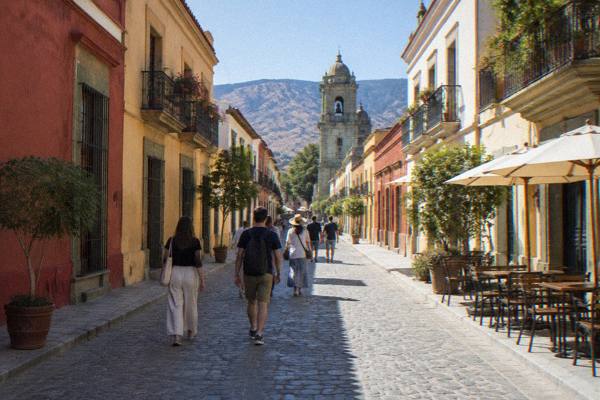
Is Oaxaca Walkable? Cobblestones, Curbs And Hills
Oaxaca City is one of Mexico's most walkable cities, and the answer below covers the whole question, from the Centro Histórico's compact grid to the archaeological sites that need a bus or a tour.
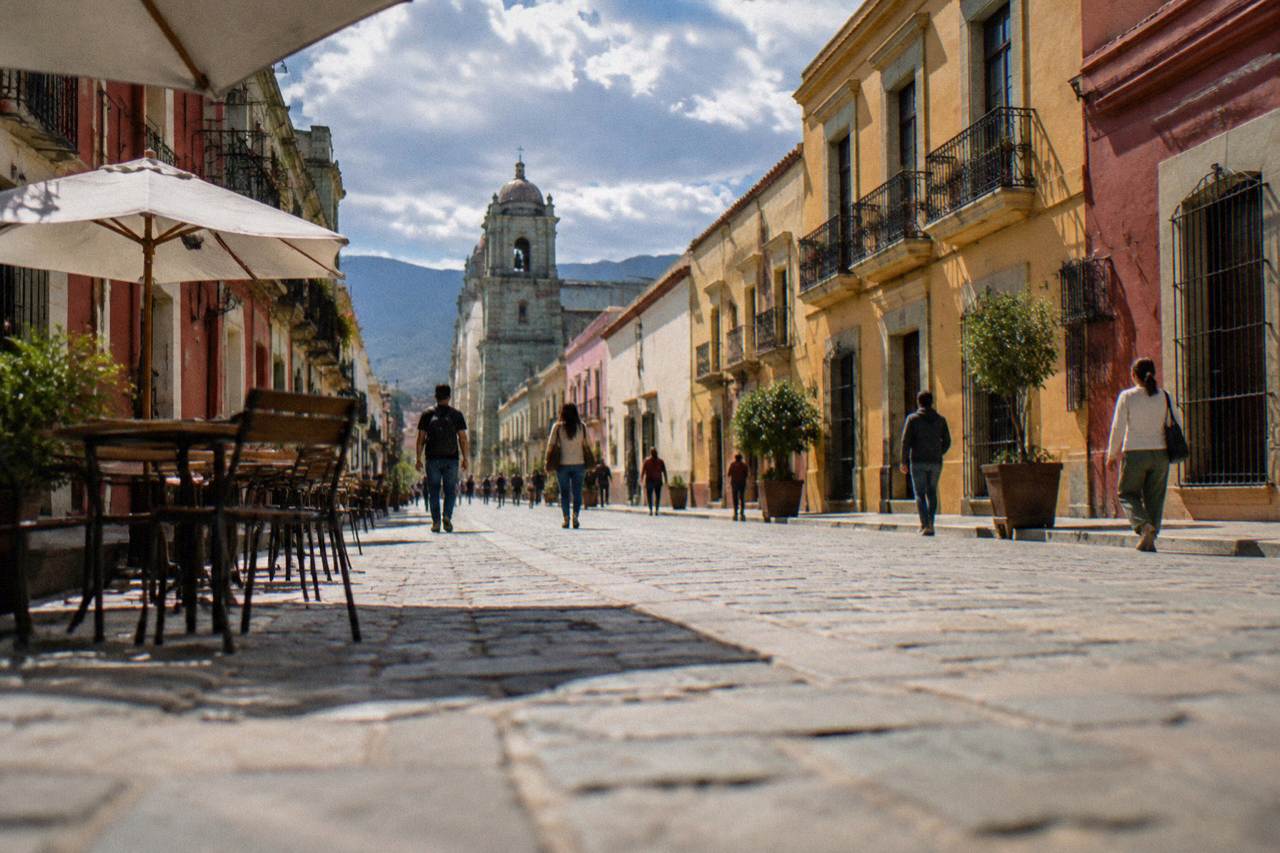
Yes. Oaxaca City is highly walkable: the Centro Histórico is compact and flat enough for a full day on foot, the Zócalo, Santo Domingo de Guzmán, the Andador Macedonio Alcalá and the central markets all sit within a short walk of each other, and only the outlying valleys sites, such as Monte Albán about 15 minutes away by road, need transport.
Oaxaca City, the capital of the state of Oaxaca in Mexico, is an inland highland city in the Valles Centrales at about 1,550 m, and the honest answer to whether it is walkable is yes, with one boundary: the historic core is made for walking, while the archaeological sites and craft villages of the surrounding valleys are not.
Is Oaxaca A Walkable City?
Yes, Oaxaca City is walkable, and the Centro Histórico is its walking heart: the Zócalo, Santo Domingo de Guzmán, the Andador Macedonio Alcalá, the Basílica de la Soledad and the central markets all sit within a compact area, and the city registered 1,324,332 tourist arrivals in 2025 with an average stay of 2.00 nights, a short stay that the centre's layout supports well.
The municipality of Oaxaca de Juárez counted 270,955 residents at the 2020 census, and the part visitors come for, the Centro Histórico, is a small fraction of that footprint. The historic core is inscribed jointly with Monte Albán on the UNESCO World Heritage list as "Historic Centre of Oaxaca and Archaeological Site of Monte Albán", property 415, which tells you the two halves of a visit: a walkable city centre, and an archaeological zone on a hill that you reach by road.
Two practical facts shape walking here. First, the city sits at altitude, about 1,550 m, so the sun feels strong and the walk to Cerro del Fortín, the hill west of the centre, is a real climb even though the streets of the core are mostly gentle. Second, there is no bike-share system in Oaxaca, so on foot, by taxi or by colectivo are the realistic options, and the site's getting around Oaxaca guide covers the full set. Oaxaca de Juárez was founded in 1529 as Antequera, and the street plan visitors walk today has been accumulating layers ever since, which is one reason the paving varies block by block.
Can You See Central Oaxaca Entirely On Foot?
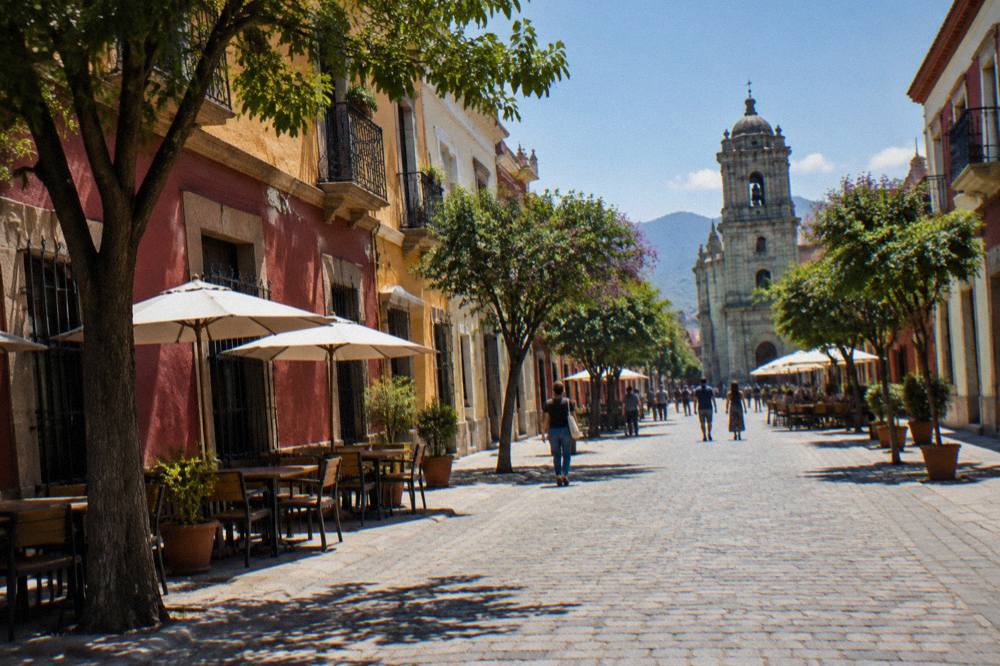
Yes, the whole of central Oaxaca can be seen on foot: the Zócalo, the Andador Macedonio Alcalá, Santo Domingo de Guzmán with the Museo de las Culturas de Oaxaca and the Jardín Etnobotánico, the Oaxaca Cathedral, the Basílica de la Soledad, the Mercado 20 de Noviembre and Mercado Benito Juárez, plus the barrios of Jalatlaco and Xochimilco, form one connected walkable area with no need for a vehicle between stops.
The connecting spine is the Andador Macedonio Alcalá, the pedestrian street that runs from the Zócalo, the Plaza de la Constitución, up to the Santo Domingo de Guzmán church complex. Along and around it sit the core sights. The Museo de las Culturas de Oaxaca, inside the former convent at Santo Domingo, is open Tuesday to Saturday only, 10:00 to 16:00, and charges 105 MXN for Mexican nationals and 210 MXN for foreign visitors, so time a walking day for midweek rather than Sunday or Monday if the museum is on the list.
Next door, the Jardín Etnobotánico runs free guided tours Monday to Friday at 10:30, 11:00, 11:30, 12:00 and 17:00, and Saturday from 10:30 to 12:00, with large and school groups asked to book two weeks ahead. Those fixed tour times are worth planning a walking route around, since the garden admits visitors on the guided schedule rather than on open wandering.
| Sight In Central Oaxaca | Hours (from the listing) | Entry (MXN) |
|---|---|---|
| Museo de las Culturas de Oaxaca | Tuesday to Saturday, 10:00 to 16:00 | 105 nationals, 210 foreigners |
| Jardín Etnobotánico (guided tour) | Mon to Fri 10:30, 11:00, 11:30, 12:00, 17:00; Sat 10:30 to 12:00 | Free |
| Monte Albán | Daily 08:00 to 17:00, last access 16:00 | 105 nationals, 210 foreigners |
| Mitla | Daily 08:00 to 17:00, last access 16:30 | 105 nationals, 210 foreigners |
| Zaachila | Thursday to Sunday, 10:00 to 16:00 | 80 nationals, 145 foreigners |
The two big central markets, the Mercado 20 de Noviembre and the Mercado Benito Juárez, sit a few blocks south of the Zócalo, close enough that a walk between the cathedral square, the markets and Santo Domingo is a single morning. The Mercado 20 de Noviembre guide and the Mercado Benito Juárez guide cover what to look for inside each. For anyone working out how many days this all takes, the site's how many days in Oaxaca guide builds the same walking core into a day-by-day plan.
What Are The Cobblestones, Curbs And Hills Of Oaxaca Like?
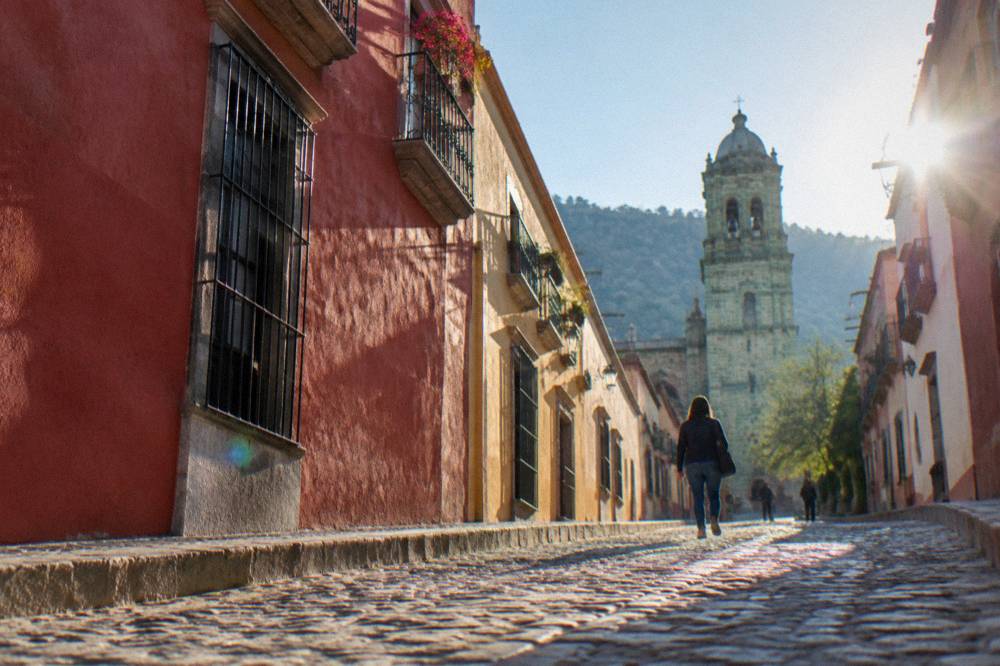
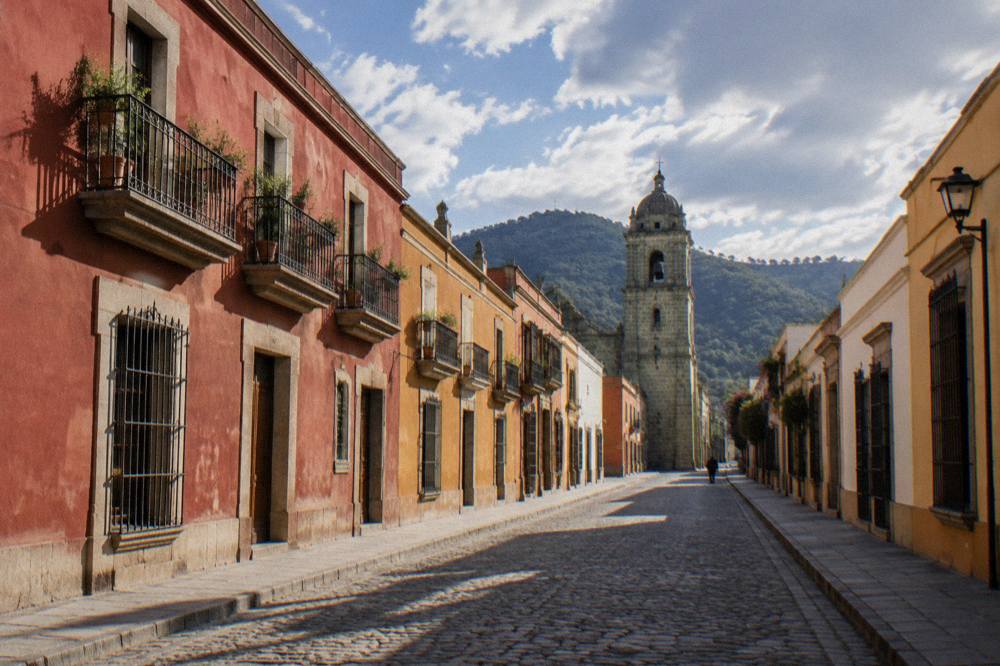
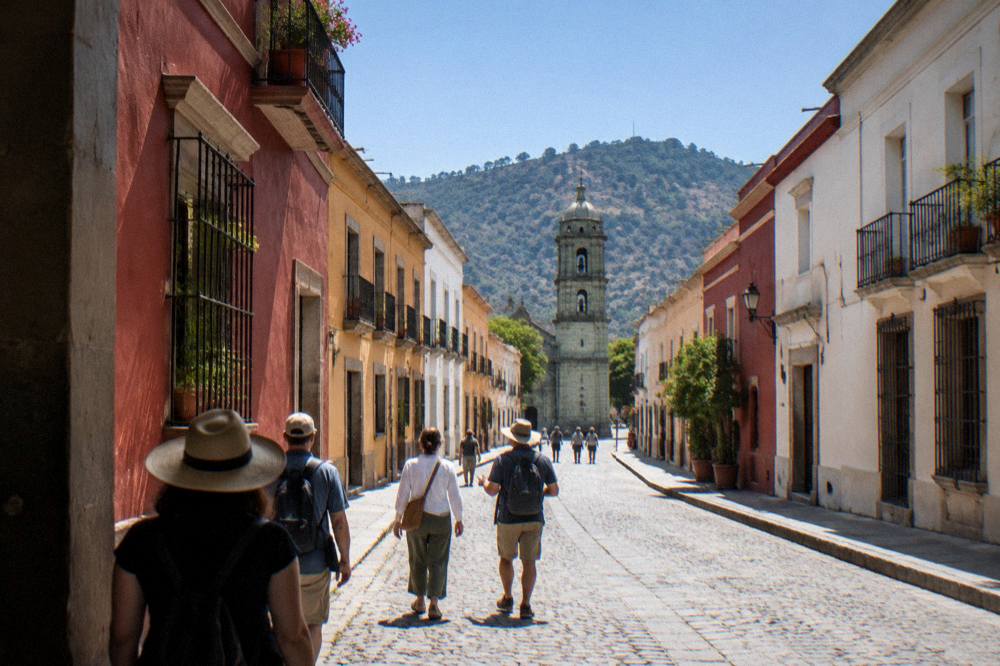
Oaxaca's historic streets are largely paved in stone, with cobblestones on many central blocks and narrower sidewalks, so comfortable closed shoes beat sandals, curbs are frequent and often stepped rather than ramped, and the one real hill inside the city is the Cerro del Fortín, the rise west of the centre above the Guelaguetza auditorium, which is a genuine climb on foot.
The stone paving is part of why the centre looks the way it does, and it is also the main physical cost of walking here: uneven surfaces, tight sidewalk widths where colonial buildings sit directly on the street line, and curb drops at corners. Wheelchair and stroller users will find parts of the Andador Macedonio Alcalá, as a pedestrian street, easier than the traffic streets around it, but the historic fabric is old and not uniformly adapted. Visitors with limited mobility may prefer to break the core into two half-day walks, centro and barrios, rather than one long loop.
Rain changes the equation. The rainy season runs May to October, with June to September the peak, and June averages 188.3 mm of rain across 19.9 days with rain on the SMN station normals, so a wet-season walk can mean slippery stone. The dry season, November to April, is drier: November averages 9.1 mm and February 4.6 mm. The Oaxaca weather by month guide has the full table.
| Month | Rain (mm) | Days With Rain | Notes For Walking |
|---|---|---|---|
| November | 9.1 | 3.5 | Dry season begins |
| December | 9.0 | 2.4 | Cool nights, 11.0 C average low |
| February | 4.6 | 1.1 | Very dry underfoot |
| April | 47.3 | 7.6 | Highs average 34.9 C, walk mornings |
| June | 188.3 | 19.9 | Peak rain, slippery stone |
| September | 163.6 | 21.4 | Frequent afternoon rain |
Can You Walk From The Centro To Jalatlaco And Xochimilco?
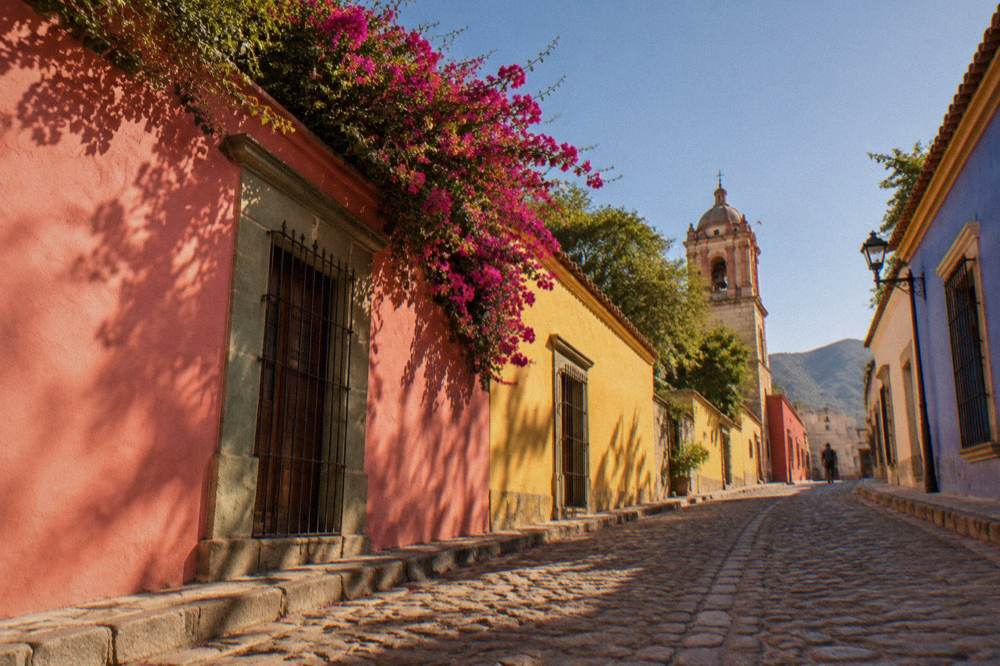
Yes, both Jalatlaco and Xochimilco are walkable extensions of the Centro Histórico, sitting just beyond its edges as historic barrios you reach on foot in a matter of minutes from the Zócalo rather than by bus, and each adds a different character to a walking day: Jalatlaco with its painted walls and quiet streets, Xochimilco as the neighbourhood that gave its name to the aqueduct traces in the area.
A realistic walking loop for one day starts at the Zócalo, runs up the Andador Macedonio Alcalá to Santo Domingo, drops back through the markets, then crosses into Jalatlaco and returns via Xochimilco toward the centre. Nothing in that loop needs transport. The Jalatlaco guide and the Xochimilco guide detail each barrio, and the Oaxaca in one day itinerary sequences a version of exactly this walk.
Beyond these barrios the city spreads south toward Santa Lucía del Camino and Xoxocotlán, and that is where walking stops being the practical answer. The south of centre and mercados guide marks where the compact core gives way to longer distances, and the Oaxaca neighbourhoods guide maps the full set.
Which Oaxaca Sights Can You Not Walk To?
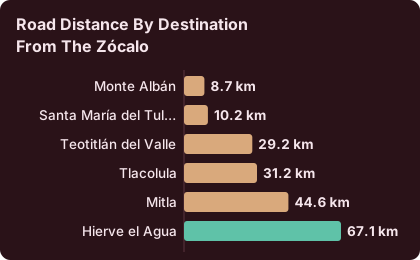
The sights you cannot walk to from central Oaxaca are the valley destinations: Monte Albán is about 15 minutes away by road, Teotitlán del Valle about 26 minutes, Tlacolula about 25, Mitla about 37, Hierve el Agua about 57, and the Sierra Norte village of Latuvi about 142, all derived drive times from the Zócalo on free-flow roads, with real traffic and mountain roads slower.
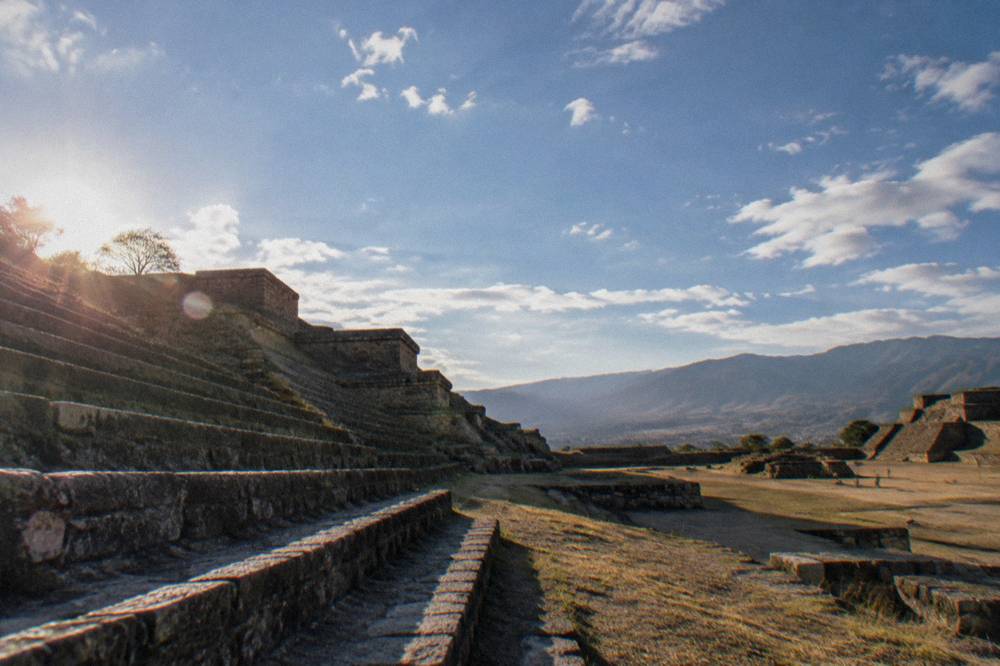
Monte Albán, the archaeological zone that shares the UNESCO inscription with the historic centre, sits on a hill above the valley. The INAH page for the site lists daily hours of 08:00 to 17:00 with last access at 16:00 and Category I entry of 105 MXN for nationals, 210 MXN for foreigners. Nobody walks up from the centre for a visit; it is a road trip, whether by tour, taxi or colectivo. The full index of guides sits on Oaxaca Travel Guide.
| Destination From The Zócalo | Road Distance | Drive Time (about) | Walkable From The Centre? |
|---|---|---|---|
| Monte Albán | 8.7 km | 15 minutes | No |
| Santa María del Tule | 10.2 km | 11 minutes | No |
| Teotitlán del Valle | 29.2 km | 26 minutes | No |
| Tlacolula | 31.2 km | 25 minutes | No |
| Mitla | 44.6 km | 37 minutes | No |
| Hierve el Agua | 67.1 km | 57 minutes | No |
The pattern is clear: the city itself is pedestrian territory, and everything headline-worthy beyond it is a drive. That split is why valley day tours exist in such numbers. A full-day tour covering the Tule tree, Mitla, Hierve el Agua and a mezcal distillery covers in one road loop what would otherwise take several separate colectivo runs, and the Mitla and Tlacolula day trip guide plus the Hierve el Agua day trip guide cover the independent alternative.
For those who prefer to eat their way through the walkable core instead, a market-based cooking class keeps the day entirely on foot in the centre, with the market visit and the class in the same walkable district.
Where Should You Stay In Oaxaca To Walk Everywhere?
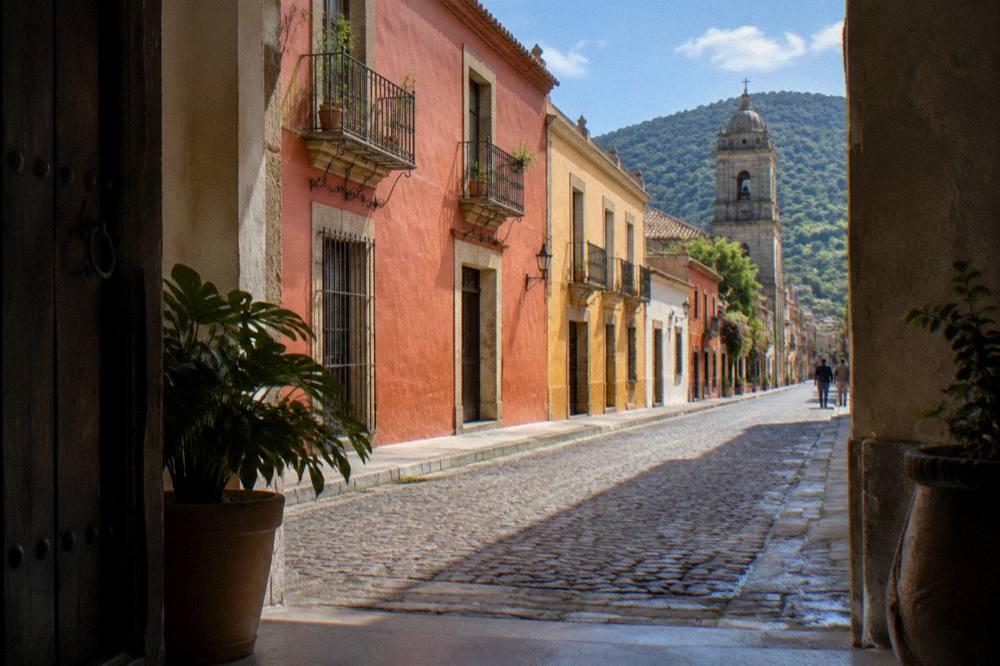
To walk everywhere in Oaxaca, stay inside the Centro Histórico or in the barrios immediately around it, Jalatlaco and Xochimilco, because from any of those bases the Zócalo, Santo Domingo, the Andador Macedonio Alcalá, the markets and the Jardín Etnobotánico are all within the same walkable radius, and the average visitor stay of 2.00 nights in 2025 makes a central base the difference between walking and commuting.
Hotel choice in Oaxaca is therefore a walkability decision more than a price decision. A hotel near the Zócalo puts the whole core at your feet; a hotel out toward Santa Lucía del Camino or beyond means a taxi at the start and end of every day. The where to stay in Oaxaca guide maps the districts, the best hotels in Oaxaca guide covers the top properties, and the state adds a 3 percent lodging tax on hotel-type stays, 5 percent for intermediaries, under the state tax law updated in December 2025, which appears on the bill rather than the advertised rate.
A central base also solves the evening question. Walking back from dinner in the centre is short, and the is Oaxaca safe to walk around at night companion question sits alongside the safety picture in the Oaxaca safety guide, which carries the advisory wording: the UK FCDO advises against all but essential travel to parts of Mexico and does not name Oaxaca on its main page; Canada advises a high degree of caution for Mexico overall; and the US State Department lists Oaxaca state at Level 2, exercise increased caution. Road blockades by teachers' unions are a standing risk that can disrupt road and airport access, so allow slack on transfer days.
When Is The Best Time Of Day To Walk In Oaxaca?
The best walking hours in Oaxaca are the morning, because the SMN station normals show April averaging a 34.9 C daily high, with March at 33.3 C and May at 33.8 C close behind, while December and January nights average lows of 11.0 and 10.3 C, so mornings are the comfortable window year-round, afternoons in the hot months need shade, and rainy-season afternoons carry the rain risk, with September averaging rain on 21.4 days.
The altitude compounds the sun: at about 1,550 m the UV is strong even when the air temperature reads mild, and the difference between the daily high and the nightly low is large in the dry season, often 15 degrees or more on the normals table. Walkers should plan the open, unshaded stretches, such as the climb toward Cerro del Fortín, for morning.
The rhythm of the day matters for museum stops too. The Museo de las Culturas closes at 16:00 and is shut Sunday and Monday, the Jardín Etnobotánico's last weekday tour is at 17:00, and INAH valley sites stop admission in the last hour before closing, so a walking day that ends at a museum needs the museum timed, not the walking.
How Many Days Do You Need To Walk Oaxaca Properly?
Two to three days is the working answer for walking Oaxaca properly: the 2025 figures show an average stay of 2.00 nights, enough for one full walking day across the Centro Histórico and barrios plus one day-trip by road to Monte Albán or the Tlacolula Valley, while three or four days lets you add the markets at leisure, the museums on their open days, and a second valley loop toward Hierve el Agua.
The itineraries the site publishes map directly onto this: Oaxaca in 2 days for the compact visit, Oaxaca in 3 days and Oaxaca in 4 days as the walking-plus-valleys balance, and how many days in Oaxaca for the full decision tree. First-time visitors should also read first time in Oaxaca before locking an itinerary.
Budget the walking days honestly: the core is flat and short, but stone surfaces and altitude make a full day feel longer than the map suggests, and the valley days are bus or tour days, not walking days. Solo travellers can add the solo in Oaxaca itinerary, and anyone arriving by air should read the Oaxaca airport guide for the transfer into the walkable centre.
Common Questions About Walking In Oaxaca
Is Oaxaca A Walkable City
Yes. Oaxaca City's Centro Histórico is compact and built for pedestrians, with the Zócalo, Santo Domingo de Guzmán, the Andador Macedonio Alcalá and the central markets all within a short walk of each other. Only the valley destinations, such as Monte Albán about 15 minutes away by road, need transport.
Can You Walk Everywhere In Oaxaca City?
You can walk everywhere in the historic core and its neighbouring barrios, Jalatlaco and Xochimilco included. You cannot walk to Monte Albán, Teotitlán del Valle, Tlacolula, Mitla or Hierve el Agua; those are road trips of roughly 15 to 57 minutes each from the Zócalo.
Are Oaxaca's Cobblestones Hard To Walk On?
The stone paving and narrow sidewalks call for comfortable closed shoes, and curbs are often stepped rather than ramped. Rain makes the stone slippery: June averages 188.3 mm of rain on the SMN normals, so dry-season months, November to April, are easier underfoot.
Is There A Hill To Climb In Oaxaca City?
The Centro Histórico itself is mostly gentle, but the Cerro del Fortín, the hill west of the centre that carries the Auditorio Guelaguetza, is a real climb at the city's altitude of about 1,550 m, and is best walked in the morning.
Where Should I Stay In Oaxaca To Be Within Walking Distance Of Everything?
Stay inside the Centro Histórico or in Jalatlaco or Xochimilco. From any of those bases the whole core is within one walkable radius, and the average visitor stay in 2025 was 2.00 nights, which a central base makes far more productive.
Do I Need Comfortable Shoes For Oaxaca?
Yes. Stone streets, uneven surfaces and stepped curbs run through the historic core, and the altitude makes a full walking day more tiring than the distances suggest. Closed, cushioned shoes are the practical choice for any day built around the centre.