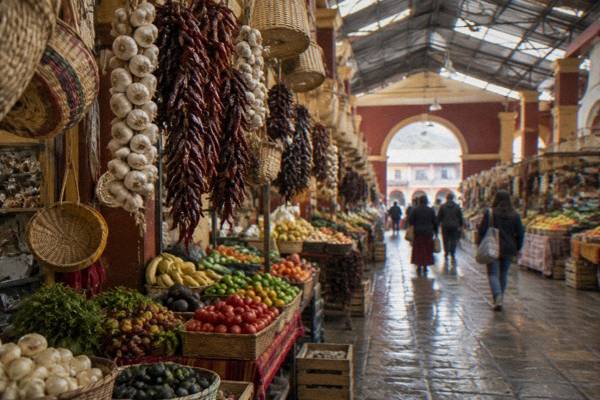
Mercado 20 De Noviembre: Smoke Alley And The Mole Counters
Mercado 20 de Noviembre is Oaxaca City's great food market, a short walk south of the Zócalo, known for its grilled-meat passageway and its counters of mole, tlayudas and hot chocolate.
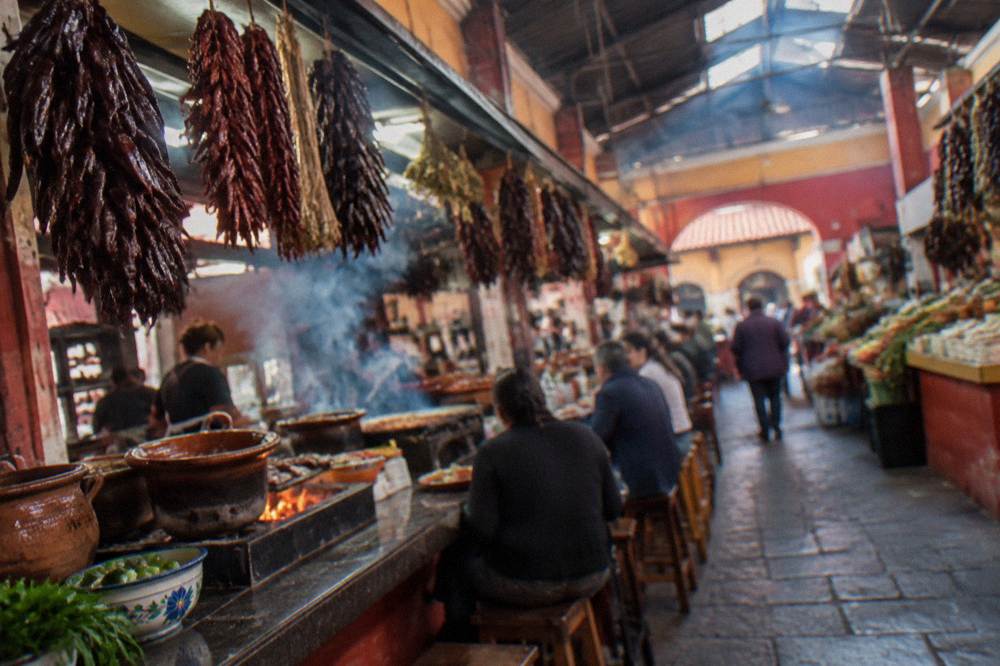
Mercado 20 de Noviembre is a covered food market in central Oaxaca City, about 300 m south of the Zócalo, founded in 1893. Its two draws are the grilled-meat passageway known as Smoke Alley and counters selling mole, tlayudas, quesillo, tejate and chocolate. Combine it with Mercado Benito Juárez next door and a market walk or cooking class.
Mercado 20 de Noviembre is Oaxaca City's best-known food market, a covered hall a few blocks south of the Zócalo in the historic centre of Oaxaca de Juárez, an inland highland city in the Valles Centrales at about 1,550 m. The state government's own history of the city's markets records the market's foundation in 1893 and its role as a key food market, with tianguis stall elements on Saturdays. Two things draw people through its doors: the grilled-meat passageway that English speakers call Smoke Alley, and rows of counters where cooks serve mole, tlayudas, quesillo, tejate and Oaxacan chocolate from dawn until the stalls close for the night.
This page covers what the market is, how Smoke Alley works dish by dish, what the mole counters serve, how to reach the hall from the Zócalo and the wider centre, what sits within walking distance, and how the calendar shapes a market visit in Oaxaca. It ends with the bookable options that fit the market best, including a cooking class that begins with shopping these same stalls. For the wider menu of the city, see things to do in Oaxaca across the whole site.
What Is Mercado 20 De Noviembre In Oaxaca?
Mercado 20 de Noviembre is a covered public food market in the historic centre of Oaxaca City, founded in 1893, sitting a few blocks south of the Zócalo beside Mercado Benito Juárez. It is the city's central place to eat rather than to sightsee: grilled meats, mole counters, tlayudas, quesillo, tejate and chocolate, all served at stall after stall through the day and into the evening.
The state government describes it as one of the markets that safeguard the identity and traditions of Oaxaca, and notes its Saturday tianguis elements. That founding year, 1893, makes it the older of the two central market buildings; Mercado Benito Juárez, directly adjacent, opened in 1894 under a different name. The two halls together form one continuous market quarter between the Zócalo and the Avenida Morelos side of the centre, and a visit usually wanders through both without a deliberate boundary.
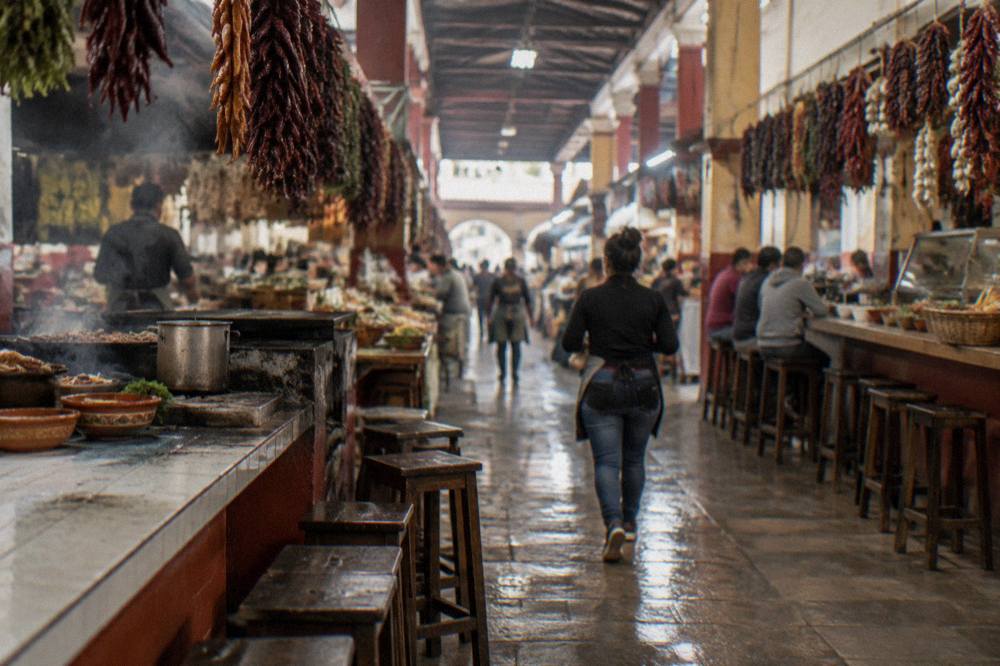
One planning note belongs here. Calle 20 de Noviembre, the street the market faces onto, underwent an intervention from February 2026 as part of the Oaxaca Camina programme: a temporary full vehicular closure of roughly two months for sidewalk widening and accessibility works, reduced afterwards to a single lane. The market itself stayed open throughout the works. Arrive on foot from the centre and the street design now serves you better than it did before.
The market also anchors the eating side of the centre in a literal way: it is the cheapest place to try the dishes Oaxaca is famous for, and it is the shopping stop for several of the cooking classes in the city, which send their groups here to buy chiles, herbs, quesillo and chocolate before returning to the kitchen. More on that in the tours section below.
What And Where Is Smoke Alley In Oaxaca's Mercado 20 De Noviembre?
Smoke Alley is the grilled-meat passageway inside Mercado 20 de Noviembre, on the market's upper food area, where dozens of stalls run charcoal grills side by side and cook tasajo, cecina and chorizo to order. You pick your meats and sides at a stall counter, they are grilled in front of you, and you eat at shared tables in the smoke-filled aisle. It is the single most famous eating experience in central Oaxaca.
The name is descriptive: the passageway's grills give the whole hall its smell and haze. Ordering follows the market pattern rather than a restaurant's. Choose the cuts, tasajo is thin cured beef, cecina is pork, and chorizo rounds out the trio, add tortillas, salsa, guacamole, grilled onions and quesillo, and the bill is assembled from what you took. Nothing about the stalls requires Spanish fluency: pointing works, and the counters are used to visitors all day.
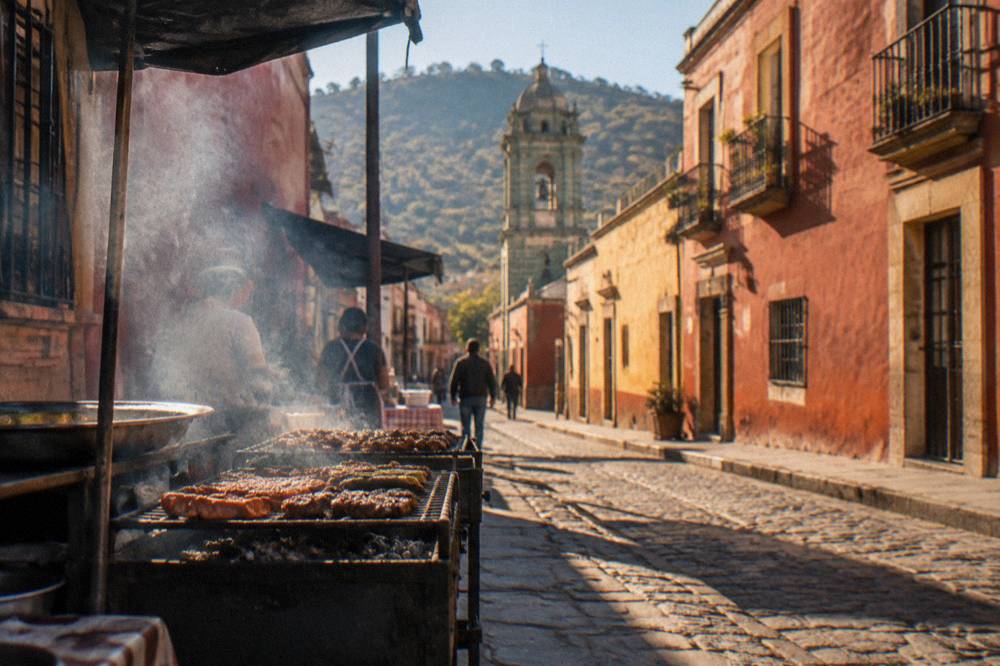
Around the grills sit the market's other anchors. Chocolate vendors grind cacao with almonds, cinnamon and sugar on the spot. The mole counters, covered in the next section, serve plates of rice, chicken and sauce. Tlayuda stands build the large crisp tortilla with asiento, beans, quesillo, cabbage and your choice of meat. Tejate, the maize-and-cacao drink, and chapulines, toasted grasshoppers, are sold from the halls' more traditional stalls. Every one of these is a named dish of Oaxacan cooking, and the market is where they all sit within fifty metres of each other.
Two practical habits make Smoke Alley easier. First, go hungry but not ravenous: portions are assembled per group at the counter, and it is normal to order progressively. Second, carry small peso notes; market stalls in Oaxaca run on cash, and grills in a smoky aisle are not the place to ask for change from a large bill.
For travellers who would rather have the market explained while eating, a guided walk turns the hall from an intimidating maze into a menu.
What Do The Mole Counters Serve In Oaxaca's Mercado 20 De Noviembre?
The mole counters are the sit-down stalls inside Mercado 20 de Noviembre where cooks serve plates of Oaxaca's signature sauces over chicken with rice and fresh tortillas. A typical counter lists several moles on its board, negro, coloradito, amarillo and verde among them, plus tamales, tlayudas and hot chocolate to drink. You order by the plate, it arrives fast, and the price sits well below any restaurant in the centre.
Mole is the dish to understand before ordering. It is a sauce family, not a single recipe: ground chiles, spices, nuts or seeds and often chocolate, cooked down into something each household and each market cook makes slightly differently. The black mole, mole negro, is the version Oaxaca is most known for, and the market counters are the easiest place in the city to try it without committing to a full restaurant meal. Order one plate of one mole and another of a different one, share, and compare.
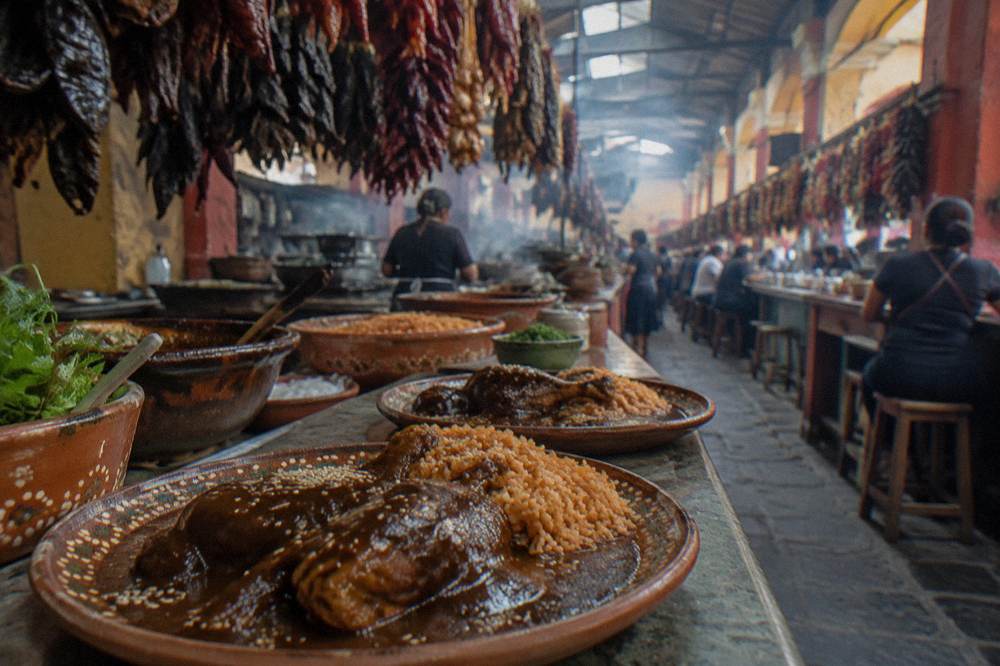
The counters also make the market the natural first stop of a deeper food itinerary. The city's wider mole story, and where each variety fits in Oaxacan home cooking, is covered in the site's guide to Oaxacan mole, and the restaurant scene beyond the market halls is mapped in the best restaurants in Oaxaca. Many travellers do both: market counters for the classic plates, restaurants for the versions that push the tradition further.
If a plate at a counter sparks the obvious next question, how the sauce is actually built, a cooking class answers it. The class featured on this page, a traditional cooking class where you learn to make an Oaxacan mole, starts from shopping the market's own ingredient stalls and ends with the sauce on the plate. Check availability on the operator's booking page.
How Do You Get To Mercado 20 De Noviembre From The Zócalo In Oaxaca?
From the Zócalo, Oaxaca's main square, you reach Mercado 20 de Noviembre on foot in under five minutes: walk one block south along Calle Flores Magón or the parallel street to Calle 20 de Noviembre and the market hall is on it, immediately south-east of Mercado Benito Juárez. No transport is needed from anywhere in the Centro Histórico; the whole historic core is compact and walkable at about 1,550 m of altitude.
The market's position is its best asset. The Zócalo is the reference point of the entire centre, and the market sits within the same grid of blocks as the Zócalo itself, Oaxaca Cathedral on its north side and the Basílica de la Soledad a short walk west. Walking is the default, and the site's longer treatment of the question, plus the walking-tour options below, cover the centre on foot in detail.
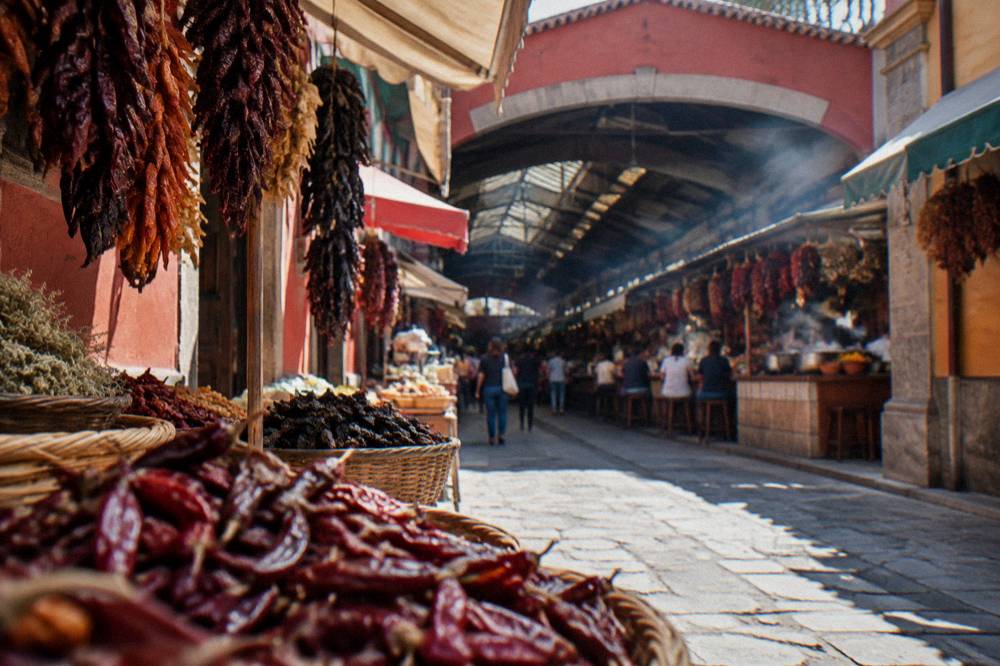
Two nearby halls are worth separating in your head, because first-time visitors conflate them. Mercado Benito Juárez, next door, is the hall for produce, herbs, chiles, crafts and bread; Mercado 20 de Noviembre is the hall for cooked food, grills and mole counters. Do the Benito Juárez stalls first for photographs and ingredient shopping, then eat in 20 de Noviembre. The state's market histories treat the two as one continuous market quarter, and physically they are. The wider set of guides lives on Oaxaca Travel Guide.
Getting there from further out follows the same logic as anywhere in the centre: hotels in Jalatlaco, Xochimilco or Reforma are all within a walk of thirty minutes or less, and taxis in Oaxaca set fares by agreement before the ride rather than on a meter. The site's transport pages cover fares and ride-hailing in detail; from the centre you will simply never need one for this market.
What Sits Within Walking Distance Of Mercado 20 De Noviembre In Oaxaca?
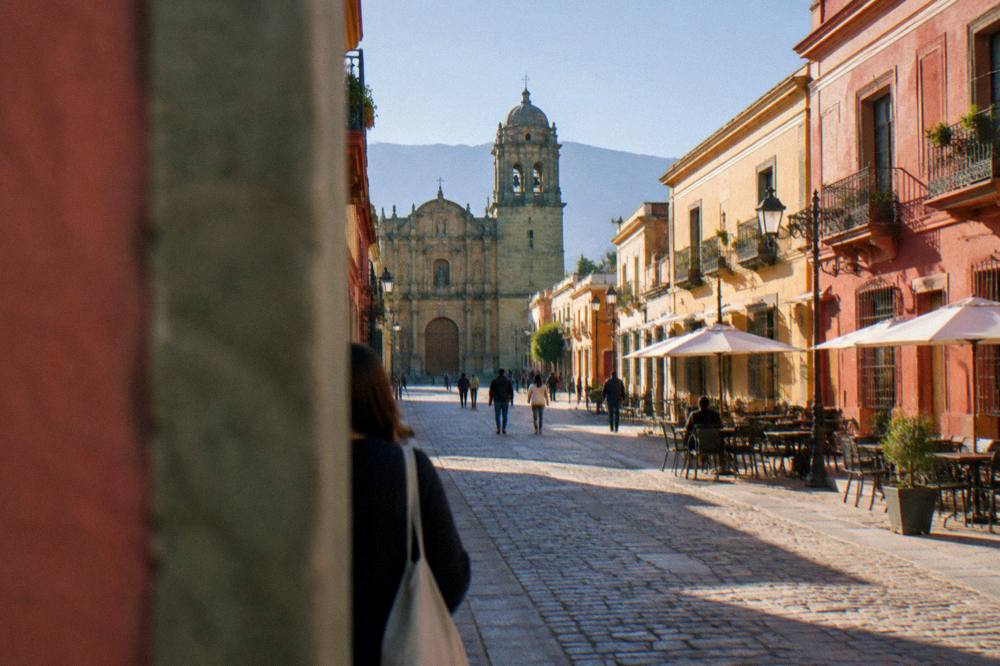
Within ten minutes on foot of Mercado 20 de Noviembre you can reach the Zócalo, Oaxaca Cathedral, the Basílica de la Soledad, the Andador Macedonio Alcalá pedestrian street, Santo Domingo de Guzmán at the far end of it, and the Museo de las Culturas de Oaxaca inside the Santo Domingo complex. That concentration is why the market works as the lunch stop at the centre of almost any day's walking itinerary in Oaxaca City.
The natural loop runs north from the market. Leave the hall, cut back to the Zócalo, and walk up the Andador Macedonio Alcalá, the pedestrian spine of the centre, towards Santo Domingo church. The Museo de las Culturas de Oaxaca is entered from the same complex: it opens Tuesday to Saturday, 10:00 to 16:00, and charges 105 MXN for Mexican nationals and 210 MXN for foreign visitors, the same Category I rate as Monte Albán and Mitla. The Jardín Etnobotánico beside it runs free guided tours Monday to Friday at 10:30, 11:00, 11:30, 12:00 and 17:00, and Saturday from 10:30 to 12:00, with large groups booking two weeks ahead.
| Sight in central Oaxaca | Walking time from the market | Hours | Entry |
|---|---|---|---|
| Zócalo | Under 5 minutes | Open public square | Free |
| Oaxaca Cathedral | About 5 minutes | Church hours vary by service | Free |
| Basílica de la Soledad | About 8 minutes | Church hours vary by service | Free |
| Museo de las Culturas de Oaxaca | About 15 minutes | Tuesday to Saturday, 10:00 to 16:00 | 105 MXN nationals, 210 MXN foreigners |
| Jardín Etnobotánico | About 15 minutes | Guided tours Mon-Fri 10:30-17:00 slots, Sat 10:30-12:00 | Free guided tours |
| Mercado Benito Juárez | Under 5 minutes | Market hall beside 20 de Noviembre | Free |
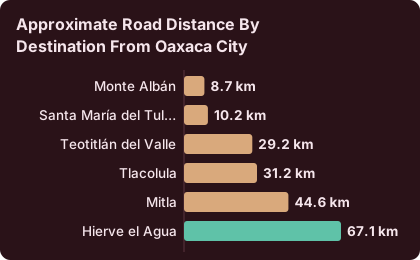
For the afternoon, the INAH archaeological zones sit beyond the city but close enough for a same-day pattern: Monte Albán about 15 minutes away by road, Mitla about 37, Hierve el Agua about 57. The market's grilled meats make a hearty base for a morning at the ruins, and the site has full pages on Monte Albán, Mitla and Hierve el Agua.
| Destination from Oaxaca City | Approximate road distance | Approximate drive time |
|---|---|---|
| Monte Albán | 8.7 km | About 15 minutes |
| Santa María del Tule | 10.2 km | About 11 minutes |
| Teotitlán del Valle | 29.2 km | About 26 minutes |
| Tlacolula | 31.2 km | About 25 minutes |
| Mitla | 44.6 km | About 37 minutes |
| Hierve el Agua | 67.1 km | About 57 minutes |
Drive times are free-flow estimates; real traffic and mountain roads are slower.
When Should You Visit Oaxaca For Market Food?
Oaxaca's dry season runs November to April and the rainy season May to October, and the market halls themselves are covered, so the calendar matters less here than for any other activity in the city. What the seasons change is the city around the market: June averages 188.3 mm of rain, January 2.4 mm, and April carries the warmest average daily high at 34.9 C, with the coolest nights in December and January.
A covered market is the rainy-day answer for Oaxaca, and the site keeps a full page on that use case. What the table below shows is the shape of the year from the SMN climate normals for the Oaxaca station, 1991 to 2020: rain concentrated from May to October, and dry, warm months from November to April.
| Month | Average high C | Average low C | Average rain mm |
|---|---|---|---|
| January | 28.9 | 10.3 | 2.4 |
| February | 31.1 | 11.6 | 4.6 |
| March | 33.3 | 13.6 | 17.6 |
| April | 34.9 | 15.8 | 47.3 |
| May | 33.8 | 16.7 | 97.9 |
| June | 30.9 | 16.7 | 188.3 |
| July | 30.1 | 15.9 | 118.6 |
| August | 30.0 | 15.9 | 131.8 |
| September | 29.1 | 16.1 | 163.6 |
| October | 29.3 | 14.5 | 63.1 |
| November | 29.0 | 12.3 | 9.1 |
| December | 28.9 | 11.0 | 9.0 |
Two calendar moments change the market most. The Guelaguetza fills Oaxaca across two July Mondays, the Lunes del Cerro, and the 2026 edition ran 20 and 27 July with Palco A tickets at 1,632 MXN and Palco B at 1,321 MXN, Palcos C and D free. Around Día de Muertos, the traditional focus is 31 October to 2 November, with the city's pan de muerto and mole traffic peaking in the market halls; the 2026 programme has not been announced, so plan on the standing pattern rather than published dates. December brings the Noche de Rábanos on 23 December, a Zócalo tradition whose 2026 edition was likewise unannounced.
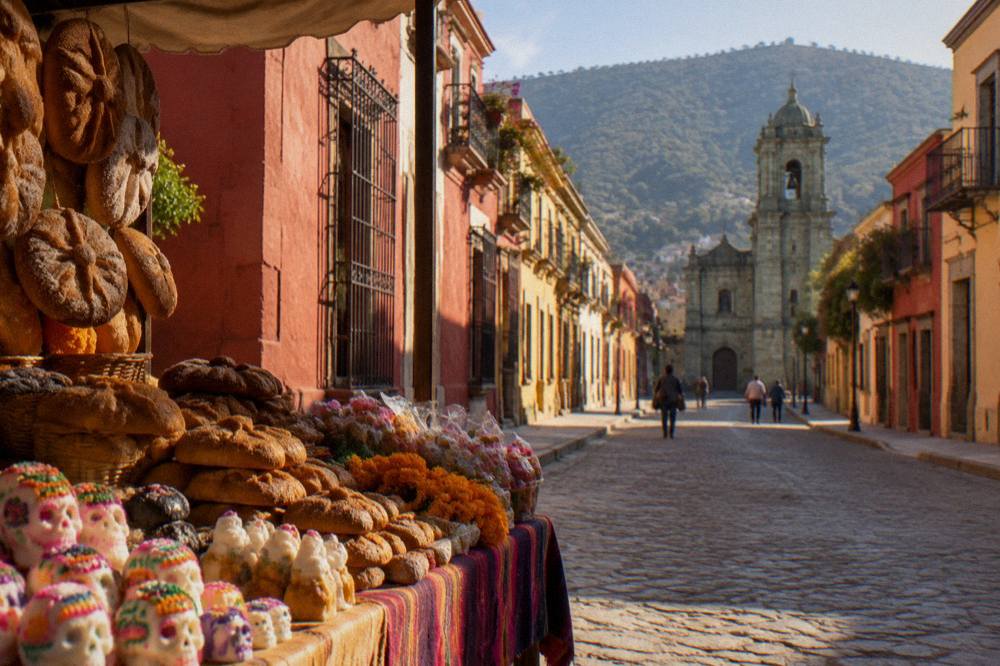
Should You Take A Market Tour Or A Cooking Class In Oaxaca?
For most of what this page covers, a guided option adds context the stalls do not explain on their own: a food and market walk interprets the halls dish by dish, a cooking class buys ingredients in the market and then cooks them, and a mezcal-and-mole tasting pairs the market's two flagship products. All three run from central Oaxaca, and the class featured here, a traditional Oaxacan mole cooking class, is the deepest of them.
The cooking class works as a natural extension of the mole counters. Its itinerary follows the market logic: buy the chiles, the chocolate and the quesillo where the counters buy them, then build the sauce from raw ingredients under instruction. For travellers whose trip budget allows one bookable food experience in Oaxaca, the class converts a market visit from a meal into a skill. The site's wider roundup, Oaxaca cooking classes, compares the options.
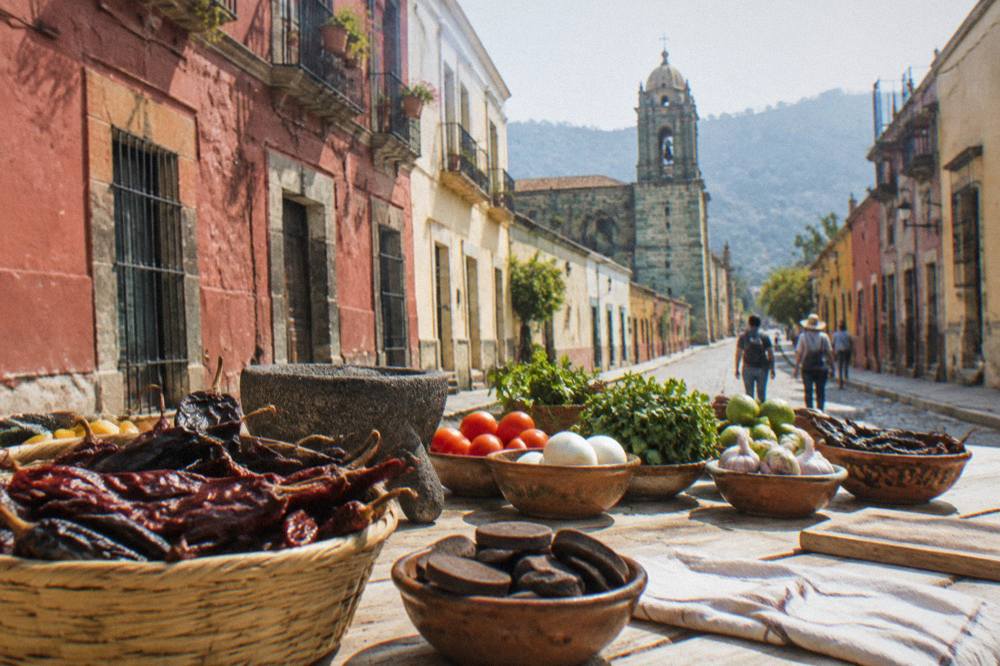
The other two formats suit different travellers. A short historic-centre walking tour usually routes through the market halls and frames them within the city's history, which is useful on a first day. A certified-sommelier mezcal and mole tasting sits at the opposite end of the scale from a market counter: same flavours, seven pairings, a seated setting. Between them, the market itself remains free to enter, and no tour is required to eat well in it.
Around the market quarter, the site's other food pages fill out the picture: Oaxacan chocolate for the grinding stalls, Mercado Benito Juárez for the neighbouring hall, and, for market days beyond the city, the Ocotlán Friday market day trip.
Common Questions About Mercado 20 De Noviembre In Oaxaca
What Is Mercado 20 De Noviembre In Oaxaca?
A covered public food market in the historic centre of Oaxaca City, founded in 1893, known for its grilled-meat passageway and mole counters. Things to do in Oaxaca across the site place it among the city's core stops.
Where Is Smoke Alley In Oaxaca?
Inside Mercado 20 de Noviembre, in the upper food area: a passageway of stalls running charcoal grills that cook tasajo, cecina and chorizo to order, eaten at shared tables in the aisle.
What Should You Eat At Mercado 20 De Noviembre In Oaxaca?
The named dishes of the hall are grilled tasajo, cecina and chorizo from Smoke Alley, mole plates from the counters, tlayudas, quesillo, tejate, chapulines and Oaxacan chocolate. Prices are set per stall and not published centrally.
How Far Is Mercado 20 De Noviembre From The Zócalo In Oaxaca?
About one block south of the Zócalo, an easy walk of under five minutes through the central grid. No transport is needed from anywhere in the Centro Histórico.
Is Mercado 20 De Noviembre The Same As Mercado Benito Juárez?
No. Mercado Benito Juárez, opened in 1894, is the adjacent hall for produce, chiles and crafts; Mercado 20 de Noviembre is the cooked-food hall with the grills and mole counters. The two sit side by side and are usually visited together.
Can You Take A Market Tour Or Cooking Class At Mercado 20 De Noviembre?
Yes. Guided food walks route through the halls, and several cooking classes, including the traditional mole cooking class featured on this page, begin by shopping the market's ingredient stalls before cooking.
The market is at its best understood as Oaxaca's pantry and dining room at once, and one visit rarely exhausts it: return for the chocolate grinders you skipped, the mole you did not order, and the Saturday tianguis elements the state's own market history records.