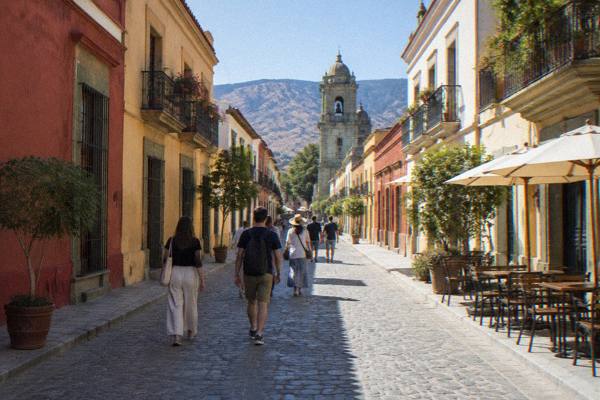
Basílica De La Soledad: The Patron Virgin Of Oaxaca
The Basílica de la Soledad in Oaxaca City is dedicated to the Virgen de la Soledad, the patron virgin of Oaxaca, and sits in the state capital, an inland highland city in the Valles Centrales at about 1,550 m. This guide covers how the basilica fits into a visit, what the surrounding sights cost and when to come.
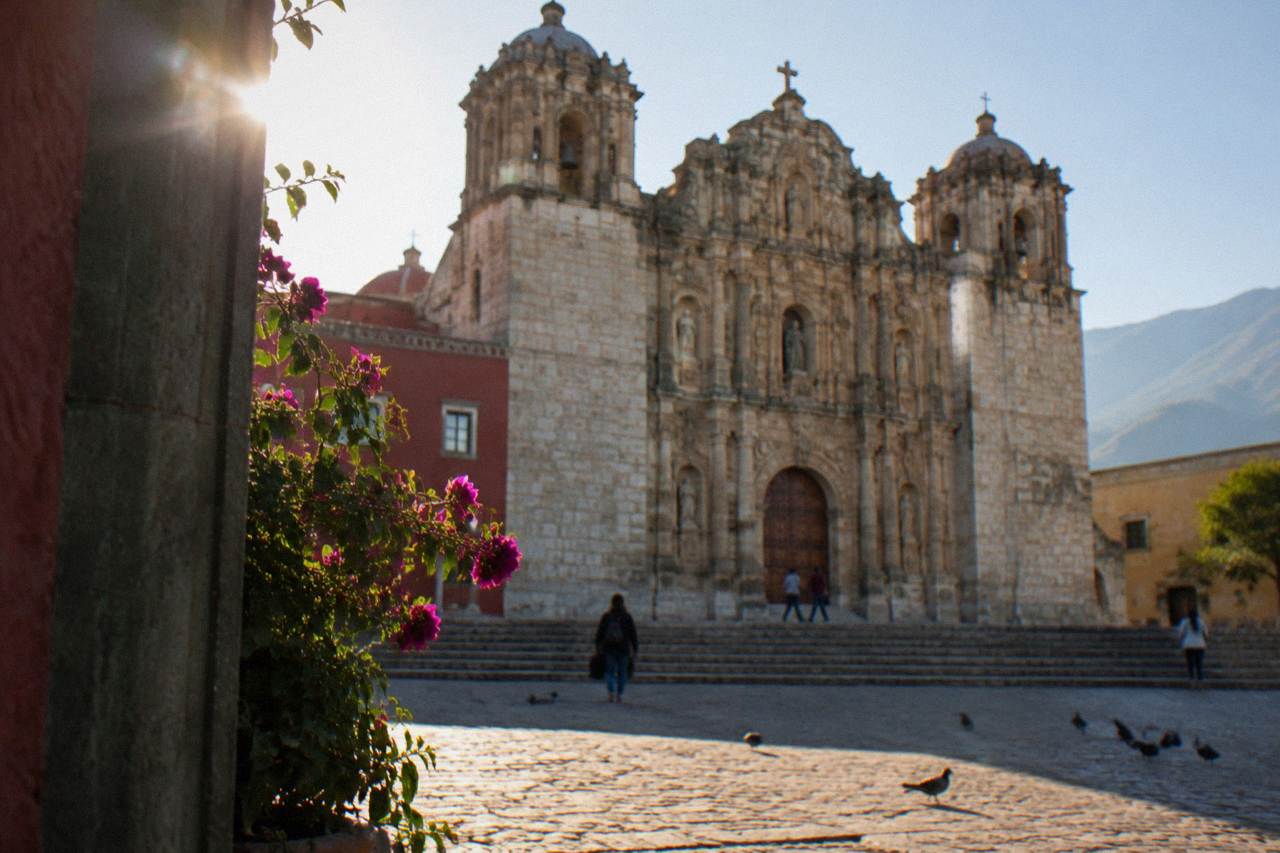
The Basílica de la Soledad is in Oaxaca City, the capital of the state of Oaxaca in Mexico, and is dedicated to the Virgen de la Soledad, the patron virgin of Oaxaca. Pair it with the Zócalo, the Oaxaca Cathedral and the Andador Macedonio Alcalá, all in the historic centre of a walkable city.
The Basílica de la Soledad stands in Oaxaca City, the capital of the state of Oaxaca in Mexico, an inland highland city in the Valles Centrales at about 1,550 m, far from any coast. The basilica is dedicated to the Virgen de la Soledad, the patron virgin of Oaxaca, and it belongs to the same walkable historic core as the Zócalo, the Oaxaca Cathedral, the Andador Macedonio Alcalá and Santo Domingo de Guzmán. The historic centre of Oaxaca, together with the archaeological site of Monte Albán, is inscribed on the UNESCO World Heritage list as the property "Historic Centre of Oaxaca and Archaeological Site of Monte Albán", number 415. Oaxaca de Juárez, to give the city its full name, was founded in 1529 as Antequera, and the municipality counted 270,955 inhabitants at the 2020 census. Planning a visit around the basilica calls for sight hours, entry fees in pesos, climate normals, festival patterns and the distances to the valley's other sights.
Where Is The Basílica De La Soledad In Oaxaca?
The Basílica de la Soledad stands in the historic centre of Oaxaca City, the state capital, an inland highland city in the Valles Centrales at about 1,550 m, with no sea, beach or navigable river anywhere near it. The basilica is dedicated to the Virgen de la Soledad, the patron virgin of Oaxaca, and the Zócalo, the city's main square, sits a short walk away at the coordinates 17.0605953, -96.7253435.
Oaxaca City is compact. The Zócalo, formally the Plaza de la Constitución, anchors the centre, and from it run the streets and the pedestrian Andador Macedonio Alcalá that link the cathedral, the basilica's quarter and, further north, the church of Santo Domingo de Guzmán. The city recorded 1,324,332 tourist arrivals across 2025, of which 1,111,799 were national visitors and 212,533 foreign, with an average stay of 2.00 nights, so a sight like the basilica is nearly always visited as part of a walking day rather than as a single destination in itself.
The wider setting matters for planning. The municipality of Oaxaca de Juárez had 270,955 inhabitants at the 2020 census and the state of Oaxaca 4,132,148. The city's timezone is UTC-6 all year: Mexico abolished daylight saving time, with the law published in the official gazette on 28 October 2022, so clocks in Oaxaca never shift with the seasons. The state lodging tax is 3 percent on hotel-type stays, or 5 percent where an intermediary platform collects it, under decree 884 published on 10 December 2025.
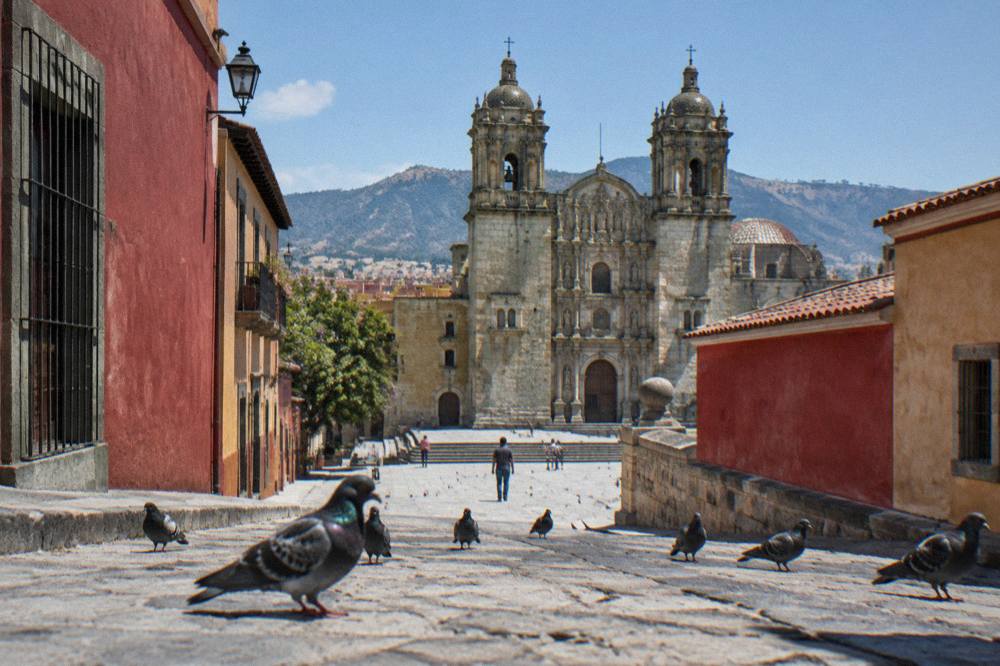
For depth on the individual sights that surround the basilica, read the site's pages on the Zócalo in Oaxaca, the Oaxaca Cathedral and Santo Domingo Church, and start any broader trip planning from things to do in Oaxaca.
How Does The Basílica De La Soledad Fit Into A Day In Oaxaca?
A workable pattern is to visit the Basílica de la Soledad as one stop on a walking circuit of Oaxaca City's historic centre, pairing it with the Zócalo, the Oaxaca Cathedral and the Andador Macedonio Alcalá, then finishing the day at Santo Domingo de Guzmán and the Jardín Etnobotánico, whose free guided tours run Monday to Friday at 10:30, 11:00, 11:30, 12:00 and 17:00, and Saturday from 10:30 to 12:00.
The Jardín Etnobotánico schedule comes from the state government's own announcement of 18 August 2025, and the tours are free, with large and school groups asked to book two weeks ahead. That fixed timetable is the one scheduling anchor the centre offers from a primary source, so it makes sense to build a walking day around it rather than around the basilica, whose own opening pattern is not carried in the facts this site works from.
A second anchor is the Museo de las Culturas de Oaxaca at Santo Domingo, which the INAH listing shows open Tuesday to Saturday, 10:00 to 16:00, and closed Sunday and Monday. Admission is 105 MXN for Mexican nationals and 210 MXN for foreign visitors. Anyone planning a Tuesday-to-Saturday stay can therefore combine the basilica, the walking streets and the museum in one day; anyone arriving on a Sunday or Monday should shift the museum to later in the week and spend the day on the streets, squares and markets instead.
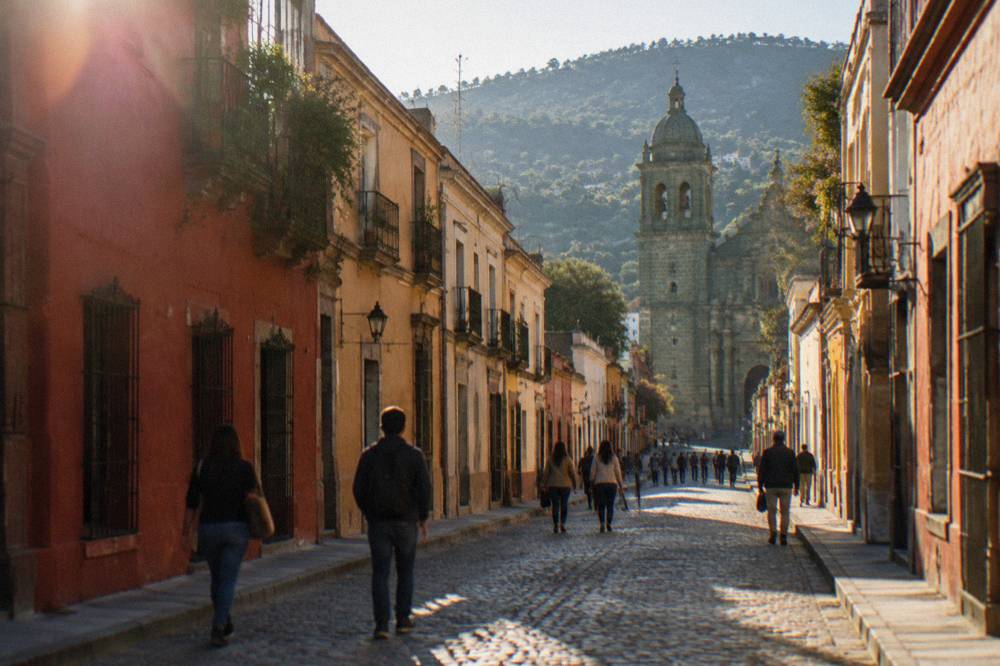
A guided walk is one way to cover the basilica and the surrounding centre without route-planning. The Oaxaca Walking Tour covers the city's culture and food on foot, and you can Check availability on the operator's booking page. For visitors who prefer to walk with more of the city's stories attached, there are also paid history walks such as the historic centre walking tour with a professional local guide, and this guide's own overview of free things to do in Oaxaca covers the squares and streets that cost nothing at all.
What Are The Opening Patterns Of Oaxaca's Main Sights?
INAH listings show Monte Albán, Mitla and Yagul open Monday to Sunday 08:00 to 17:00, Atzompa open Monday to Sunday 08:00 to 16:00 with last access at 15:00, Zaachila open Thursday to Sunday 10:00 to 16:00 only, and the Museo de las Culturas de Oaxaca open Tuesday to Saturday 10:00 to 16:00 only. The basilica, as a working church, follows a church schedule rather than an INAH timetable.
The table below collects every sight hour this site carries. Two patterns matter for planning a basilica-centred stay. First, the INAH archaeological zones run seven days a week, so a valley day trip never conflicts with a weekday. Second, the museum and Zaachila have closed days, so a short visit that lands on the wrong day of the week simply moves those two stops elsewhere.
| Sight in and around Oaxaca City | Days open | Hours | Last access |
|---|---|---|---|
| Monte Albán (INAH) | Monday to Sunday | 08:00 to 17:00 | 16:00 |
| Mitla (INAH) | Monday to Sunday | 08:00 to 17:00 | 16:30 |
| Yagul (INAH) | Monday to Sunday | 08:00 to 17:00 | 16:00 |
| Dainzú (INAH) | Monday to Sunday | 08:00 to 17:00 | 16:30 |
| Lambityeco (INAH) | Monday to Sunday | 08:00 to 17:00 | 16:30 |
| Atzompa (INAH) | Monday to Sunday | 08:00 to 16:00 | 15:00 |
| Zaachila (INAH) | Thursday to Sunday only | 10:00 to 16:00 | not stated |
| Museo de las Culturas de Oaxaca (INAH) | Tuesday to Saturday only | 10:00 to 16:00 | not stated |
| Jardín Etnobotánico (free guided tours) | Monday to Friday at set times; Saturday mornings | 10:30, 11:00, 11:30, 12:00, 17:00; Sat 10:30 to 12:00 | not applicable |
The INAH listing pages also carry a single published rate for visits outside normal hours at several of the zones: 730 MXN, a figure that appears on the Yagul, Lambityeco, Atzompa and Museo de las Culturas pages. For the basilica itself, this guide has no opening hours or entry fee on record, and church schedules in Oaxaca are set locally, so confirm on arrival or with your accommodation before planning an early or late visit.
What Do Oaxaca's Sights And Sites Cost To Visit?
The INAH sites charge by category: Category I, which covers Monte Albán, Mitla and Yagul, costs 105 MXN for Mexican nationals and 210 MXN for foreign visitors, while Category III, covering Dainzú, Lambityeco and Zaachila, costs 80 MXN and 145 MXN respectively, and the Museo de las Culturas de Oaxaca charges 105 and 210 MXN. The Jardín Etnobotánico's guided tours are free.
Every figure in that answer comes from the INAH zone pages themselves. Note that Atzompa's entry fee is not carried on its page, which lists hours only, so do not assume a figure for it. The basilica, as a church rather than an INAH property, sits outside this fee structure altogether, and this guide does not publish an entry charge for it.
| Sight | Category | Nationals (MXN) | Foreign visitors (MXN) |
|---|---|---|---|
| Monte Albán | INAH Category I | 105 | 210 |
| Mitla | INAH Category I | 105 | 210 |
| Yagul | INAH Category I | 105 | 210 |
| Dainzú | INAH Category III | 80 | 145 |
| Lambityeco | INAH Category III | 80 | 145 |
| Zaachila | INAH Category III | 80 | 145 |
| Museo de las Culturas de Oaxaca | INAH museum | 105 | 210 |
| Jardín Etnobotánico | State garden, guided tours | free | free |
Beyond entry fees, the fixed local costs a visitor can plan on are few: the state lodging tax of 3 percent on hotel-type stays, and the INAH 730 MXN out-of-hours rate where a zone publishes it. Bus, taxi, colectivo and palenque-visit prices are best checked on the spot or with the operator.
When Should You Time A Visit Around Oaxaca's Festivals?
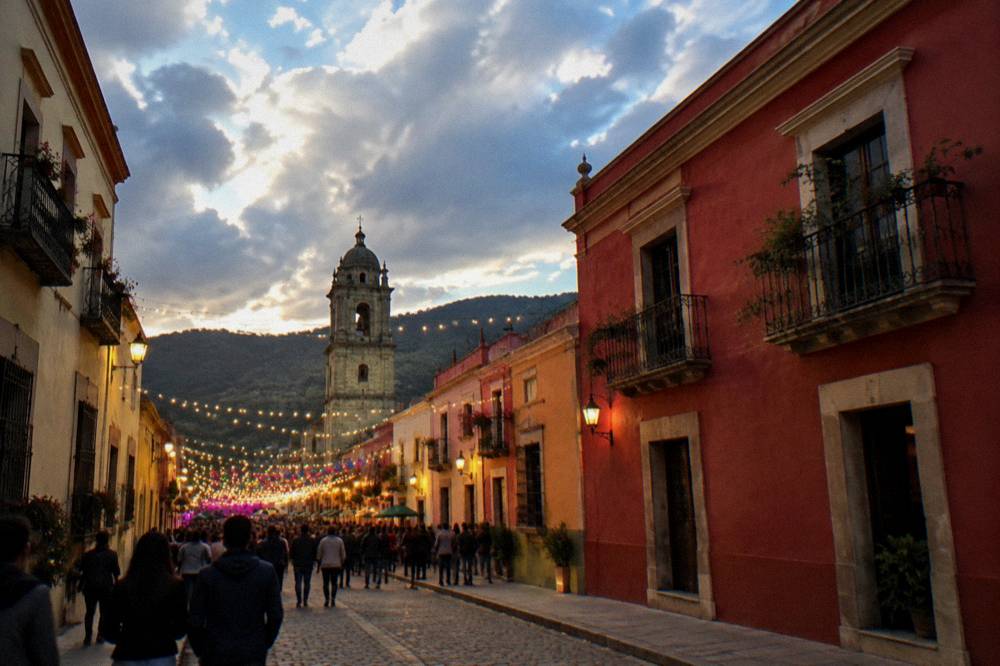
The two standing festival anchors near the basilica are Guelaguetza, which falls on two Mondays in July at the Auditorio Guelaguetza on the Cerro del Fortín, and Día de Muertos, which centres on the traditional dates of 31 October to 2 November; the 2026 Guelaguetza edition ran on 20 and 27 July 2026 with Palco A at 1,632 MXN and Palco B at 1,321 MXN, while Palcos C and D were free, but 2027 dates are not announced.
For Guelaguetza, the 2026 figures are a reference for scale rather than a promise of next year's prices. Tickets for that edition were sold only through the official Superboletos channel, with a limit of two per account, and the paid sections sold out quickly. The related programme that July included Calendas on 18 and 25 July and Convites on 1, 10 and 11 July, all part of a month labelled "Julio, mes de la Guelaguetza". A Feria del Mezcal ran in the same month at the Centro Cultural y de Convenciones de Oaxaca in Santa Lucía del Camino, with an entry price of about 80 MXN. Other pages covering the same trip are gathered on Oaxaca Travel Guide.
For Día de Muertos, the 2025 programme ran 25 October to 4 November with more than 140 activities, and the 2026 programme has not been announced. The traditional dates to plan around are 31 October to 2 November, with cemeteries open at night around 1 and 2 November and neighbourhood celebrations in places such as Jalatlaco and Xoxocotlán. No 2026 dates for Noche de Rábanos have been announced either; that tradition falls on 23 December, and the last published edition was the 128th, in December 2025. More detail sits in this guide's guides to Día de Muertos in Oaxaca and Noche de Rábanos.
| Festival in Oaxaca | Standing pattern | Last published edition | Next edition |
|---|---|---|---|
| Guelaguetza (Lunes del Cerro) | Two Mondays in July, Auditorio Guelaguetza, Cerro del Fortín | 20 and 27 July 2026 | not announced |
| Feria del Mezcal | Held within the July Guelaguetza month, CCCO Santa Lucía del Camino | 17 to 28 July 2026 | not announced |
| Día de Muertos | Centres on 31 October to 2 November | 2025 programme: 25 Oct to 4 Nov, 140+ activities | not announced |
| Noche de Rábanos | 23 December tradition in the city centre | 128th edition, December 2025 | not announced |
One standing risk to weigh against festival timing: road blockades by teachers' unions are a recurring feature in Oaxaca and can disrupt road and airport access for hours or a day at a time. This guide does not date individual blockades, but anyone travelling around a major festival should keep a buffer in the itinerary and monitor official channels.
What Is The Weather Like Around The Basílica De La Soledad In Oaxaca?
Oaxaca City has a dry season from November to April and a rainy season from May to October, with rain peaking between June and September; the SMN station normals for 1991 to 2020 show June averaging 188.3 mm of rain and January just 2.4 mm, April with a mean daily high of 34.9 C, and December and January with the lowest mean daily lows at 11.0 C and 10.3 C.
The full monthly table below is the SMN station 20079 normals, the same series the national weather service publishes for the city. The figures are averages, and this guide writes them as such: April's 34.9 C mean daily high and January's 2.4 mm of rain describe a normal month, not a forecast. There is no winter snow at this altitude and latitude, and no sea breeze, because there is no sea: the Pacific coast is a far extension from this inland valley city.
| Month | Mean daily high (C) | Mean daily low (C) | Rain (mm) |
|---|---|---|---|
| January | 28.9 | 10.3 | 2.4 |
| February | 31.1 | 11.6 | 4.6 |
| March | 33.3 | 13.6 | 17.6 |
| April | 34.9 | 15.8 | 47.3 |
| May | 33.8 | 16.7 | 97.9 |
| June | 30.9 | 16.7 | 188.3 |
| July | 30.1 | 15.9 | 118.6 |
| August | 30.0 | 15.9 | 131.8 |
| September | 29.1 | 16.1 | 163.6 |
| October | 29.3 | 14.5 | 63.1 |
| November | 29.0 | 12.3 | 9.1 |
| December | 28.9 | 11.0 | 9.0 |
What this means in practice for a basilica visit: the rainy-season months deliver their rain on many days, with the normals showing 19.9 days of rain in June, 20.4 in July, 20.5 in August and 21.4 in September, so a church stop is a useful anchor on a wet afternoon. The dry months of November through March each average well under 20 mm, and this guide's guide to Oaxaca in the rain covers the indoor half of the city for the other season.
How Far Are Oaxaca's Day Trips From The Basílica?
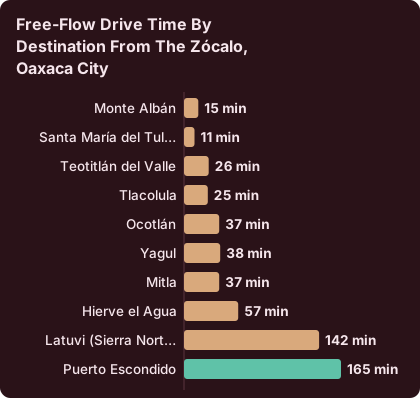
From the Zócalo, the derived drive times are about 15 minutes to Monte Albán, about 11 minutes to Santa María del Tule, about 26 minutes to Teotitlán del Valle, about 37 minutes to Mitla, about 57 minutes to Hierve el Agua and about 165 minutes to Puerto Escondido on the new highway, all measured as free-flow times that real traffic and mountain roads make slower.
These are computed distances from the city centre, so treat them as floors rather than promises. The valley's main archaeological and natural sights all sit within an hour's drive, which is why a two-part stay works so well in Oaxaca: mornings on foot around the basilica, the Zócalo and the markets, and one or two full days out to Monte Albán, Mitla or Hierve el Agua.
| Destination from the Zócalo, Oaxaca City | Distance (km) | Free-flow drive time |
|---|---|---|
| Monte Albán | 8.7 | about 15 minutes |
| Santa María del Tule | 10.2 | about 11 minutes |
| Teotitlán del Valle | 29.2 | about 26 minutes |
| Tlacolula | 31.2 | about 25 minutes |
| Ocotlán | 32.5 | about 37 minutes |
| Yagul | 41.9 | about 38 minutes |
| Mitla | 44.6 | about 37 minutes |
| Hierve el Agua | 67.1 | about 57 minutes |
| Latuvi (Sierra Norte) | 110.4 | about 142 minutes |
| Puerto Escondido | 190.1 | about 165 minutes |
The Pacific coast towns are extensions, not day trips in the ordinary sense, and this guide treats them that way in its guides to Oaxaca to Puerto Escondido and the Sierra Norte pages such as Capulalpam de Méndez. The 2025 visitor counts show where the crowds actually went: Monte Albán received 416,675 visitors across the year, Mitla 104,428, Yagul 10,185, Lambityeco 5,545 and Zaachila 4,229, so the smaller zones are genuinely quiet by comparison even though this guide makes no crowd promises.
Is The Area Around The Basílica De La Soledad Easy To Walk?
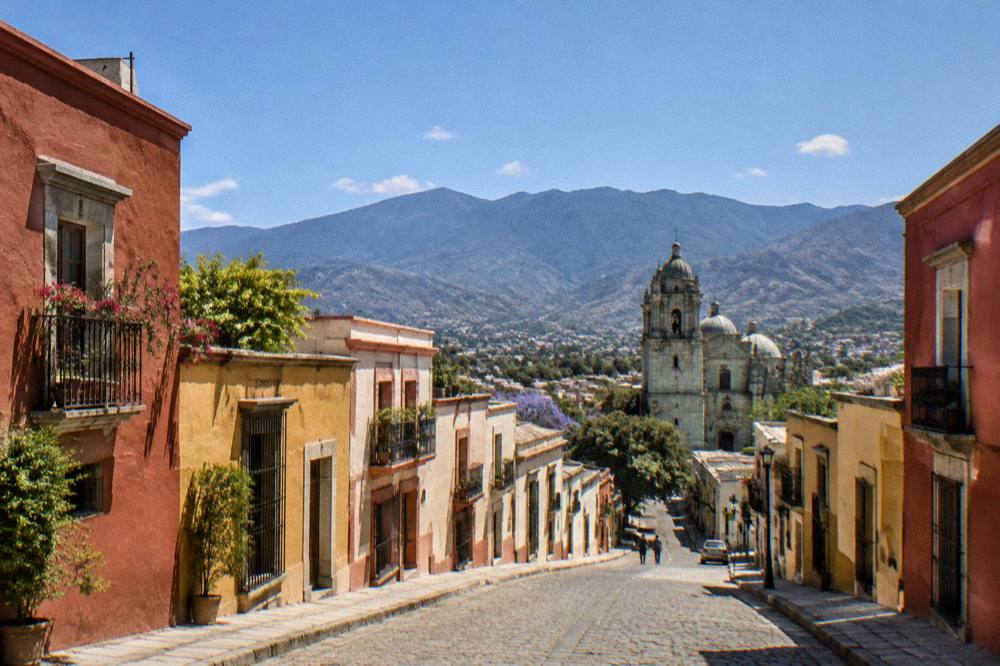
Oaxaca City is a walkable highland city, and the answer is structural: the Zócalo, the Oaxaca Cathedral, the Basílica de la Soledad, the Andador Macedonio Alcalá and Santo Domingo de Guzmán all sit in one continuous historic centre that a visitor covers on foot, with the city's markets, including Mercado 20 de Noviembre and Mercado Benito Juárez, in the same band.
No bike-share exists in Oaxaca, which sharpens the point: the practical choices in the centre are walking, taxis agreed at a fare before setting off, and colectivos for the valley routes, and this guide's guides to getting around Oaxaca and is Oaxaca walkable cover each. The altitude of about 1,550 m means the air is thinner than at sea level, and April's normal high of 34.9 C makes midday walking a matter of pacing rather than distance; this guide's page on Oaxaca altitude and sun goes into detail.
For a sense of how the neighbourhoods around the centre differ, this guide's guides to Jalatlaco, Xochimilco and the centro histórico break the walkable city into pieces. The markets deserve their own afternoon: see Mercado 20 de Noviembre and Mercado Benito Juárez.
A valley day trip pairs well with the basilica day because the INAH zones open at 08:00 and close mid-to-late afternoon, leaving the evening for the centre. The Hierve el Agua, Mitla, Tule, Rugs and Mezcal day tour is one of the tour list's most-reviewed options for that loop, and this guide's pages on Monte Albán, Mitla and Hierve el Agua cover each stop in depth.
For a craft afternoon closer to the basilica, the alebrije painting workshop with the Jiménez family runs in the city and pairs with this guide's guides to San Martín Tilcajete alebrijes and the city's own museums, including the Museo Textil de Oaxaca and the Rufino Tamayo museum, which reopened in August 2025 after more than three years closed for state restoration work.
How Many Days Should You Give Oaxaca After The Basilica?
The city's own 2025 numbers show an average stay of 2.00 nights, but a basilica-centred visit that also takes in Monte Albán, one valley day trip and the museums comfortably fills three to five days, and this guide's itinerary guides cover every length from one day to a full week.
This guide publishes ready-made plans at Oaxaca in one day, Oaxaca in 3 days and Oaxaca in a week, plus the planning overview at Oaxaca itinerary planning. The logic is simple: the basilica, the Zócalo and the walking streets take one unhurried day; Monte Albán takes a half-day given its 08:00 to 17:00 opening; and each valley loop, whether Mitla and Hierve el Agua or the craft villages, takes a full day. Travellers weighing Oaxaca against another colonial city can read Oaxaca versus San Miguel de Allende.
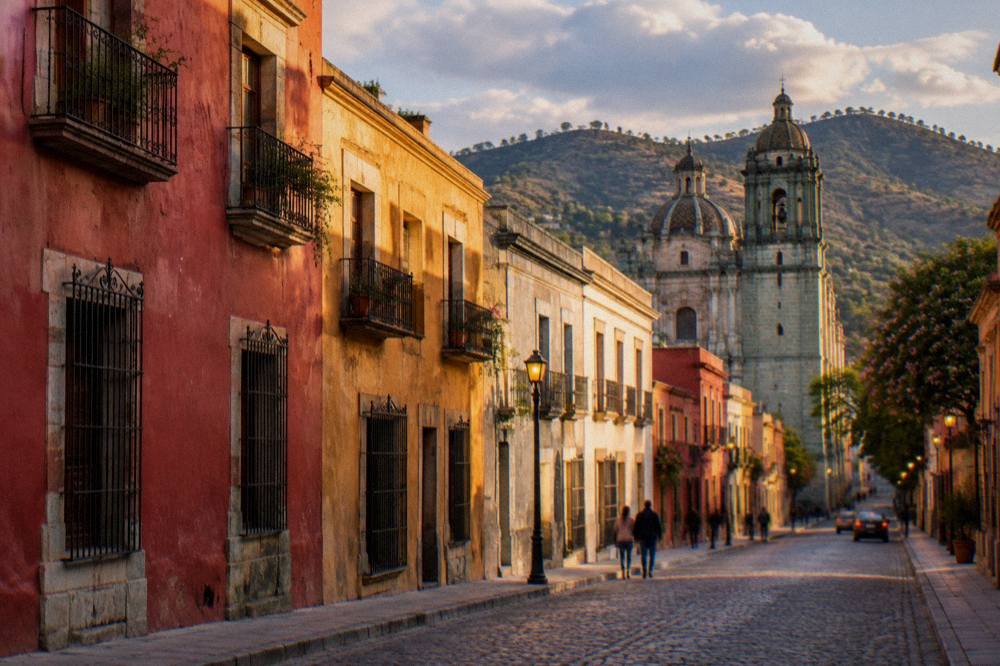
Family travellers and first-timers have their own considerations, covered in Oaxaca with kids and first time in Oaxaca. Anyone visiting around December should also read this guide's answer page on when Noche de Rábanos is held, since the basilica's quarter sits in the band of streets where that December tradition takes shape.
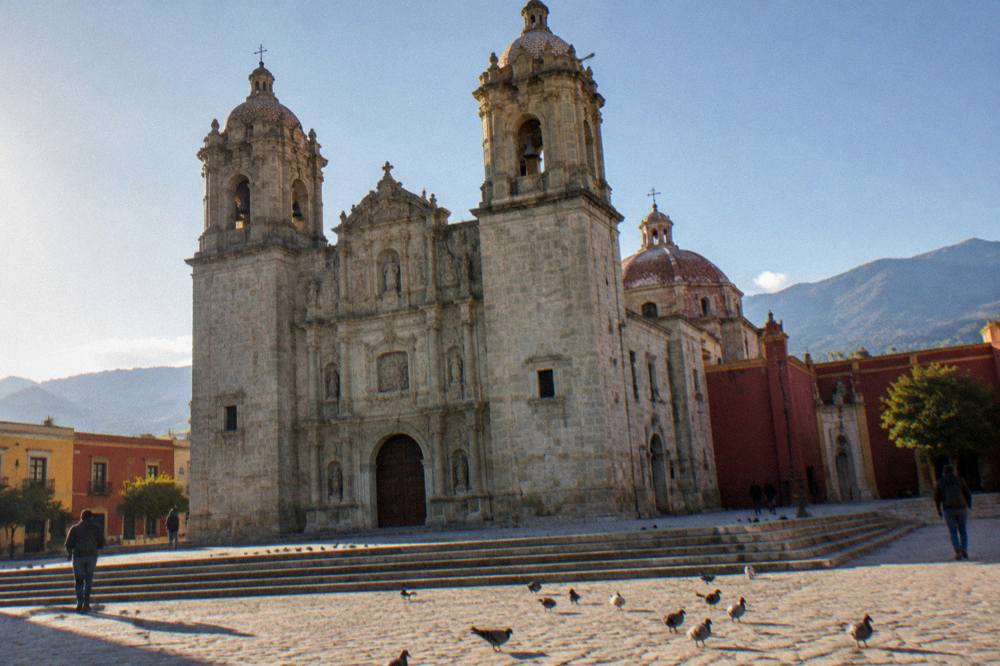
Common Questions About The Basílica De La Soledad In Oaxaca
What Is The Basílica De La Soledad In Oaxaca?
It is the basilica in Oaxaca City dedicated to the Virgen de la Soledad, the patron virgin of Oaxaca, standing in the walkable historic centre of the state capital alongside the Zócalo, the Oaxaca Cathedral and the Andador Macedonio Alcalá.
Does The Basílica De La Soledad Charge Entry?
The available records carry no entry fee or opening hours for the basilica, which is a working church rather than an INAH property. Confirm locally on arrival. The INAH sites and museums around it do carry published fees, from 80 MXN at the Category III zones to 210 MXN for foreign visitors at Category I sites.
How Do I Get To The Basílica De La Soledad?
The basilica sits in Oaxaca City's historic centre, a compact area best covered on foot from the Zócalo. There is no bike-share in the city. Taxis in Oaxaca work on fares agreed before the ride, and colectivos serve the valley routes from city departure points.
What Is Near The Basílica De La Soledad?
The Zócalo, the Oaxaca Cathedral, the Andador Macedonio Alcalá, the Mercado 20 de Noviembre and Mercado Benito Juárez, and, further along the centre, Santo Domingo de Guzmán with the Museo de las Culturas de Oaxaca and the Jardín Etnobotánico, whose free guided tours run Monday to Friday at set times and Saturday mornings.
When Is The Best Time To See The Basilica And Oaxaca's Festivals?
The dry season runs November to April and the rainy season May to October, with June averaging 188.3 mm of rain. Guelaguetza falls on two Mondays in July, and Día de Muertos centres on 31 October to 2 November; this guide publishes no best-month ranking, and 2027 Guelaguetza dates are not announced.
Can I Visit Monte Albán On The Same Trip As The Basilica?
Yes. Monte Albán is about 15 minutes' drive from the Zócalo, open Monday to Sunday 08:00 to 17:00 with last access at 16:00, and entry is 105 MXN for nationals and 210 MXN for foreign visitors, so it pairs naturally with a city day built around the basilica.
The Basílica de la Soledad rewards the same approach as the rest of Oaxaca City: arrive on foot, keep the INAH timetables and the Jardín Etnobotánico tour times in view, carry pesos for the zone entries, and save the valley's big sights for the long daylight of the dry season.