Jardín Etnobotánico: The Guided Garden Beside Santo Domingo
The Jardín Etnobotánico in Oaxaca City is a walled botanical garden attached to the Santo Domingo de Guzmán complex, and it is seen on free guided tours rather than wandered freely. This page gives the published tour schedule, the INAH museum it shares a courtyard with, and how the garden fits a first day in the Centro Histórico.
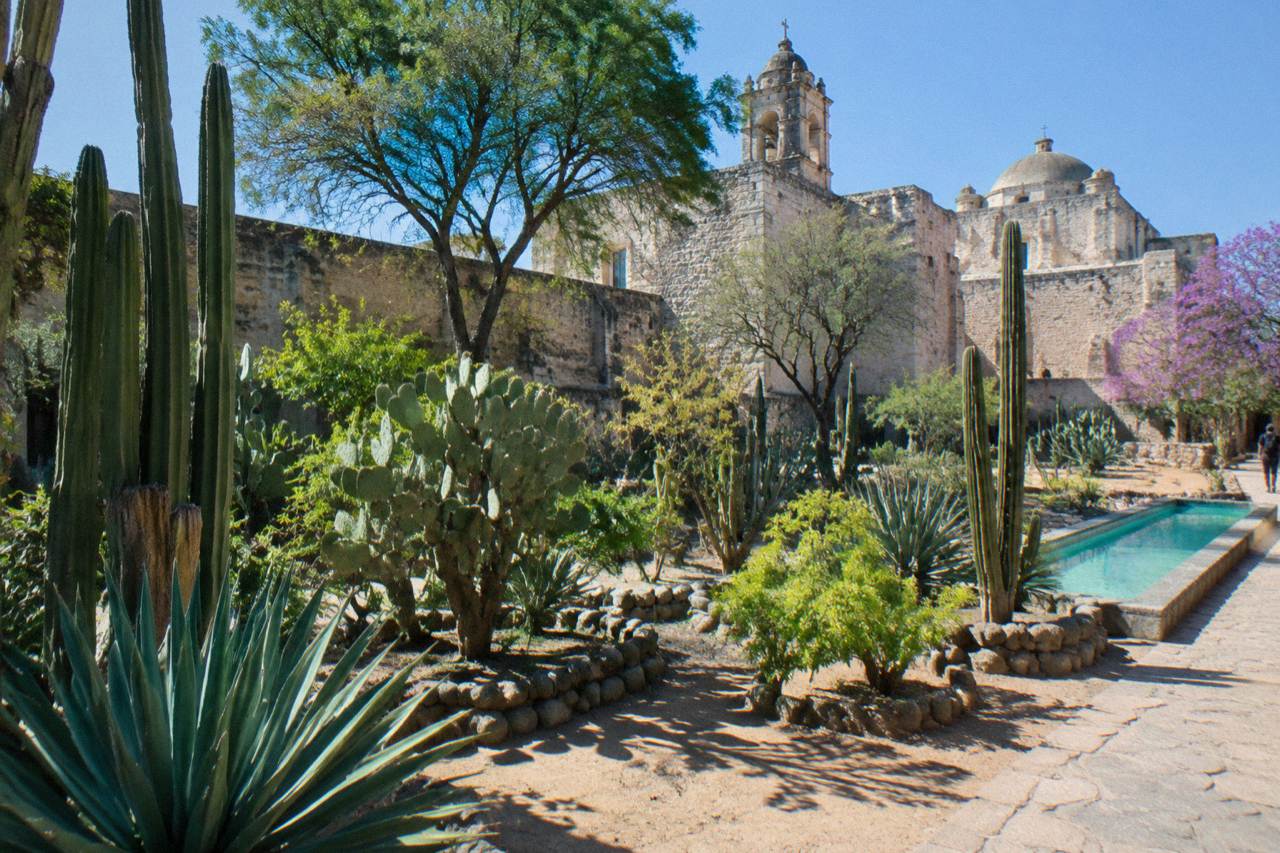
The Jardín Etnobotánico in Oaxaca City offers free guided tours Monday to Friday at 10:30, 11:00, 11:30, 12:00 and 17:00, and Saturday from 10:30 to 12:00, according to a state government release. The garden sits beside Santo Domingo de Guzmán, and large groups book two weeks ahead.
The Jardín Etnobotánico in Oaxaca City occupies the grounds beside the Santo Domingo de Guzmán complex, the monumental church and former convent at the heart of the Centro Histórico, and it works differently from almost every other sight in the city: you see it on a guided tour, the tours are free, and the schedule is fixed. A state government release describing the garden as a living bridge between nature and culture also publishes the tour times, which this page sets out in full.
What Is The Jardín Etnobotánico In Oaxaca?
The Jardín Etnobotánico is a botanical garden on the grounds of the former Santo Domingo de Guzmán convent in Oaxaca City, the inland highland capital of the state of Oaxaca at about 1,550 m, and it is visited through free guided tours rather than open wandering. The state release that publishes the schedule calls it a living bridge between nature and culture, a description that fits its position inside one of the most visited building complexes in the city.
The garden's setting is what makes it unusual. The Santo Domingo complex holds the church itself, the Museo de las Culturas de Oaxaca inside the former convent, and the garden on the convent grounds, all within a few minutes' walk of the Andador Macedonio Alcalá, the pedestrian street that links the complex to the Zócalo. A visit to the garden therefore rarely happens alone: it slots between the church and the museum, or between the museum and a walk down the Andador toward the central square.
The city around it explains the pull. Oaxaca de Juárez is the capital of a state of 4,132,148 people (Censo 2020), and the municipality itself counts 270,955 inhabitants. In 2025 the city recorded 1,324,332 tourist arrivals, with an average stay of 2.00 nights, so a large share of visitors are working with two or three days and a tight Centro Histórico circuit. A garden with fixed free tour times is exactly the kind of sight that rewards a little planning.
When Are The Free Guided Tours Of The Oaxaca Garden?
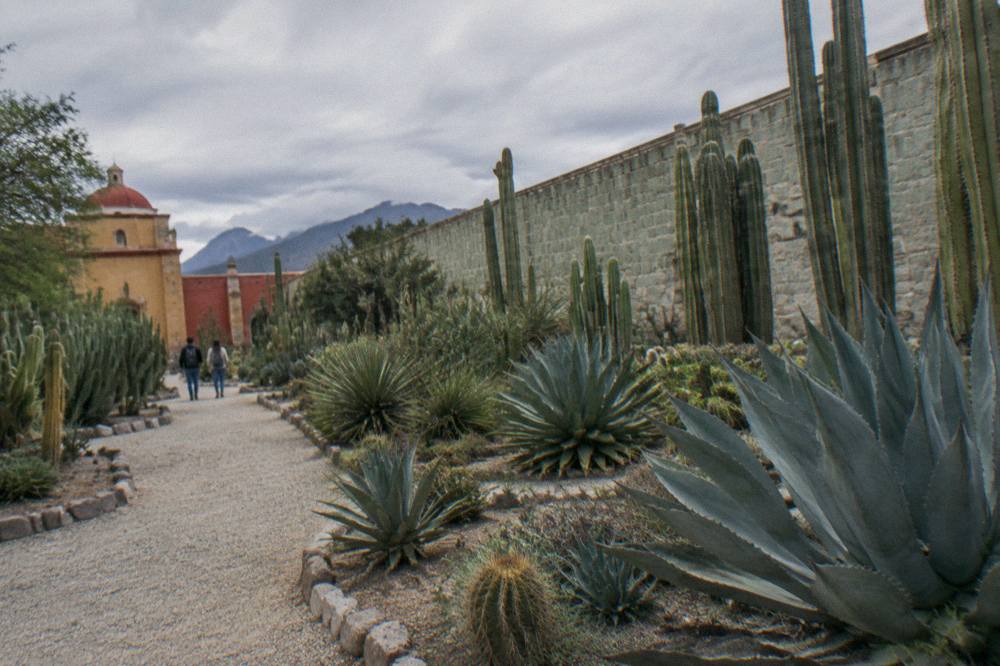
Free guided tours of the Jardín Etnobotánico run Monday to Friday at 10:30, 11:00, 11:30, 12:00 and 17:00, and on Saturday from 10:30 to 12:00, according to the state government release of 18 August 2025. The tours are free of charge, and large groups and school groups must book two weeks ahead. There is no tour slot listed for Sunday in that release.
| Day | Free guided tour times |
|---|---|
| Monday | 10:30, 11:00, 11:30, 12:00, 17:00 |
| Tuesday | 10:30, 11:00, 11:30, 12:00, 17:00 |
| Wednesday | 10:30, 11:00, 11:30, 12:00, 17:00 |
| Thursday | 10:30, 11:00, 11:30, 12:00, 17:00 |
| Friday | 10:30, 11:00, 11:30, 12:00, 17:00 |
| Saturday | 10:30 to 12:00 |
| Sunday | No tour listed |
Two scheduling consequences follow from that table. First, the morning slots cluster between 10:30 and 12:00, which is also when the Museo de las Culturas de Oaxaca is open (10:00 to 16:00, Tuesday to Saturday), so a single morning can hold a museum visit and a garden tour on the same block. Second, the 17:00 weekday slot is the only evening option, which suits a day built around markets or a food tour of Oaxaca earlier on.
The two-week rule for large and school groups matters for anyone travelling as more than a family. If your group is sizeable, the release's own instruction is to reserve two weeks ahead; independent travellers and small parties simply arrive for a listed slot. Since the tours are the published way to see the garden, planning around them is the whole game.
How Do You Reach The Garden From The Zócalo In Oaxaca?
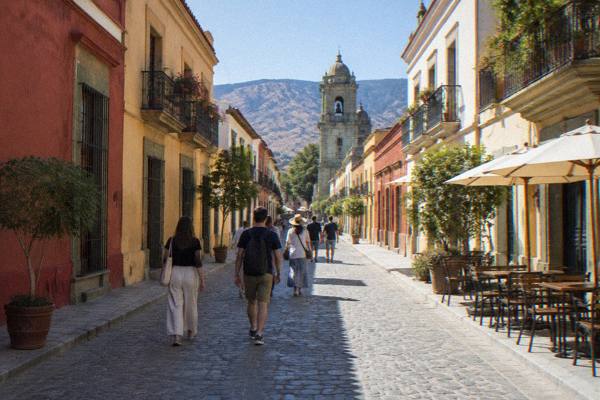
The Jardín Etnobotánico sits on the Santo Domingo block, a short walk up the Andador Macedonio Alcalá from the Zócalo, Oaxaca City's Plaza de la Constitución, in the Centro Histórico, a UNESCO World Heritage property listed as the Historic Centre of Oaxaca and Archaeological Site of Monte Albán. No transport is needed; the whole route is pedestrian street through the historic core.
The walk itself is the standard first stroll in Oaxaca. From the Zócalo you pass the cathedral on one side and the entrance to the Andador on the other, then follow the pedestrian street north past shops and galleries until the Santo Domingo complex opens up. The Basílica de la Soledad sits a few blocks west of the Zócalo and makes an easy detour before or after. Everything in this paragraph is within the Centro Histórico, which is why the question of whether you need a car in the centre answers itself: you do not.
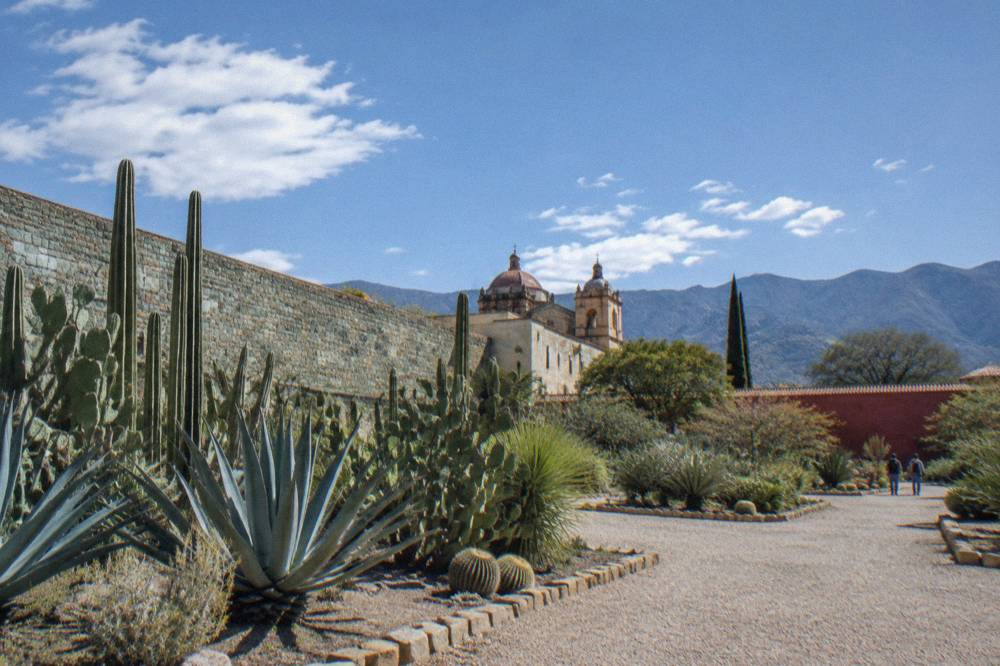
Because the garden, the church and the museum share one block, the practical question is sequencing rather than travel. A pattern that fits the published hours: start at the Zócalo mid-morning, walk the Andador, visit the Museo de las Culturas after its 10:00 opening, and take a garden tour slot from the table above. The museum beside the garden is closed Sunday and Monday, so travellers in the city on those two days lean on the garden and the church alone.
For visitors who want the whole Centro Histórico explained rather than navigated solo, a guided walk is the efficient option, and the site's featured pick for this page is the historic center walking tour with a professional local guide, which covers this district on foot.
What Does A Visit To The Oaxaca Garden Cost?
Entry to the Jardín Etnobotánico is free: the guided tours are published as free of charge by the Oaxaca state government, with no fee listed for individuals or small parties in the release. The only published cost attached to the garden's block belongs to the neighbouring Museo de las Culturas de Oaxaca, an INAH museum charging 105 MXN for Mexican nationals and 210 MXN for foreign visitors. The state lodging tax, 3 percent on hotel-type stays, is a separate charge on accommodation and not on sightseeing.
That makes the garden one of the few fixed-schedule sights in Oaxaca City that costs nothing. The contrast with the INAH archaeological zones is worth seeing side by side:
| Site | Admission, MXN | Hours |
|---|---|---|
| Jardín Etnobotánico (guided tours) | Free | Mon to Fri 10:30, 11:00, 11:30, 12:00, 17:00; Sat 10:30 to 12:00 |
| Museo de las Culturas de Oaxaca (INAH) | 105 nationals / 210 foreigners | Tue to Sat 10:00 to 16:00 |
| Monte Albán (INAH, Category I) | 105 / 210 | Daily 08:00 to 17:00, last access 16:00 |
| Mitla (INAH, Category I) | 105 / 210 | Daily 08:00 to 17:00, last access 16:30 |
| Zaachila (INAH, Category III) | 80 / 145 | Thu to Sun 10:00 to 16:00 |
Note the asymmetries, because they trip people up. Zaachila opens Thursday to Sunday only, the Museo de las Culturas closes Sunday and Monday, and the garden has no Sunday tour listed. A traveller who assumes every Oaxaca sight runs the same weekly calendar will lose at least one of these to a closed door. The full index of guides sits on Oaxaca Travel Guide.
Money in Oaxaca is otherwise simple to plan.
Which Oaxaca Sights Share The Garden's Block Or Its Schedule?
The Jardín Etnobotánico's block holds the Santo Domingo de Guzmán church and the Museo de las Culturas de Oaxaca, and its neighbourhood, the Centro Histórico, also contains the Zócalo, the cathedral, the Andador Macedonio Alcalá, the Basílica de la Soledad, the Museo Textil de Oaxaca and the Rufino Tamayo museum of pre-Hispanic art. All of these sit within walking distance of each other, which is why the Centro fills most first-day itineraries.
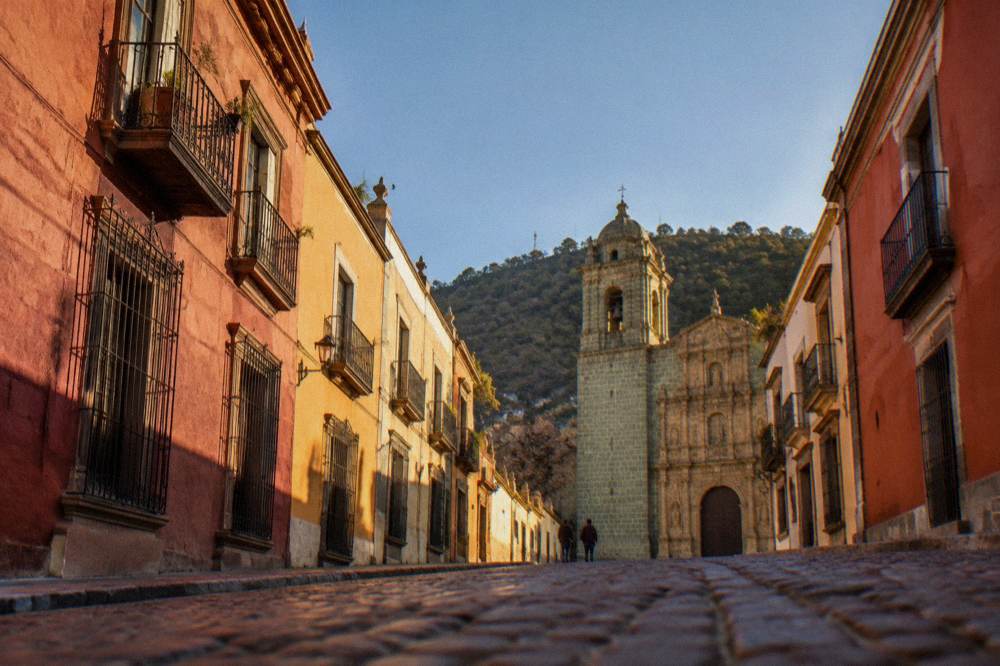
The Santo Domingo church is the anchor of the block and the reason the garden exists where it does, on the old convent grounds. The Museo de las Culturas de Oaxaca fills the former convent itself and is the one sight on the block with a published INAH fee. Beyond the block, the two museums most often paired with it on a culture-heavy day are the textile museum and the Rufino Tamayo museum, the latter reopened in August 2025 after more than three years closed for state-supervised restoration.
A practical way to hold all of this in one view is a walking circuit. The site's one day in Oaxaca itinerary sequences exactly these pieces: Zócalo, cathedral, Andador, Santo Domingo, museum, garden. If your day runs long, the neighbourhoods of Jalatlaco and Xochimilco ring the centre and extend the walk without needing transport.
How Does The Garden Fit A Day Trip From Oaxaca City?
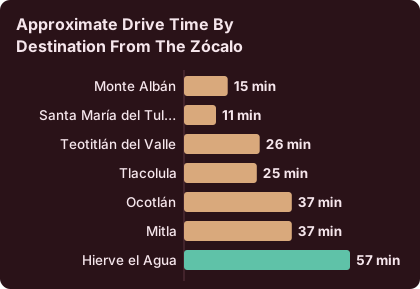
The Jardín Etnobotánico is a city sight, so day trips work the other way around: the garden fills a morning or the 17:00 slot in Oaxaca City, and the valley sites sit beyond it at derived drive times of about 15 minutes to Monte Albán, about 37 minutes to Mitla and about 57 minutes to Hierve el Agua from the Zócalo. Those times are computed from mapped roads and are free-flow estimates; real traffic and mountain roads run slower.
| Destination from the Zócalo | Approximate drive time | Approximate distance |
|---|---|---|
| Monte Albán | About 15 minutes | 8.7 km |
| Santa María del Tule | About 11 minutes | 10.2 km |
| Teotitlán del Valle | About 26 minutes | 29.2 km |
| Tlacolula | About 25 minutes | 31.2 km |
| Ocotlán | About 37 minutes | 32.5 km |
| Mitla | About 37 minutes | 44.6 km |
| Hierve el Agua | About 57 minutes | 67.1 km |
The structure that follows is the one most itineraries use. Keep the Centro Histórico, including the garden, for the city day or days; give the Tlacolula Valley (Tule, Teotitlán del Valle, Mitla, Hierve el Agua) its own full day; and give Monte Albán a half day, since it is about 15 minutes from the centre. The site has full guides to Monte Albán, Mitla, Hierve el Agua and the Tule tree for each of those days.
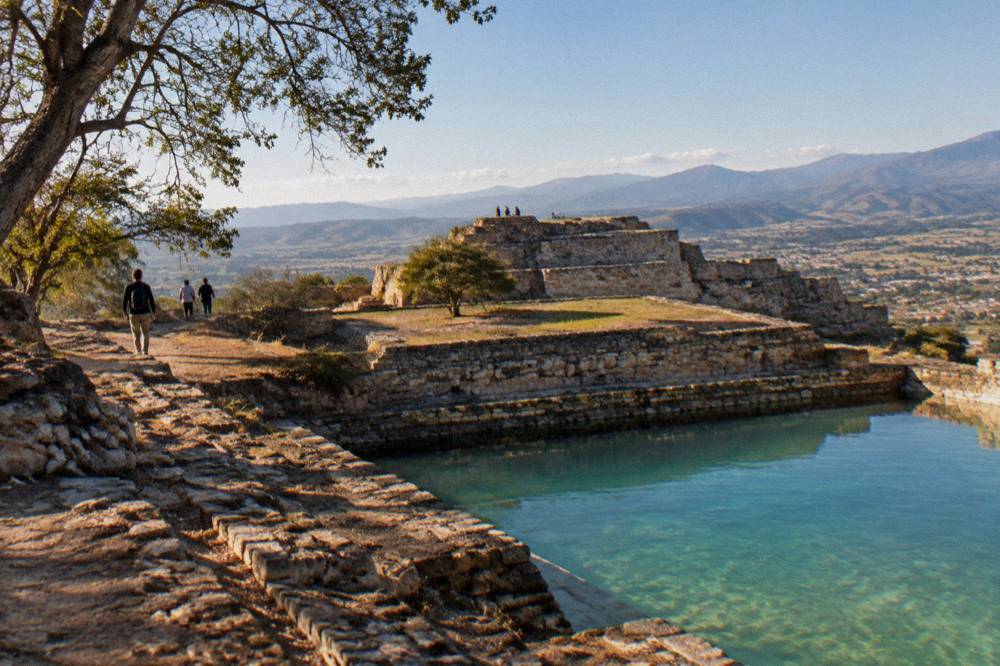
The visitor numbers show where the crowds concentrate. In 2025, Monte Albán recorded 416,675 visitors, of whom 342,962 were national and 73,713 foreign, while Mitla recorded 104,428 and Yagul 10,185. The garden's guided, scheduled format is the opposite model: fixed small slots in a walled city block, which is why the tour timetable rather than the road is the thing to plan around.
For travellers who would rather not arrange valley transport themselves, a valley day trip from the city covers Hierve el Agua, Mitla, the Tule tree and craft stops in one loop, and a Monte Albán tour handles the ruins half day the same way. Both leave the city-centre day, garden included, free for walking.
What Is The Best Time Of Day And Year For The Oaxaca Garden?
The published schedule answers the time of day directly: weekday slots run at 10:30, 11:00, 11:30, 12:00 and 17:00 and Saturday slots from 10:30 to 12:00, so mornings offer the most choice and the 17:00 weekday tour is the only evening option. For the time of year, the climate table matters more than any ranking: Oaxaca's dry season runs November to April and the rainy season May to October, with June averaging 188.3 mm of rain and January 2.4 mm.
The monthly normals from the SMN station in the city, 1991 to 2020, give the full picture:
| Month | Mean high C | Mean low C | Rain mm |
|---|---|---|---|
| January | 28.9 | 10.3 | 2.4 |
| February | 31.1 | 11.6 | 4.6 |
| March | 33.3 | 13.6 | 17.6 |
| April | 34.9 | 15.8 | 47.3 |
| May | 33.8 | 16.7 | 97.9 |
| June | 30.9 | 16.7 | 188.3 |
| July | 30.1 | 15.9 | 118.6 |
| August | 30.0 | 15.9 | 131.8 |
| September | 29.1 | 16.1 | 163.6 |
| October | 29.3 | 14.5 | 63.1 |
| November | 29.0 | 12.3 | 9.1 |
| December | 28.9 | 11.0 | 9.0 |
Two practical readings follow. April has a mean daily high of 34.9 C, so a garden tour in the earlier morning slots suits that month, and the 17:00 slot exists only on weekdays, not Saturdays. In the rainy season, afternoon rain is the pattern the table shows (September averages 163.6 mm across 21.4 days with rain), which again favours the morning slots for an unsheltered garden walk.
Oaxaca keeps UTC-6 all year, since Mexico abolished seasonal clock changes in a law published in October 2022, so the tour times need no daylight-saving adjustment in any month.
Can You Visit The Garden On An Oaxaca Tour?
Yes, the garden sits inside the standard historic-centre walking territory of Oaxaca City, and guided walking products cover the district that contains it. The historic center walking tour with a professional local guide covers the streets between the Zócalo and Santo Domingo, and a street-art walk led by a working artist adds Jalatlaco, though the garden's own free tours remain the published way to see the garden itself. Booking a paid walking tour of the Centro and arriving independently for a free garden slot are compatible plans, not competing ones.
The site's featured walk for this page, the historic center walking tour with a professional local guide, is the natural fit, covering the streets between the Zócalo and Santo Domingo. If you want the same block plus a deeper dive into the surrounding neighbourhoods, the street-art walk led by a working artist covers the mural side of the centre and Jalatlaco.
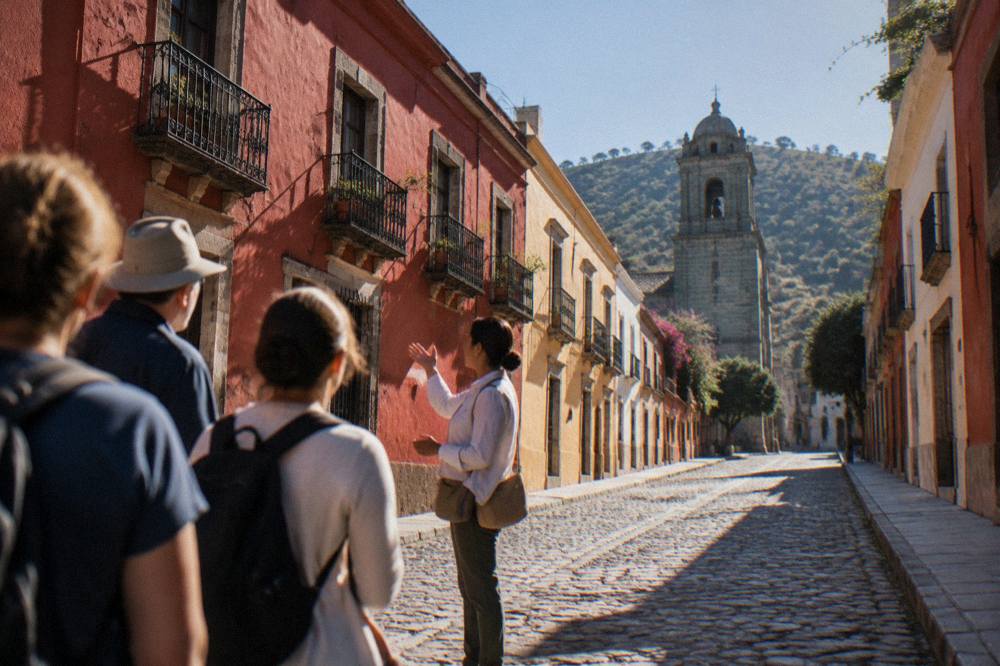
Two other formats pair well around a garden visit. A private car-and-driver day reaches craft towns and valley sites that walking tours never touch, with master artisan stops. And a cooking class with market visit turns the morning market walk into a meal. You can compare the walking tour with the alternatives before committing: Check availability on the operator's booking page.
What Else Should You Know Before Visiting The Oaxaca Garden?
Three things carry the planning weight: the tour schedule is fixed and free, the neighbouring Museo de las Culturas closes Sunday and Monday while the garden lists no Sunday tour at all, and large or school groups must reserve two weeks ahead. Everything else about the visit is ordinary Centro Histórico logistics on foot.
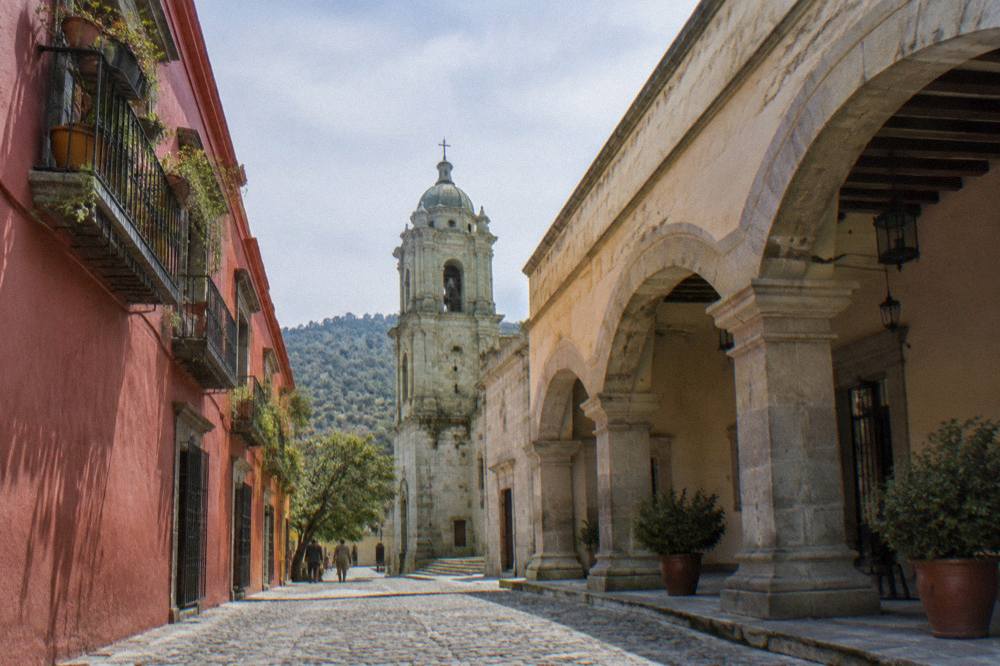
Beyond the block, the garden fits neatly into the bigger Oaxaca picture. The city's 2025 arrivals of 1,324,332 came with an average stay of 2.00 nights, which is short, and the things to do in Oaxaca overview exists precisely for that constraint. If your stay stretches past two nights, the markets deserve the time the garden cannot absorb on its own: the Mercado Benito Juárez and the Mercado 20 de Noviembre both sit south of the Zócalo, minutes from the Andador route you will already be walking.
Food is the other natural pairing. A cooking class with a market visit turns a Centro morning into a full plate, and the class the site rates highest on this theme is Grandma's Recipes, where the whole menu is prepared and eaten.
Common Questions About The Jardín Etnobotánico
Is The Jardín Etnobotánico In Oaxaca Free?
Yes. The guided tours are published as free of charge by the Oaxaca state government. Large and school groups must book two weeks ahead.
When Are The Jardín Etnobotánico Tours?
Free guided tours run Monday to Friday at 10:30, 11:00, 11:30, 12:00 and 17:00, and Saturday from 10:30 to 12:00. No Sunday tour is listed in the state release.
Where Is The Jardín Etnobotánico?
In Oaxaca City, on the grounds of the former Santo Domingo de Guzmán convent in the Centro Histórico, at the top of the Andador Macedonio Alcalá, a short walk from the Zócalo.
Can You Walk Around The Garden Without A Tour?
The published way to see the garden is the guided tour: the state schedule lists guided slots only, and the release is the description of how visits work. Arrive for one of the listed times.
Is The Museo De Las Culturas De Oaxaca Open The Same Days?
No. The museum is open Tuesday to Saturday from 10:00 to 16:00 and is closed Sunday and Monday. Its INAH admission is 105 MXN for nationals and 210 MXN for foreign visitors.
How Long Should I Plan For The Santo Domingo Block?
Plan a morning: the museum opens at 10:00, the garden's tour slots cluster between 10:30 and 12:00, and the church sits between them on the same block, all walkable from the Zócalo.
The Jardín Etnobotánico rewards the traveller who reads a timetable: a free, fixed-schedule tour beside one of Mexico's grandest church complexes, wrapped in a walkable Centro Histórico that fills the rest of any day in Oaxaca City.