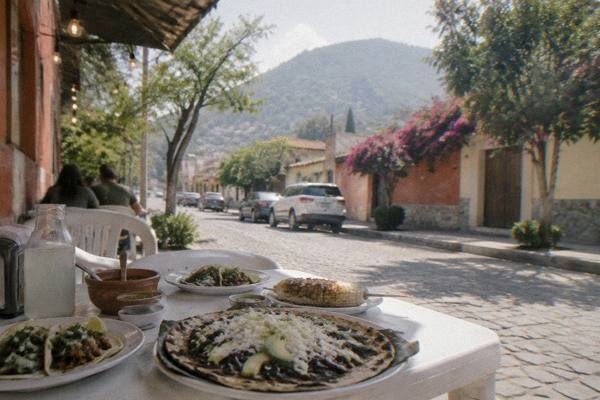
Street Food In Oaxaca: Tacos, Memelas And Chapulines
Oaxaca City eats in the street as much as in its restaurants: tacos at dusk, memelas off the comal, chapulines by the scoop, tejate by the cup. This guide maps the dishes, the market zones, the drinks and the practical questions around eating street food in the capital of the state of Oaxaca.
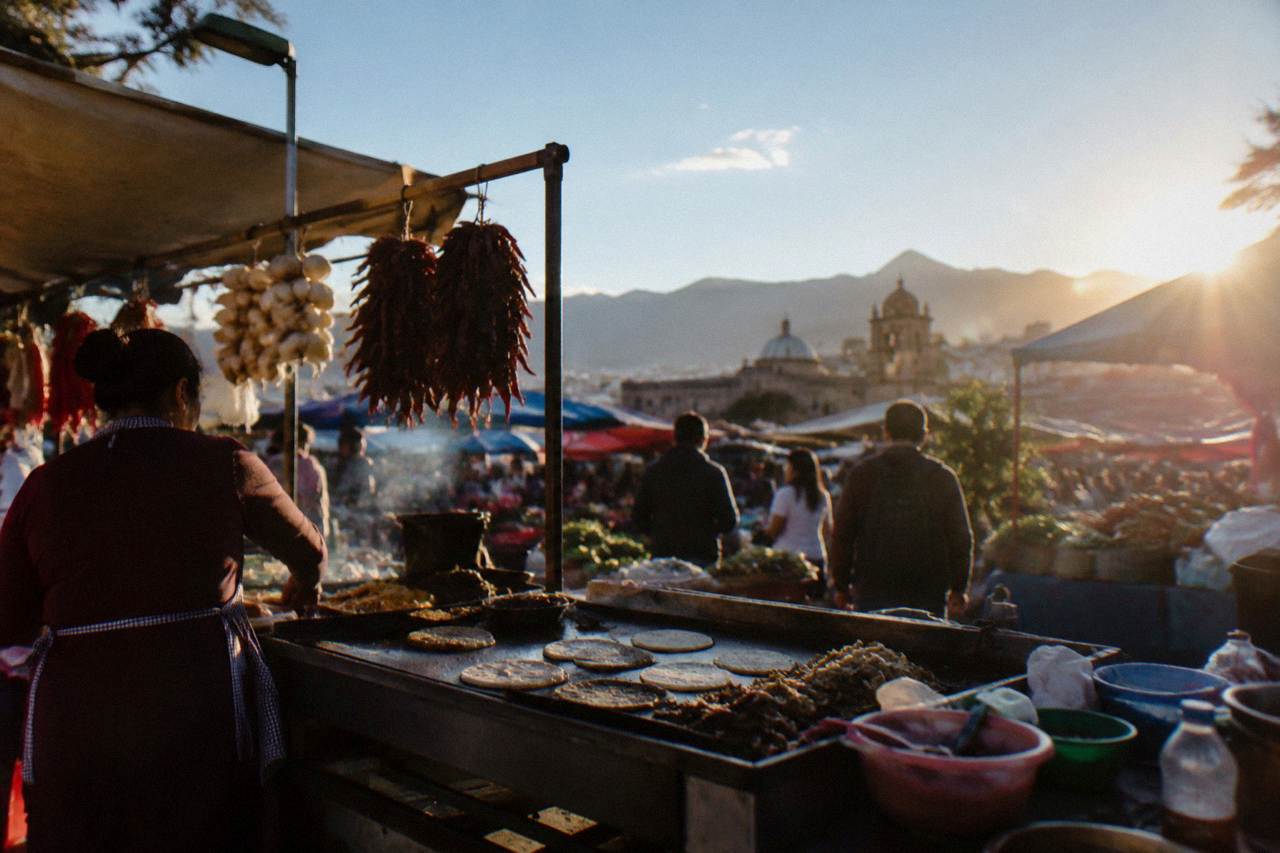
Prices are in pesos, the city sits inland at about 1,550 m, and no official price list or market opening hours are published, so this guide focuses on what the dishes are and where they concentrate.
Oaxaca City, the inland highland capital of the state of Oaxaca in Mexico, is a place where a serious amount of eating happens standing up. The street food scene runs through the markets of the historic centre, the blocks south of the Zócalo, and the weekly flow of valley towns around the city, and it is built on a short list of dishes repeated with endless variation: tacos, memelas, tlayudas, empanadas de amarillo, and chapulines, the grasshoppers sold by the scoop. The dishes, the neighbourhoods where the action concentrates, the drinks served alongside it, and the calendar that shapes the scene are covered below. Deeper reading on the wider table sits in what to eat in Oaxaca, and the shortest answer to the headline question is in the site's best street food in Oaxaca answer page.
Where To Eat Street Food In Oaxaca: The Central Zones
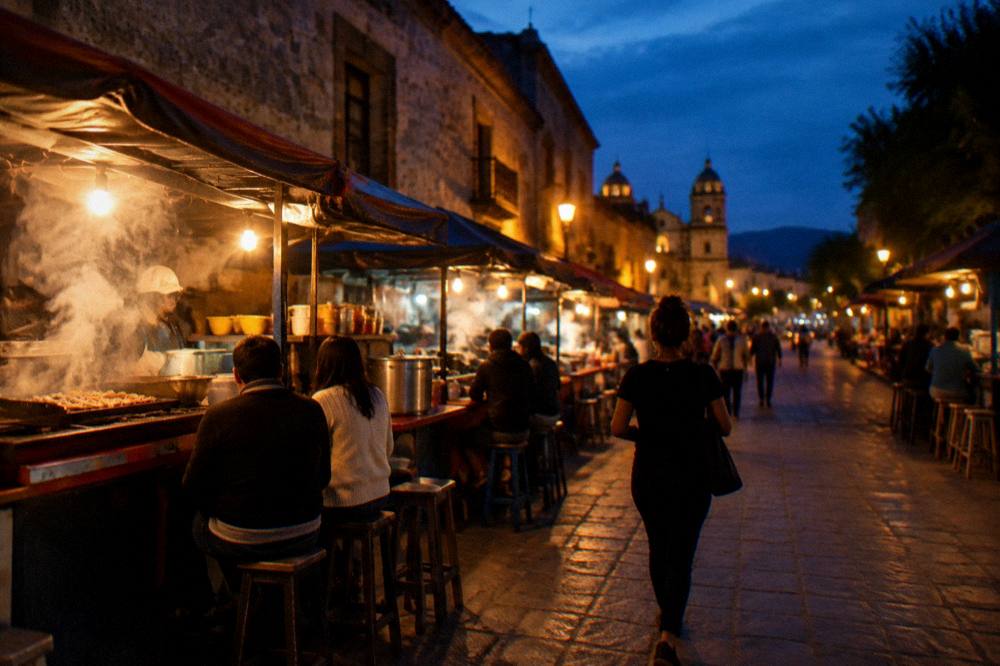
Street food in Oaxaca City concentrates in three central zones: the market block formed by Mercado 20 de Noviembre and Mercado Benito Juárez just south of the Zócalo, the walking streets around the Andador Macedonio Alcalá, and the evening stall scenes of the neighbourhoods ringing the centre, above all Jalatlaco. Each zone has its own rhythm, with the markets at their busiest in the middle of the day and the street carts and griddles taking over after dark.
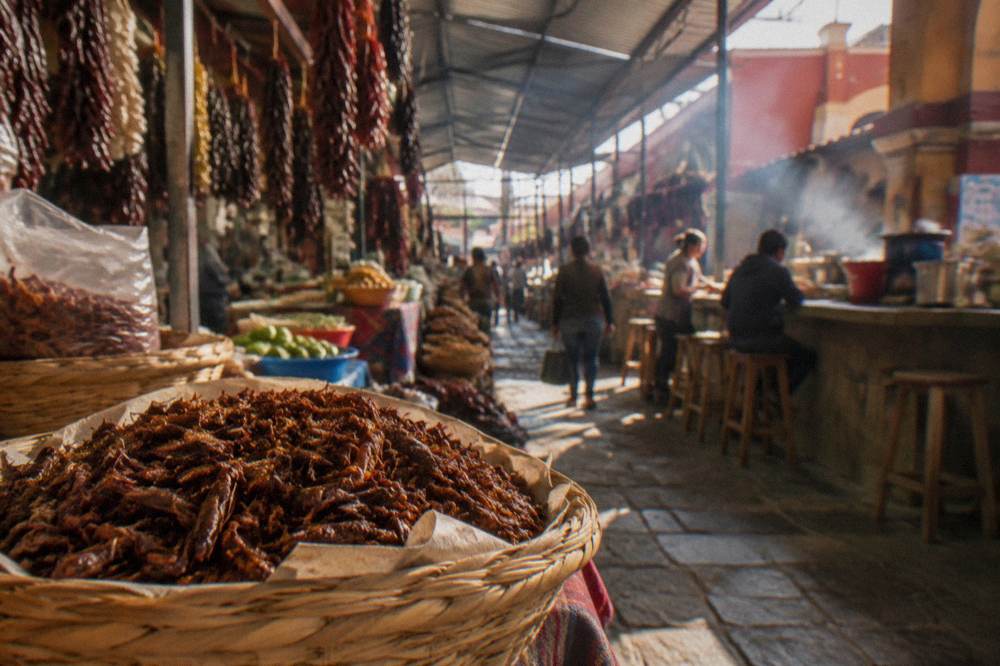
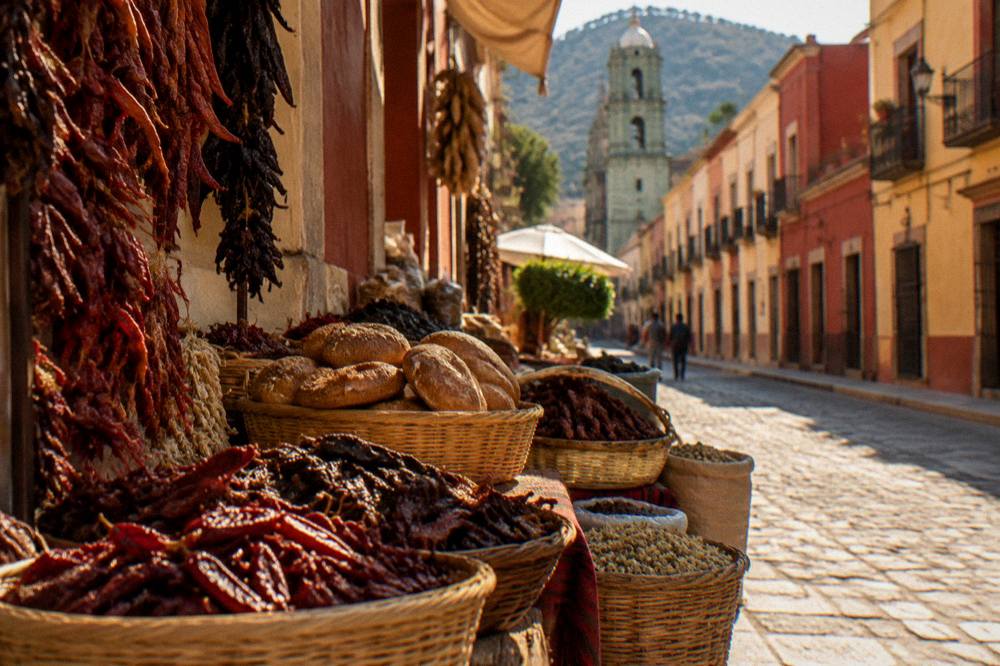
The Mercado 20 de Noviembre is the food heart of that first zone. State government pages record its founding in 1893 and its role as a key food market, with tianguis stalls appearing on Saturdays, though no official current opening hours are published. Inside and around it, the smoke and the comal griddles define the experience: this is where memelas, quesadillas with quesillo, and grilled meats are prepared in front of you. The Benito Juárez market sits a block away and carries the ingredient side of the same food culture, chillies, chocolate, bread and cheese, alongside its own eating stalls.
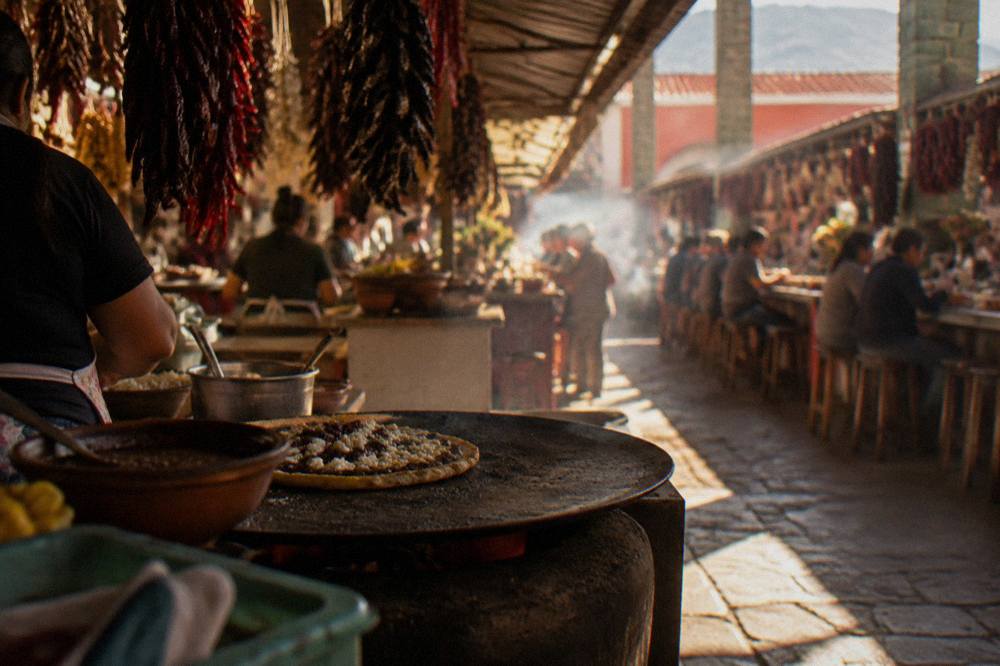
The second zone is the pedestrian spine of the centre. The Andador Macedonio Alcalá runs from the Zócalo toward Santo Domingo de Guzmán, and its edges and side streets carry the daytime trade: nieves, tamales, and the small carts that appear around the Zócalo itself. The historic centre of Oaxaca and the archaeological site of Monte Albán together form UNESCO World Heritage property 15, listed as "Historic Centre of Oaxaca and Archaeological Site of Monte Albán", which is the formal reason this compact grid of food streets stays protected.
The third zone is the neighbourhoods. Jalatlaco, Xochimilco and the streets south of the centre toward the Abastos area each have their own evening scenes, from tlayuda stands to late-night taco carts. The site's neighbourhood guide covers the character of each barrio; for eating purposes, the pattern is simple: the closer to the Zócalo, the earlier things close; the deeper into the barrios, the later the griddles run.
What Are The Essential Street Dishes In Oaxaca?
The essential street dishes of Oaxaca City are tacos, memelas, tlayudas, empanadas de amarillo, quesadillas filled with quesillo, chapulines, tejate and nieves. A memela is a small oval of griddled masa with asiento and bean paste, while a tlayuda is the large crisp tortilla finished with tasajo, chorizo or cecina, and chapulines are toasted grasshoppers with chilli and lime, eaten as a snack or filling. A memela is a small oval of masa, thicker than a tortilla, topped and griddled; a tlayuda is the large crisp tortilla spread with asiento and beans and finished with meat and quesillo; chapulines are toasted grasshoppers seasoned with chilli and lime, eaten as a snack or folded into other dishes.
The table below is the short list. Costs are in pesos and set stall by stall.
| Dish | What It Is |
|---|---|
| Tacos | Small tortillas filled from the stall's选项, most often grilled or braised meats, topped with salsa and onion |
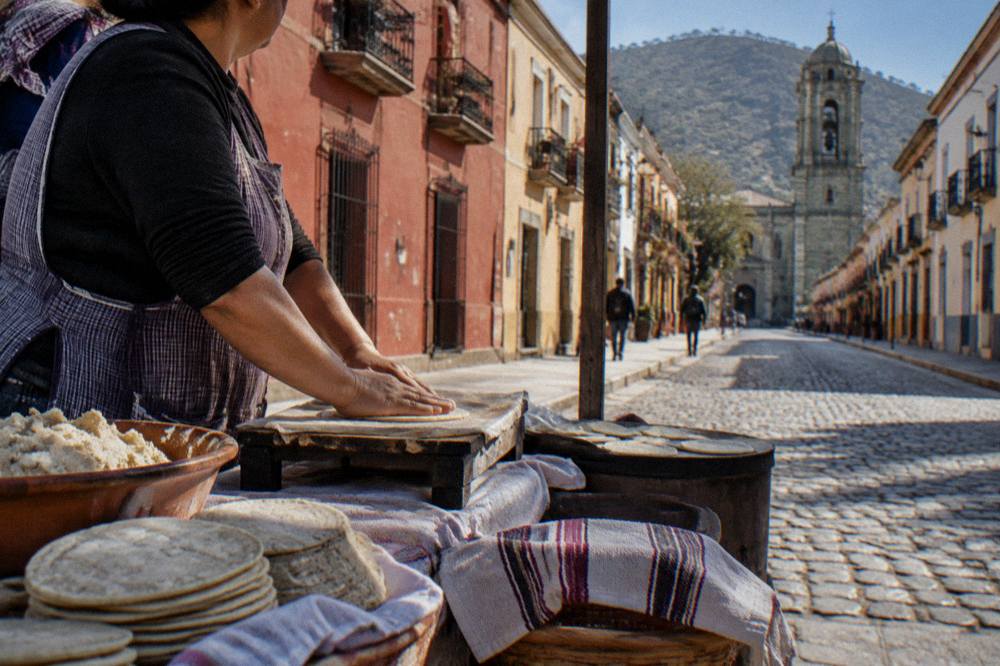
| Memelas | Oval masa base, griddled on a comal, spread with asiento and bean paste, finished with toppings |
| Tlayudas | Large crisp tortilla with asiento, black bean spread, quesillo and tasajo, chorizo or cecina |
| Quesadillas | Folded tortillas filled with quesillo, the stringy Oaxacan cheese, and other fillings |
| Empanadas de amarillo | Masa turnovers filled with the yellow mole of the valleys |
| Chapulines | Toasted grasshoppers with chilli and lime, sold by the scoop and used as a filling or snack |
| Tejate | A cold, pre-Hispanic maize and cacao drink, served from basins by market vendors |
| Nieves | Hand-churned ices in fruit and milk flavours, sold around the Zócalo and Alcalá |
Note the deliberate error of honesty in the taco row: this site does not rank stalls or name a single best taquería, because such a ranking does not exist. The what food is Oaxaca famous for answer page expands on the restaurant side of the same canon, including the seven moles that rarely appear at street stalls but define the city's table.
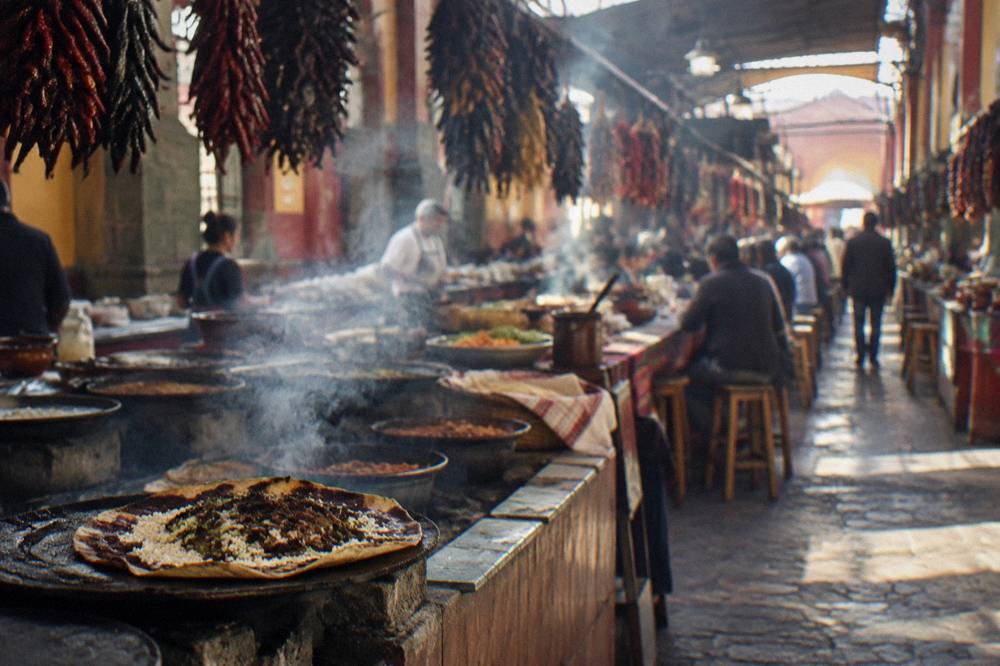
Vegetarians are unusually well served for a street food culture built around meat. Memelas and quesadillas skip meat without losing anything structural, quesillo is the anchor, and the site's vegetarian and vegan food in Oaxaca guide details the plant-based side, including the markets where vegetable-forward fillings dominate. A dedicated vegetarian cooking class with a market visit also runs from the city and appears in the tour blocks below.
Tacos, Memelas And Chapulines: What To Order First In Oaxaca
Order a memela first, because it is the dish that shows the comal technique most clearly; follow it with tacos from a specialist stall; and treat chapulines as a snack or a filling rather than a dish on their own. The order matters less than the specialisation: in Oaxaca a stall usually does one thing, and the longest queue is generally the most reliable signal of which stall does it well.
Chapulines deserve their own paragraph because they are the dish visitors ask about most. They are grasshoppers, toasted on a comal with chilli and lime, and they appear three ways: by the scoop as a snack, scattered into a quesadilla, or folded into tacos. They are seasonal in the sense that harvests vary, and this page states no specific seasonality dates. What can be said is that they are ordinary food here, sold in market stalls alongside chillies and dried shrimp, not a dare or a novelty.
The taco layer of the scene is where the regional meats appear: tasajo, cecina and chorizo are the classic trio that also tops tlayudas, and stalls around the markets grill them in view. Salsas run from dry chilli blends to simple fresh choppers, and the standing advice is universal street-food advice: watch the salsa being used by locals, and start milder than you think you need. For a reader who wants the stalls decoded in company, the evening street food tour with 14 tastings is the site's featured pick for this subject, and its block sits below.
A word on how this page handles "best". The bare superlative is banned from this site's product copy for anything that lacks checking, and the same discipline applies to stalls. The what to eat in Oaxaca guide works the same way: dishes and zones yes, unverifiable rankings no.
Which Markets Anchor Street Food In Oaxaca?
Three markets anchor the street food scene of Oaxaca City: Mercado 20 de Noviembre for cooked food, Mercado Benito Juárez for ingredients and smaller stalls, and the Mercado de Abastos for the wholesale-scale Saturday experience, with the valley's weekly town markets ringing the city across the week. The city markets run daily; the town markets run on their own weekly day, and no official current hours are published for any of them.
The core is the two central markets. State pages record 20 de Noviembre's 1893 founding and its Saturday tianguis extension; the Benito Juárez market is described in the same state material as a historic central market near the Zócalo. Around them sits the street itself: the tamal carts of the early morning, the nieves vendors of the afternoon, and the evening griddles. The south of centro and mercados guide maps that walk in detail.
| Market | Role In The Food Scene | Detail |
|---|---|---|
| Mercado 20 de Noviembre | Cooked food, griddle stalls, smoke hall | Founded 1893; Saturday tianguis extension (state government) |
| Mercado Benito Juárez | Ingredients, chocolate, cheese, smaller eating stalls | Historic central market near the Zócalo (state government) |
| Mercado de Abastos | Wholesale scale, Saturday focus | Serving the capital and nearby towns since 1978 (state government) |
| Valley town markets | Weekly market days in the towns around the city | Days vary by town; no official hours published |
The valley towns are the deep end. Tlacolula, Ocotlán, Etla and Zaachila each hold a weekly market, and those days are common knowledge in the region, but no official statement of them is at hand, so the table above stops short of naming days. What can be said is the drive time from the Zócalo: Tlacolula about 25 minutes, Ocotlán about 37 minutes, derived from mapping on OSM roads, with real traffic slower. The Tlacolula Sunday market and Ocotlán and Friday market guides carry the detail; Zaachila's own INAH archaeological zone opens Thursday to Sunday, 10:00 to 16:00, which pairs the town's market day question with its ruins.
What To Drink With Street Food In Oaxaca?
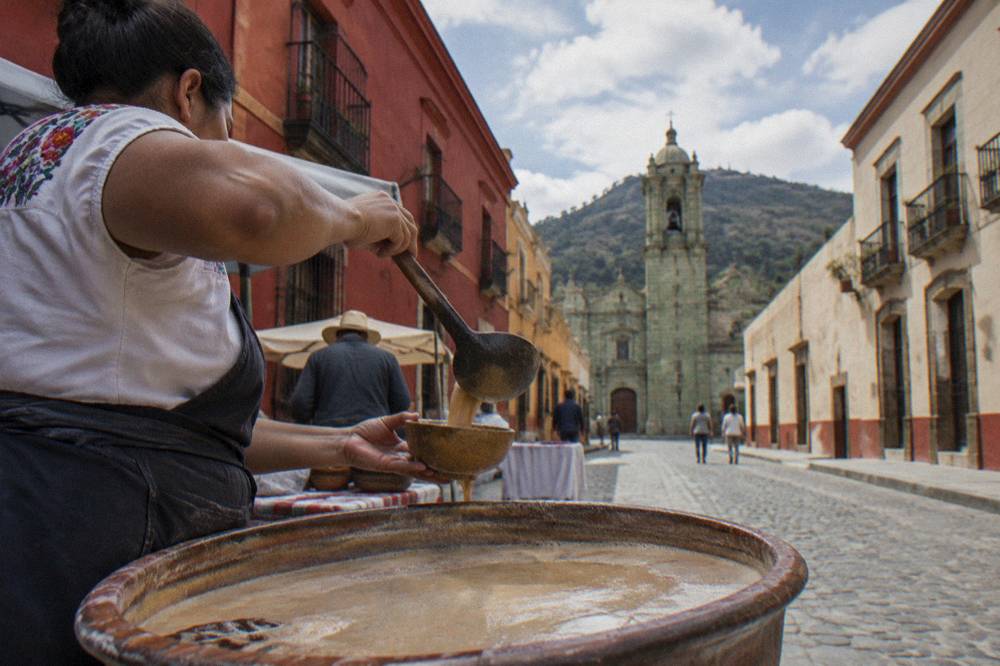
The street drinks of Oaxaca City are tejate, a cold drink of maize and cacao served from basins by market vendors, Oaxacan chocolate drunk hot, fresh waters (aguas frescas) such as horchata and jamaica, and mezcal, with coffee a close fifth thanks to the city's serious café culture. Tejate and chocolate are the two that belong specifically to the street and market scene; mezcal belongs to the tasting rooms but also rides along with food in the evenings.
Tejate is the signature: a cold drink of maize and cacao, prepared by hand and served from basins by market vendors, with the city's state-run museum and tourism material treating it as part of the region's living food identity. Oaxacan chocolate is drunk hot, whisked and often sweetened, and the markets sell it in blocks alongside the mills that grind it. Aguas frescas, horchata, jamaica and seasonal fruit waters, appear at nearly every cooked-food stall. The Oaxacan chocolate and Oaxaca coffee and cafés guides expand both.
| Drink | Where You Find It | Notes |
|---|---|---|
| Tejate | Market vendors, served cold from basins | A named regional drink in the state's own food material |
| Oaxacan chocolate | Markets and cafés, drunk hot | Sold in blocks; the markets carry dedicated mills |
| Aguas frescas | Cooked-food stalls | Flavours rotate with fruit availability |
| Mezcal | Tasting rooms, evening tours | Santiago Matatlán is described by the state as the world capital of mezcal |
| Coffee | City cafés | A distinct café scene; see the site's coffee guide |
Mezcal deserves a flag. Street stalls are not the place to learn mezcal; the tasting rooms of the centre and the palenques of Santiago Matatlán are, and the state government repeatedly describes Matatlán as the "Capital Mundial del Mezcal". Palenque visit prices and schedules are in the mezcal route guide, which handles the subject properly, and the mezcal in Oaxaca page covers the drink itself.
Is Street Food In Oaxaca Safe To Eat?
Street food in Oaxaca City carries the same risk profile as street food anywhere in Mexico: hot, freshly griddled food from busy stalls is the low-risk end, and the standard advice from every government health service is to favour stalls with high turnover and food cooked in front of you. No official Oaxaca-specific street food safety assessment exists, so this section stays at the level of what the advisories actually say, plus one Oaxaca-specific note on water.
The water note matters. This site's material carries no official statement on tap water safety in Oaxaca, and the dedicated drinking water in Oaxaca page explains exactly why the answer is written the way it is. In practice for street food: hot food off a comal is cooked; cold drinks made with water, including some aguas and ices, are where caution lives. Ice and washed produce are the two variables no guide can certify from here. The wider set of guides lives on Oaxaca Travel Guide.
On the wider safety picture, the advisories are calmer than the headlines suggest. The UK FCDO advises against all but essential travel to parts of Mexico and does not name Oaxaca on its main page; Canada advises a high degree of caution for Mexico overall with regional advisories; the US State Department lists Oaxaca state at Level 2, exercise increased caution, with no restrictions on US government staff for Oaxaca City itself. Road blockades by teachers' unions are a standing risk that can disrupt road and airport access, undated here because they are sporadic. The full picture is in is Oaxaca safe.
How Do The Seasons Change Street Food In Oaxaca?
The seasons change street food in Oaxaca mainly through the rain: the dry season runs November to April with under 20 mm of rain a month from November to March, and the rainy season runs May to October with a peak from June to September, when June averages 188.3 mm. Street eating continues year-round, but the evening stall scenes contract in the wet months and expand across the dry ones, and the festival calendar stacks food events into specific weeks.
The climate figures come from the SMN station normals for Oaxaca (station 20079, normals 1991-2020), the station record at 1,594 m in a city written here at about 1,550 m. There is no winter cold to plan around: December and January average lows of 11.0 and 10.3 degrees, and April's average high of 34.9 degrees is the figure the table below shows without ranking it.
| Month | Average High C | Average Low C | Rain Mm | Rain Days |
|---|---|---|---|---|
| January | 28.9 | 10.3 | 2.4 | 1.4 |
| February | 31.1 | 11.6 | 4.6 | 1.1 |
| March | 33.3 | 13.6 | 17.6 | 4.1 |
| April | 34.9 | 15.8 | 47.3 | 7.6 |
| May | 33.8 | 16.7 | 97.9 | 13.7 |
| June | 30.9 | 16.7 | 188.3 | 19.9 |
| July | 30.1 | 15.9 | 118.6 | 20.4 |
| August | 30.0 | 15.9 | 131.8 | 20.5 |
| September | 29.1 | 16.1 | 163.6 | 21.4 |
| October | 29.3 | 14.5 | 63.1 | 12.0 |
| November | 29.0 | 12.3 | 9.1 | 3.5 |
| December | 28.9 | 11.0 | 9.0 | 2.4 |
The food calendar rides on top of that. The Guelaguetza takes over July, with Lunes del Cerro performances in 2026 held on 20 and 27 July at the Auditorio Guelaguetza on the Cerro del Fortín, paid seats at 1,632 and 1,321 pesos, and free sections C and D; the Feria del Mezcal ran alongside it, reported at 17 to 28 July at the CCCO in Santa Lucía del Camino with entry of about 80 pesos. Día de Muertos centres on 31 October to 2 November by tradition, with pan de muerto and mole at the centre of the table; the 2026 programme has not been announced, so only the standing pattern is stated here. Noche de Rábanos keeps its 23 December tradition, and the 2026 edition is likewise unannounced. The Día de Muertos, Guelaguetza and Noche de Rábanos guides carry each in full.
How Do Tours And Walks Fit Around Street Food In Oaxaca?
Tours fit around street food in Oaxaca in three shapes: a guided food-and-market walk through the centre, a cooking class that begins in a market, and an evening street food walk led by a local, with each shape covering ground that is hard to decode alone on a first visit. This page's featured pick is the evening street food walk with 14 tastings.
Walking tours are the natural companion because the centre is compact and walkable. The site's Oaxaca walking tour guide covers the historic centre routes, and the Oaxaca food tour page carries the marketplace walk option. For readers who want to move between eating, a bike ride to the Tule tree east of the city pairs a food morning with a valley ride, and the blocks below carry both that option and a Sierra Norte hike for the appetite side of the equation.
The pairing logic is simple. A street food evening walk covers the centro's stalls; a market-focused morning covers the ingredient layer; a cooking class converts the market into a meal; and the valley day trips, Tule, Teotitlán del Valle, Mitla and Hierve el Agua, add the town-market layer. Drive times from the Zócalo are about 11 minutes to Santa María del Tule, about 26 to Teotitlán del Valle and about 37 to Mitla, all derived figures, with mountain roads slower in practice. The Hierve el Agua day trip and Mitla and Tlacolula day trip guides carry those routes.
How Many Days Do You Need For Street Food In Oaxaca?
Two full days cover the core street food of Oaxaca City, one for the market-and-centre layer and one for an evening stall walk, while four to five days let you add a valley market town, a cooking class and a mezcal tasting without rushing. The state's own tourism data puts the average stay at exactly 2.00 nights, so the two-day pattern is what the numbers show visitors actually do.
The itinerary logic is straightforward. Day one: 20 de Noviembre and Benito Juárez at midday, the Alcalá and Zócalo stalls in the afternoon, an evening walk through Jalatlaco. Day two: a market morning with a cooking class, or a valley trip to Tlacolula or Teotitlán del Valle. Beyond that, the site's Oaxaca in 2 days and Oaxaca in 3 days guides sequence the full city, and how many days in Oaxaca answers the question in detail. Budget planning belongs to the Oaxaca travel costs and budget guide, which is honest about which costs are published and which are not.
Two practical notes close the planning picture. First, the state lodging tax is 3 percent on hotel-type stays, 5 percent where an intermediary platform applies it, per the state fiscal law updated in December 2025. Second, transport around the food zones is mostly on foot; the getting around Oaxaca and taxis, Uber and DiDi in Oaxaca guides cover the rest.
Practical Facts For Eating Your Way Through Oaxaca
The practical base for a street food trip to Oaxaca City: an inland city at about 1,550 m in the Valles Centrales, UTC-6 all year with no daylight saving since 2022, pesos for every stall purchase, and a dry season from November to April that is the calendar backbone of a food-focused visit. The table gathers the numbers a food traveller actually uses.
| Fact | Figure | Note |
|---|---|---|
| Elevation | About 1,550 m | Inland highland city, no sea |
| Timezone | UTC-6 all year | DST abolished in 2022 |
| Currency | MXN pesos at stalls | Tour prices are shown in US dollars |
| 2025 city arrivals | 1,324,332 | 212,533 foreign; state tourism report |
| Average stay | 2.00 nights | Same report |
| Lodging tax | 3 percent | 5 percent for intermediary platforms |
| Dry season | November to April | SMN station normals 1991-2020 |
| Rainy season | May to October | Peak June to September |
Getting there and sleeping are covered in depth elsewhere on the site: flights to Oaxaca, Oaxaca airport, Mexico City to Oaxaca, ADO bus to Oaxaca, where to stay in Oaxaca and best hotels in Oaxaca. For readers weighing Oaxaca against another food city, the Oaxaca vs Puebla comparison is the closest like-for-like, and the wider set of things to do in Oaxaca sits at the root of the site.
For the food-focused visitor who wants the stalls decoded rather than discovered blind, the evening street food walk with 14 tastings remains the featured pick, and you can Check availability on the operator's booking page.
Common Questions About Street Food In Oaxaca
What Is The Most Famous Street Food In Oaxaca?
Memelas, tlayudas and chapulines are the three dishes most associated with Oaxaca's street stalls, alongside tacos and quesadillas filled with quesillo. The full dish-by-dish list, with no invented prices or rankings, is in the tables above.
Are Chapulines Safe To Eat?
Chapulines are toasted on a comal with chilli and lime and sold as ordinary market food in Oaxaca. They carry the same considerations as any street food: fresh, hot and busy is the pattern every health service recommends.
What Should Vegetarians Order From Oaxaca Street Stalls?
Memelas and quesadillas with quesillo, empanadas de amarillo and vegetable tamales are the core vegetarian options. The site's vegetarian and vegan food in Oaxaca guide covers the full plant-based picture, and a vegetarian cooking class with a market visit runs from the city.
Is Oaxaca Street Food Expensive?
Street food in Oaxaca is priced in pesos and set stall by stall, and no official price list exists, so this site prints no figures. For the honest state of cost data for the whole trip, see the Oaxaca travel costs and budget guide.
When Is The Best Time Of Year For Street Food In Oaxaca?
The dry season, November to April, is when the evening stall scenes run at full scale; the rainy season from May to October peaks June to September, with June averaging 188.3 mm of rain. Festival weeks, Guelaguetza in July and Día de Muertos around 31 October to 2 November, stack food events onto the calendar.
Can You Explore Oaxaca Street Food Without Spanish?
Yes, pointing and the dish names in this guide carry most transactions, since stalls display their food openly. A guided evening walk adds translation and context, and the featured tour's live listing carries its current price and availability.