Oaxaca Coffee And Cafés
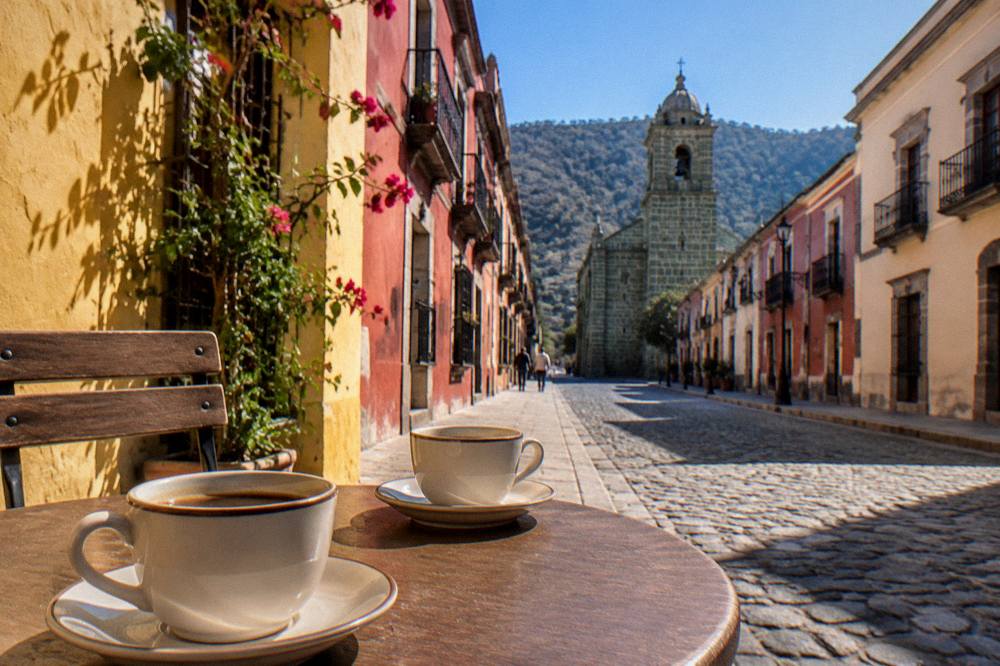
Oaxaca City is an inland highland capital at about 1,550 m in the Valles Centrales of Mexico, and its café life sits inside that setting: colonial streets, market food, chocolate and mezcal within walking distance of each other.
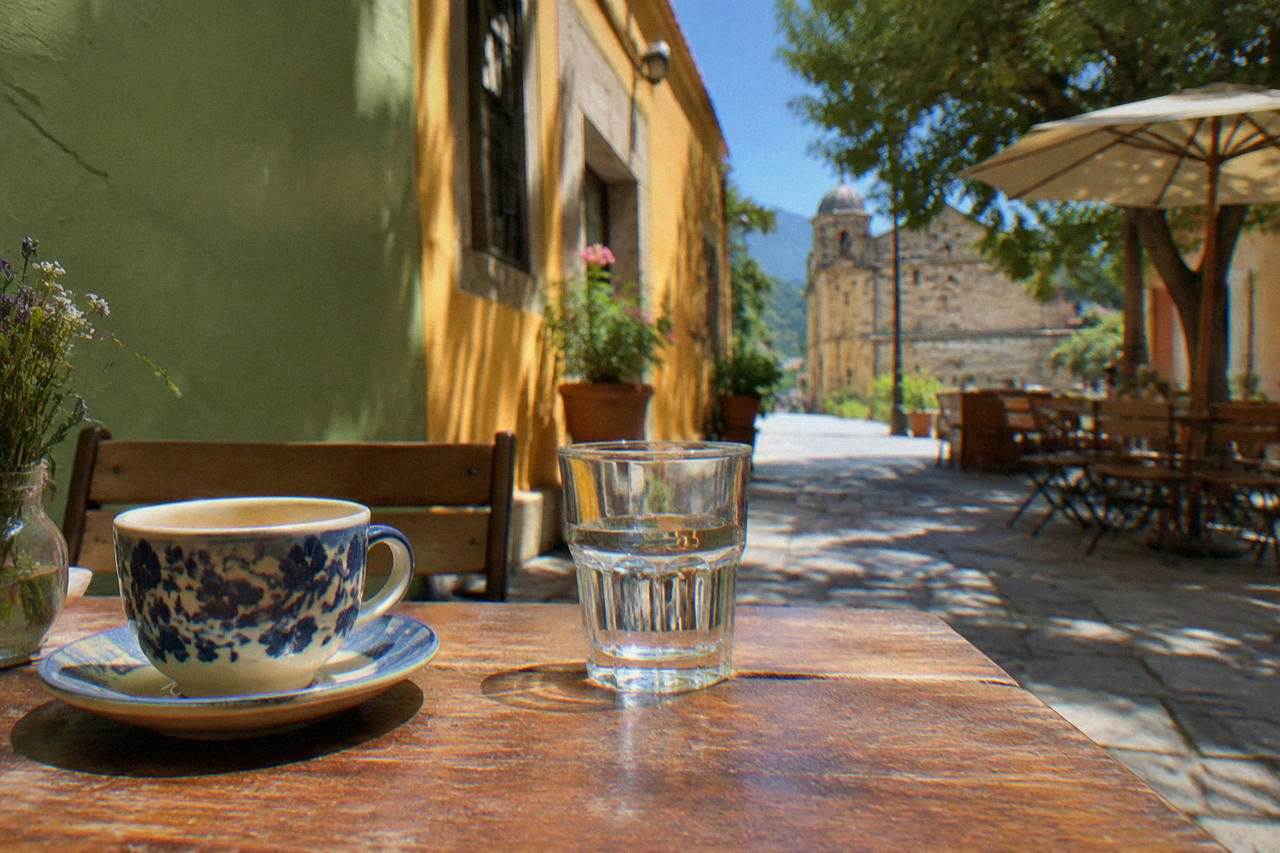
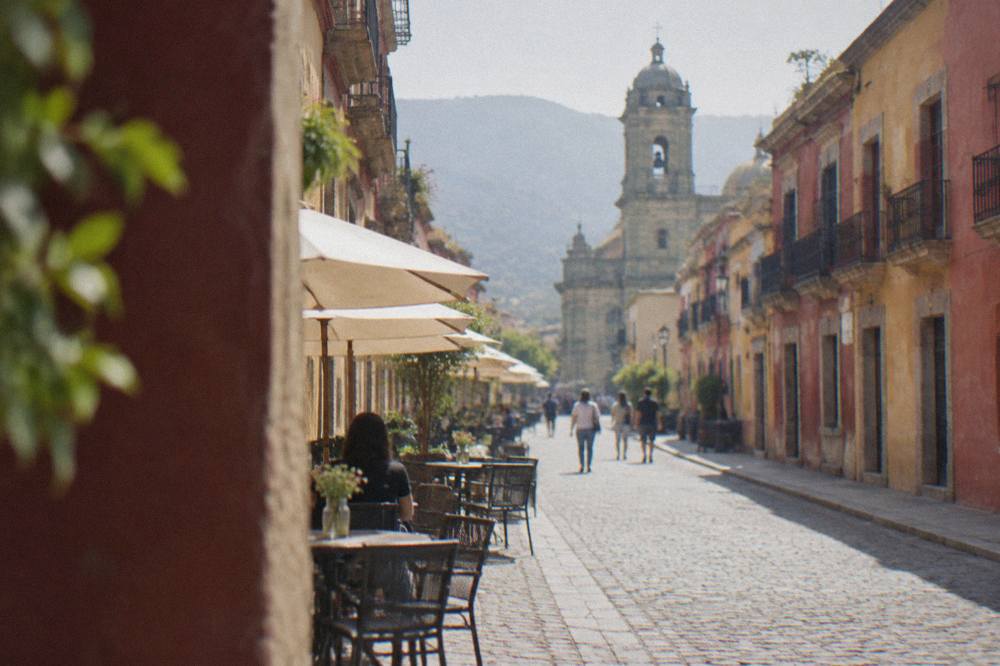
Café life in Oaxaca City concentrates in the Centro Histórico around the Andador Macedonio Alcalá and the Zócalo, and in the neighbouring barrios of Jalatlaco and Xochimilco. The city is walkable, inland, and about 1,550 m above sea level, so mornings are cool and afternoons warm through most of the year.
Oaxaca de Juárez, the capital of the state of Oaxaca in Mexico, is an inland highland city in the Valles Centrales at about 1,550 m, and its café culture grows out of that geography rather than out of any coastline. There is no sea here. What there is instead is a compact, walkable historic centre whose UNESCO listing, "Historic Centre of Oaxaca and Archaeological Site of Monte Albán", property 415, wraps the Santo Domingo de Guzmán church, the Zócalo and the Andador Macedonio Alcalá into a zone a coffee drinker can cross on foot, with the barrios of Jalatlaco and Xochimilco a short walk beyond. This page covers how café time fits that city: where it sits, what belongs on the table beside the cup, when the weather suits a terrace, and which guided experiences pair well with a slow morning.
Where Should You Drink Coffee In Oaxaca City?
The useful answer is a walkable triangle: the Andador Macedonio Alcalá between Santo Domingo de Guzmán and the Zócalo, the streets immediately around the Zócalo itself, and the barrio of Jalatlaco a few blocks east, with Xochimilco as a quieter fourth option. All of it lies in the Centro Histórico, which the UNESCO listing covers as a single inscribed property, and all of it is flat enough to wander between cups.
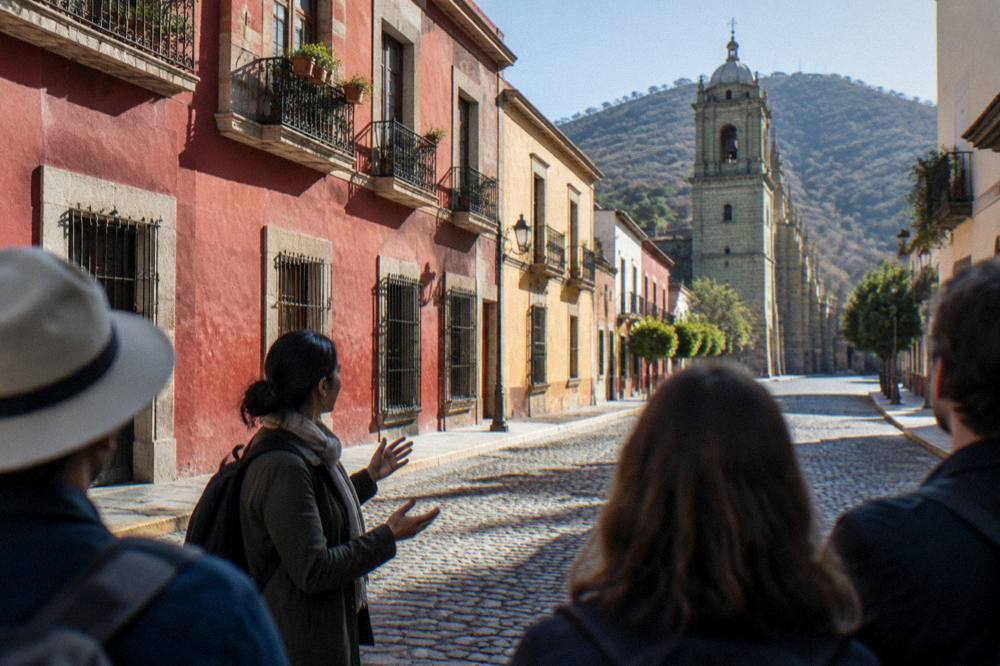
The Andador is the pedestrian spine that connects the Santo Domingo complex to the main square, and the blocks either side of it carry the densest concentration of places to sit down. The Zócalo, formally the Plaza de la Constitución, sits at the southern end of that line, so a morning walk can run church to square with a stop anywhere along the way. Individual café names, hours and prices are left out; the street pattern, the altitude and the walkability are what shape a café plan.
Jalatlaco and Xochimilco are the two barrios most often paired with the centre in the site's neighbourhood coverage, and both are close enough that a coffee there does not consume a morning. The Xochimilco neighbourhood guide sibling pages and the site's own barrio articles carry more street detail, and the walk between them and the Andador is itself part of the appeal. Oaxaca City was founded in 1529 as Antequera, and the street plan of the centre still reflects that colonial grid, which is why a café crawl here is measured in blocks rather than transit rides.
What Belongs On A Oaxaca Café Table Besides Coffee?
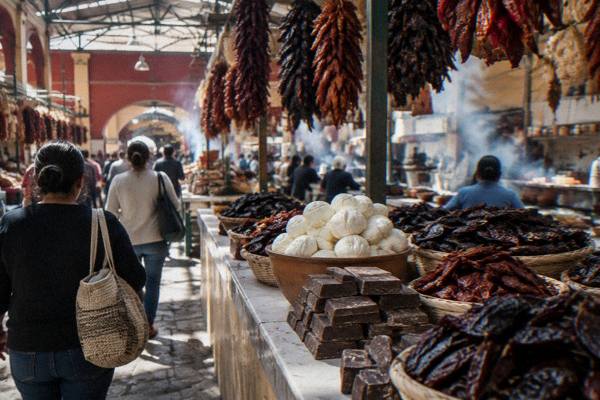
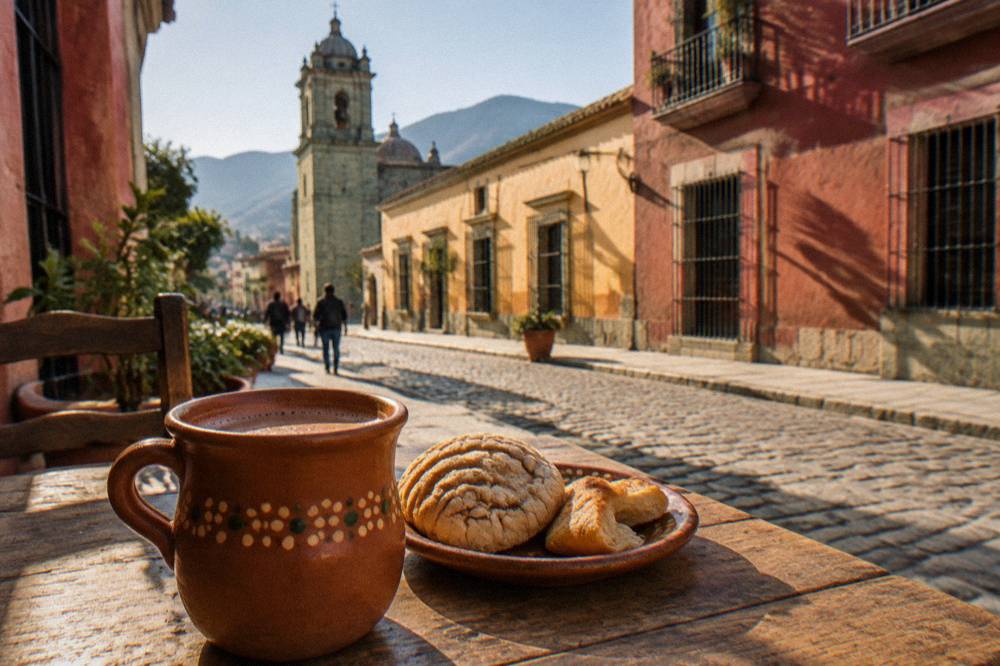
The shortlist the sources support is chocolate, tejate, and the market dishes that surround café life: tlayuda, mole, quesillo and chapulines, all named in the destination's own food record. Chocolate in its Oaxacan drink form is the one that belongs to the café table most directly, tejate is its market-side counterpart, and the rest are the reasons a coffee morning so easily becomes a food morning. No primary source carries a dish price.
Oaxacan chocolate appears across the site's food coverage, and a free walking tour on the tour list even names Xochimilco's chocolate in its title, which tells you how tightly the drink is bound to the city's identity. The practical point for a café visitor is that the table here is wider than the cup: a morning that starts with chocolate or coffee in the centre can end at a market food stall without changing neighbourhoods.
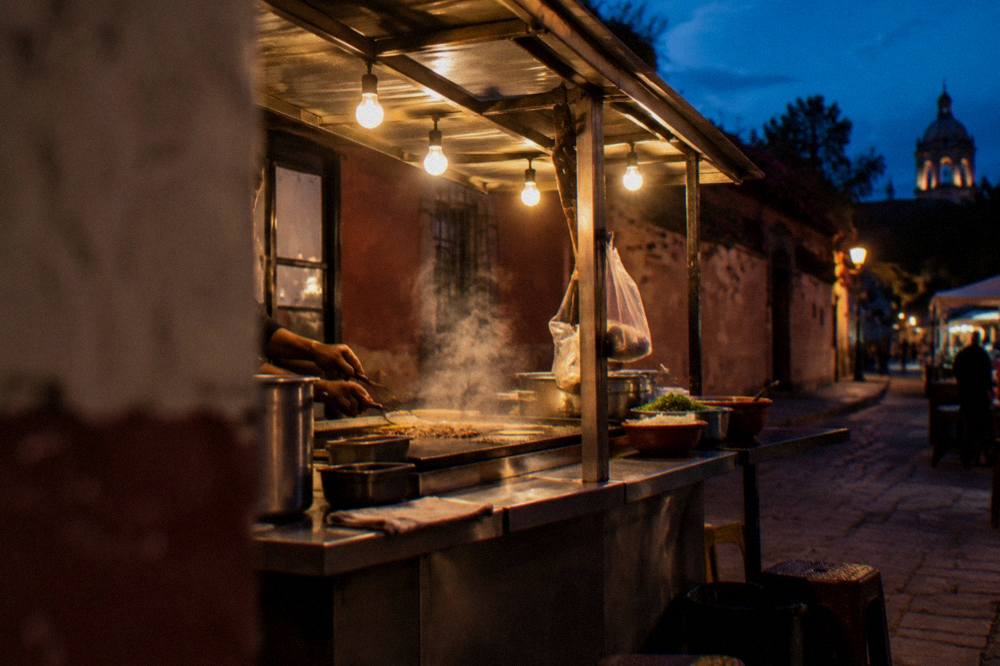
The bridge from café table to full food table is short, and a guided walk is one way across it. The site's featured pick for this page is the Oaxaca Streets Food Tour with 14+ Tastings, which covers the street food a café only hints at; the listing's own page carries the current details. For readers who want the pairing in one glance, the band below shows how that tour sits beside a short city walk and a mezcal experience.
The dishes above each have their own page in the site's food section, and the table below maps them so a café morning can be extended dish by dish.
| Dish or drink | What it is | Site page covering it |
|---|---|---|
| Chocolate | A traditional Oaxacan drink, tied to the Xochimilco barrio in tour listings | /guides/oaxacan-chocolate/ (sibling listing) |
| Tejate | A traditional drink of the region, named without seasonality | /guides/what-to-eat-in-oaxaca/ coverage |
| Tlayuda | A named market dish of Oaxaca | Tlayudas In Oaxaca |
| Mole | A named dish family of Oaxacan cooking | Oaxacan Mole |
| Quesillo | A named Oaxacan cheese | Oaxaca Cheese Quesillo |
| Chapulines | A named market food | What To Eat In Oaxaca |
Which Oaxaca Neighbourhoods Suit A Café Morning Best?
For a first visit the Centro Histórico is the practical base: the Andador Macedonio Alcalá, the Zócalo and the blocks around Santo Domingo de Guzmán put cafés, the Jardín Etnobotánico and the museums in one walkable zone. Jalatlaco adds a quieter barrio feel a short walk east, Xochimilco sits beside it, and Reforma extends the options north of the centre. All are covered in the site's neighbourhood pages, and none requires a car.
The choice between them is a choice of pace rather than of quality. The centre puts everything at the door, including the Museo de las Culturas de Oaxaca, which the INAH page lists as open Tuesday to Saturday, 10:00 to 16:00, a schedule worth knowing if a museum stop is planned around café time. Jalatlaco and Xochimilco trade that density for residential streets, and the site's best time to visit Oaxaca page folds the neighbourhood question into the wider timing one.
| Area | Where it sits | Notes |
|---|---|---|
| Centro Histórico | The Zócalo itself | UNESCO property 415, Andador Macedonio Alcalá, Santo Domingo de Guzmán |
| Jalatlaco | A short walk east | Barrio named across the site's coverage and tour listings |
| Xochimilco | Adjacent to Jalatlaco | Named in a walking tour title for its chocolate tradition |
| Reforma | North of the centre | Paseo Juárez el Llano park area in site coverage |
A café morning in the centre can be combined with a museum or garden hour without breaking stride: the Jardín Etnobotánico runs free guided tours Monday to Friday at 10:30, 11:00, 11:30, 12:00 and 17:00 and Saturday from 10:30 to 12:00, with large groups booking two weeks ahead, so an 11:00 tour slots neatly between a first coffee and a late lunch.
When Does Oaxaca Weather Suit A Café Terrace?
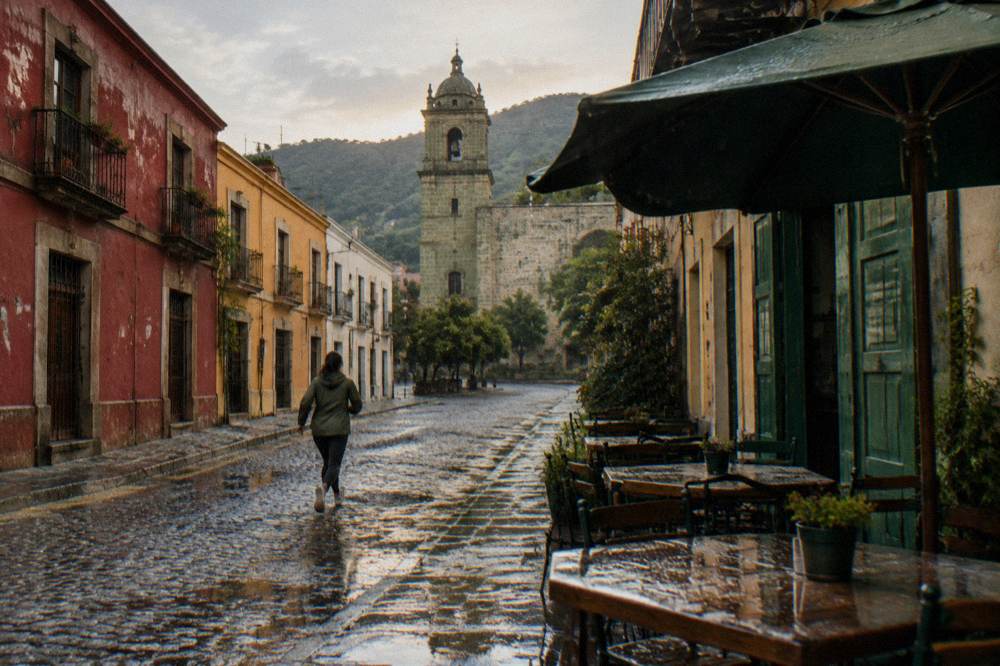
The climate normals for Oaxaca, from the SMN station record for 1991 to 2020, show dry-season months from November to April with very little rain, and a rainy season from May to October. Terrace weather is therefore a dry-season question first, but rainy-season afternoons are workable too, since rain falls on roughly 20 days a month in the peak and café interiors fill the gaps.
The table below is the station data itself, and it is the only climate source this site prints. The dry months carry 2.4 mm to 9.1 mm of rain in total, while June averages 188.3 mm. April has a mean daily high of 34.9 C and January a mean nightly low of 10.3 C, which is the spread a café wardrobe has to cover: cool mornings, warm afternoons, no snow at any point in the year at this altitude.
| Month | Mean daily high C | Mean nightly low C | Rain mm |
|---|---|---|---|
| Jan | 28.9 | 10.3 | 2.4 |
| Feb | 31.1 | 11.6 | 4.6 |
| Mar | 33.3 | 13.6 | 17.6 |
| Apr | 34.9 | 15.8 | 47.3 |
| May | 33.8 | 16.7 | 97.9 |
| Jun | 30.9 | 16.7 | 188.3 |
| Jul | 30.1 | 15.9 | 118.6 |
| Aug | 30.0 | 15.9 | 131.8 |
| Sep | 29.1 | 16.1 | 163.6 |
| Oct | 29.3 | 14.5 | 63.1 |
| Nov | 29.0 | 12.3 | 9.1 |
| Dec | 28.9 | 11.0 | 9.0 |
For readers planning around the rain rather than around it, the Oaxaca in the rain itinerary exists precisely for the wet months, and the weather by month page expands each line of the table above. Neither page ranks months: the figures are stated, and the reader decides.
Can You Combine Coffee In The City With A Day Trip To The Valleys?
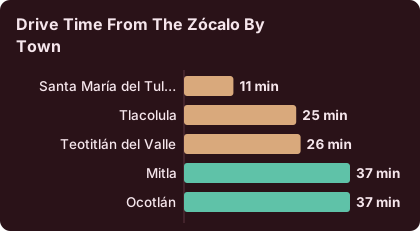
Yes, and the derived drive times make the case: Santa María del Tule sits about 11 minutes from the Zócalo, Teotitlán del Valle about 26 minutes, Tlacolula about 25, Mitla about 37 and Hierve el Agua about 57, all on valley roads that real traffic and mountain driving make slower than the free-flow figures. A café breakfast in the centre therefore pairs naturally with a morning in the Tlacolula Valley, the craft-village region the site covers in its day-trip pages.
They mean the valley is not a distant expedition but a short transfer, and the site's Teotitlán del Valle coverage aside, each valley destination has its own page under the site's day-trip section. The relevant pairing for this article is temporal rather than geographic: an early coffee in the Centro Histórico, then a valley loop, then an evening back in the centre, which is the shape most of the site's itinerary pages follow.
| Town | Drive time from the Zócalo | Notes |
|---|---|---|
| Santa María del Tule | About 11 minutes | The Tule tree has its own site page |
| Tlacolula | About 25 minutes | Sunday market day is not stated |
| Teotitlán del Valle | About 26 minutes | Weaving village, covered in its own guide |
| Mitla | About 37 minutes | INAH Category I site, 105/210 MXN entry |
| Ocotlán | About 37 minutes | Craft and market town with its own page |
Mitla's INAH page lists Monday to Sunday opening, 08:00 to 17:00 with last access at 16:30, and Category I entry of 105 MXN for nationals and 210 MXN for foreign visitors, figures that also apply to Monte Albán and Yagul. A valley day trip that includes Mitla therefore has a hard schedule anchor that a café breakfast has to respect, which is the honest arithmetic behind "leave early". Everything else covered here is indexed on Oaxaca Travel Guide.
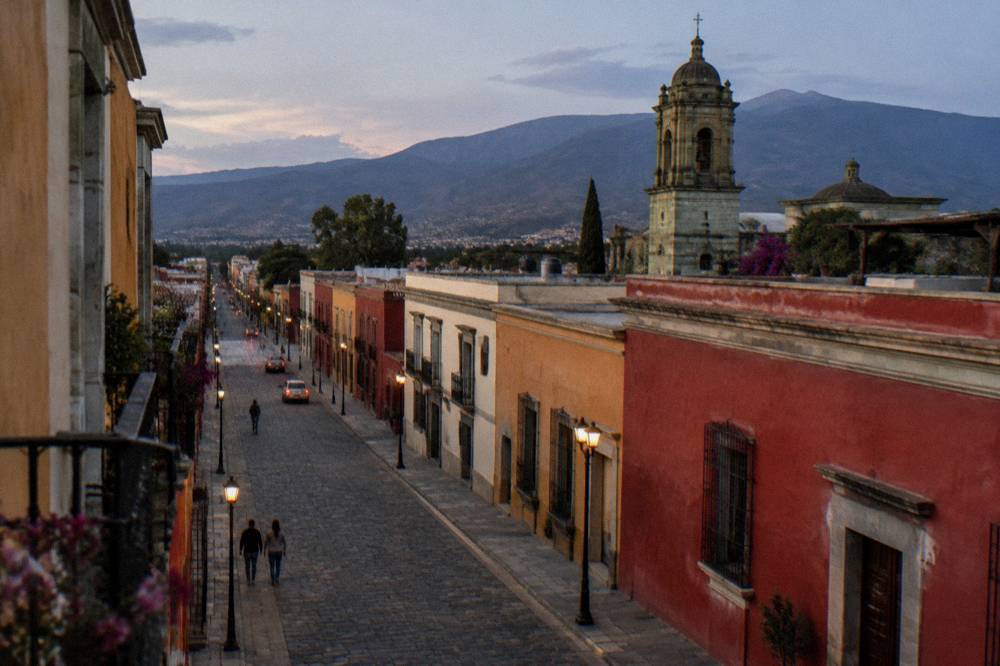
Between the valley and the café table sits the mezcal tradition, and the site's mezcal coverage, including the Mezcal In Oaxaca page, treats it as the evening counterpart to a morning of chocolate and coffee.
How Do Coffee Mornings Fit A First Oaxaca Itinerary?
The site's itinerary pages converge on a simple split for a first visit: two to three nights based in the Centro Histórico, mornings given to cafés, the Jardín Etnobotánico and the barrios, one day given to Monte Albán, and one day given to the Tlacolula Valley. The city logged 1,324,332 tourist arrivals in 2025 with an average stay of 2.00 nights, so the typical visit is short and the walkable centre fills it.
The itinerary pages themselves carry the detail: how many days in Oaxaca frames the length question, and the one-day through five-day builds each start from the same walkable core. A café-first traveller is not sacrificing sightseeing by staying central, because the centre holds the Zócalo, the Andador, Santo Domingo and the Jardín Etnobotánico's free guided tours within a few blocks of any terrace.
Monte Albán deserves its own half day regardless: the INAH page lists Monday to Sunday, 08:00 to 17:00, last access 16:00, with Category I entry at 105 MXN for nationals and 210 MXN for foreign visitors, and the site's Monte Albán guide sibling pages cover the visit in full. The site is about 15 minutes from the Zócalo by the derived road figure, close enough that an early ruins departure and a late-morning coffee back in the centre fit the same day without strain.
What Do The City's Numbers Say About Planning A Café Trip?
Oaxaca City logged 1,324,332 tourist arrivals in 2025, of which 1,111,799 were national and 212,533 foreign, hotel occupancy of 51.73 percent and an average stay of 2.00 nights, with national visitors making up 83.95 percent of the total. For a café traveller those numbers mean a short, domestically driven visit pattern, a compact centre that absorbs it, and no evidence in the record of a long-stay café scene that would justify a base outside the Centro Histórico.
The table below sets the key planning figures in one place, all from the state tourism indicators document and the 2020 census.
| Figure | Value | Source tier |
|---|---|---|
| National share of arrivals, 2025 | 83.95 percent | Same document |
| Average stay, 2025 | 2.00 nights | Same document |
| Hotel occupancy, 2025 | 51.73 percent | Same document |
| Municipality population | 270,955 (Censo 2020) | INEGI census |
| State population | 4,132,148 (Censo 2020) | INEGI census |
| Monte Albán visitors, 2025 | 416,675 | State indicators |
Two further planning facts belong in the margin. Oaxaca runs on UTC-6 all year, since Mexico abolished daylight saving in 2022. And the state lodging tax is 3 percent on hotel-type stays, 5 percent for intermediaries, under the state fiscal code, which is why a hotel bill does not always match its headline rate. Neither changes a coffee order, but both change a budget.
Which Tours Pair Well With A Café Day In Oaxaca?
The pairings that make sense from the tour list are a food-and-markets walk for the table, a short historic-centre walk for the streets between cafés, and a mezcal experience for the evening, and this page's featured tour, the Oaxaca Streets Food Tour with 14+ Tastings, is the one that extends a coffee morning into a full food day.
The featured street food walk sits at the centre of that trio because it covers the exact territory this page is about, the food streets around the centre, with tastings rather than narration as its format. Readers deciding between it and a self-guided café crawl should weigh one thing: the guided version puts the dish selection in a local's hands, while the self-guided version trades that for the freedom the walkable centre gives anyway. Both work; the band below shows the three picks together for comparison.
The featured tour also has its own full page on this site, the streets food tour with 14+ tastings, where the itinerary is described in detail. To check dates for your own travel window, Check availability on the operator's booking page.
For travellers building the wider trip around these café days, the practical pages are where to stay in Oaxaca for the base, getting around Oaxaca for the distances, and Oaxaca travel costs and budget for the arithmetic. The things to do in Oaxaca root page carries the full activity index if the food angle widens into a general plan.
Common Questions About Coffee And Cafés In Oaxaca
Is Oaxaca City Good For Cafés?
Yes, in the specific sense the geography allows: a flat, walkable, UNESCO-listed historic centre with the Andador Macedonio Alcalá, the Zócalo, Jalatlaco and Xochimilco all within a short walk of each other, at an altitude of about 1,550 m that keeps mornings cool.
What Is Oaxacan Chocolate?
It is a traditional drink form of chocolate tied to the city, named across the destination's food record and even in the title of a free Xochimilco walking tour on the tour list. It is served hot and belongs to the same table culture as coffee and tejate.
Can I Sit Outside At A Café In Oaxaca Year Round?
The dry season, November to April, carries 2.4 mm to 9.1 mm of rain per month in the station normals, so terrace weather is reliable then. The rainy season, May to October, peaks between June and September with 118.6 mm to 188.3 mm per month, and indoor tables cover those afternoons.
Is Oaxaca City Walkable For A Café Crawl?
Yes. The Centro Histórico's colonial grid puts the Andador, the Zócalo, Jalatlaco and Xochimilco in one walkable zone, and the site's walkability coverage treats the centre as flat and compact. No car is needed for a café morning.
Do Café Mornings Work With Day Trips To The Valleys?
They do. Derived drive times put Santa María del Tule about 11 minutes from the Zócalo, Tlacolula about 25, Teotitlán del Valle about 26 and Mitla about 37, so an early coffee precedes a valley loop easily, with real traffic slower than the free-flow figures.
What Else Should I Plan Around Café Time In Oaxaca?
The Jardín Etnobotánico's free guided tours run Monday to Friday at 10:30, 11:00, 11:30, 12:00 and 17:00 and Saturday from 10:30 to 12:00, and the Museo de las Culturas de Oaxaca opens Tuesday to Saturday, 10:00 to 16:00, so both slot between morning coffee and lunch.
A café plan for Oaxaca City is really a walking plan with cups in it: pick a base in the Centro Histórico, work the Andador and the Zócalo in the morning when the air is cool, give one day to Monte Albán and one to the Tlacolula Valley, and let the dry season or a well-timed terrace roof handle the rest.