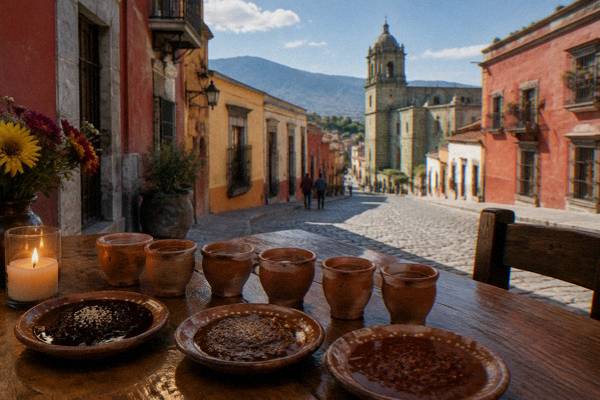
Mezcal In Oaxaca: How To Taste It And Which Bars To Visit
Oaxaca City is the place most associated with mezcal in Mexico, an inland highland capital where tasting rooms, markets and valley distilleries sit within a short drive of the Zócalo.
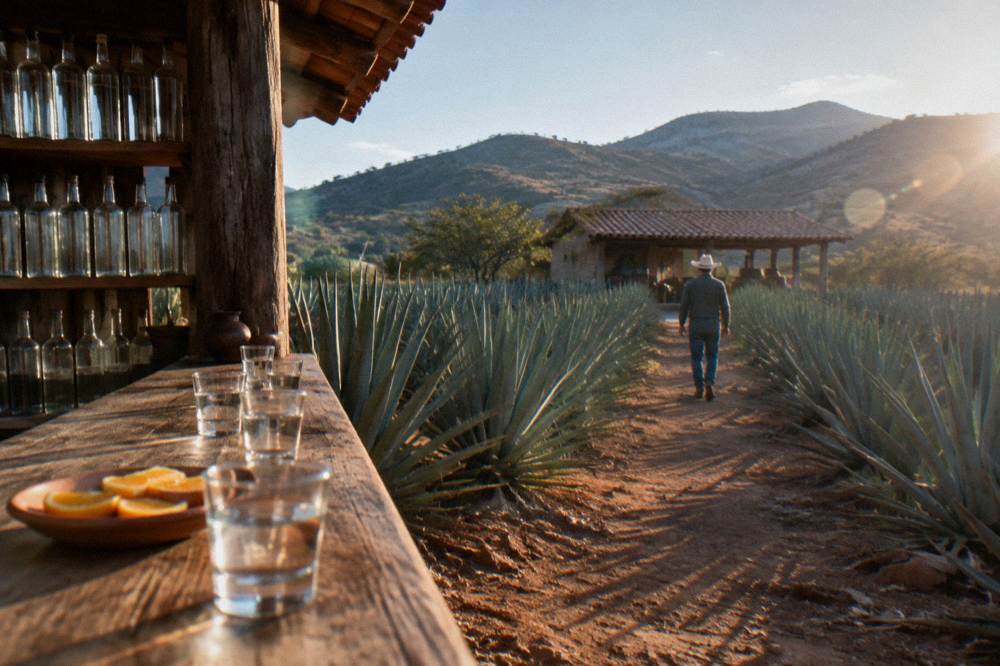
Taste mezcal in Oaxaca City at small pours, sip rather than shoot, book a guided tasting or workshop, and time a visit around the Feria del Mezcal in July if the calendar allows.
Oaxaca City, the capital of the state of Oaxaca in Mexico, sits inland in the Valles Centrales at about 1,550 m, and it is the place mezcal is most associated with anywhere in the country. The spirit turns up across the city: in tasting rooms around the historic centre, on food tours that pair it with mole, in cooking classes, and in the valley towns east of the city where distilleries cluster. The state government's own tourism material calls Santiago Matatlán, on the Tlacolula side of the valley, the "Capital Mundial del Mezcal", and a July fair dedicated to the spirit runs each year in Santa Lucía del Camino. This guide lays out how tasting works here, which booked experiences cover it, and how the pieces fit together, with the pick of the tastings collected at the end.
What Is Mezcal In Oaxaca And How Does The City Relate To It?
Mezcal in Oaxaca is a distilled agave spirit, and Oaxaca City functions as its tasting capital: the state government markets Santiago Matatlán, as the "Capital Mundial del Mezcal", and the city itself holds the Feria del Mezcal each July at the Centro Cultural y de Convenciones in Santa Lucía del Camino. The spirit is woven into the city's food culture, from market meals to mole pairings.
Oaxaca de Juárez was founded in 1529 as Antequera, and its historic centre shares World Heritage listing with Monte Albán as the "Historic Centre of Oaxaca and Archaeological Site of Monte Albán", property 415 on the UNESCO list. That listing is about the streets and the ruins, but the same compact centre is where the mezcal economy meets visitors: the Andador Macedonio Alcalá, the Zócalo, the Jalatlaco and Xochimilco neighbourhoods, and the markets that ring the centre. The city recorded 1,324,332 tourist arrivals across 2025, of which 212,533 were foreign visitors, and the average stay was 2.00 nights, so for many travellers a tasting or a workshop is the single deepest dive into the spirit that the trip allows.
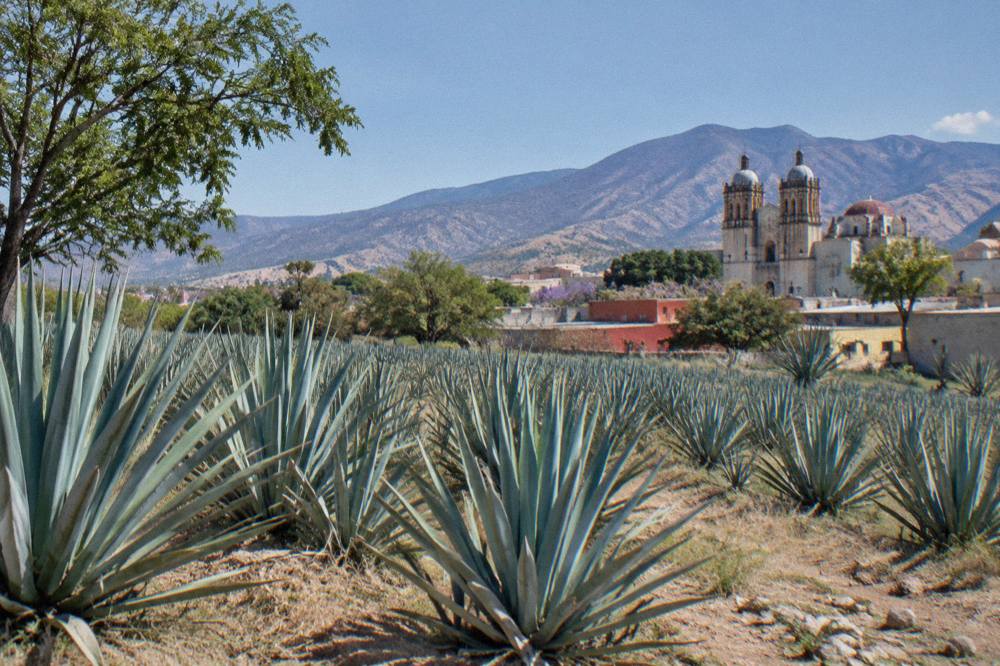
What the official sources do not give is a tidy set of numbers about production. The state pages describe Santiago Matatlán as home to many palenques, the small distilleries where mezcal is made, with references over the years to dozens and, historically, to more than a hundred. They publish no current count and no visitor price list for palenque tours. What the sources do establish is the geography: the distilleries sit in the Tlacolula Valley, the same corridor that carries visitors to Mitla, Hierve el Agua and the Tule tree, which is why mezcal stops appear on so many valley day trips.
For context on how the spirit sits in Mexican culture generally, the site's answer page on mezcal and tequila comparisons covers the standing question, and the Oaxaca markets and shopping guide covers where bottles and local goods are sold in the centre.
How Do You Taste Mezcal Properly In Oaxaca?
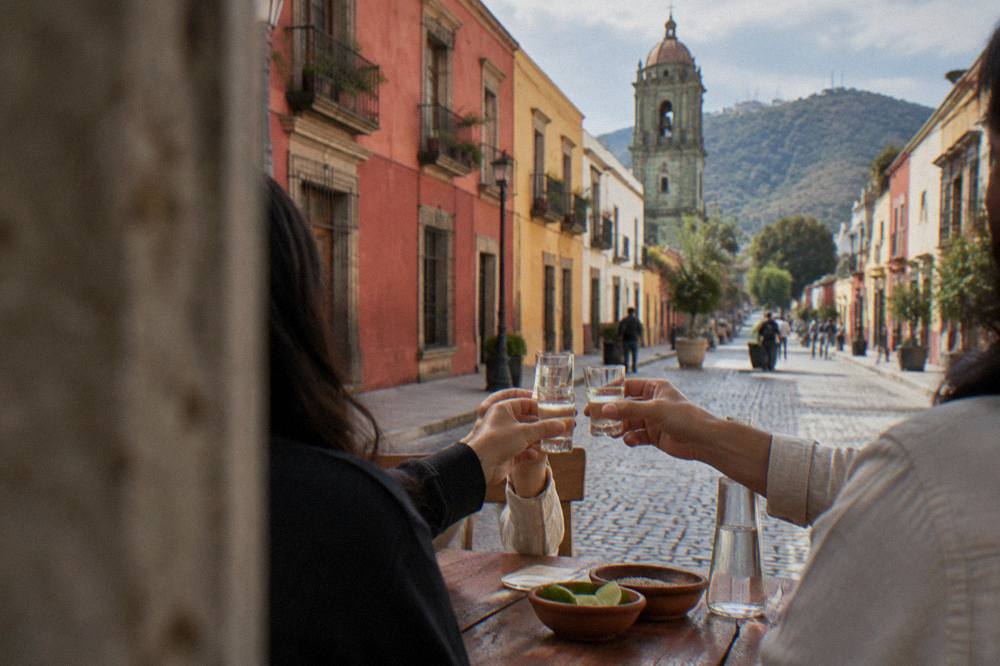
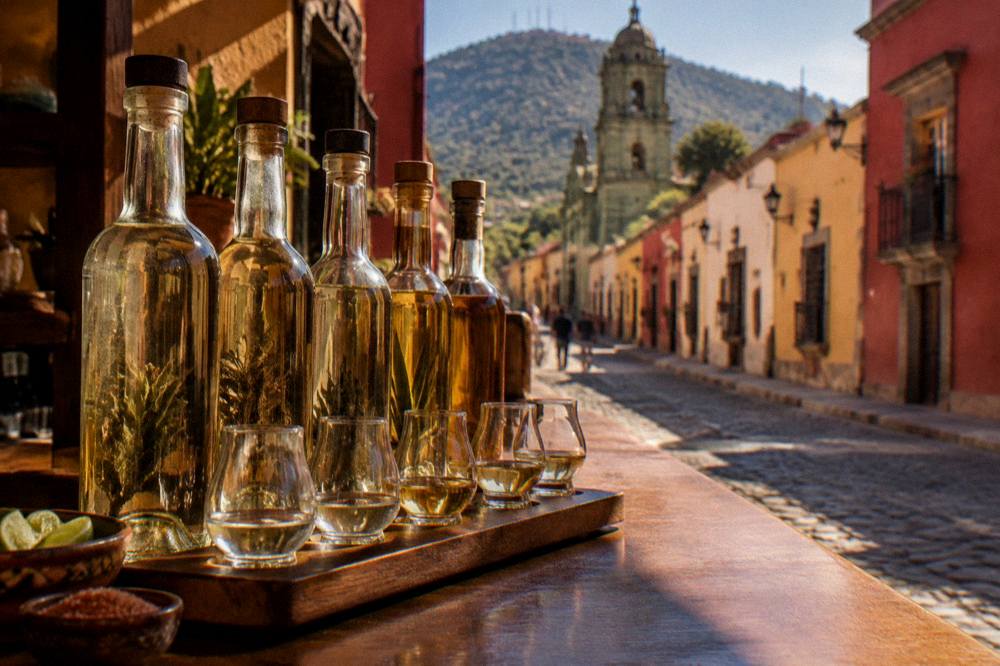
Tasting mezcal in Oaxaca means small pours, sipping rather than shooting, and taking the glass in short pulls with a water chaser, the way tasting rooms in the city pour it: flights typically move from younger, clearer spirits to aged ones, and a guided tasting or a workshop is the way to learn the vocabulary, since the listings in the city pair each pour with an explanation of the agave and the region.
The city's booked experiences range from short sommelier-led pairings to full workshops where you mix mezcal cocktails yourself.
The practical difference between drinking and tasting is pace and portion. A tasting flight is a sequence of small pours, and the point is to notice how each one differs before moving on. The vocabulary that matters is on the labels and the menus: the agave variety, the age statement, and the place it was made. Oaxaca's mezcal carries protected-origin status, though the details of that protection vary and go beyond what this site covers.
Two things help a first tasting land well. First, eat something first: the city's food culture is built around the spirit, and a tasting that follows a market meal or runs alongside food, as the pairing experiences do, works better than one on an empty stomach. Second, go with someone who pours for a living. The sommelier-led pairing sessions listed in the city run through a fixed number of pours matched to mole, which turns an abstract tasting into something concrete. The mole side of that pairing is covered in the site's Oaxacan mole guide.
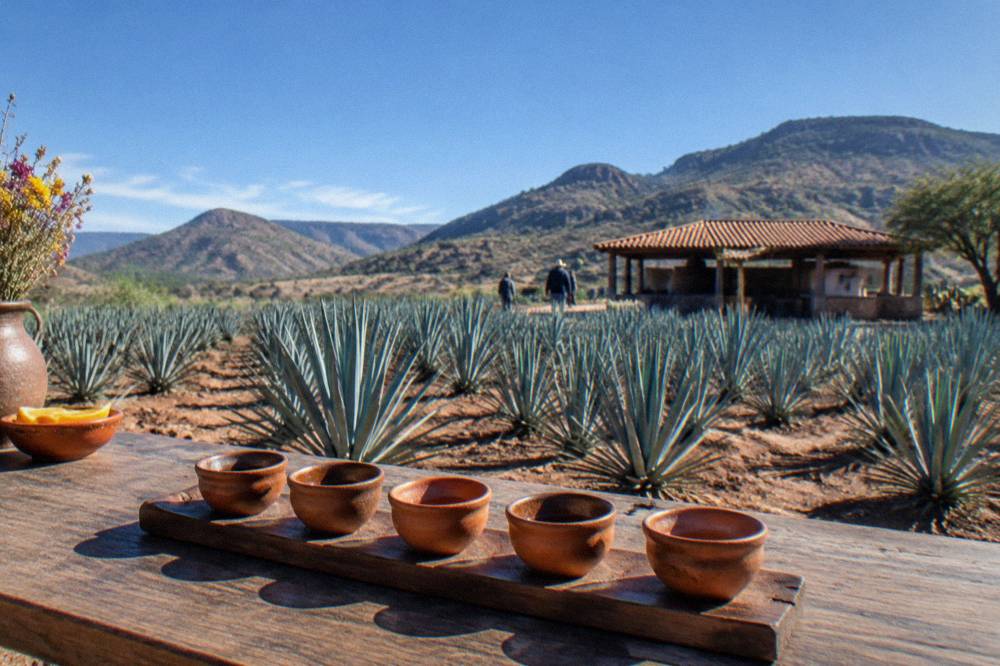
The table below summarises the tasting formats available as bookable experiences in the city.
| Format | What It Involves | Where It Runs |
|---|---|---|
| Sommelier pairing session | A fixed set of mezcal and mole pairings led by a certified sommelier | Oaxaca City |
| Mixology workshop | Building mezcal cocktails with organic mezcal, hands-on | Oaxaca City |
| Distillery tour | Behind-the-scenes access at a family distillery | Oaxaca City and surroundings |
| Countryside agave visit | Agave fields in the valleys with tasting | Central Valleys |
| Valley day trip with mezcal stop | Mezcal distillery stop inside a wider Mitla and Hierve el Agua loop | Tlacolula Valley |
Which Mezcal Tastings And Workshops Can You Book In Oaxaca?
The bookable mezcal experiences in Oaxaca City divide into tastings, pairings, workshops and distillery visits: the sommelier pairings run in the centre, the mixology workshop teaches mezcal cocktails with organic mezcal, behind-the-scenes distillery tours take you into a family operation, and several valley day trips fold a mezcal stop into a loop that also covers Mitla, the Tule tree and Hierve el Agua.
The featured pick for this page is the mixology workshop: it is the format that teaches you to do something with the spirit rather than only identify it, and it runs in the city, so it slots into any itinerary without a valley drive. It sits alongside food and culture walks as a strong evening or late-afternoon anchor.
The pairing sessions are the alternative for travellers who want depth without hands-on work. The sommelier-led pairing format matches a fixed number of mezcal pours against mole courses, which is a genuinely Oaxacan pairing rather than a generic tasting. For visitors who want the countryside, the distillery and agave-field experiences leave the city for the valleys, and the craft-route tours through San Martín Tilcajete, Jalieza and Ocotlán can be combined with them across two days.
Between the tasting room and the distillery sits the food side of the city, and the evening street food format pairs naturally with mezcal: the listing covers a large number of tastings across an evening walk. The site's Oaxaca food tour overview collects the cooking-class side of the same culture for travellers who would rather make the meal than walk to it.
Where Can You Drink Mezcal Around Oaxaca City?
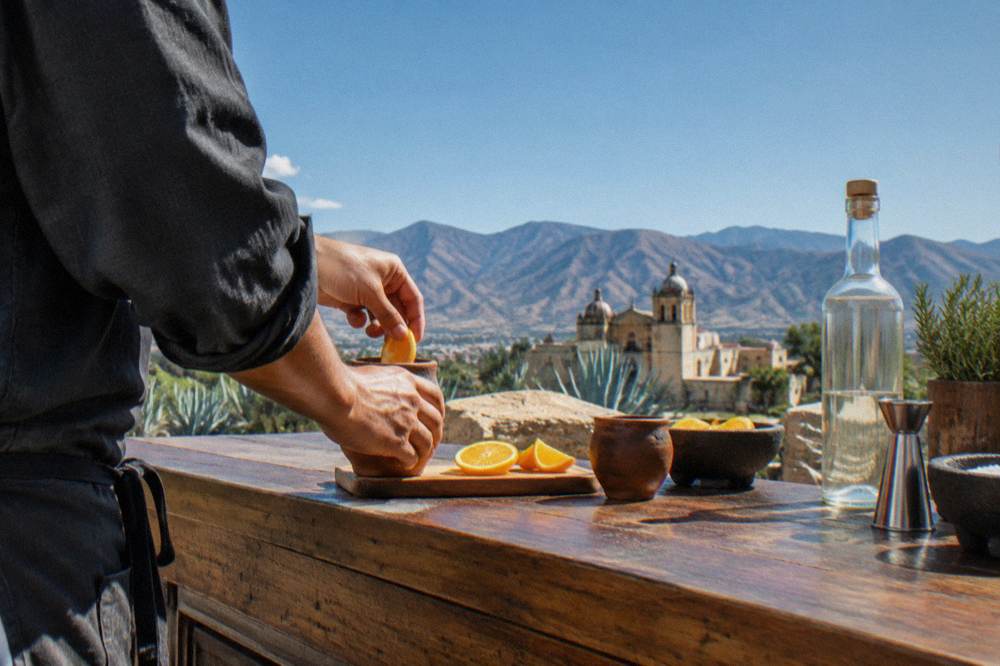
Mezcal in Oaxaca City is drunk in the historic centre's tasting rooms and restaurants, around the Andador Macedonio Alcalá and the Zócalo, in the Jalatlaco and Xochimilco neighbourhoods, and inside the markets, particularly Mercado 20 de Noviembre, and the deepest single introduction remains a booked tasting or workshop, since the city's mezcal experiences are structured, explained and short enough to fit an evening.
The geography matters. The historic centre is compact and walkable, which is why an evening tasting followed by a walk works so well here. The Andador Macedonio Alcalá is the pedestrian spine that connects the Zócalo to the Santo Domingo de Guzmán church, and the blocks either side of it carry the bulk of the city's restaurants and tasting rooms. Jalatlaco and Xochimilco sit just outside the centre and both appear across this site's neighbourhood coverage. No official page publishes a list of named bars with hours; what the sources do support is the pattern: small pours, tasting flights and mezcal paired with food, in and around the centre.
The Jalatlaco guide and the Oaxaca at night guide cover the evening side of the city in detail. For travellers building a first evening, the sequence that the site's itinerary pages use is a walking tour or food walk first, then a tasting, then dinner: the city's average visitor stay is 2.00 nights, so one well-chosen evening experience carries real weight.
How Does A Mezcal Tasting Fit Into A Day In Oaxaca?
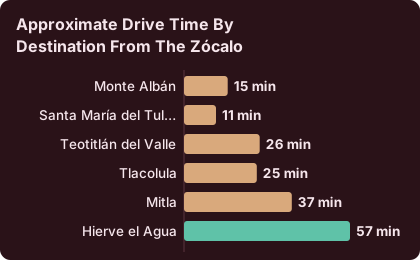
A mezcal tasting fits into an Oaxaca day in three ways: as an evening anchor in the city after a day of sights, as a short afternoon session between museum visits, or as a stop inside a valley day trip, since the distilleries sit on the same corridor as Mitla, the Tule tree and Hierve el Agua, roughly 37 minutes' drive to Mitla and about 57 minutes to Hierve el Agua from the Zócalo, so a single booked loop can carry the whole day.
The valley arithmetic is what makes Oaxaca unusual. The distances from the Zócalo, computed on road-network routes and stated as free-flow minimums, are short: about 15 minutes to Monte Albán, about 11 to Santa María del Tule, about 26 to Teotitlán del Valle, about 25 to Tlacolula, about 37 to Mitla and about 57 to Hierve el Agua. Real traffic and mountain roads are slower than these figures, but the corridor still fits in a day, which is exactly what the full-day loop products exploit: Tule, Mitla, Hierve el Agua and a mezcal distillery stop in one booked trip.
| Destination From The Zócalo | Approximate Drive Time | Approximate Distance |
|---|---|---|
| Monte Albán | About 15 minutes | About 8.7 km |
| Santa María del Tule | About 11 minutes | About 10.2 km |
| Teotitlán del Valle | About 26 minutes | About 29.2 km |
| Tlacolula | About 25 minutes | About 31.2 km |
| Mitla | About 37 minutes | About 44.6 km |
| Hierve el Agua | About 57 minutes | About 67.1 km |
For travellers who would rather split the days, the site's five-day Oaxaca itinerary sequences the city, the valley and the craft villages across a week-shaped stay, and the mezcal route to Santiago Matatlán is the dedicated distillery day trip. Solo travellers and couples have their own angles covered in the solo in Oaxaca and Oaxaca for couples pages.
When Is The Feria Del Mezcal In Oaxaca?
The Feria del Mezcal in Oaxaca ran 17 to 28 July 2026 at the Centro Cultural y de Convenciones de Oaxaca in Santa Lucía del Camino, with entry of about 80 MXN and hundreds of stands, as part of the wider Guelaguetza month programme of July, which in 2026 carried 140-plus activities, so confirm the dates on the official page before planning around them.
The fair is the one moment in the year when the whole mezcal economy of the state gathers in one hall. The state releases describe stands selling mezcal alongside crafts and food, tied into the July Guelaguetza programme. The Guelaguetza itself runs on two Mondays in July, the Lunes del Cerro, at the Auditorio Guelaguetza on the Cerro del Fortín; the 2026 edition was 20 and 27 July, with paid sections at 1,632 MXN and 1,321 MXN plus fees and free sections C and D. Those are 2026 figures given as reference, since the 2027 dates are not announced.
| July Oaxaca Item | 2026 Detail As Published |
|---|---|
| Feria del Mezcal | Reported 17 to 28 July, CCCO Santa Lucía del Camino, entry about 80 MXN |
| Guelaguetza Lunes del Cerro | 20 and 27 July, two shows each day at 10:00 and 17:00 |
| Guelaguetza paid seats | Palco A 1,632 MXN, Palco B 1,321 MXN, plus fees |
| Guelaguetza free seats | Palcos C and D, free by arrival |
| Ticket channel | Superboletos, limit of two per account |
July is therefore the month with the densest mezcal-adjacent programming, but it is also a crowded month. Travellers who want the fair should book rooms early and treat the whole week around the Lunes del Cerro as peak. The site's Guelaguetza guide covers the festival in full.
What Is The Weather Like For Mezcal Season In Oaxaca?
Oaxaca City's climate splits into a dry season from November to April and a rainy season from May to October with the heaviest rain from June to September, per the SMN station normals for 1991 to 2020: June averages 188.3 mm of rain, September 163.6 mm and January 2.4 mm, while afternoon highs hold near 30 C for much of the year, so a mezcal tasting works year-round and the main planning variable is evening rain in the wet months.
The city sits at about 1,550 m, so evenings cool off even when afternoons are warm. The normals put January's average low at 10.3 C and April's average high at 34.9 C. An evening tasting or a walk to a mezcalería in December or January wants a layer; a July visit wants an umbrella slot in the plan, since July averages 118.6 mm of rain and 20.4 days with rain.
| Month | Average High C | Average Low C | Average Rain Mm |
|---|---|---|---|
| January | 28.9 | 10.3 | 2.4 |
| April | 34.9 | 15.8 | 47.3 |
| July | 30.1 | 15.9 | 118.6 |
| September | 29.1 | 16.1 | 163.6 |
| November | 29.0 | 12.3 | 9.1 |
The full month-by-month picture, including the June figure of 188.3 mm and the annual total of 853.3 mm, is in the Oaxaca weather by month guide, and the trade-offs by season are laid out in the best time to visit Oaxaca page.
Can You Visit A Palenque Or Distillery From Oaxaca City?
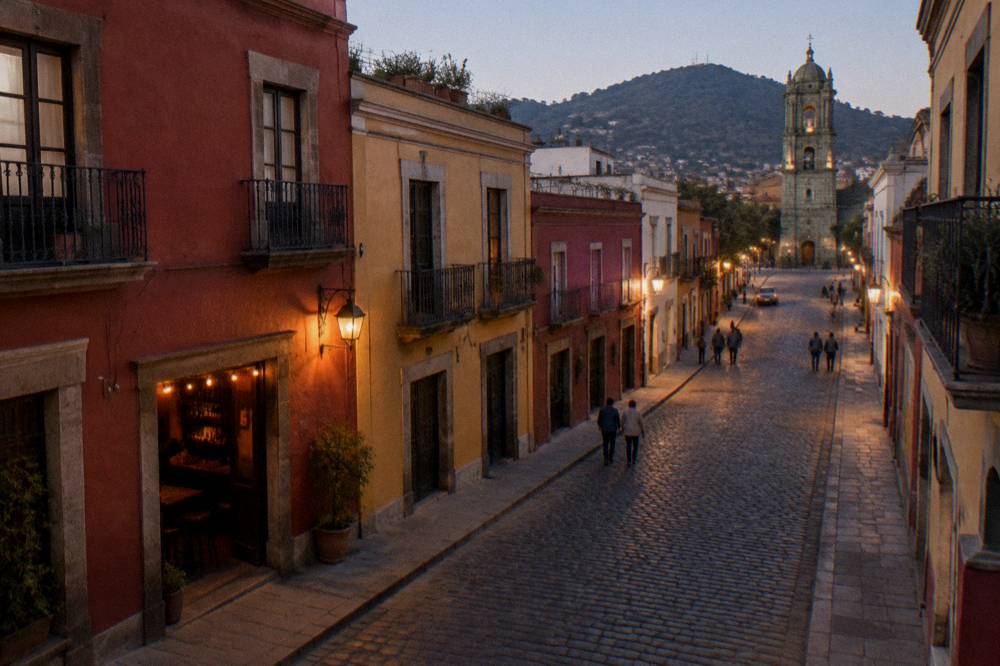
Yes, several bookable experiences from Oaxaca City go behind the scenes at distilleries: one offers behind-the-scenes access at a family operation, one visits an award-winning family distillery, and the valley day trips include a mezcal distillery stop among Tule, Mitla and Hierve el Agua, so the choice is between a distillery-focused half day and a full valley loop that folds mezcal into a wider day.
The distillery-focused products differ mainly in depth and shape. The behind-the-scenes format goes into the working side of a palenque. The sustainable-distillery product centres on one award-winning family operation. The countryside agave-field experiences add the field itself to the tasting. A standalone price for walking into a palenque unbooked appears on none of the official pages, so no such price is quoted here; the booked tours carry the access.
For travellers combining mezcal with crafts, the valley craft routes work as a second day: the San Martín Tilcajete, Jalieza and Ocotlán route covers alebrijes and market towns, and the alebrije painting workshops in San Martín Tilcajete add a hands-on counterweight to the tastings. The San Martín Tilcajete guide covers that side of the valley.
How Much Time Should You Give Mezcal On An Oaxaca Trip?
On a two-night stay, the average for the city, one evening tasting or workshop is the realistic mezcal commitment, since Oaxaca visitors averaged 2.00 nights in 2025; on a four or five-night stay, add either a sommelier pairing or a valley day trip with a distillery stop, and only dedicated enthusiasts need a third experience, because the formats overlap and the city's other claims on your time, from Monte Albán to the markets, are strong.
The 2025 figures give the shape of a typical visit: 1,324,332 arrivals in the city, 212,533 of them foreign, with hotel occupancy at 51.73 percent. Monte Albán alone drew 416,675 visitors in 2025, far ahead of Mitla at 104,428. Those numbers say the ruins, not the spirit, are the anchor for most trips, and mezcal is the evening layer on top. The how many days in Oaxaca page sequences the trade-offs.
A workable split for a first visit of three or four nights: one full day for Monte Albán or a craft-village loop, one full day for the Tlacolula Valley corridor with a mezcal stop, and evenings for the centre, with one of those evenings given to a tasting, a pairing or the mixology workshop. The things to do in Oaxaca page carries the full menu of options, and the Oaxaca Travel Guide homepage frames the city as a whole.
What Should You Know Before Drinking Mezcal In Oaxaca?
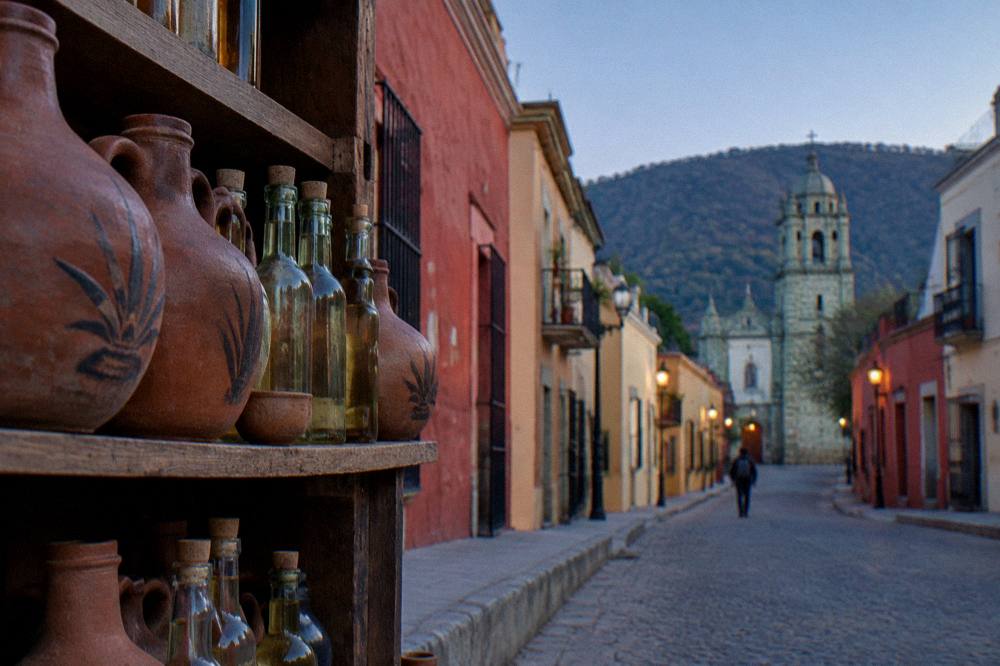
Before drinking mezcal in Oaxaca, know four things: the spirit is stronger than beer and is served in small pours, altitude and evening cool play a role at about 1,550 m, the state adds a 3 percent lodging tax to hotel-type stays that is worth spotting on your bill, and the city sits on UTC-6 all year with no daylight saving, so evening plans shift with the season without a clock change.
A few practicalities round out the picture. Oaxaca is an inland highland city: there is no sea and no beach nearby, and the Pacific coast at Puerto Escondido is about 165 minutes' drive on the new highway, a far extension rather than an evening trip. Safety-wise, the UK FCDO advises against all but essential travel to parts of Mexico and does not name Oaxaca on its main page; Canada advises a high degree of caution for Mexico overall; the US State Department lists Oaxaca state at Level 2, Exercise Increased Caution, with restrictions only in the Isthmus region. Road blockades by teachers' unions are a standing risk that can disrupt road and airport access for hours at a time. The is Oaxaca safe page covers this in full.
| Practical Item | What Applies In Oaxaca City |
|---|---|
| Altitude | About 1,550 m |
| Timezone | UTC-6 all year, no daylight saving |
| Lodging tax | 3 percent on hotel-type stays, 5 percent for intermediaries |
| Currency for local costs | MXN |
| Climate split | Dry November to April, rainy May to October |
| Nearest coast | Puerto Escondido, about 165 minutes by road |
If a workshop rather than a straight tasting appeals, the mixology format with organic mezcal can be checked directly: Check availability. Its tour page on this site also carries the full detail: organic mezcal mixology workshop.
Common Questions About Mezcal In Oaxaca
Is Mezcal In Oaxaca The Same As Tequila?
No. They are both distilled from agave, but they are different protected products from different regions and production traditions. The site's dedicated answer page covers the comparison in detail.
How Do You Drink Mezcal In Oaxaca?
In small pours, sipped slowly rather than shot, usually with a water chaser. Tasting flights move through different agaves and age styles, and guided tastings explain each pour.
Where Is Mezcal Made Near Oaxaca City?
In the valleys east of the city, above all around Santiago Matatlán, which the state markets as the "Capital Mundial del Mezcal". The distilleries sit on the same corridor as Tlacolula, Mitla and Hierve el Agua.
Can You Visit A Mezcal Distillery From Oaxaca City?
Yes. Several bookable tours include behind-the-scenes distillery access, and valley day trips fold a mezcal stop into loops that also visit Mitla, the Tule tree and Hierve el Agua.
When Is The Feria Del Mezcal In Oaxaca?
It runs in July as part of Guelaguetza month. The 2026 edition ran 17 to 28 July at the CCCO in Santa Lucía del Camino with entry of about 80 MXN; confirm the current year's dates on the official page before planning.
Do You Need To Book A Mezcal Tasting In Oaxaca In Advance?
The booked formats, sommelier pairings, workshops and distillery tours, run on fixed schedules and the operator's booking page shows current availability, so checking ahead is the practical approach.
Mezcal is the thread that runs through Oaxaca City's evenings, its food culture and its eastern valley, and one booked experience, chosen to match the shape of the trip, is enough to turn a drink into an understanding of the place.