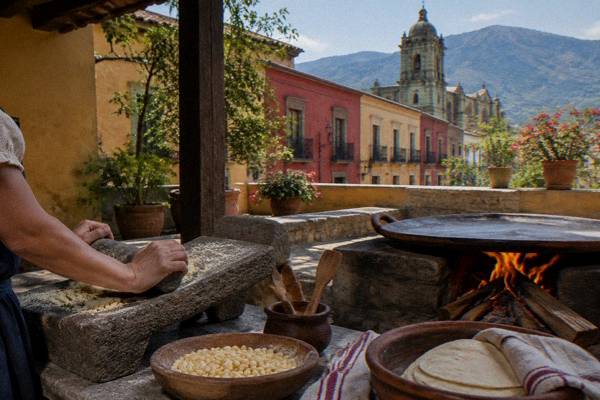
Oaxaca Cooking Classes: Market Visit, Mole And Tortillas
Cooking classes are one of the most bookable experiences in Oaxaca City, and nearly all of them follow the same arc: a guided walk through a food market, then a hands-on session built around mole, tortillas and salsas.
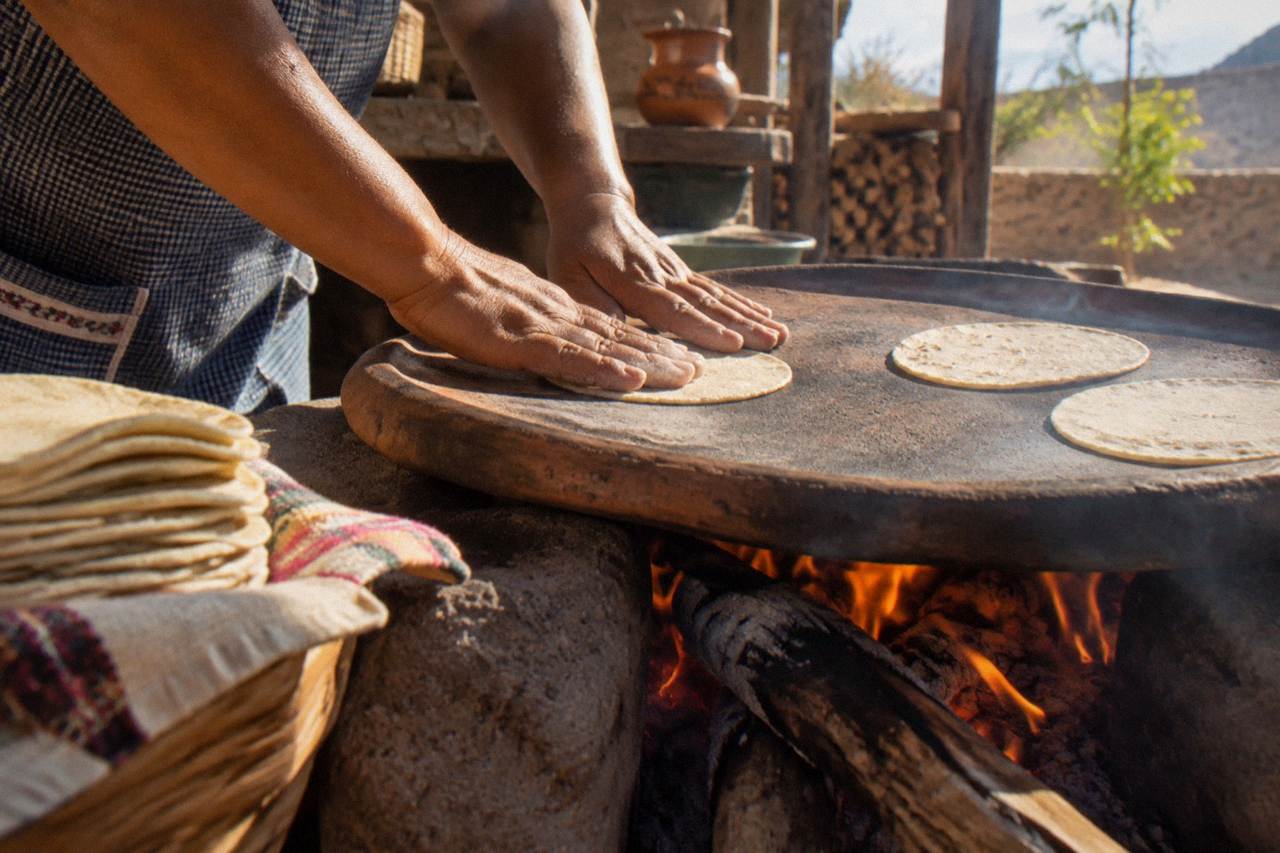
"Most cooking classes in Oaxaca City start with a market visit to buy ingredients, then move to a kitchen where you cook mole, tortillas and salsas from scratch under a local instructor.
Oaxaca City, the capital of the state of Oaxaca in Mexico, sits inland in the Valles Centrales at about 1,550 m, and its food is the reason a large share of travellers book a kitchen day at all. The city registered 1,324,332 tourist arrivals across 2025, per the state tourism indicators, and cooking classes sit alongside ruins and mezcal among its most listed products. This page explains how the classes actually work: the market walk, the mole and tortilla session, the vegetarian options, and how to fit a class into a wider trip built around pages like things to do in Oaxaca.
Why Take A Cooking Class In Oaxaca City?
A cooking class in Oaxaca City compresses the region's food culture into a single structured session: you shop for ingredients in a working market, cook signature dishes such as mole and handmade tortillas under a local instructor, and eat what you made. Classes are among the most-reviewed food products in the city, and the tour list includes traditional classes, vegetarian classes and market-immersion formats. Because everything is hands-on, a class doubles as a cooking lesson and a guided food walk, which is why many travellers slot one into a first visit alongside a food and markets tour of Oaxaca.
The format suits the destination. Oaxaca's dishes, mole above all, are multi-ingredient preparations that are hard to reverse-engineer from a restaurant plate, and the state's markets hold raw materials, dried chiles, quesillo, chapulines, chocolate, that look baffling without a guide. A class walks you from stall to stove. The city's compact centre makes this easy: the main food markets sit within walking distance of the Zócalo, covered in detail on our south-of-centro and mercados area guide.
There is also a practical reason to book one early in a trip. The techniques and ingredients you learn, how a salsa is built, what nixtamal dough should feel like, change how every later meal reads. Travellers who cook first tend to order better afterwards, and the state's restaurant scene, covered in our guide to the best restaurants in Oaxaca, rewards that vocabulary.
What Happens On The Market Visit Before Class?
Nearly every Oaxaca City cooking class opens with a guided walk through a central food market, usually Mercado 20 de Noviembre or Mercado Benito Juárez, where the instructor buys the exact ingredients for the day's menu and explains each one at the stall. You carry the produce back to the kitchen yourself, which means the market visit is not a warm-up act but the sourcing stage of the class. Expect to handle dried chiles, herbs, quesillo and masa, and to taste as you go.
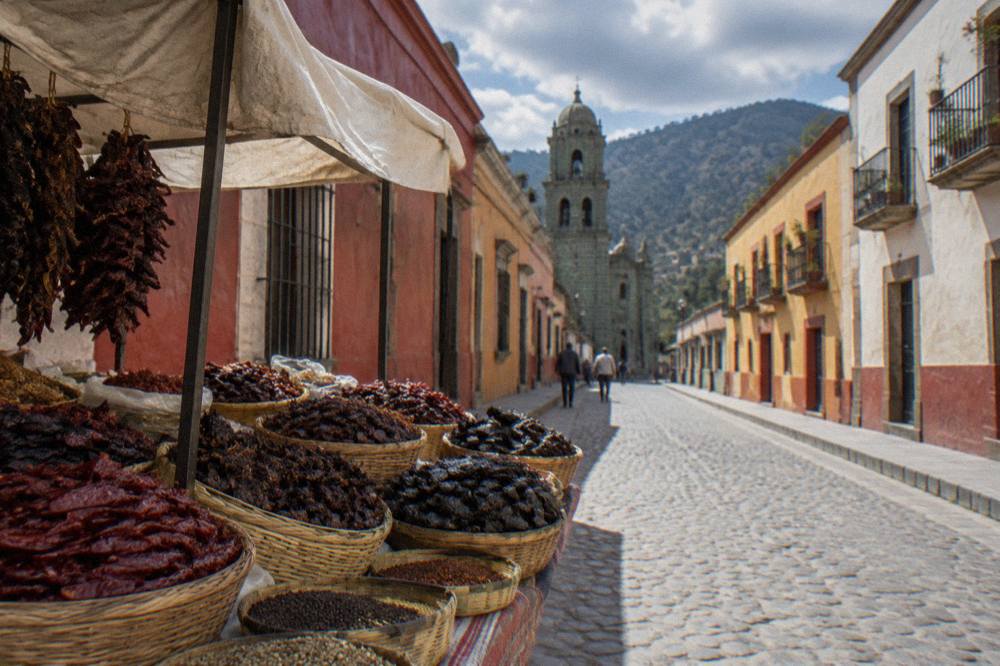
The two anchor markets sit side by side south of the centre. Mercado 20 de Noviembre is the food market, founded in 1893, with a tianguis element on Saturdays per the state government's own description of the market system. Mercado Benito Juárez, inaugurated in 1894, is the historic general market where classes often buy chillies, spices and chocolate. Official pages do not publish market opening hours, so treat the class's own meeting time as the operative schedule: the operator decides when the walk starts.
Some classes extend the sourcing further afield. The weekly regional markets of the Valles Centrales, Tlacolula, Ocotlán, Etla and Zaachila, each run on their own market day, and the state's own communications describe them as part of a tianguis and trueque tradition in the valleys, without publishing schedules. Our Tlacolula Sunday market day-trip guide and our answer page on what Tlacolula market is known for cover that scene; for a first class, the central markets are the default because they are walkable from anywhere in the historic centre.
What you buy is the menu. A mole class loads up on chiles, nuts, seeds and chocolate; a tortilla and salsa session buys masa or dried corn; a vegetarian class buys vegetables, quesillo and herbs. The instructor explains the difference between ingredients that look identical to an outsider, and that stall-side explanation is the part travellers consistently mention in reviews of the top-listed classes.
Which Dishes Do Oaxaca Cooking Classes Teach?
The standard Oaxaca cooking class menu teaches mole, plus handmade corn tortillas and fresh salsas. Classes vary by theme: some build the menu around a single mole, others add tlayudas or quesillo, and a few focus tightly on salsas and tortillas. A drink such as agua fresca, tejate or hot chocolate usually appears, with the exact menu set by each class listing. Mole is the centrepiece because it is the dish least reproducible without instruction: dozens of ingredients, each prepared separately, then combined. Tortillas are the counterweight, pure technique, learned by hand in minutes of coaching and ruined without it.
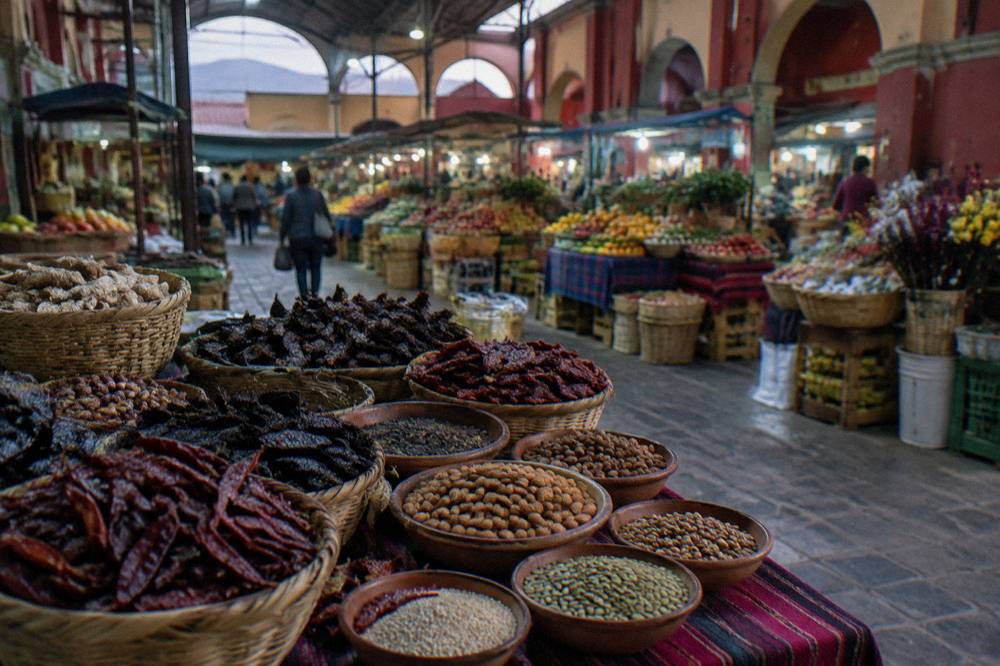
The sauce families behind mole are set out in full in our guide to Oaxacan mole, which pairs well with this page when you want the theory behind the class. Around that core, classes vary by theme. Some build the menu around a single mole; others add tlayudas, the large toasted tortilla dish, or quesillo, the string cheese that the state produces in its own right, covered in our cheese pages. Chocolate recurs as both ingredient and drink, and Oaxacan chocolate has its own traditions, which we treat separately in the guide to Oaxacan chocolate. A few classes teach a full festive menu; a few focus tightly on salsas and tortillas.
The table below maps the dishes you will meet to what the class session actually trains:
| Dish Or Drink | What The Class Teaches You To Do | Where You Source It On The Market Walk |
|---|---|---|
| Mole | Toast and blend chiles, nuts, seeds and spice into a finished sauce | Dried chile stalls and spice vendors |
| Corn tortillas | Work masa by hand and press and cook on a hot comal | Masa mill or tortilleria, or dried corn |
| Salsas | Roast, boil or raw-blend chile, tomato, onion and garlic | Vegetable and chile stalls |
| Tlayudas | Assemble and toast the large tortilla with beans, quesillo and meat or vegetables | Tortilleria and quesillo vendors |
| Tejate | Recognise the drink and its maize-and-cacao base | Drink stalls in the central markets |
| Hot chocolate | Froth the chocolate traditionally served with bread | Chocolate mills near the markets |
That structure, source then cook, is what separates a Oaxaca class from a demonstration cooking evening elsewhere. If a full market-and-kitchen day sounds like more commitment than you want, the lighter alternative is a dedicated tasting walk, and the food tour options for Oaxaca City cover those.
If the cooking class is the one that settles the trip, the box below goes straight to it.
Mole, Tortillas And Salsas: The Hands-On Part Explained
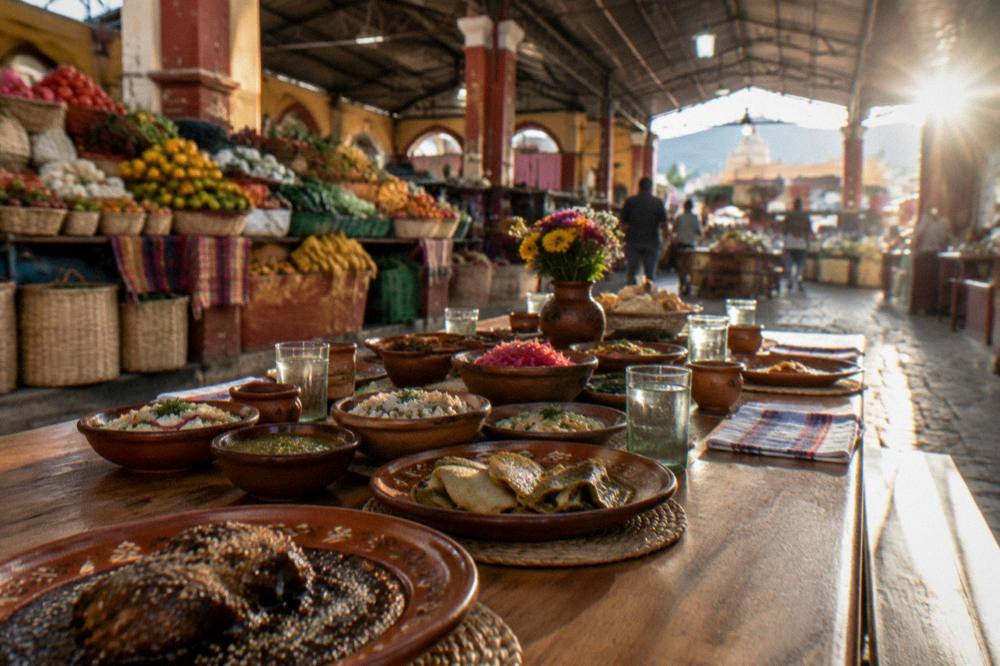
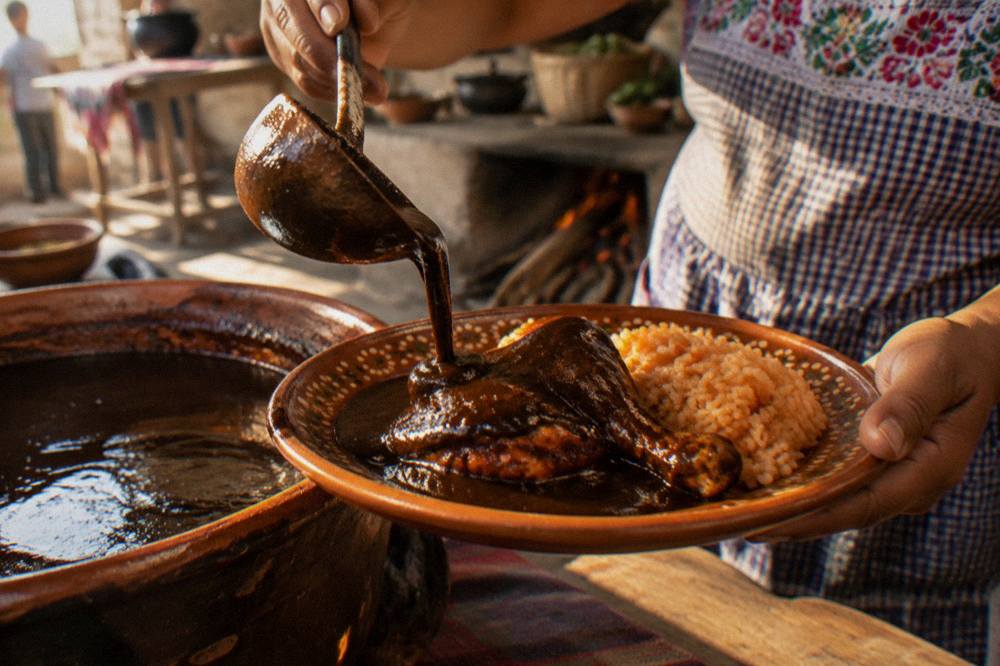
In the kitchen phase of an Oaxaca cooking class you personally toast, blend, press and cook: mole ingredients are toasted in sequence, salsa components are roasted or blended, and tortillas are pressed by hand and cooked on a comal until you can do one unaided. Instructors demonstrate each step, then hand over the tool. There is no spectator role. By the end, the group eats the full menu together, which is the point of the exercise.
Mole work is the longest stage. Each ingredient is treated before anything combines: chiles are cleaned and toasted, seeds and nuts are toasted separately, and the blending happens in stages so the sauce builds layer by layer. The class teaches why the order matters, and that is the knowledge a restaurant meal cannot transfer. Our Oaxacan mole guide sets out the sauce families; the class makes one of them tangible.
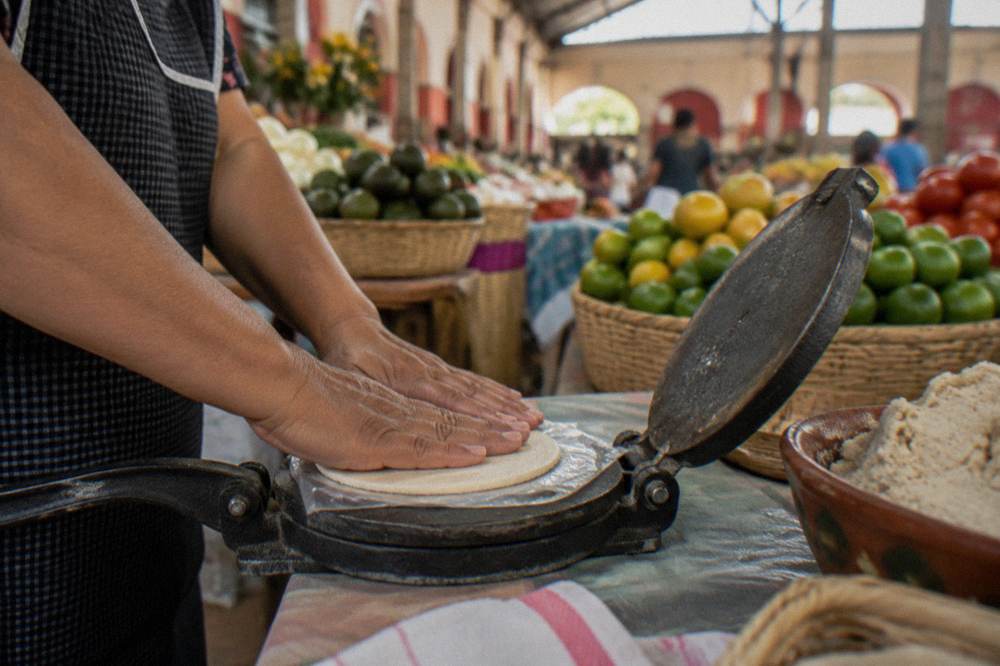
Tortillas are the fastest skill and the most satisfying. You work masa into balls, press them, and lay them on the comal, watching for the moment they puff. Salsas fill the gaps between the two, and each class usually produces two or three: a roasted salsa, a raw salsa and something with more chile heat. Drinks and dessert round out the menu, often including hot chocolate or agua fresca made from whatever fruit the market yielded that morning. Other pages covering the same trip are gathered on Oaxaca Travel Guide.
Are There Vegetarian And Vegan Cooking Classes In Oaxaca?
Yes: Oaxaca City has dedicated vegetarian cooking classes with their own market tours, including a listed vegetarian class that shops for vegetables, herbs and quesillo and cooks a meat-free Oaxacan menu, and vegan adaptations are commonly arranged by asking the operator before booking. The vegetarian format matters in Oaxaca because so much of the classic repertoire, including several moles, can be built without meat stock, and the market walk makes the substitution visible rather than theoretical.
The site's featured class for this page is exactly that product: the vegetarian cooking class with local market tour, which the listing describes as a market visit followed by a hands-on vegetarian session. If the date matters to your itinerary, Check availability on the operator's booking page.
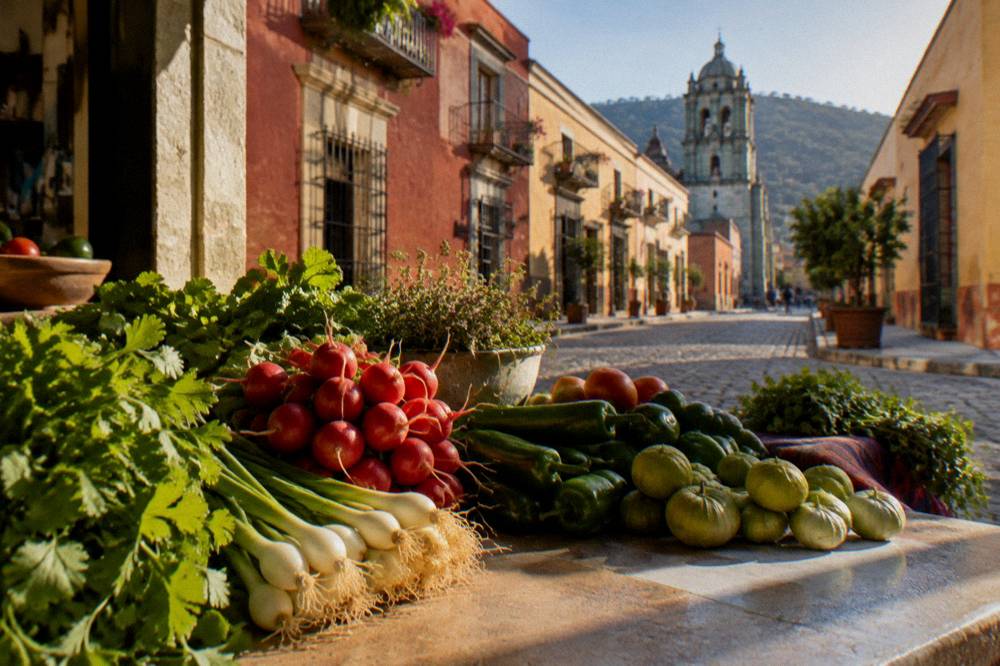
For travellers weighing the food side of the trip more broadly, our one day in Oaxaca itinerary shows where a class slots into a short visit, and the vegetarian food landscape beyond classes is wide enough that we cover it in its own right. The honest summary: a vegetarian visitor loses very little in Oaxaca, and a vegetarian class is the most direct route into the cuisine's techniques.
How Much Do Oaxaca Cooking Classes Cost?
Classes in the city are priced per person, all ingredients and the market walk are included in the listed products, and the group classes cluster at a lower per-person price than private formats. When a listing's current price matters to your decision, the live listing is the source.
To compare formats rather than figures: the traditional classes teach the fullest classic menu; the vegetarian class builds the same technique set without meat; the market-immersion products fold more of the market into the experience. Solo blocks elsewhere on this page print each product's live figures directly, and the bands above show the three products this site pairs with a cooking-class page: the vegetarian class, an alebrije painting workshop for a craft-day alternative, and a Benito Juárez National Park trek for an outdoor contrast.
Local costs that are not bookable products are in pesos. For context on the wider budget picture, including what a trip to the city costs beyond classes, our itinerary and budget pages carry the detail, and transport realities such as getting around Oaxaca and where to stay in Oaxaca matter more to the total than the class itself.
Cooking Class Or Food Tour: Which Suits You?
Choose a cooking class if you want to leave with technique and a full meal you cooked yourself; choose a food tour if you want to taste more dishes across more stops in the same hours, and choose a mezcal tasting if the interest is drink rather than food. The formats overlap on markets, since both tour them, but a class stops and cooks while a tour keeps moving.
| Format | Time Shape | What You Leave With | Best Fit |
|---|---|---|---|
| Cooking class | Market walk plus kitchen session, meal at the end | Recipes, techniques, one full menu | Travellers who cook at home |
| Food and markets tour | Walking, multiple tasting stops | A broad tasting survey of the city | First-time visitors with limited time |
| Mezcal tasting | Seated or distillery-visit format | Tasting vocabulary for mezcal | Drink-focused travellers |
| Craft workshop | Studio session, often outside the centre | A finished handmade object | Families and rainy-day planners |
The weather can tip this decision, and the city's climate is strictly two-season. The SMN station normals for Oaxaca give the monthly picture:
| Month | Mean Daily High (C) | Mean Rain (mm) | Mean Days With Rain |
|---|---|---|---|
| Jan | 28.9 | 2.4 | 1.4 |
| Feb | 31.1 | 4.6 | 1.1 |
| Mar | 33.3 | 17.6 | 4.1 |
| Apr | 34.9 | 47.3 | 7.6 |
| May | 33.8 | 97.9 | 13.7 |
| Jun | 30.9 | 188.3 | 19.9 |
| Jul | 30.1 | 118.6 | 20.4 |
| Aug | 30.0 | 131.8 | 20.5 |
| Sep | 29.1 | 163.6 | 21.4 |
| Oct | 29.3 | 63.1 | 12.0 |
| Nov | 29.0 | 9.1 | 3.5 |
| Dec | 28.9 | 9.0 | 2.4 |
Dry season runs November to April and rainy season May to October, with June to September the peak of the rain. A market walk plus kitchen day works in either season; a walking food tour with many outdoor stops is more exposed, and our Oaxaca in the rain itinerary is built for exactly those months.
How To Fit A Cooking Class Into Your Oaxaca Itinerary?
Book a cooking class on day two or three of a trip to Oaxaca City, after you have seen the historic centre but before your final restaurant nights, because the class recalibrates how you read every later menu you order from. A class takes roughly half a day including the market walk, which leaves the afternoon open for something else. The ruins, the craft villages and the valley all sit close enough that the same day can hold both halves.
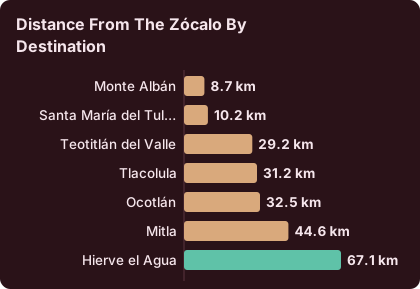
The city's position makes pairing easy. Monte Albán is about 15 minutes' drive from the Zócalo, Mitla about 37, Hierve el Agua about 57. Derived drive times from the centre, free-flow and rounded up, with real traffic and mountain roads slower:
| Destination | Distance From The Zócalo | Free-Flow Drive Time |
|---|---|---|
| Monte Albán | 8.7 km | About 15 min |
| Santa María del Tule | 10.2 km | About 11 min |
| Teotitlán del Valle | 29.2 km | About 26 min |
| Tlacolula | 31.2 km | About 25 min |
| Ocotlán | 32.5 km | About 37 min |
| Mitla | 44.6 km | About 37 min |
| Hierve el Agua | 67.1 km | About 57 min |
For a one-week visit, a natural arc runs a first-day orientation walk, the class on day two, then the valley day trips and the coast extensions. Longer plans are laid out in our four days in Oaxaca itinerary. Classes run year-round, but if your trip targets the July Guelaguetza period or the late-October Día de Muertos dates, book the kitchen day well ahead, since the whole city's capacity tightens around the festivals and the 2026 Guelaguetza's Palco A and B seats sold out rapidly per the state's own release.
What Should You Know Before Booking A Class?
Before booking an Oaxaca cooking class, check three things on the operator's booking page: the meeting point and whether hotel pickup is included, the menu and its vegetarian or vegan flexibility, and the cancellation terms, which on the featured products vary from product to product.
Dietary needs come first. Nut allergies matter more here than in most cuisines, because moles are built on nuts and seeds; tell the operator at booking, not on arrival. Spice tolerance is the other variable: salsas are made to taste, but the dried chiles bought at market vary, and the class can moderate heat if it knows in advance. Language is rarely a barrier: the listed classes operate in Spanish and English.
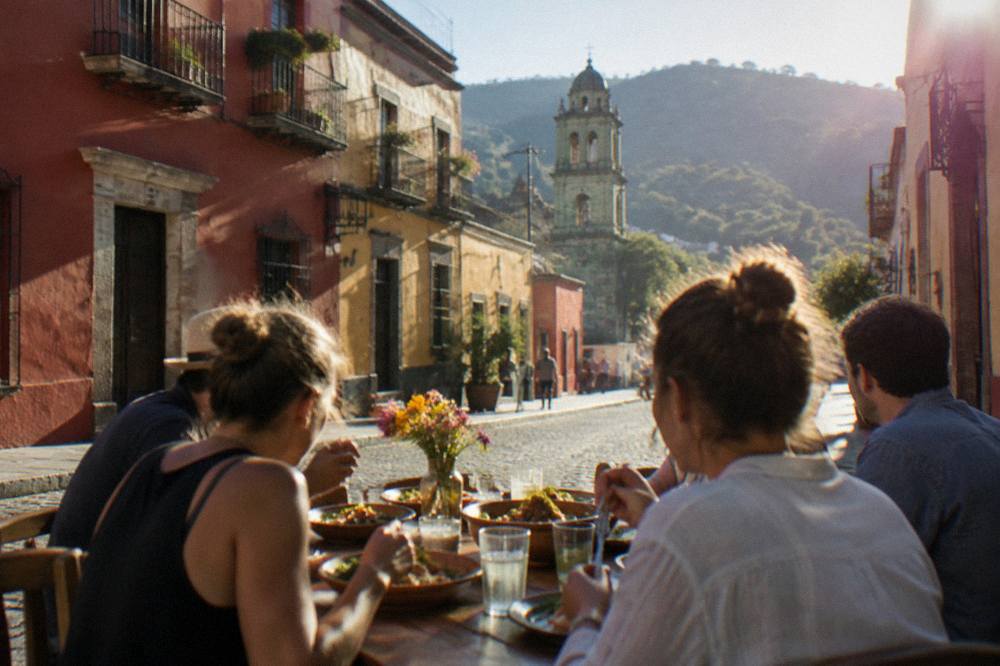
Then think about the day's shape. A class with a market walk starts in the morning by design, since that is when the markets are at their fullest, and the meal lands at midday, the main eating time in Mexico. Wear closed shoes for the kitchen, bring a small bag for the market phase, and arrive hungry. If you are combining the class with an afternoon at an INAH site, note the site-specific rules: Monte Albán is open Monday to Sunday 08:00 to 17:00 with last access at 16:00 and charges 105 MXN for nationals and 210 MXN for foreign visitors, while the Museo de las Culturas de Oaxaca opens Tuesday to Saturday only, 10:00 to 16:00.
If a vegetarian menu is not what you are after, the traditional formats below and further up this page carry the classic mole-and-tortilla menu.
Common Questions About Oaxaca Cooking Classes
Do Oaxaca Cooking Classes Include The Market Visit?
Most listed classes in Oaxaca City do. The typical format is a guided walk through Mercado 20 de Noviembre or Mercado Benito Juárez to buy the day's ingredients, followed by the kitchen session. The exact format is stated on each operator's booking page.
What Dishes Will I Cook In An Oaxaca Cooking Class?
The core menu in most classes is a mole, handmade corn tortillas and fresh salsas, often with a drink such as hot chocolate or agua fresca, and sometimes tlayudas or a dessert. Vegetarian classes build the same technique set without meat.
Are There Vegetarian Or Vegan Cooking Classes In Oaxaca City?
Yes. The city has dedicated vegetarian classes with their own market tours, and vegan adaptations are commonly arranged by contacting the operator before booking. The featured class on this page is a vegetarian class with a market visit.
How Long Does A Cooking Class In Oaxaca Take?
Class lengths vary by product, and each operator's booking page prints the exact duration alongside price and rating. As a shape, the market walk plus kitchen session plus shared meal fills a morning through midday.
Where Do Cooking Classes In Oaxaca Meet?
Most meet at or near the central markets south of the Zócalo, since the market walk is the first stage of the class. Some products include pickup; the operator states the meeting arrangement for each one.
Can Children Join An Oaxaca Cooking Class?
Many classes welcome children, and the hands-on tortilla and salsa work suits them. Check the operator's booking page for any age policy before booking, and see our family pages for wider planning.
A cooking class is the single most transferable souvenir Oaxaca City sells: the market route, the mole method and the tortilla hand stay with you long after the trip, and one morning in a Oaxaca kitchen will change how you cook at home.