Where To Stay In Oaxaca: Centro, Jalatlaco Or Reforma
Oaxaca City is an inland highland capital at about 1,550 m in the Valles Centrales, and almost every visit turns on one decision: sleep inside the historic core, in Jalatlaco, or out along Reforma. This guide compares the three bases with figures on distances, seasons, taxes and admissions.
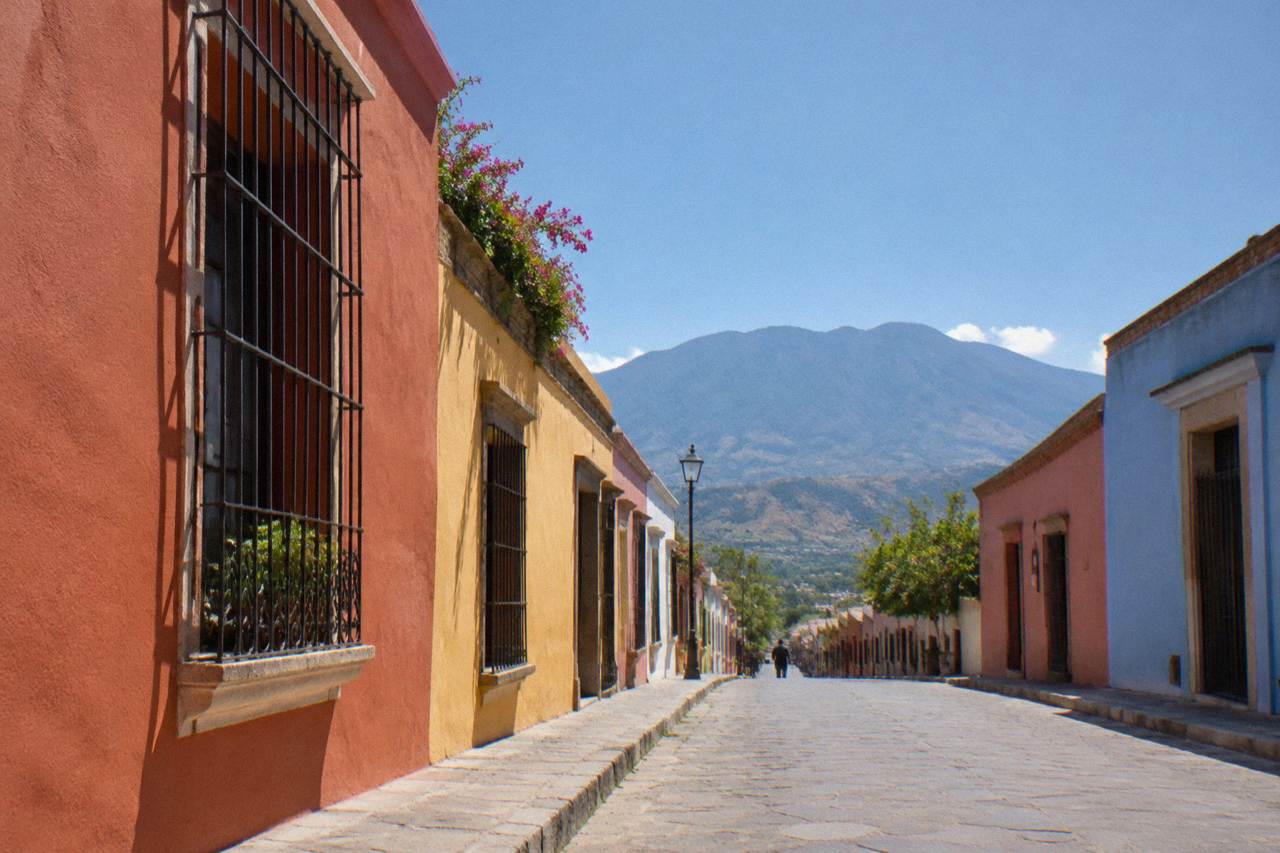
Centro Histórico is the practical base for a first visit: the Zócalo, Santo Domingo de Guzmán and the Andador Macedonio Alcalá are all walkable, and the 2025 city count of 1,324,332 arrivals tells you where services cluster. Jalatlaco sits a short walk from the centre with a quieter, residential feel, while Reforma stretches east toward the ADO buses and the airport road.
Oaxaca de Juárez, the capital of the state of Oaxaca in Mexico, is an inland highland city in the Valles Centrales at about 1,550 m, and its hotel stock concentrates in three pockets: the Centro Histórico around the Zócalo, the neighbouring barrios of Jalatlaco and Xochimilco, and the long Reforma corridor east of the centre. The choice shapes everything else in a trip, from which morning market is closest to how long the drive to Monte Albán feels. For a wider look at the options, the Oaxaca Travel Guide covers every area of the city.
Where To Stay In Oaxaca City: Which Neighbourhood Fits Your Trip?
For a first visit of two to three nights, the Centro Histórico is the default answer: it puts the Zócalo, Santo Domingo de Guzmán, the Andador Macedonio Alcalá and the Mercado 20 de Noviembre within one walkable core, and the average stay in the city in 2025 was 2.00 nights. Jalatlaco suits travellers who want a residential barrio beside the centre, and Reforma suits longer stays, drivers and anyone who values quick access east toward the ADO terminals and the airport road. Nothing in the city is far from anything else: the whole built-up centre fits between the Cerro del Fortín and the eastern suburbs, and the state's entire population is 4,132,148 spread across a far larger territory than the capital alone.
The comparison below is the short version. Each neighbourhood then gets its own section with the facts that attach to it.
| Base | Character | Best fits | Full page |
|---|---|---|---|
| Centro Histórico | The UNESCO-listed core around the Zócalo and the Andador Macedonio Alcalá | First visits, short stays, walk-everywhere trips | /areas/oaxaca-centro-historico/ |
| Jalatlaco | A low-rise barrio of painted houses beside the centre | Visitors who want quiet nights near everything | /areas/jalatlaco/ |
| Reforma | The long corridor east of the centre | Longer stays, drivers, bus-and-airport access | /areas/reforma-oaxaca/ |
Two facts frame any stay. The city recorded 1,324,332 tourist arrivals in 2025, of which 1,111,799 were national and 212,533 foreign, and hotel occupancy across the year averaged 51.73 percent, per the state tourism indicators. Those numbers describe a city that is busy but not saturated outside the festival peaks, which means the neighbourhood choice is about character and convenience, not scarcity.
Is Centro Histórico The Best Base For A First Visit To Oaxaca?
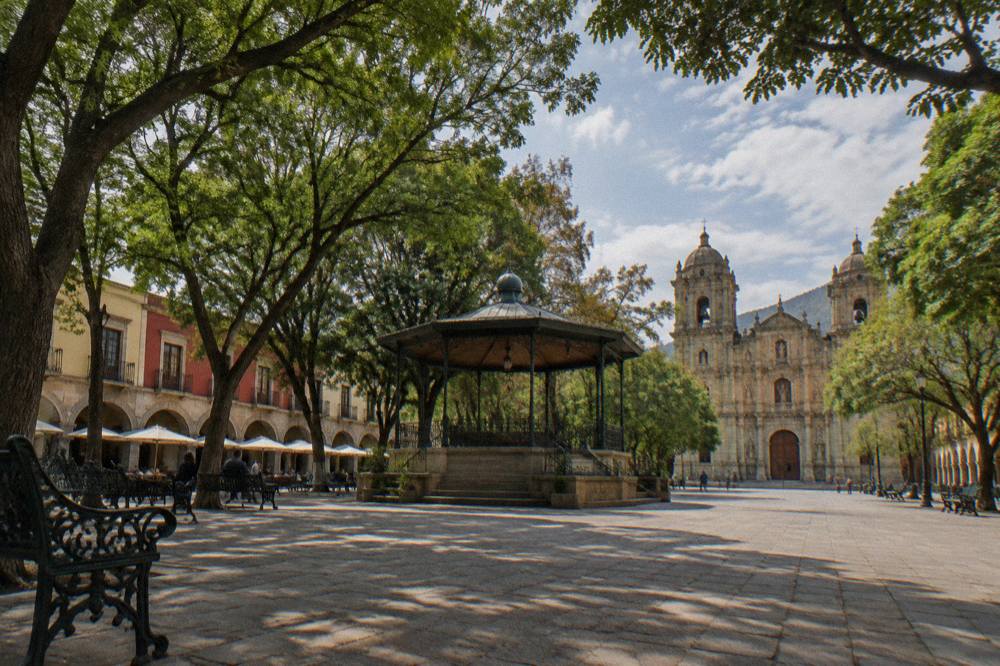
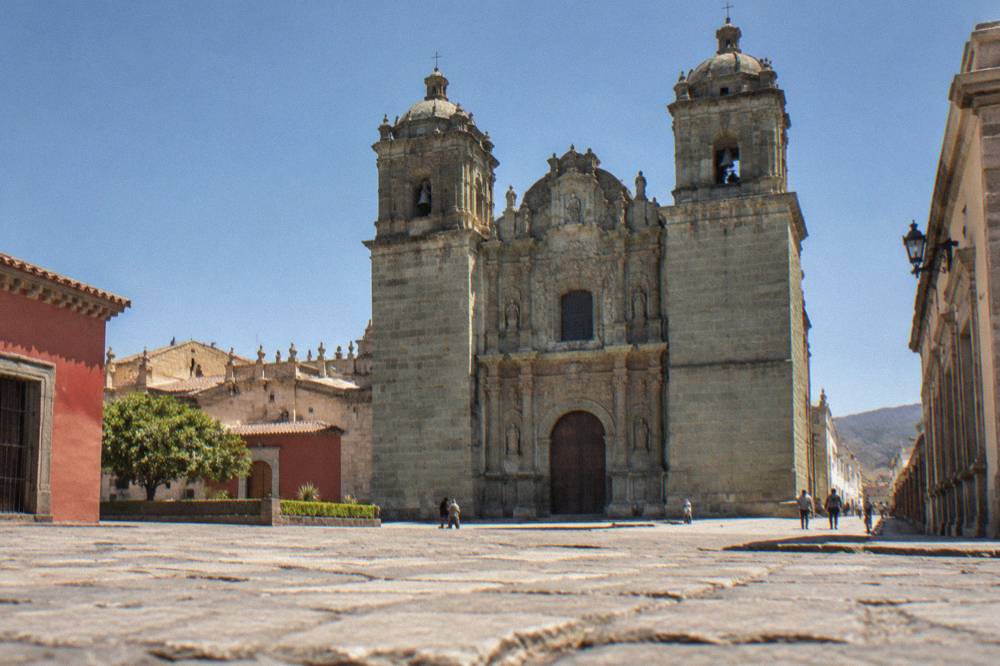
Yes, for most itineraries: the Centro Histórico places the Zócalo, the Cathedral, the Basílica de la Soledad, the Andador Macedonio Alcalá and Santo Domingo de Guzmán inside one walkable core, and the UNESCO property is named "Historic Centre of Oaxaca and Archaeological Site of Monte Albán", so staying central means sleeping inside the inscribed area itself. The district also holds the Museo de las Culturas de Oaxaca, open Tuesday to Saturday 10:00 to 16:00 with admission at 105 MXN for nationals and 210 MXN for foreign visitors, and the Jardín Etnobotánico, whose free guided tours run Monday to Friday at 10:30, 11:00, 11:30, 12:00 and 17:00 and Saturday from 10:30 to 12:00.
The practical argument for Centro is time. Monte Albán is about 15 minutes by road from the Zócalo, roughly 8.7 km on free-flowing traffic, so central hotels sit closest to the departure points for the ruins and the valley day trips. The trade-off is noise and festival crowds: the Zócalo carries temporary Día de Muertos decorations mounted 25 to 28 October and removed after 6 November in the current pattern, and during Guelaguetza the whole core fills with the July programme's events.
Central does not have to mean loud. The blocks around Paseo Juárez El Llano and the streets south of the Zócalo toward the mercados are part of the historic core but sit a few streets back from the Andador. Anyone weighing a single-night or two-night visit, covered in detail on How Many Days In Oaxaca, will find the centre the only base that makes a one-day plan work, as laid out in the Oaxaca In One Day itinerary.
A culture and history walking tour is the fastest way to read the neighbourhood before committing to it, and the Culture, History and Traditions of Oaxaca City walk covers exactly the ground a Centro base gives you. You can Check availability on the operator's booking page.
What Is It Like To Stay In Jalatlaco?
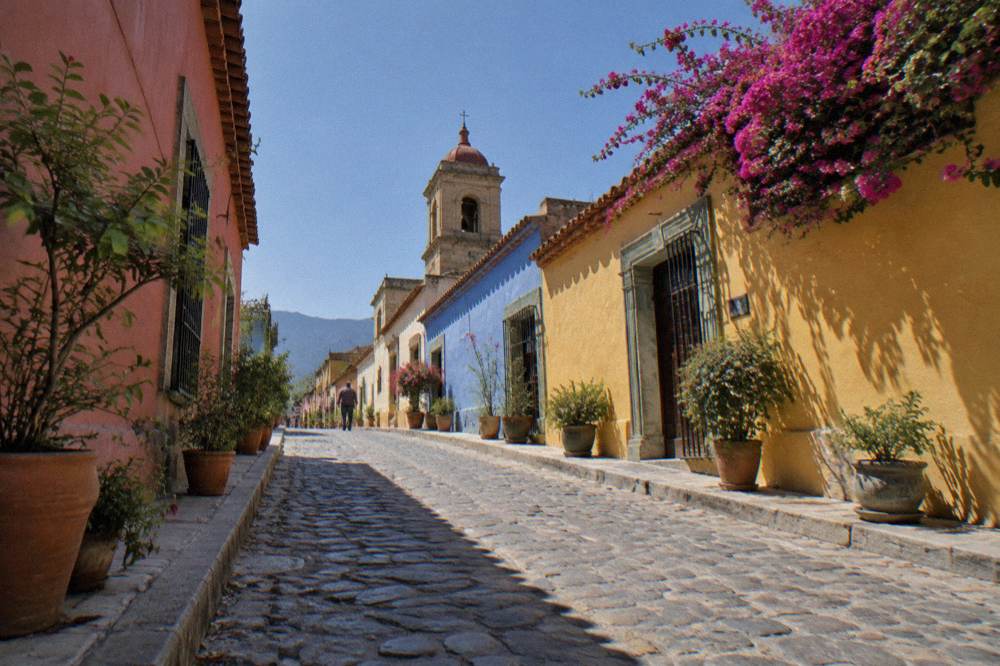
Jalatlaco is a low-rise barrio immediately beside the Centro Histórico, and it answers a specific question for visitors: where to sleep close to the centre without being on top of the Andador Macedonio Alcalá, in a neighbourhood that keeps its quiet evenings while leaving central mornings a walk away. The barrio appears throughout the city's Día de Muertos programme, with tapetes and decorated facades among its standing traditions, and it is one of the neighbourhoods the state's own festival communications name when describing where the celebrations concentrate alongside Xoxocotlán and the pantheons.
What the sources do not do is price or rank Jalatlaco against Centro; no official figure exists for hotel rates in either place, and this site does not invent one. What is verifiable is positional: Jalatlaco sits east of the Cerro del Fortín side of the centre, and everything in the historic core remains a walk away, while the corridor toward Reforma and the bus stations begins at its edge. That makes it a natural midpoint for visitors who want quiet evenings and central mornings.
Jalatlaco also carries a distinctive street-art presence, with mural tours of the barrio among the city's free-walk offerings. Travellers deciding between the barrio and the core can read the full Jalatlaco page and the broader Oaxaca Neighbourhoods overview before booking.
Is Reforma A Good Place To Stay In Oaxaca?
Reforma is the long corridor running east from the centre, and it suits three kinds of visitor: anyone staying longer than a long weekend, anyone with a car, and anyone who wants the fastest run at the ADO bus network and the airport road without paying central festival-night rates for the privilege. The airport, Xoxocotlán International, is operated by ASUR with normal operating hours of 06:00 to 20:00, and the highway east is the direction travelers leave for the coast, with Puerto Escondido about 165 minutes away on the new highway under free-flow conditions.
The honest weakness of Reforma is walking distance. The Zócalo, Santo Domingo de Guzmán and the mercados sit at the western end of the corridor, and a Reforma base means a taxi or colectivo ride for evening plans in the core. In exchange, the corridor sits closer to Santa Lucía del Camino, where the Feria del Mezcal runs each July at the Centro Cultural y de Convenciones with entry at about 80 MXN, and closer to the eastern departure points for valley transport.
Reforma is also the base that makes a Oaxaca In 2 Days or longer plan easier to pace, because the itinerary can split centre days from eastern days. Drivers should read Driving In Oaxaca before committing, and everyone arriving by air should check the Oaxaca Airport and Getting Around Oaxaca pages, since ride-hailing does not serve the terminal and onward transport is a planning item.
Which Other Neighbourhoods Work For Staying In Oaxaca City?
Xochimilco, the barrio directly north of the centre below the Cerro del Fortín, is the main fourth option: it keeps a residential scale while sitting within walking distance of the Andador Macedonio Alcalá, and its aqueduct-side streets carry their own walking-tour traditions. Beyond it, Santa Lucía del Camino and Xoxocotlán function as eastern and southern extensions rather than visitor bases, and the state's wider territory, from the Sierra Norte to the coast, is a matter of day trips and long extensions rather than city accommodation.
The one thing no neighbourhood choice changes is geography. Oaxaca City is inland, at altitude, with no sea and no river through town, so any instinct to book "near the water" misreads the map. The Pueblos Mancomunados in the Sierra Norte begin at Latuvi, about 142 minutes by road from the Zócalo, and the nearest Pacific beaches are a far extension beyond Puerto Escondido at about 165 minutes on the new highway. Both are covered on their own pages.
For visitors who prefer to let the itinerary pick the bed, the Oaxaca In 3 Days and longer plans explain how neighbourhood and pace interact, and Is Oaxaca A Walkable City... no external pages here; the walkability answer in brief: the historic core is compact and pedestrian-scaled, which is the structural reason the centre commands the attention it does. The What Part Of Oaxaca Is Best To Stay In answer page restates the short version for anyone skimming.
How Far Is Each Oaxaca Sight From The Centre?
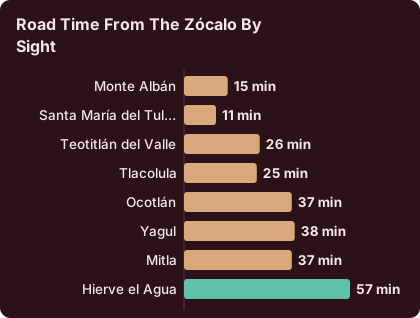
Every headline sight in the Valles Centrales sits within about an hour of the Zócalo by road: Monte Albán about 15 minutes, Santa María del Tule about 11, Tlacolula about 25, Teotitlán del Valle about 26, Mitla about 37, Ocotlán about 37, Yagul about 38 and Hierve el Agua about 57 under free-flow conditions. These are derived road times, computed on mapped roads without traffic; real traffic and mountain roads make them slower, so treat each as a floor rather than a promise.
The table a Centro or Jalatlaco base works from is below. Reforma sits slightly farther from the western valley sights and slightly closer to the eastern ones, by a margin of minutes, not hours.
| Sight | Road time from the Zócalo | Notes |
|---|---|---|
| Monte Albán | About 15 minutes | INAH site, daily 08:00 to 17:00, last access 16:00 |
| Santa María del Tule | About 11 minutes | The Tule tree sits by the church |
| Teotitlán del Valle | About 26 minutes | Weaving village in the Tlacolula Valley |
| Tlacolula | About 25 minutes | Valley town east of the city |
| Ocotlán | About 37 minutes | Valley town south of the city |
| Yagul | About 38 minutes | INAH Category I, daily 08:00 to 17:00 |
| Mitla | About 37 minutes | INAH Category I, last access 16:30 |
| Hierve el Agua | About 57 minutes | Fees and hours are set by the local community |
Zaachila is the schedule outlier: it opens Thursday to Sunday only, 10:00 to 16:00, which matters if a valley circuit lands on a Monday.
| Site | Category | Nationals (MXN) | Foreign visitors (MXN) | Hours |
|---|---|---|---|---|
| Monte Albán, Mitla, Yagul | I | 105 | 210 | Daily 08:00 to 17:00 |
| Dainzú, Lambityeco, Zaachila | III | 80 | 145 | Zaachila Thu to Sun 10:00 to 16:00 |
| Museo de las Culturas de Oaxaca | Museum | 105 | 210 | Tuesday to Saturday 10:00 to 16:00 |
A base in the centre keeps all of this reachable on tours or colectivos; a base in Reforma keeps the eastern half of the list marginally closer. Neither changes the distances materially, which is why the neighbourhood decision is about atmosphere and evenings rather than logistics.
How Does The Season Affect Where You Stay In Oaxaca?
The dry season runs November to April and the rainy season May to October, with the heaviest rain concentrated June to September: June averages 188.3 mm, September 163.6 mm, August 131.8 mm and July 118.6 mm, against 2.4 mm in January and 9.0 mm in December, per the SMN station normals for 1991 to 2020. Season shapes the neighbourhood choice less than it shapes the calendar: festival dates, not rainfall, are what compress the city's accommodation.
| Month | Mean high C | Mean low C | Rain mm | Days with rain |
|---|---|---|---|---|
| January | 28.9 | 10.3 | 2.4 | 1.4 |
| February | 31.1 | 11.6 | 4.6 | 1.1 |
| March | 33.3 | 13.6 | 17.6 | 4.1 |
| April | 34.9 | 15.8 | 47.3 | 7.6 |
| May | 33.8 | 16.7 | 97.9 | 13.7 |
| June | 30.9 | 16.7 | 188.3 | 19.9 |
| July | 30.1 | 15.9 | 118.6 | 20.4 |
| August | 30.0 | 15.9 | 131.8 | 20.5 |
| September | 29.1 | 16.1 | 163.6 | 21.4 |
| October | 29.3 | 14.5 | 63.1 | 12.0 |
| November | 29.0 | 12.3 | 9.1 | 3.5 |
| December | 28.9 | 11.0 | 9.0 | 2.4 |
April carries the highest mean daily high at 34.9 C and January the lowest mean nightly low at 10.3 C, so packing for the same week can mean sun protection and a jacket for the evening. Rooms with fans or shade matter in April; a roof that holds in a June downpour matters more. The month-by-month detail sits on the Oaxaca Weather By Month page, and the timing trade-offs are on Best Time To Visit Oaxaca.
What Should You Know About Costs, Taxes And Booking In Oaxaca?
The state lodging tax, the Impuesto al Hospedaje, is 3 percent on hotel-type stays and 5 percent where an intermediary or platform collects the payment, under decree 884 published 10 December 2025, and it is charged on top of the room rate. No public figure exists for typical nightly hotel prices in Oaxaca, so this site prints none: room rates are checked on the operator's own listing, and the standing costs that can be stated are the admissions and taxes below.
| Item | Figure | Basis |
|---|---|---|
| Lodging tax, direct stay | 3 percent | State decree 884, 10 December 2025 |
| Lodging tax, via platform | 5 percent | Same decree |
| Monte Albán admission | 105 / 210 MXN | INAH Category I |
| Jardín Etnobotánico guided tour | Free | Monday to Friday 10:30 to 17:00 slots, Saturday 10:30 to 12:00 |
| City arrivals, 2025 | 1,324,332 | State tourism indicators |
Payment and cash handling have their own page, Money, ATMs And Cash In Oaxaca, and overall trip budgeting is on Oaxaca Travel Costs And Budget. The timezone is stable year-round at UTC-6, since Mexico abolished seasonal clock changes with the law published 28 October 2022, so arrival times and check-in times need no seasonal adjustment.
Is Any Part Of Oaxaca City Unsafe For Visitors?
The UK FCDO advises against all but essential travel to parts of Mexico and does not name Oaxaca on its main page; Canada advises a high degree of caution in Mexico overall with regional advisories; the US State Department lists Oaxaca state at Level 2, exercise increased caution, with restrictions applying only in the Isthmus region. None of the three advisories singles out any neighbourhood of Oaxaca City, so the Centro, Jalatlaco and Reforma comparison is not a safety comparison in any direction.
The standing practical risk is disruption, not crime: road blockades by teachers' unions occur sporadically and can interrupt highway and airport access for hours at a time. Any date given to such an event would be invented, so the honest advice is simply to keep a buffer around airport-bound travel days. The full picture, including advisory wording, is on Is Oaxaca Safe, and the overnight-equivalent question is handled on Oaxaca At Night.
Common Questions About Where To Stay In Oaxaca
Where To Stay In Oaxaca: Centro, Jalatlaco Or Reforma?
Centro Histórico for a first visit and short stays, Jalatlaco for quiet beside the centre, Reforma for longer stays, drivers and bus or airport access. All three sit inside the same compact city, and every headline sight is within about an hour of the Zócalo by road.
Is It Better To Stay In The Center Of Oaxaca?
For a first trip of two or three nights, yes: the average stay in 2025 was 2.00 nights, and a central base puts the Zócalo, Santo Domingo de Guzmán, the Andador Macedonio Alcalá and the mercados within walking distance, with Monte Albán about 15 minutes away by road.
Is Jalatlaco Walkable To The Centro Histórico?
Yes, Jalatlaco sits directly beside the historic core, and its streets carry their own walking-tour traditions, including free-walk street-art tours. No official walking-time figure exists, but the barrio is contiguous with the centre, not separated from it.
What Is The Cheapest Area To Stay In Oaxaca?
Structurally, rooms farther from the Zócalo and the Andador Macedonio Alcalá face lower demand, and the lodging tax is 3 percent on hotel-type stays either way.
When Should I Book Accommodation For Oaxaca Festivals?
Book early for July's Guelaguetza and the late-October-to-early-November Día de Muertos period, the two windows the state's own communications treat as the peaks. Guelaguetza 2026 tickets went on sale 15 May 2026 with paid sections selling out fast, which indicates the pressure on rooms for those dates.
Does It Matter Which Neighbourhood I Choose For Day Trips?
Only marginally. Monte Albán is about 15 minutes from the Zócalo, Mitla about 37, Hierve el Agua about 57, and valley tours depart from the centre; Reforma sits a few minutes closer to the eastern valley towns, Jalatlaco is effectively central for departure purposes.