Oaxaca Vs Mexico City: Which To Visit First
Oaxaca City is a highland state capital of 270,955 people about 1,550 m up in the Valles Centrales, while Mexico City is the country's largest urban hub. The comparison comes down to scale, pace and what each city gives access to.
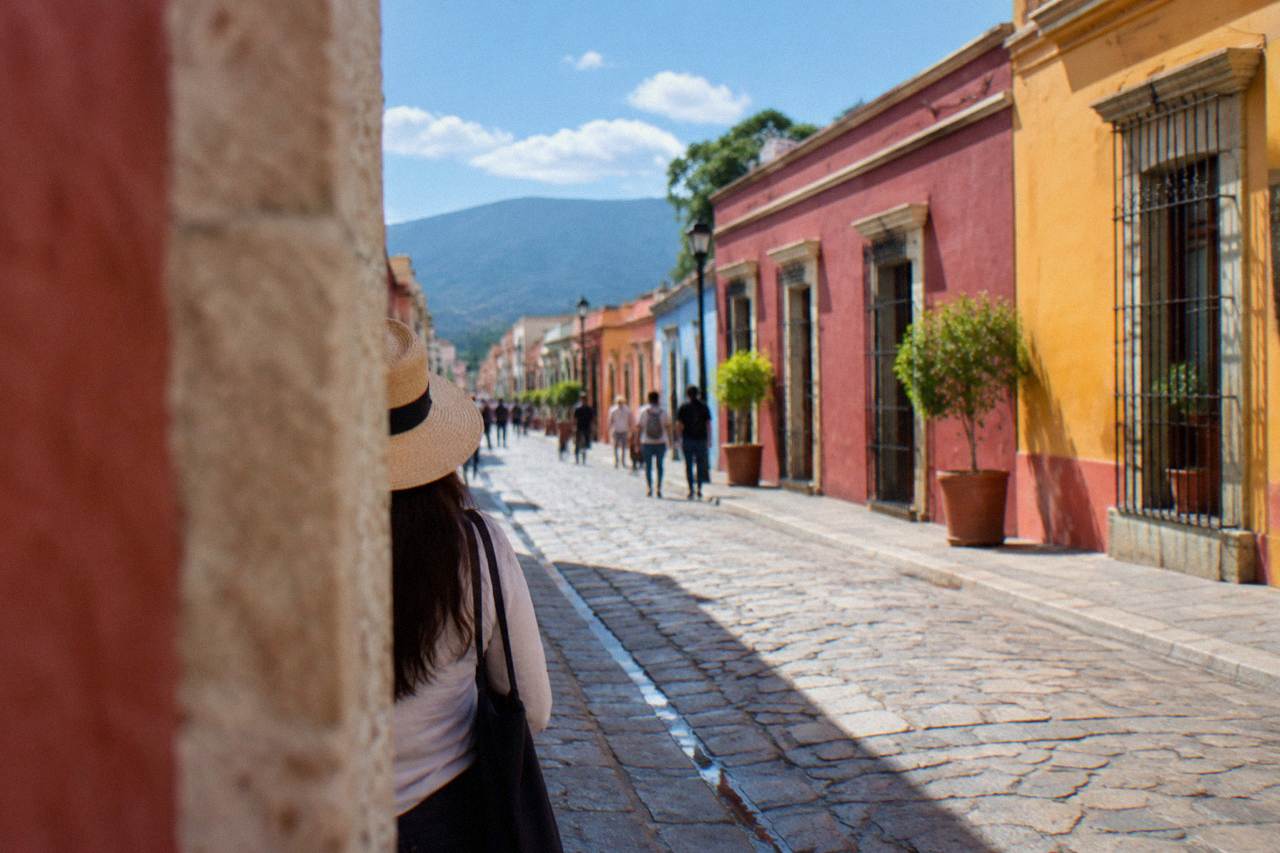
Oaxaca City suits a first trip focused on markets, mezcal, ruins and craft villages within an hour of the centre; Mexico City suits a first trip built on museums and metropolitan scale. Many travellers combine both, and the route between them is well served.
Oaxaca City, officially Oaxaca de Juárez, is the capital of the state of Oaxaca in Mexico: an inland highland city in the Valles Centrales at about 1,550 m, with 270,955 residents in the municipality at the 2020 census and no sea, port or beach anywhere in the city. Mexico City, by contrast, is the country's principal metropolis and transport hub, and the two are far enough apart that the order in which you visit them shapes the whole trip. This page compares them on size, travel between them, what Oaxaca uniquely offers, climate, time needed and cost structure, with booking suggestions for the tours that compress the Oaxaca side of the decision. The broader Oaxaca Travel Guide covers each of these topics in more depth.
Is Oaxaca Or Mexico City Better For A First Trip To Mexico?
For a first trip built around markets, ruins, mezcal and craft traditions within about an hour of one walkable centre, Oaxaca City is the stronger fit; for a first trip built on museums and metropolitan scale, Mexico City is. Oaxaca recorded 1,324,332 tourist arrivals in 2025 against a municipal population of just 270,955, so the city's economy and daily rhythm revolve around visitors in a way a megalopolis does not, while its sights stay clustered in the Centro Histórico.
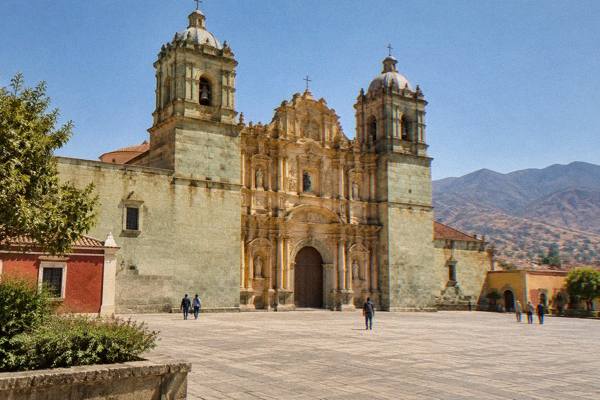
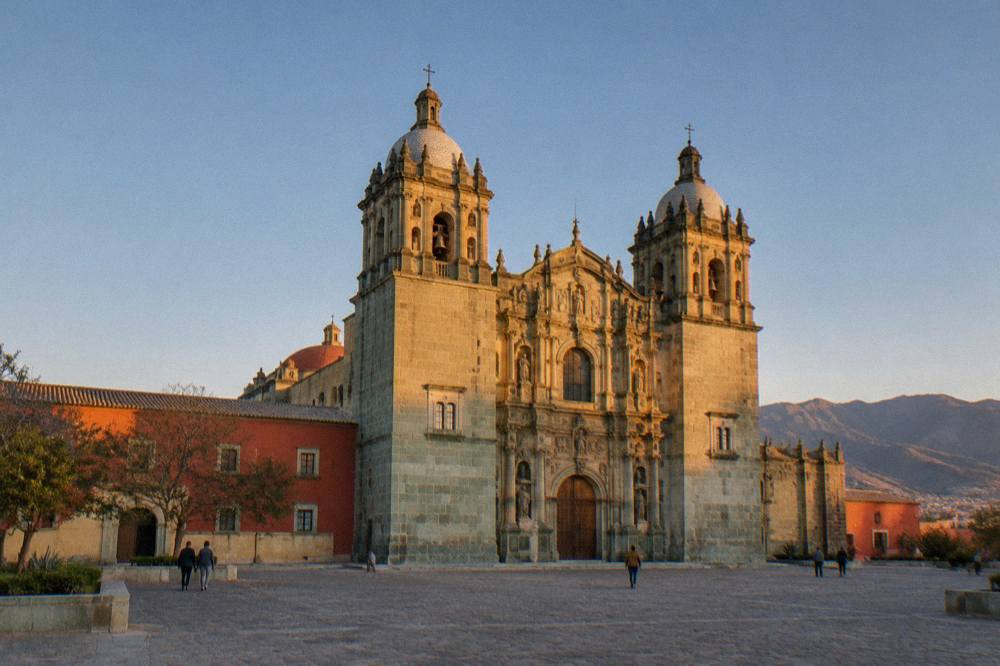
Neither choice is wrong, and the honest framing is structural rather than a ranking. Oaxaca City packs its core sights, the Zócalo, Santo Domingo de Guzmán, the Andador Macedonio Alcalá and the markets, into a compact UNESCO-listed historic centre: the property is inscribed as "Historic Centre of Oaxaca and Archaeological Site of Monte Albán", World Heritage property 415. From the Zócalo, Monte Albán is about 15 minutes away by road, Santa María del Tule about 11, Teotitlán del Valle about 26 and Hierve el Agua about 57. That concentration is what a first-time visitor trades against Mexico City's sheer mass.
A first Mexico City trip usually means a longer stay and more transit between districts; a first Oaxaca trip usually means walking out of your hotel door into the historic centre each morning. If your available time is under five days, that difference matters more than any single sight on either side.
For orientation on the Oaxaca side, the site's first time in Oaxaca primer lays out the practical sequence, and the full things to do in Oaxaca index lists every category in one place.
How Do Oaxaca And Mexico City Compare On Size And Atmosphere?
Oaxaca City is small enough that its entire visitor economy fits inside one historic centre: 270,955 municipal residents at the 2020 census, a state population of 4,132,148 around it, and an average tourist stay of 2.00 nights in 2025, with hotel occupancy at 51.73 percent. Mexico City operates on an entirely different scale, and the comparison is between a valley capital you walk and a metropolis you ride.
The numbers describe the difference better than adjectives. Oaxaca's 2025 arrivals split 1,111,799 national and 212,533 foreign visitors, 83.95 percent national and 16.05 percent foreign, which tells you the city is a Mexican destination first and an international one second. The average stay of 2.00 nights also tells you something practical: most people treat Oaxaca as a short, dense visit or as a base for valley day trips, not as a week-long city break in the metropolitan sense.
| Oaxaca City fact | Figure | Source basis |
|---|---|---|
| Municipal population | 270,955 | INEGI Censo 2020 |
| State population | 4,132,148 | INEGI Censo 2020 |
| Tourist arrivals, 2025 | 1,324,332 | Sectur Oaxaca indicators |
| Foreign share of arrivals | 16.05 percent | Sectur Oaxaca indicators |
| Hotel occupancy, 2025 | 51.73 percent | Sectur Oaxaca indicators |
| Average stay | 2.00 nights | Sectur Oaxaca indicators |
| Altitude | About 1,550 m | DEM and SMN station data |
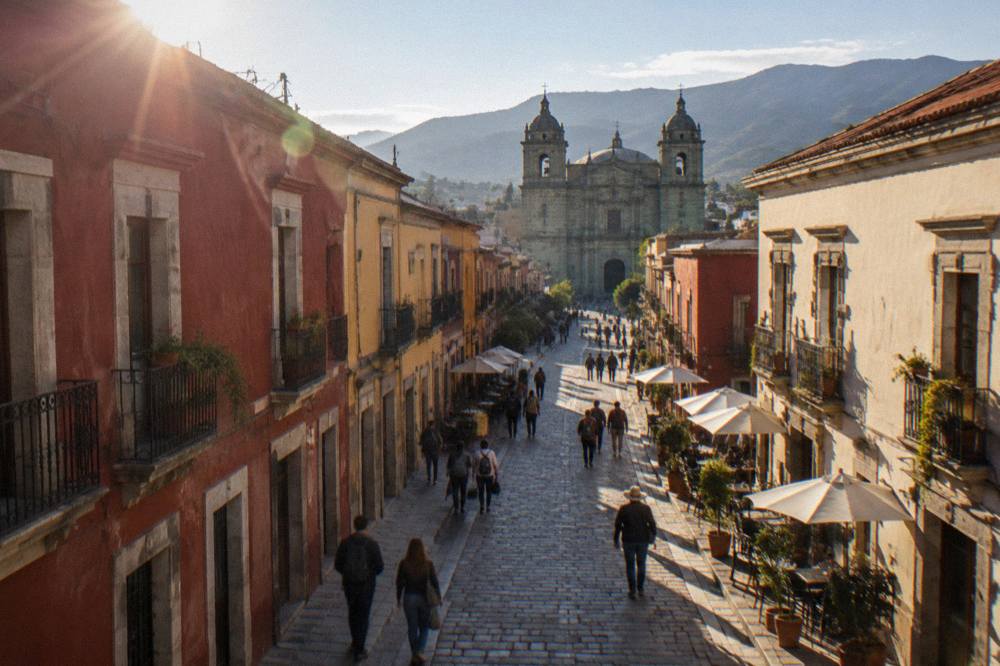
Atmosphere follows from those figures. A city of 270,955 people whose sights sit within walking distance of each other runs at a different pace from a capital region of millions, and Oaxaca's festival calendar, Guelaguetza over two July Mondays, Día de Muertos centred on the traditional 31 October to 2 November dates, Noche de Rábanos on 23 December, periodically swells it well beyond that baseline. The where to stay in Oaxaca guide maps the neighbourhoods if the compact-centre appeal is what tips your decision.
How Far Is Oaxaca From Mexico City And How Do You Travel Between Them?
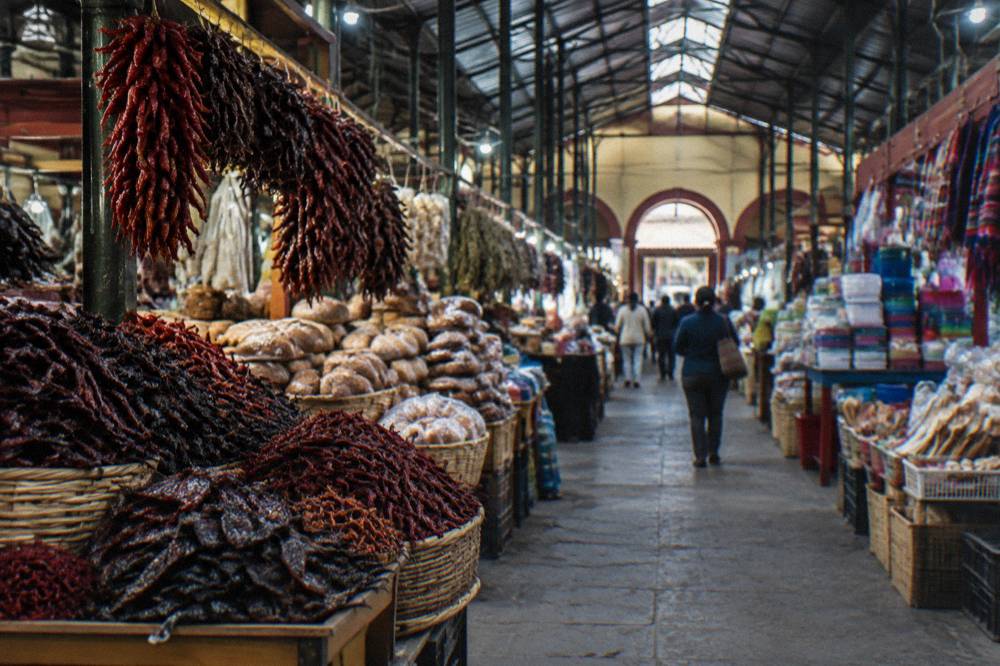
Oaxaca City and Mexico City are linked by daily flights into Oaxaca's Xoxocotlán airport (OAX), operated by ASUR, and by long-distance ADO bus services booked through ado.com.mx, and the site's dedicated route guides walk through each option; fares and schedules are set by the operators, so no figure is quoted here. The pairing works in either direction, which is exactly why the "which first" question exists: the two cities form a natural two-stop trip.
The practical detail lives in three route pages. The Mexico City to Oaxaca guide covers the southbound direction, the Oaxaca airport guide explains the arrival side, including that OAX operates as the region's ASUR-run gateway, and the ADO bus guide covers the overland alternative, where the operator's own site is the booking channel. A comparison of flying versus the bus also exists as a separate answer.
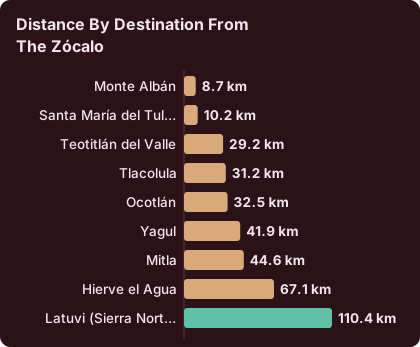
Once you are in the Valles Centrales, the geography of the Oaxaca side of the trip is short-range. These are derived free-flow drive times from the Zócalo, and real traffic and mountain roads are slower, so treat each as "about":
| Destination from the Zócalo | Distance | About (drive time) |
|---|---|---|
| Monte Albán | 8.7 km | 15 minutes |
| Santa María del Tule | 10.2 km | 11 minutes |
| Teotitlán del Valle | 29.2 km | 26 minutes |
| Tlacolula | 31.2 km | 25 minutes |
| Ocotlán | 32.5 km | 37 minutes |
| Yagul | 41.9 km | 38 minutes |
| Mitla | 44.6 km | 37 minutes |
| Hierve el Agua | 67.1 km | 57 minutes |
| Latuvi (Sierra Norte) | 110.4 km | 142 minutes |
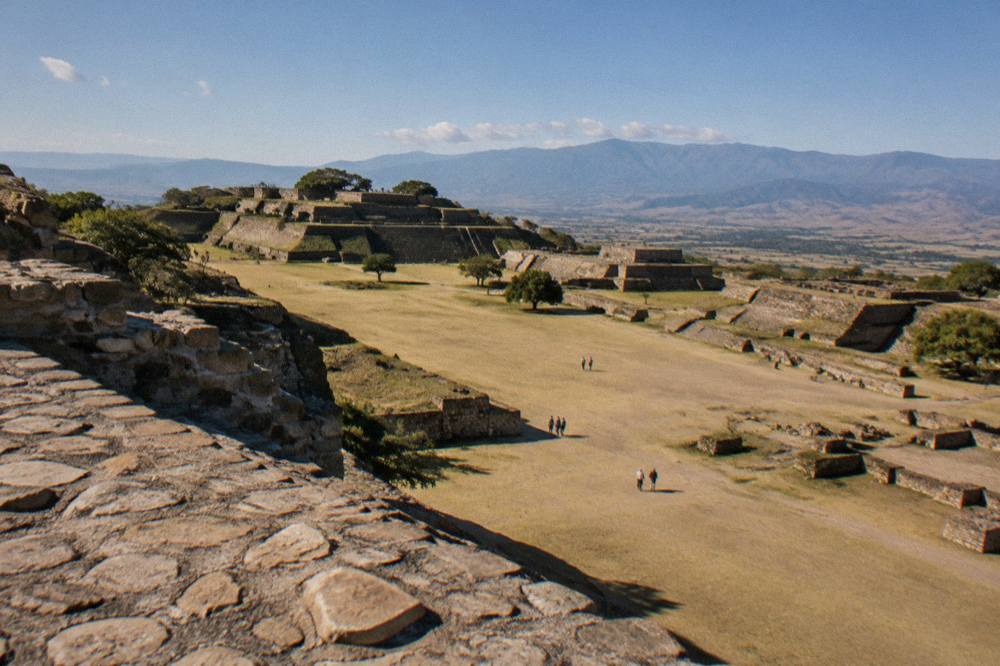
That table is the heart of the comparison. From a hotel near the Oaxaca Zócalo you can stand on Monte Albán's Grand Plaza roughly a quarter of an hour after leaving the centre; the equivalent outing from Mexico City is a different kind of journey altogether.
What Can You Do In Oaxaca That You Cannot Do In Mexico City?
Oaxaca's unmatched offer is density of accessible pre-Hispanic archaeology and living craft traditions: Monte Albán drew 416,675 visitors in 2025 and sits about 15 minutes from the centre, Mitla 104,428 about 37 minutes, and the surrounding valley holds Teotitlán del Valle, San Bartolo Coyotepec, San Martín Tilcajete and Santiago Matatlán, all within an hour's drive, a combination Mexico City cannot replicate as a day-out pattern.
The INAH archaeological zones around the city charge by category, which makes multi-site touring cheap in pesos and easy to plan:
| INAH site | Hours | Last access | MXN nationals | MXN foreigners |
|---|---|---|---|---|
| Monte Albán | Mon to Sun 08:00 to 17:00 | 16:00 | 105 | 210 |
| Mitla | Mon to Sun 08:00 to 17:00 | 16:30 | 105 | 210 |
| Yagul | Mon to Sun 08:00 to 17:00 | 16:00 | 105 | 210 |
| Dainzú | Mon to Sun 08:00 to 17:00 | 16:30 | 80 | 145 |
| Lambityeco | Mon to Sun 08:00 to 17:00 | 16:30 | 80 | 145 |
| Zaachila | Thu to Sun 10:00 to 16:00 | 16:00 | 80 | 145 |
Two scheduling traps matter when you plan that list: Zaachila opens Thursday to Sunday only, 10:00 to 16:00, and Atzompa, 08:00 to 16:00 with last access at 15:00, closes earlier than the big three. The Museo de las Culturas de Oaxaca at Santo Domingo is likewise open Tuesday to Saturday only, 10:00 to 16:00. Getting these days wrong costs a morning, which is a real risk on a short first trip.
Beyond the sites, the Oaxaca-only pattern is the craft-village circuit and the mezcal country behind it. The Teotitlán del Valle guide covers the weaving town, the Santiago Matatlán mezcal route covers the distillery country, and the Hierve el Agua guide covers the petrified-waterfalls outing that anchors most valley day trips.
How Does The Weather Compare Between Oaxaca And Mexico City?
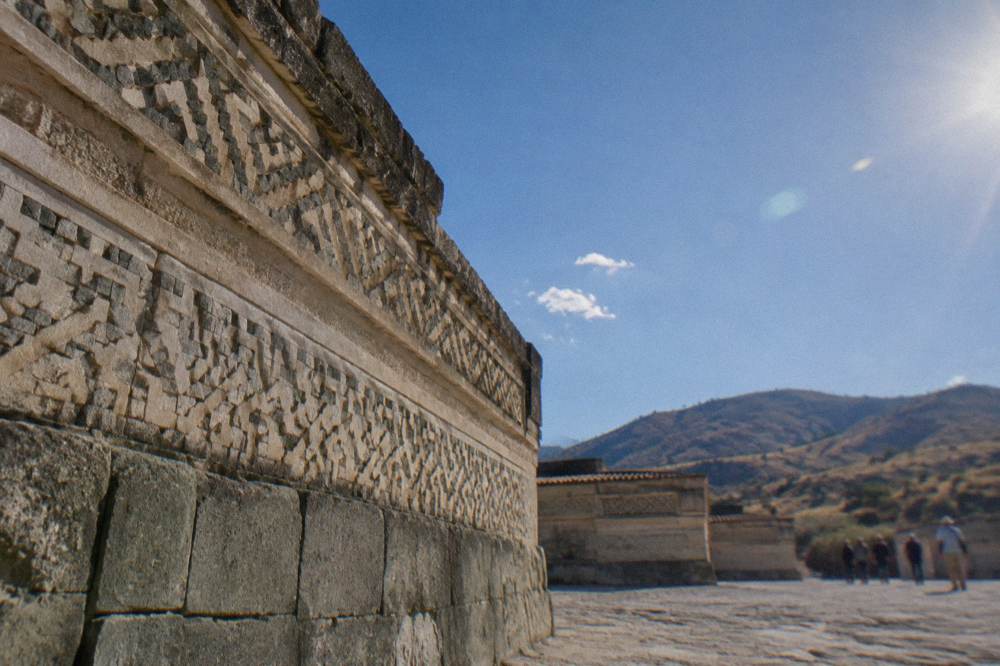
Oaxaca City runs a dry season from November to April and a rainy season from May to October with the heaviest totals from June to September, on SMN station normals for 1991 to 2020: June averages 188.3 mm of rain and January 2.4 mm, April's average daily high is 34.9 C and January's average overnight low is 10.3 C, so pack for warm days and genuinely cool nights at about 1,550 m rather than lowland heat.
The altitude is the point that surprises arrivals from either direction. This is a highland valley city with cold-shoulder nights in December and January, not a beach climate, and the monthly figures make the pattern plain:
| Month | Average high C | Average low C | Rain mm |
|---|---|---|---|
| Jan | 28.9 | 10.3 | 2.4 |
| Feb | 31.1 | 11.6 | 4.6 |
| Mar | 33.3 | 13.6 | 17.6 |
| Apr | 34.9 | 15.8 | 47.3 |
| May | 33.8 | 16.7 | 97.9 |
| Jun | 30.9 | 16.7 | 188.3 |
| Jul | 30.1 | 15.9 | 118.6 |
| Aug | 30.0 | 15.9 | 131.8 |
| Sep | 29.1 | 16.1 | 163.6 |
| Oct | 29.3 | 14.5 | 63.1 |
| Nov | 29.0 | 12.3 | 9.1 |
| Dec | 28.9 | 11.0 | 9.0 |
Rain in the June-to-September window falls on roughly 20 days per month on the same normals, but the annual total, 853.3 mm, still leaves the November-to-April stretch nearly rain-free, with 1.4 days of rain on average in January against 21.4 in September. Timing a first Oaxaca visit into the dry months removes the main weather variable; the best time to visit Oaxaca guide and the month-by-month weather breakdown take this further, and the rainy-season guide covers the flip side if your dates are fixed in summer.
How Many Days Do You Need In Oaxaca Versus Mexico City?
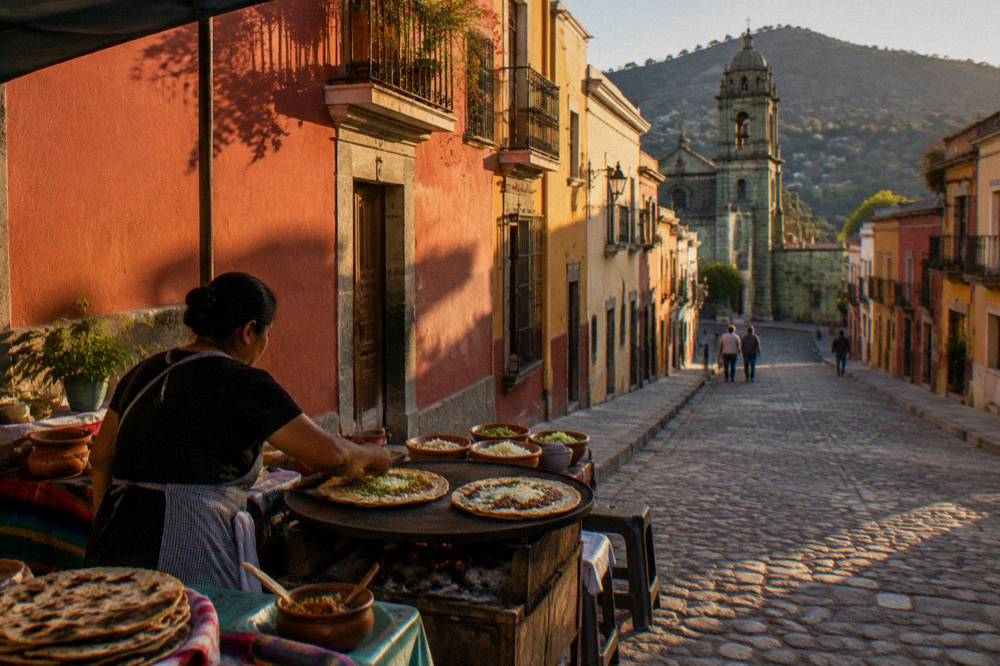
Oaxaca City rewards two to five days: one for the historic centre, one for Monte Albán, one for a valley day trip toward Mitla and Hierve el Agua and one or two more for markets, cooking and mezcal, and the 2025 average stay of 2.00 nights shows how tightly the core fits together. Mexico City absorbs a week without exhausting it, which is the real asymmetry: Oaxaca compresses, Mexico City expands.
The site's ready-made sequences make the Oaxaca arithmetic concrete: one day, two days, three days, four days, five days and a full week, plus a dedicated answer on how many days are enough. If you are splitting one trip between the two cities, the workable pattern is the shorter block in Oaxaca and the longer block in Mexico City, or the reverse if the valley day trips are your priority, since each Hierve el Agua or Sierra Norte outing consumes a full day in itself.
Festival dates can force the arithmetic upward. Guelaguetza runs over two Mondays in July at the Auditorio Guelaguetza on the Cerro del Fortín, with 2026's edition held on 20 and 27 July, Palco A at 1,632 MXN and Palco B at 1,321 MXN, and Palcos C and D free, a useful reference for what a July visit involves. Día de Muertos centres on the traditional 31 October to 2 November dates, and Noche de Rábanos falls on 23 December; both fill the city well beyond its 2.00-night baseline.
Is Oaxaca Cheaper Or More Expensive Than Mexico City?
No cross-city price comparison is established here, so treat any ranking you read elsewhere with caution; what the sources do establish is Oaxaca's cost structure: INAH archaeology tickets at 80 to 210 MXN depending on site category and nationality, free guided tours at the Jardín Etnobotánico, a 3 percent state lodging tax on hotel-type stays, and bookable tours whose prices print on their own listings rather than in prose.
That structure is favourable for a visitor. A day of archaeology at Monte Albán costs 210 MXN at the foreign rate; the smaller Category III sites cost 145 MXN. The Jardín Etnobotánico's guided visits are free, running Monday to Friday at 10:30, 11:00, 11:30, 12:00 and 17:00 and Saturday from 10:30 to 12:00, with large groups booking two weeks ahead. The one accommodation line item to expect is the state lodging tax, 3 percent on hotel-type stays and 5 percent where an intermediary platform is involved.
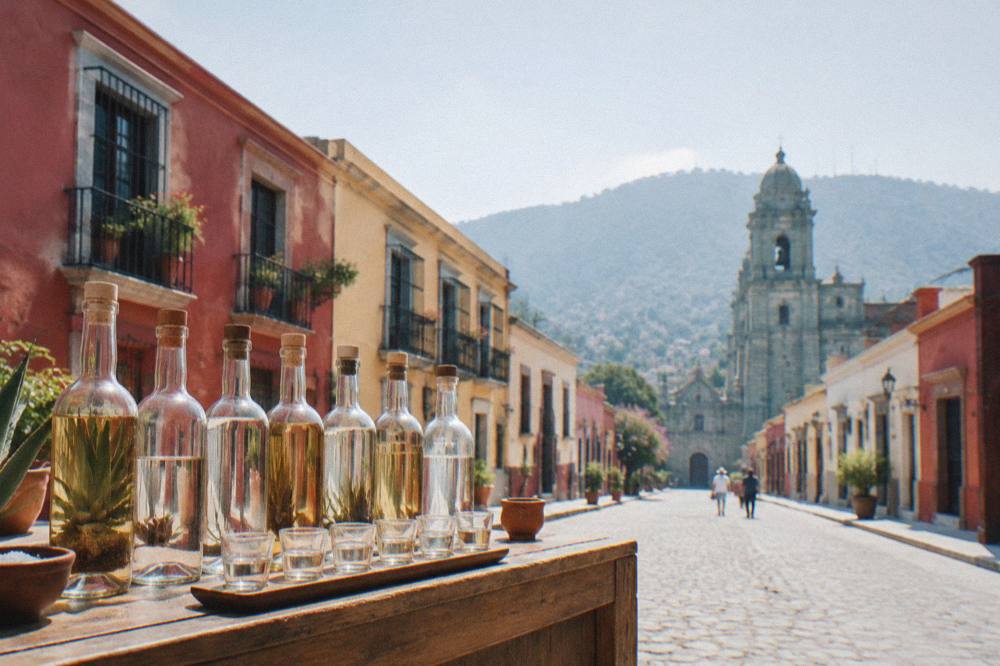
For the paid side, use the operator's booking page for the current price. Food is the category Oaxaca is built around, and the what to eat in Oaxaca guide, the mole guide and the tlayudas guide map it dish by dish; the budget and costs guide pulls the planning picture together.
Is Oaxaca As Safe As Mexico City For Visitors?
The advisory picture does not rank the two cities, but for Oaxaca specifically: the UK FCDO advises against all but essential travel to parts of Mexico and does not name Oaxaca on its main page, Canada advises a high degree of caution for Mexico overall without listing Oaxaca as an avoid area, and the US State Department lists Oaxaca state at Level 2, exercise increased caution, with restrictions in the Isthmus region rather than the city itself.
Two practical notes attach to that. First, road blockades by teachers' unions are a standing risk in Oaxaca that can disrupt road and airport access for hours at a stretch; they are protest actions, not a crime pattern, and they resolve, but they can complicate a transfer day. Second, none of this is an Oaxaca-versus-Mexico-City ranking, and the site does not make one; the Oaxaca safety guide carries the detail, including the advisory wording in full.
Read the advisories yourself before booking; conditions change and this guide does not predict them.
Which Should You Visit First, Oaxaca Or Mexico City?
Start in Mexico City if you want the metropolis first and a downshift into the valley afterwards; start in Oaxaca if you want immersion first and the big city as a finale, and since the two are chained by flights and ADO buses, the order is a mood choice, not a logistics constraint. Oaxaca first gives you Monte Albán, the markets and the valley villages while your energy is highest; Mexico City first eases you in through a major hub.
One genuine sequencing argument favours Oaxaca first: the city's 2025 occupancy averaged 51.73 percent, but Guelaguetza week and Día de Muertos overwhelm it, so if your dates touch either festival, book the Oaxaca end of the trip early regardless of order. A second favours whichever city you fly into more cheaply: OAX is ASUR-operated with domestic links plus United States routes, and the flights to Oaxaca guide lays out the arrival options.
However you order it, the Oaxaca block deserves at least a guided orientation on day one. A short walking tour of the historic centre sets up everything after it, and you can Check availability on the operator's booking page; the historic-centre walking tour guide explains what the format covers, and the site's getting around overview handles the rest.
The comparison, in the end, is not a contest. Mexico City and Oaxaca City do different jobs, and the route between them is easy enough that the strongest first trip to Mexico often includes both.
Common Questions About Oaxaca Vs Mexico City
Is Oaxaca Better Than Mexico City For A First Trip To Mexico?
Neither is objectively better. Oaxaca City concentrates markets, mezcal, archaeology and craft villages within about an hour of a walkable centre, which suits a shorter first trip; Mexico City suits a first trip built on museums and metropolitan scale. Many first-timers combine the two.
Can You Visit Oaxaca And Mexico City On The Same Trip?
Yes. The two are linked by flights into Oaxaca's Xoxocotlán airport and by ADO bus services booked through ado.com.mx. Fares and schedules are set by the operators, and the site's Mexico City to Oaxaca and ADO bus guides cover each option.
How Many Days Do You Need In Oaxaca Compared With Mexico City?
Oaxaca rewards roughly two to five days depending on how many valley day trips you add; the 2025 average stay was 2.00 nights. Mexico City typically absorbs a week or more, which is why splitting a combined trip usually means a shorter Oaxaca block and a longer Mexico City block.
Is Oaxaca Cheaper Than Mexico City?
No cross-city price comparison exists. Oaxaca's known cost structure includes INAH site tickets at 80 to 210 MXN, free Jardín Etnobotánico guided tours and a 3 percent state lodging tax; tour prices print on each operator's booking page.
What Is The Best Month To Visit Oaxaca City?
The sources give figures rather than a ranking: the dry season runs November to April, with January averaging just 2.4 mm of rain, and June through September average over 118 mm each month. Festival dates, Guelaguetza in July and Día de Muertos around 31 October to 2 November, may outweigh weather in your planning.
Is Oaxaca Safe Compared With Mexico City?
Advisories do not rank the two. For Oaxaca, the UK FCDO does not name the state among its advised-against areas, Canada lists no avoid-travel zone for Oaxaca, and the US State Department lists Oaxaca state at Level 2, exercise increased caution. Read the advisory pages directly before booking.