Oaxaca Travel Costs: A Daily Budget In Pesos And Dollars
Oaxaca City budgets in pesos and dollars: the fixed published fees, the tax on your hotel bill, and the costs that only the operator's booking page can tell you.
The published fixed costs in Oaxaca City are INAH site admissions of 80 to 210 MXN, a 3 percent state lodging tax on hotel stays, and tour and class prices that sit on the live listings. Everything else in a daily budget is variable.
Oaxaca de Juárez, the capital of the state of Oaxaca in Mexico, is an inland highland city in the Valles Centrales at about 1,550 m, and budgeting for it starts with one honest distinction: some costs are published fixed fees in pesos, and others move with the season, the operator and the day. The INAH admissions to Monte Albán, Mitla and Yagul are printed figures. The state lodging tax is a printed percentage. For the wider picture of what the city offers, see things to do in Oaxaca.
What Are The Fixed Costs Of A Day In Oaxaca City?
The published fixed costs are INAH archaeological site admissions of 80 to 210 MXN depending on site category and nationality, a 3 percent state lodging tax on hotel-type stays, and free entry to the Jardín Etnobotánico guided tours at published times. Food, taxi and hotel nightly rates have no published primary figures and stay variable.
That is the whole skeleton of an honest Oaxaca budget. A day built around one Category I site, a free guided garden tour and a walking tour priced by the operator's booking page has exactly two fixed cash outlays you can plan to the peso. Add the lodging tax, which the state law puts at 3 percent on hotel-type stays and 5 percent when an intermediary or platform collects the payment, under decree 884 published 10 December 2025.
The rest of this guide walks each budget line in turn: admissions, tours, beds, food, transport, season and the free layer.
What Do Oaxaca Archaeological Sites And Museums Cost?
INAH charges by category: Category I sites (Monte Albán, Mitla, Yagul) cost 105 MXN for Mexican nationals and 210 MXN for foreign visitors, while Category III sites (Dainzú, Lambityeco, Zaachila) cost 80 and 145 MXN, per the INAH pages for each zone. The Museo de las Culturas de Oaxaca charges the Category I rates and opens Tuesday to Saturday only, 10:00 to 16:00.
These are the most reliable numbers in any Oaxaca budget because INAH prints them per zone. Note the traps: Zaachila opens Thursday to Sunday 10:00 to 16:00 only, so a Tuesday plan fails there. Atzompa runs 08:00 to 16:00 with last access at 15:00, an hour earlier than Monte Albán. The out-of-hours visit option, listed at 730 MXN on the Yagul, Lambityeco, Atzompa and Museo de las Culturas pages, exists for visitors who cannot fit the standard windows.
| Site or museum | Hours | Last access | Nationals MXN | Foreigners MXN |
|---|---|---|---|---|
| Monte Albán | Mon to Sun 08:00 to 17:00 | 16:00 | 105 | 210 |
| Mitla | Mon to Sun 08:00 to 17:00 | 16:30 | 105 | 210 |
| Yagul | Mon to Sun 08:00 to 17:00 | 16:00 | 105 | 210 |
| Dainzú | Mon to Sun 08:00 to 17:00 | 16:30 | 80 | 145 |
| Lambityeco | Mon to Sun 08:00 to 17:00 | 16:30 | 80 | 145 |
| Zaachila | Thu to Sun 10:00 to 16:00 | 16:00 | 80 | 145 |
| Atzompa | Mon to Sun 08:00 to 16:00 | 15:00 | not on the page | not on the page |
| Museo de las Culturas de Oaxaca | Tue to Sat 10:00 to 16:00 | 16:00 | 105 | 210 |
A two-site archaeology day, Monte Albán plus Mitla, means two Category I admissions at 210 MXN each for a foreign visitor and 105 MXN each for a national, so the fixed admissions line doubles with each added Category I stop. A Category III add-on such as Lambityeco or Dainzú raises the foreign day by 145 MXN each. Monte Albán is about 15 minutes from the Zócalo by road, Mitla about 37, and Yagul about 38; these are free-flow drive times and real traffic on mountain roads is slower. More detail sits on the Monte Albán guide, the Mitla guide and the Yagul and Dainzú guide.
How Much Do Tours And Classes Cost In Oaxaca?
Tour and class prices in Oaxaca City sit on each operator's booking page, so check the listing for the current price, rating and duration before you book, and treat any figure remembered from elsewhere as out of date until the listing confirms it.
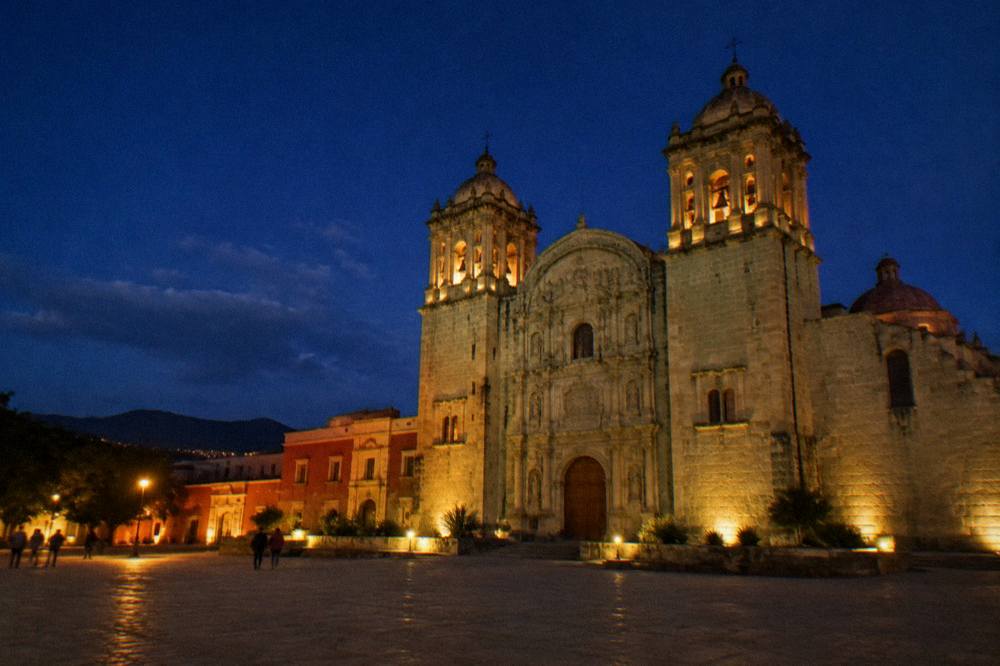
What can be said in prose is what each product covers. The historic center walking tour pairs a professional local guide with the core of the Centro Histórico, a UNESCO property listed as "Historic Centre of Oaxaca and Archaeological Site of Monte Albán". The street food tour builds a full evening around tastings across the city. The private car and driver option covers a full craft day with master artisans, priced per group rather than per person, which changes the arithmetic for families.
Cooking classes, mezcal tastings and craft workshops follow the same rule: the listing is the price. A mole class, a vegetarian market-to-table class and a printmaking workshop sit at different price points on the tour list, and a per-group private option can undercut per-person products once three or four people share it. When comparing, read what is included: a class with a market visit and full meal is a different budget line from a tasting.
The Oaxaca cooking classes guide and the mezcal tour guide break the categories down product by product.
Where Does The Accommodation Budget Go In Oaxaca?
The one published accommodation figure is tax: Oaxaca state charges 3 percent on hotel-type stays, and 5 percent when an intermediary or platform handles the payment, under decree 884 published 10 December 2025. Nightly rates themselves have no published primary source, so no hotel price, no seasonal range and no average appears here, and the live rate for your dates is the figure to check.
What the published data does show is demand shape. The 2025 Sectur indicators report 1,324,332 tourist arrivals in the city, an average stay of 2.00 nights and hotel occupancy of 51.73 percent across the year. Occupancy that low on an annual average means demand is highly concentrated: Guelaguetza in July and Día de Muertos at the turn of November absorb the pressure, and the rest of the year spreads thin. Budgeting implication: the same room can price very differently in late July versus a plain Tuesday in March, and no fixed figure survives that spread.
Neighbourhood choice moves the budget too, in ways the where to stay in Oaxaca guide maps in detail, with the best hotels, boutique hotels and hostels and budget stays pages carrying the tiers. Wherever you book, expect the 3 or 5 percent lodging tax on the bill; on a platform-collected booking the higher rate applies.
What Does Eating In Oaxaca Cost?
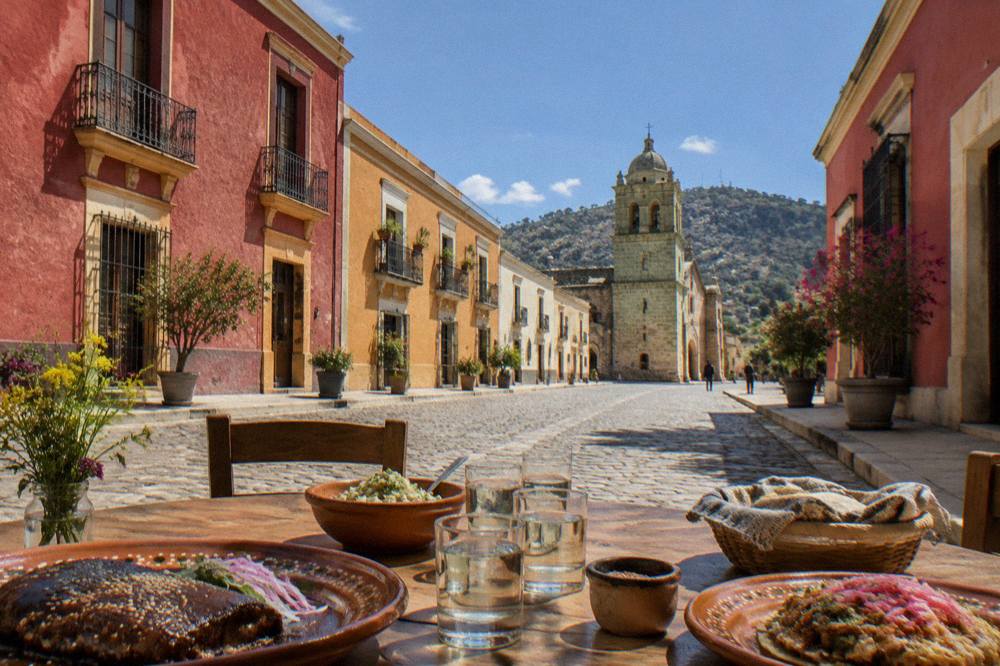
No primary source publishes meal or market-food prices for Oaxaca City, so none are given, not even a plausible range. What the food budget actually contains is published in kind: tlayudas, mole, quesillo, chocolate, tejate and chapulines are the named local foods, sold in the markets and street stalls of the Centro Histórico, and prices are read at the stall.
The honest way to plan the food line is structurally. A market-based eating day in the Centro Histórico, centred on Mercado 20 de Noviembre or Mercado Benito Juárez, replaces two restaurant sittings with stall food, and a food tour with tastings included collapses several snack purchases into a single operator-listed price. A cooking class with a market visit does the same and adds the meal you cook. These structural swaps matter more to the budget than any per-plate figure a guidebook could quote.
The what to eat in Oaxaca guide inventories the dishes, with deeper pages on mole, tlayudas and quesillo. For where to sit down, the best restaurants in Oaxaca guide carries the tiers. One operator-listed option that bundles the market walk with tastings:
What Does Getting Around Oaxaca Cost?
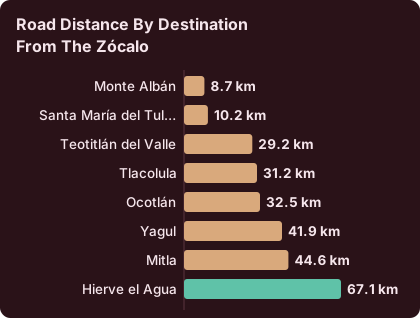
No primary source publishes taxi, colectivo or bus fares for Oaxaca, so no fare appears here. What is published and derivable is geography: Monte Albán is about 15 minutes from the Zócalo by road, Tule about 11, Teotitlán del Valle about 26, Tlacolula about 25, Ocotlán about 37 and Hierve el Agua about 57, all free-flow estimates that real traffic and mountain roads extend.
Distance, not fare, is the budget lever you can plan. The valley sites sit in two loose rings: a near ring (Monte Albán, Tule, Atzompa) reachable in well under half an hour, and a far ring (Teotitlán del Valle, Tlacolula, Mitla, Yagul, Hierve el Agua) where each stop costs a bigger slice of the day. A shared valley day trip priced per person by an operator listing often beats four separate local transport legs once time is counted, and the day trip guide and getting around Oaxaca guide lay out the modes.
| Destination from the Zócalo | Road distance | Free-flow drive time |
|---|---|---|
| Monte Albán | 8.7 km | about 15 min |
| Santa María del Tule | 10.2 km | about 11 min |
| Teotitlán del Valle | 29.2 km | about 26 min |
| Tlacolula | 31.2 km | about 25 min |
| Ocotlán | 32.5 km | about 37 min |
| Yagul | 41.9 km | about 38 min |
| Mitla | 44.6 km | about 37 min |
| Hierve el Agua | 67.1 km | about 57 min |
Arriving in the city has its own page: the Oaxaca airport guide, flights to Oaxaca and the Mexico City to Oaxaca and ADO bus guides cover the entry routes, with fares left to the live systems. The taxis, Uber and DiDi guide covers city rides the same way.
How Does The Season Change An Oaxaca Budget?
Season changes the Oaxaca budget through demand and rain, not through any published price switch. Dry season runs November to April and rainy season May to October with rain peaking June to September; SMN station normals show June averaging 188.3 mm of rain against 2.4 mm in January. July carries Guelaguetza, whose 2026 paid seats ran 1,632 and 1,321 MXN, with free sections alongside.
The fixed costs do not move with the weather: an INAH ticket is the same 210 MXN for a foreign visitor in any month, and the lodging tax percentage is constant. What moves is the hotel rate under that tax, and the second money moment of the year is Día de Muertos, whose traditional core dates are 31 October to 2 November. The 2026 festival programme has not been announced, so no 2026 schedule or price claim belongs on this page.
| Month | Mean high C | Mean low C | Rain mm |
|---|---|---|---|
| Jan | 28.9 | 10.3 | 2.4 |
| Feb | 31.1 | 11.6 | 4.6 |
| Mar | 33.3 | 13.6 | 17.6 |
| Apr | 34.9 | 15.8 | 47.3 |
| May | 33.8 | 16.7 | 97.9 |
| Jun | 30.9 | 16.7 | 188.3 |
| Jul | 30.1 | 15.9 | 118.6 |
| Aug | 30.0 | 15.9 | 131.8 |
| Sep | 29.1 | 16.1 | 163.6 |
| Oct | 29.3 | 14.5 | 63.1 |
| Nov | 29.0 | 12.3 | 9.1 |
| Dec | 28.9 | 11.0 | 9.0 |
These are SMN station normals for the Oaxaca station, 1991 to 2020. April's mean daily high of 34.9 C and June's 188.3 mm rain average are the two numbers that most often surprise visitors who assumed a uniform tropical climate. The month-by-month detail, with the day-count figures, sits in the Oaxaca weather by month guide, and the planning trade-offs are in best time to visit Oaxaca.
What Do Oaxaca Festivals Cost To Attend?
Guelaguetza 2026, now past, priced its Auditorio Guelaguetza seats at 1,632 MXN for Palco A and 1,321 MXN for Palco B, with Palcos C and D free, sold through Superboletos with a two-ticket account limit; those figures stand as a reference until 2027 dates are announced. The Feria del Mezcal 2026 ran 17 to 28 July at the CCCO with entry at about 80 MXN. Jardín Etnobotánico guided tours are free at published times.
Festival budgeting is therefore lumpy rather than linear. A July visit can absorb a four-figure peso seat, or nothing at all in the free sections, plus the lodging surge that month brings.
| Event or entry | Standing cost | Source |
|---|---|---|
| Guelaguetza Palco A | 1,632 MXN plus fees | 2026 reference, past event |
| Guelaguetza Palco B | 1,321 MXN plus fees | 2026 reference, past event |
| Guelaguetza Palcos C and D | free | 2026 reference |
| Feria del Mezcal entry | about 80 MXN | 2026 edition |
| Jardín Etnobotánico guided tour | free | current published schedule |
| INAH out-of-hours visit | 730 MXN | listed on several zone pages |
The Jardín Etnobotánico schedule is specific: free guided tours Monday to Friday at 10:30, 11:00, 11:30, 12:00 and 17:00, and Saturday 10:30 to 12:00, with large and school groups booking two weeks ahead. Noche de Rábanos keeps its traditional 23 December date; the current edition's details are not announced, so no 2026 ticket claim belongs here. The full calendar context is in the Guelaguetza guide, the Día de Muertos guide and the Oaxaca events and festivals guide.
What Free And Low-Cost Options Exist In Oaxaca?
The published free layer in Oaxaca City includes the Jardín Etnobotánico guided tours at set times, the free Palcos C and D at Guelaguetza, and the Zócalo, Andador Macedonio Alcalá and the historic neighbourhoods of Jalatlaco and Xochimilco, which carry no admission at all. Atzompa's INAH page lists hours only, with no fee printed.
A low-spend day is structurally easy in this city. Walk Jalatlaco and Xochimilco in the morning, take a free garden tour slot at midday, sit in the Zócalo in the afternoon and close on the Andador Macedonio Alcalá, whose guide pages, Zócalo, Andador, Jalatlaco and Xochimilco, map each one. The single biggest free-versus-paid decision is guiding: a professional local guide on the historic center walk is priced by the listing, and the free options page inventories what costs nothing.
The related tour on this page is the guided historic center walk, and its current price, rating and duration are on the live listing: Check availability. The free things to do in Oaxaca guide carries the full no-spend itinerary.
How Should You Build The Peso Budget For Oaxaca?
Build the Oaxaca budget in three lines: fixed admissions you can price to the peso (80 to 210 MXN per INAH site by category and nationality, 730 MXN out of hours), a 3 or 5 percent lodging tax applied to whatever room rate your dates return, and operator-listed products whose prices only the live listing holds. Add festival seats in July and around Día de Muertos if your dates overlap.
The method matters more than any total. Price the fixed layer first, because it is the only layer that never surprises. Then price the product layer from live listings on your exact dates, since tour availability shifts with season. Then leave the food and local transport lines as read-at-the-stall and agree-before-you-ride items, which is how the city actually prices them. A sample fixed skeleton for a foreign visitor's two-site archaeology day, admissions only, is two Category I tickets at the published 210 MXN each; everything above that line is dates, season and appetite.
| Budget line | Fixed or variable | What is published |
|---|---|---|
| INAH site admission | fixed | 80 to 210 MXN by category and nationality |
| Museo de las Culturas admission | fixed | 105 MXN national, 210 MXN foreign, Tue to Sat |
| INAH out-of-hours visit | fixed | 730 MXN at zones listing the option |
| State lodging tax | fixed percentage | 3 percent hotel stays, 5 percent via platforms |
| Guelaguetza seats | fixed per edition | 2026: 1,632 and 1,321 MXN, Palcos C and D free |
| Hotel nightly rate | variable | no published primary figure |
| Tours and classes | variable | operator's booking page |
| Meals and market food | variable | read at the stall |
| Taxis and colectivos | variable | no published primary fare |
Length of stay is the last multiplier, and the how many days in Oaxaca guide with the itineraries from one day to a week size it. Practical matters that touch the wallet, from cash to safety, sit in money, ATMs and cash in Oaxaca and is Oaxaca safe.
Common Questions About Oaxaca Travel Costs
How Much Does Monte Albán Cost?
Monte Albán charges 105 MXN for Mexican nationals and 210 MXN for foreign visitors, per the INAH page for the zone, and opens Monday to Sunday 08:00 to 17:00 with last access at 16:00.
Is Oaxaca Expensive?
The published fixed costs are modest: INAH admissions of 80 to 210 MXN, free Jardín Etnobotánico tours and a 3 percent lodging tax. Hotel nightly rates, meals and taxis have no published primary figures, so the total depends on dates and choices.
What Taxes Go On An Oaxaca Hotel Bill?
Oaxaca state charges a lodging tax of 3 percent on hotel-type stays, and 5 percent when an intermediary or platform collects the payment, under decree 884 published 10 December 2025.
Do I Need Cash In Oaxaca?
INAH admissions are published in pesos, and much of the market and local transport layer works in cash.
When Is The Most Expensive Time To Visit Oaxaca?
Demand concentrates around Guelaguetza in July, whose 2026 paid seats ran 1,632 and 1,321 MXN, and around Día de Muertos at the turn of November. No 2026 festival programme or official high-season date range has been announced, so treat these as the standing pattern.
Are Tours In Oaxaca Worth The Price?
That is a dates-and-coverage question. A guided half day at Monte Albán, a market food walk and a per-group private craft day each cover ground that would otherwise cost separate admissions, transport and time; the live prices, ratings and review counts print in the blocks on this page so the comparison is real rather than remembered.
The Oaxaca Travel Guide homepage collects the full site, and the budget pages linked through this article carry every figure to its source so your peso plan stands on printed numbers rather than guesses.