Oaxaca To Puebla: Bus Times, Stops And Whether It Pairs Well
Puebla sits far north of Oaxaca City on the highway toward Mexico City, and the bus connection between them is a matter for the operator's timetable, not a rule of thumb. This page sets out what is known, what the climate and visitor numbers say about timing, and how to judge whether Puebla belongs in an Oaxaca trip at all.
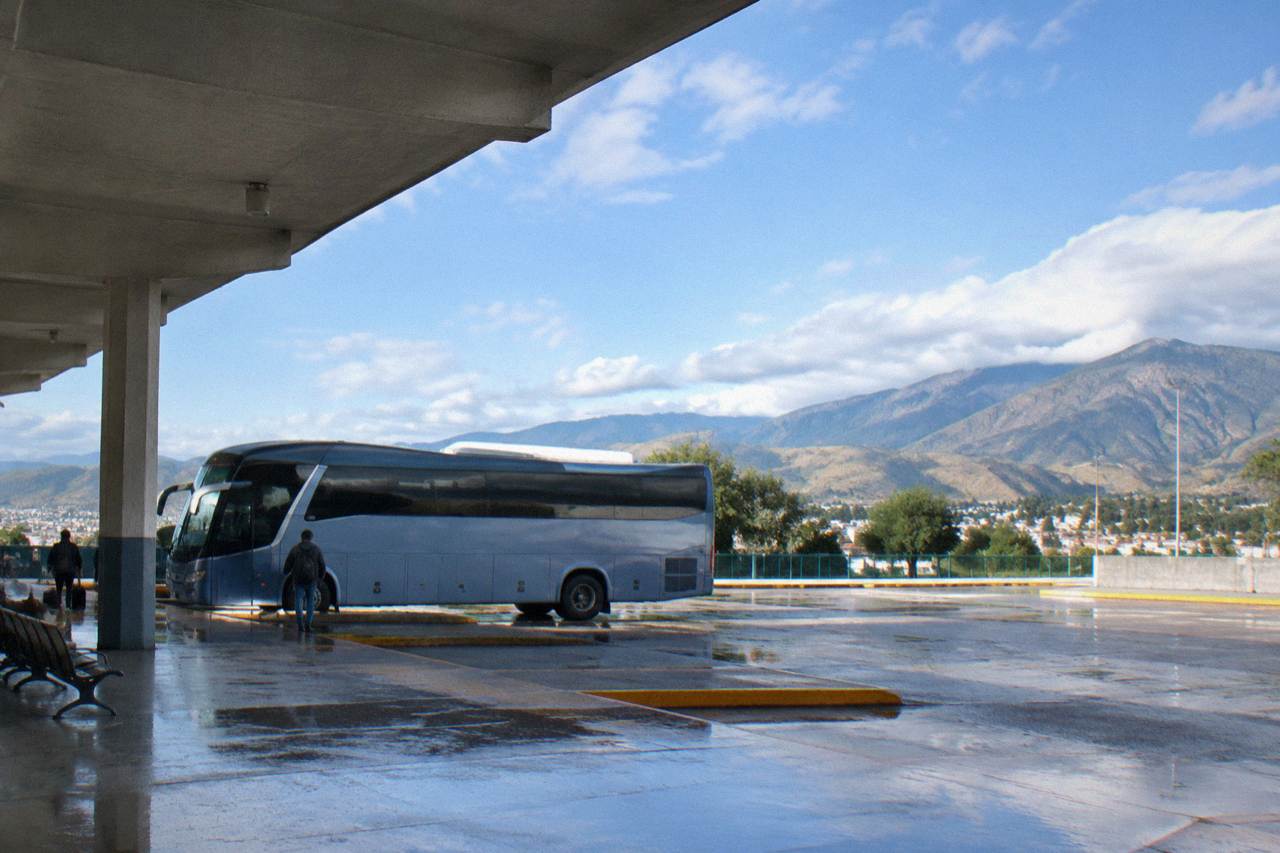
Puebla is a long extension from Oaxaca City, not a valley day trip. Buses run on the Oaxaca to Mexico City corridor, and ADO sets the times and fares; treat Puebla as a stop on a wider loop rather than an out-and-back excursion.
Oaxaca City, the inland highland capital of the state of Oaxaca in Mexico, sits in the Valles Centrales at about 1,550 m, and Puebla lies far beyond the valleys to the north on the corridor that runs toward Mexico City. The two cities share a bus corridor, a highway geography of climbs and descents, and a reputation as colonial-era destinations, but they do not share a day-trip radius. Everything on this page hangs on that one fact, and on what the operator's own timetable says rather than on folklore about schedules.
The honest framing comes first: the Oaxaca Travel Guide desk treats Puebla the way it treats Puerto Escondido, as a long extension best paired with an overnight, and the comparison page at Oaxaca Versus Puebla covers which city suits which traveller. What follows is the transport reality, the planning tables, and a verdict on the pairing.
Is Puebla A Realistic Day Trip From Oaxaca?
No, Puebla is not a realistic day trip from Oaxaca City, because the corridor is a long intercity bus route on the Oaxaca to Mexico City axis, and the operator, not the traveller, sets the clock. ADO runs the first-class services along this corridor, and its published timetables and fares govern every variation; the operator sets both the journey time and the fare and revises them.
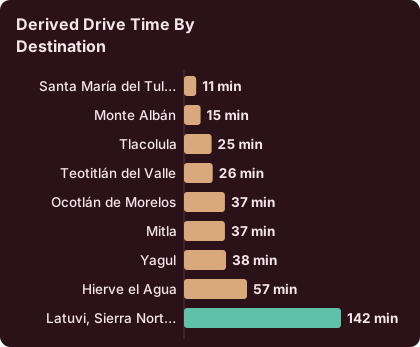
The comparison that matters is with the destinations that genuinely sit in day-trip range of the Zócalo. Hierve el Agua is about 57 minutes away by road in free-flow conditions, Mitla about 37, Teotitlán del Valle about 26. Those are derived figures, computed on OSM roads without traffic, and real mountain driving is slower. Puebla belongs to a different category altogether, the same one as Oaxaca To Puerto Escondido and Oaxaca To Huatulco on the coast side: an extension with an overnight, or a waypoint on a loop that ends somewhere else.
Travellers who try to squeeze Puebla into a single day from Oaxaca City typically end up spending the whole day on buses and arriving back late. The pairing that works is Oaxaca City for several nights, then Puebla en route to or from Mexico City, using the corridor in one direction only. The Mexico City To Oaxaca guide covers the same highway from the other end, and the answer page How Close Is Puebla To Oaxaca? addresses the distance question directly.
How Do You Travel Between Oaxaca And Puebla?
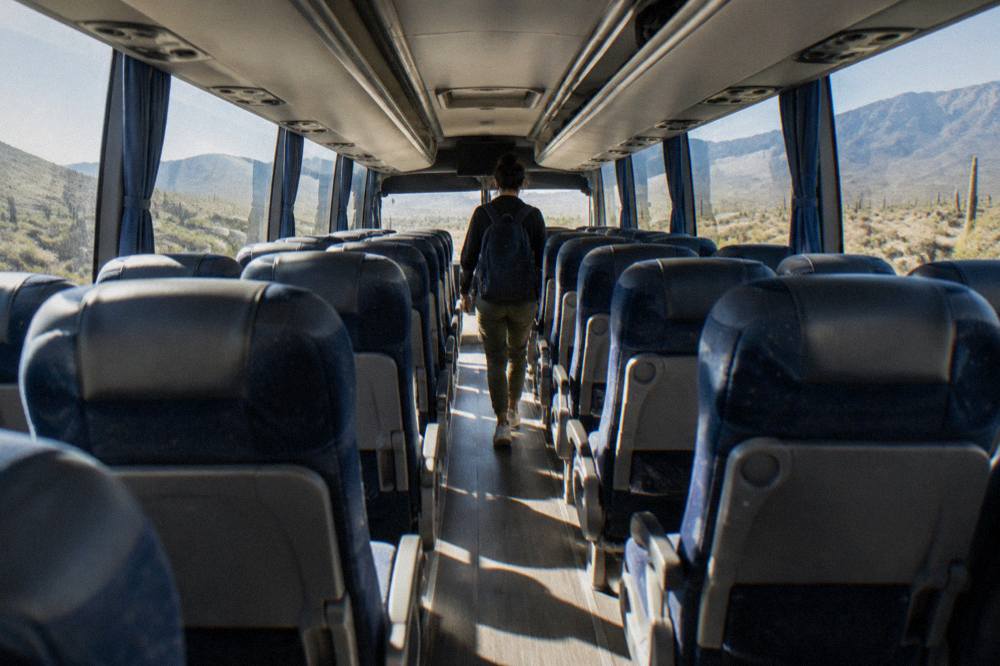
The practical answer is the intercity bus: ADO, whose official site is ado.com.mx, operates the first-class services on this corridor, and its own pages carry the timetables, classes and fares. No fare figure and no journey duration is stated on this page, because those belong to the operator and change with service class and season. Booking is done through the operator's channels or a reseller.
The ADO network is the backbone of long-distance land travel out of Oaxaca City, and the dedicated ADO Bus Oaxaca guide covers terminals, classes and the booking process in depth. The question Is It Better To Fly Or Take The Bus To Oaxaca? weighs the same trade-off for the capital. For Puebla specifically, the flight option does not really exist as a alternative: the airport at Xoxocotlán, operated by ASUR, serves domestic hubs and a handful of US cities, and Puebla is not a flight away, so the bus corridor is the whole story.
One caution that applies to the whole region: road blockades by teachers' unions are a standing risk in Oaxaca state and can disrupt road and airport access for hours at a time. These are protest actions, resolved after hours or days in reported cases, and no calendar predicts them. A traveller with a fixed bus departure should build slack into any same-day connection, especially around the airport access road and Federal Highway 190.
For anyone whose real goal is a big day out from Oaxaca City rather than Puebla itself, the valley products are the efficient answer:
What Should You See Near Oaxaca Before A Long Bus Day?
The valley destinations around Oaxaca City repay the mornings you have before a long corridor day, and all of them are closer than anything on the Puebla route: Monte Albán about 15 minutes from the Zócalo, Santa María del Tule about 11, Teotitlán del Valle about 26, and Hierve el Agua about 57 in free-flow conditions. These are derived road times, so treat them as floors, not promises, since mountain traffic adds time.
The table below collects the derived drive times from the Zócalo. They are computed on OSM roads at free flow, and the real rule is that curves, gradients and market-day traffic stretch every one of them.
| Destination | Direction from the Zócalo | Derived drive time |
|---|---|---|
| Santa María del Tule | Valles Centrales east | about 11 minutes |
| Monte Albán | West ridge | about 15 minutes |
| Tlacolula | Tlacolula Valley | about 25 minutes |
| Teotitlán del Valle | Tlacolula Valley | about 26 minutes |
| Ocotlán de Morelos | Valles Centrales south | about 37 minutes |
| Mitla | Tlacolula Valley east | about 37 minutes |
| Yagul | Tlacolula Valley east | about 38 minutes |
| Hierve el Agua | Beyond Mitla | about 57 minutes |
| Latuvi, Sierra Norte | North mountains | about 142 minutes |
Two of these pair naturally with a corridor departure. The Tlacolula Sunday Market and the Mitla And Tlacolula Day Trip pages cover the valley east of the city, which is the same direction the highway takes before it climbs out of the region. The INAH sites along that axis have their own published hours and fees, which the next table summarizes from the INAH zone pages.
| INAH site | Hours | Last access | Fee, MXN |
|---|---|---|---|
| Monte Albán | Monday to Sunday 08:00 to 17:00 | 16:00 | 105 national / 210 foreign |
| Mitla | Monday to Sunday 08:00 to 17:00 | 16:30 | 105 national / 210 foreign |
| Yagul | Monday to Sunday 08:00 to 17:00 | 16:00 | 105 national / 210 foreign |
| Dainzú | Monday to Sunday 08:00 to 17:00 | 16:30 | 80 national / 145 foreign |
| Lambityeco | Monday to Sunday 08:00 to 17:00 | 16:30 | 80 national / 145 foreign |
| Zaachila | Thursday to Sunday 10:00 to 16:00 | 16:00 | 80 national / 145 foreign |
| Atzompa | Monday to Sunday 08:00 to 16:00 | 15:00 | not on the INAH page |
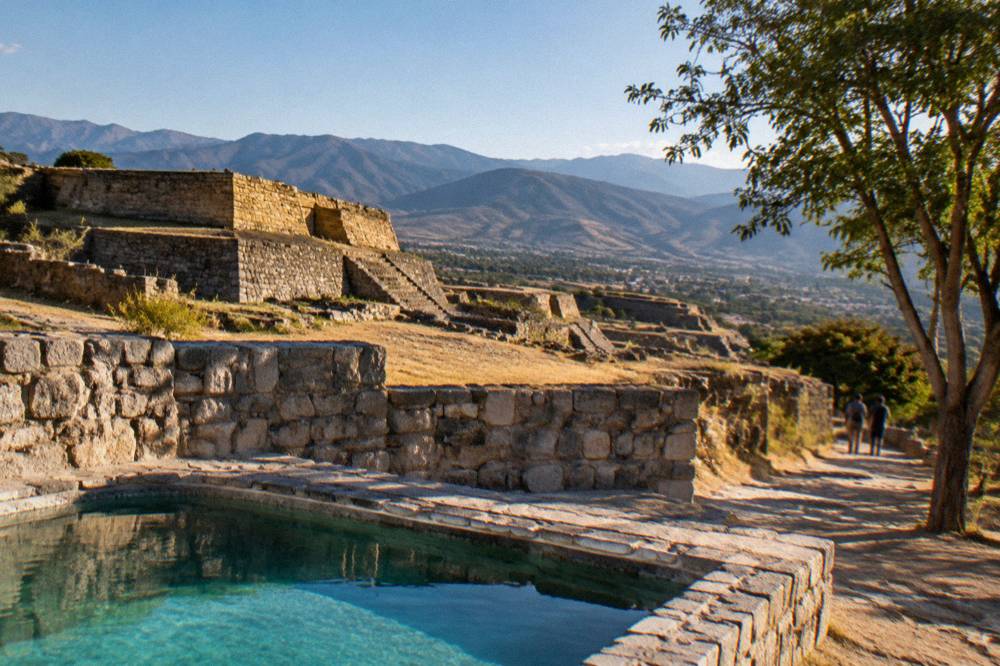
Zaachila's Thursday-to-Sunday window matters for planning, because it is the one valley INAH site that closes on weekdays, and Atzompa closes earlier than the rest, at 16:00 with last access at 15:00. Nobody should move one site's hours onto another's. The category structure is stable across the INAH pages: Category I sites, Monte Albán, Mitla and Yagul, charge 105 MXN to nationals and 210 to foreign visitors, and Category III sites, Dainzú, Lambityeco and Zaachila, charge 80 and 145.
The Hierve el Agua half day is the single most asked-about valley excursion on this site, and it fits the day before a corridor departure better than almost anything else, since it returns to the city without an overnight.
Does Puebla Pair Well With An Oaxaca Trip?
The pairing works when Puebla is a waypoint on a one-way loop, typically Oaxaca City, then Puebla, then Mexico City, or the reverse, and fails when it is treated as a radial excursion from an Oaxaca base. The corridor geography, one long highway north toward the capital region, makes the loop cheap in time and the out-and-back expensive, and nothing in the bus schedule changes that arithmetic.
Consider what the two cities offer. Oaxaca City pairs its UNESCO-listed historic centre, the property is formally "Historic Centre of Oaxaca and Archaeological Site of Monte Albán", property 415, with the Valles Centrales craft villages, the mezcal country of Santiago Matatlán, and the festivals that fill the calendar. Puebla competes on its own historic centre and its position beside Mexico City. The honest verdict of the Oaxaca Versus Puebla comparison is that the cities are complements, not substitutes, and the corridor turns that complementarity into an itinerary.
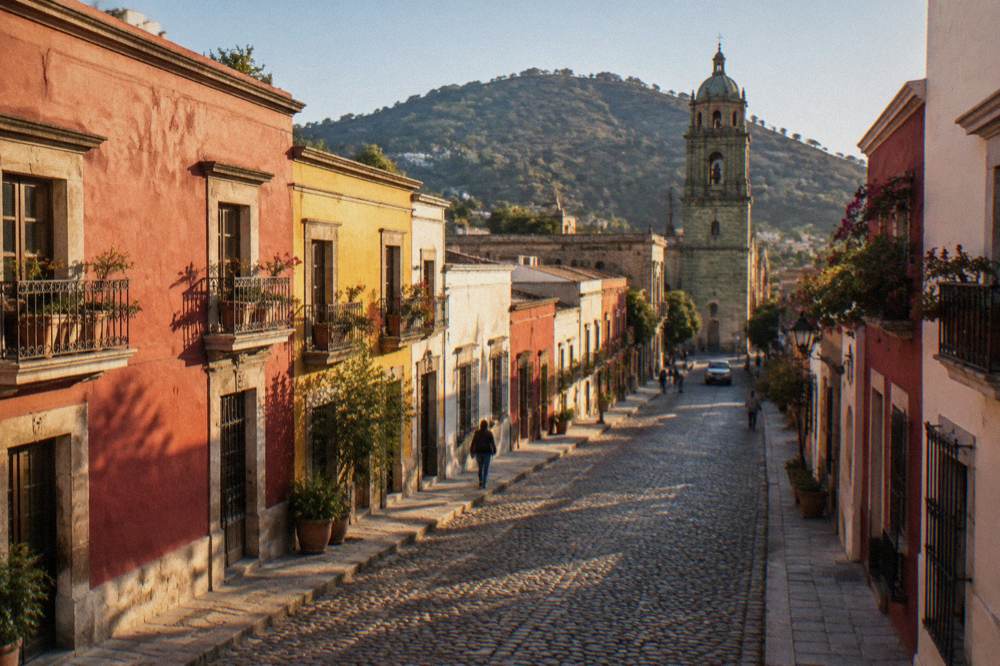
For travellers with limited nights, the arithmetic is stark. Oaxaca City recorded 1,324,332 tourist arrivals across 2025, with an average stay of 2.00 nights, and every one of those nights is better spent on the valleys than on a bus seat duplicated in both directions. The How Many Days In Oaxaca Is Enough? question is answered elsewhere on this site, but the short version relevant here is that the valley day trips alone, Hierve El Agua Day Trip, Teotitlán del Valle, San Bartolo Coyotepec Black Pottery and San Martín Tilcajete Alebrijes, fill more worthwhile days than a Puebla out-and-back consumes.
What Does The Climate Table Say About Timing The Journey?
The SMN station normals for Oaxaca, station 20079 in the city, 1991 to 2020, show a dry season from November to April and a rainy season from May to October with its peak from June to September, and June carries the largest monthly total at 188.3 mm while January carries the smallest at 2.4 mm. The corridor bus runs in all of it, but mountain rain and the standing blockade risk both argue for margin in any tight connection.
The full monthly picture from the station normals:
| Month | Mean daily high C | Mean daily low C | Rain mm |
|---|---|---|---|
| January | 28.9 | 10.3 | 2.4 |
| February | 31.1 | 11.6 | 4.6 |
| March | 33.3 | 13.6 | 17.6 |
| April | 34.9 | 15.8 | 47.3 |
| May | 33.8 | 16.7 | 97.9 |
| June | 30.9 | 16.7 | 188.3 |
| July | 30.1 | 15.9 | 118.6 |
| August | 30.0 | 15.9 | 131.8 |
| September | 29.1 | 16.1 | 163.6 |
| October | 29.3 | 14.5 | 63.1 |
| November | 29.0 | 12.3 | 9.1 |
| December | 28.9 | 11.0 | 9.0 |
Read the table rather than the folklore. April has the highest mean daily high at 34.9 C and December to January the lowest mean nightly lows, 11.0 and 10.3 C. September averages 163.6 mm of rain on 21.4 days with rain, and June 188.3 mm on 19.9 days; those two months are the core of the wet half of the year on the valley floor. None of this closes the highway, and the rainy season has its own case, which the site covers separately, but a traveller choosing between a June corridor crossing and a February one should know the numbers before choosing.
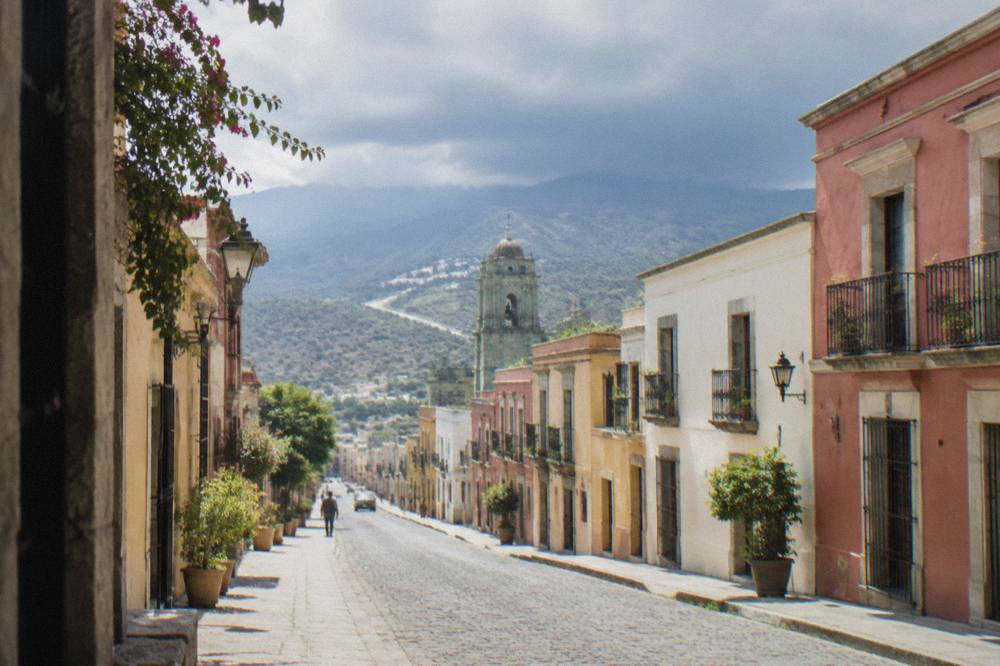
The days-with-rain column tells the planning story as clearly as the totals:
| Month | Days with rain | Season |
|---|---|---|
| January | 1.4 | dry |
| February | 1.1 | dry |
| March | 4.1 | dry |
| April | 7.6 | dry, turning |
| May | 13.7 | rainy season begins |
| June | 19.9 | rainy peak |
| July | 20.4 | rainy peak |
| August | 20.5 | rainy peak |
| September | 21.4 | rainy peak |
| October | 12.0 | rainy, easing |
| November | 3.5 | dry |
| December | 2.4 | dry |
Two further facts sharpen any calendar decision. Oaxaca has been on UTC-6 all year since Mexico abolished daylight saving, under the law published on 28 October 2022, so a bus departure time means the same thing in every season. And the state lodging tax, the Impuesto al Hospedaje, is 3 percent on hotel-type stays, 5 percent when an intermediary platform is involved, under decree 884 published in December 2025, which is a real line on every accommodation bill in both cities.
What Do The Visitor Numbers Say About Where Time Goes?
The 2025 Sectur figures show where time actually goes in this region: Monte Albán received 416,675 visitors, Mitla 104,428 and the smaller valley sites a few thousand each, while Oaxaca City logged 1,324,332 arrivals of which 1,111,799 were national and 212,533 foreign. The gravitational pull of the valleys, not the corridor north, is what the data records.
The site-level breakdown from the Sectur indicators:
| Site | 2025 visitors | National | Foreign |
|---|---|---|---|
| Monte Albán | 416,675 | 342,962 | 73,713 |
| Mitla | 104,428 | split not given | split not given |
| Yagul | 10,185 | split not given | split not given |
| Lambityeco | 5,545 | split not given | split not given |
| Zaachila | 4,229 | split not given | split not given |
The city-level split is the sharper planning fact: 83.95 percent of Oaxaca City's 2025 arrivals were national travellers and 16.05 percent foreign, with hotel occupancy at 51.73 percent across the year. Occupancy that averages just over half does not describe a city that is ever closed out, but festival windows behave differently. Guelaguetza 2026, held on 20 and 27 July at the Auditorio Guelaguetza, sold its Palco A seats at 1,632 MXN and Palco B at 1,321 MXN through Superboletos and exhausted them quickly, with Palcos C and D free; the 2027 dates are not announced. In a July festival week, a corridor plan that treats bus seats and beds as plentiful fails, and in an ordinary week it holds.
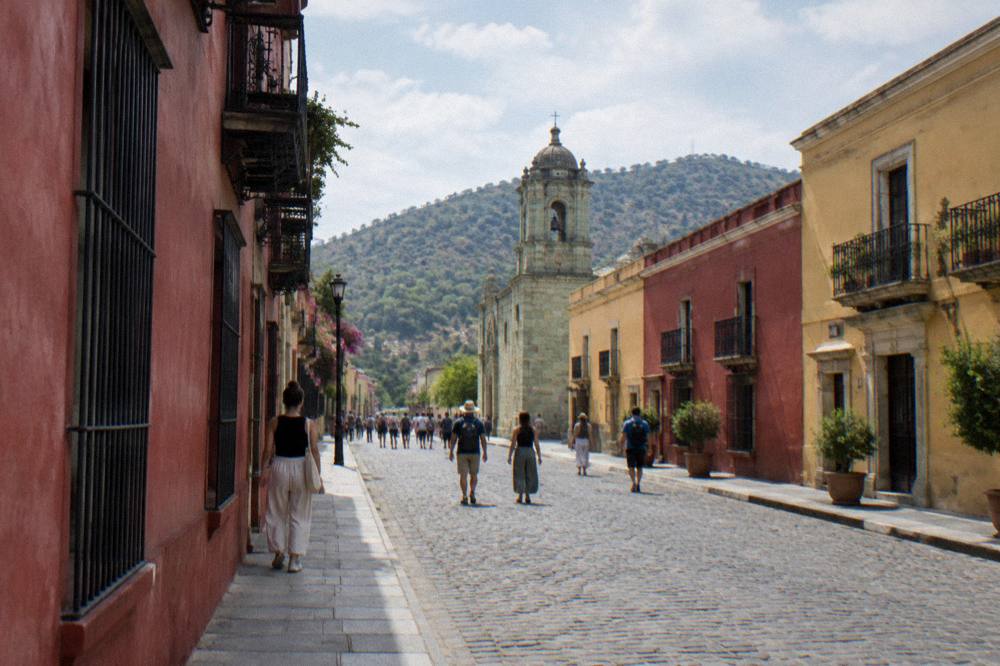
What Can You Book Around Oaxaca If You Skip The Puebla Run?
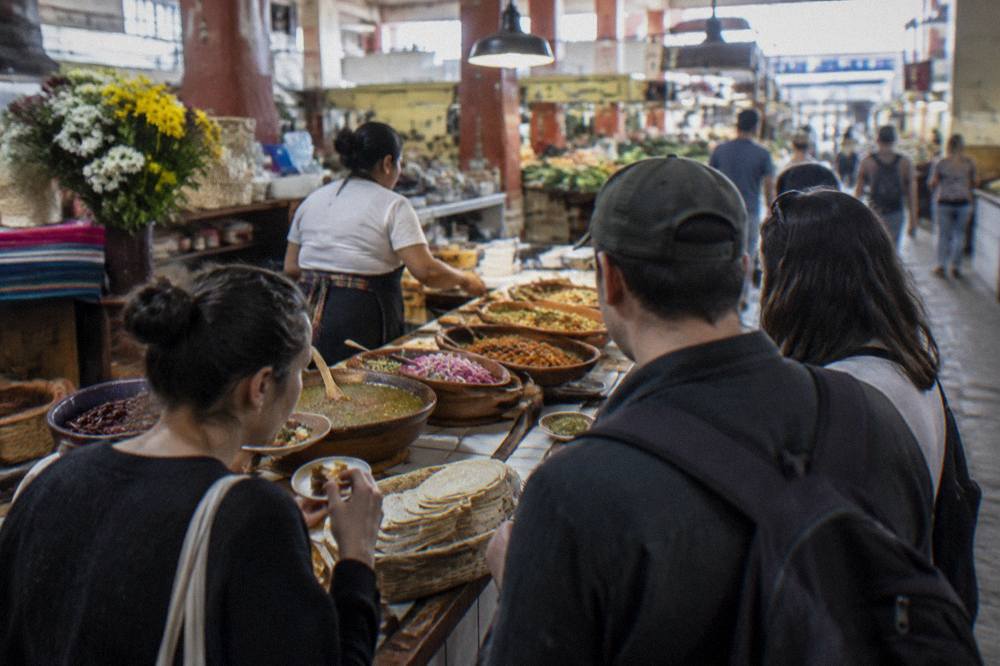
If the verdict lands against Puebla, the productive move is to convert the same days into valley and city products: a Hierve el Agua half day, an artist-led street art walk, and a food and markets tour cover the three things the corridor cannot deliver, mineral springs and ruins, working artists, and the market food culture of the historic centre. Each is bookable with free cancellation on the operator's booking page, which a fixed bus itinerary is not.
The logic is simple. A day spent on the corridor is a day with no decisions in it, just a seat and a schedule. A day spent in the valleys or the centro is a day of choices, and the choices are what the rest of this site documents: the Mezcal Route Santiago Matatlán, the Ocotlán And Friday Market run, Zaachila And The Thursday Market, and the mountain country of the Sierra Norte And Pueblos Mancomunados for travellers who want altitude rather than highway. The Cuilapan De Guerrero stop sits closest to the city of the western options.
For the city days themselves, the essentials are already covered in depth: the Things To Do In Oaxaca root page, and for the corridor questions that remain, Oaxaca To Mexico City and How Long Is The Bus From Mexico City To Oaxaca? close the loop from the other direction. The coastal questions have their own pages, including How Long Is The Bus From Puerto Escondido To Oaxaca City?, for travellers building a wider circuit.
Common Questions About Travelling From Oaxaca To Puebla
Can You Do Puebla As A Day Trip From Oaxaca?
The corridor is an intercity bus route on the Oaxaca to Mexico City axis, and ADO sets the times and fares on its own channels. As a radial day trip it consumes the day in transit; as a waypoint on a one-way loop toward or from Mexico City it works well.
How Do You Buy Bus Tickets From Oaxaca To Puebla?
Through the operator. ADO's official site is ado.com.mx, and its pages carry the timetables, service classes and current fares, which this site does not restate. Resellers also sell the same departures.
Which Is Better, Oaxaca Or Puebla?
They are complements rather than rivals. The full comparison, including the food, ruins and festival differences, is on the Oaxaca Versus Puebla guide elsewhere on this site.
What Should You See Near Oaxaca City Before A Long Bus Day?
The valley options: Monte Albán about 15 minutes from the Zócalo, Santa María del Tule about 11, Teotitlán del Valle about 26, and Hierve el Agua about 57 in free-flow conditions, all derived times that real traffic extends.
When Is The Best Time Of Year For The Bus Corridor?
The SMN normals show the dry season from November to April, with January at 2.4 mm of rain, and the rainy season from May to October, with June at 188.3 mm. The highway runs in all seasons; tight connections deserve extra margin in the wet months and during any blockade action.
Is The Oaxaca To Puebla Route Affected By Blockades?
Road blockades by teachers' unions are a standing risk in Oaxaca state and have disrupted road and airport access for hours at a time in reported cases. They are resolved after hours or days, and no calendar predicts them, so build slack into same-day connections.
The final word is the honest one: Puebla rewards a night, the valleys reward a morning, and the corridor rewards a plan that never asks the same highway twice.