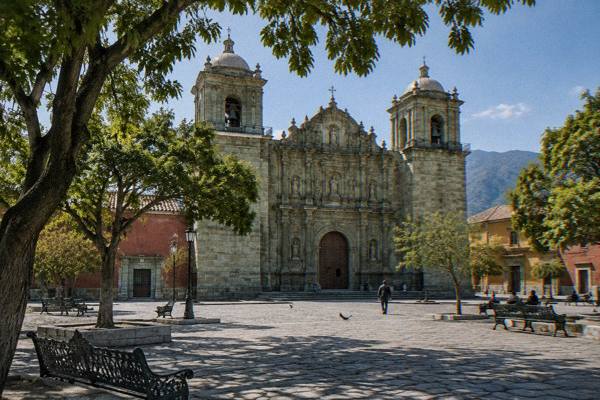
Colectivos And Mototaxis Around The Valley
This guide explains how that network works, what is known about the sites at each end of a ride, and where a tour or a private driver fits in.
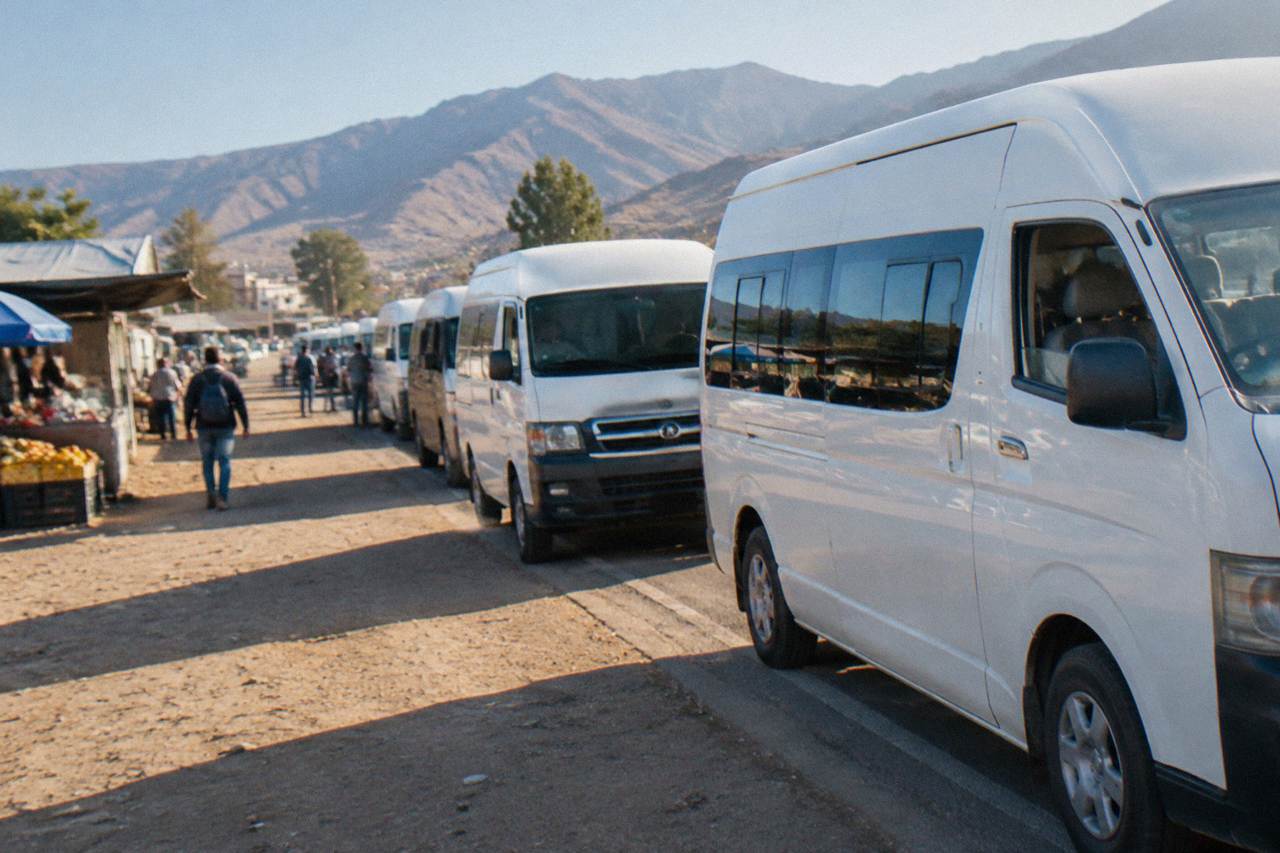
Colectivos are shared vans that leave central Oaxaca City for valley towns such as Tlacolula, Mitla and Teotitlán del Valle once they fill, while mototaxis are short-range three-wheelers used inside those towns. Fares are set by the operators, so confirm before boarding.
Oaxaca City, the capital of the state of Oaxaca in Mexico, is an inland highland city at about 1,550 m, and its historic centre is only one node of a wider network of valley towns. Tlacolula, Mitla, Teotitlán del Valle, Ocotlán and Zaachila all sit within an hour's drive, and the everyday transport that connects them is not the tourist shuttle but the colectivo, a shared van that departs when full, supplemented at the town end by the mototaxi, a three-wheeled cab for short hops. The guide that follows explains how that system works, which destinations it serves, what the figures say about the archaeological sites and museums at each end of a ride, and when a booked tour is the better instrument. For the wider picture of city transport, see the companion guide to getting around Oaxaca, and for a full route plan start with Oaxaca in three days.
What Are Colectivos And Mototaxis In Oaxaca?
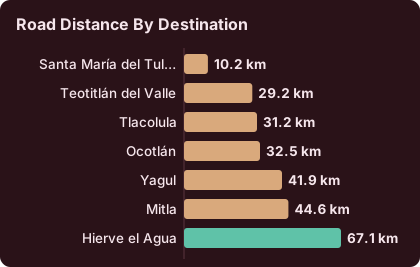
A colectivo in Oaxaca is a shared van that runs a fixed route between the city and a valley town, loading passengers at a departure point and leaving only when its seats are taken, while a mototaxi is a small motorised three-wheeler that carries one or two passengers on short hops within and between towns. Neither runs on a printed timetable, and fares for both are set by the operators, so the figure to pay is confirmed at the vehicle, not on this page.
The colectivo system is the working transport of the Valles Centrales. Routes fan out from informal stands and yards in Oaxaca City toward the towns of the Tlacolula valley to the east, the Ocotlán and Zaachila direction to the south, and the Etla valley to the north. Each vehicle bears the destination on the windscreen. Passengers share the van with residents commuting, shopping and moving goods, which is what keeps the service frequent through the day.
The mototaxi is the last-mile layer. In towns such as Tlacolula and around the valley's smaller villages, three-wheelers queue near the market and the main square and cover distances too long to walk comfortably in the midday heat and too short to justify a private cab. In Oaxaca City itself, mototaxis are not the standard form of transport; city transport is covered separately in the guide to taxis, Uber and DiDi in Oaxaca.
Planning a valley day around these vehicles works well for flexible travellers. The trade-off is simple: colectivos are cheap and frequent, but they serve the towns, not the scattered sights, and a site such as Hierve el Agua sits at the end of further local transport from Mitla or San Lorenzo Albarradas. A guided day trip collapses those legs into one booking, which is why the Hierve el Agua and mezcal-making tour from the city is a common choice for that particular route.
Where Do You Catch Colectivos From Oaxaca City?
Colectivos in Oaxaca City depart from designated stands and yards rather than a single central terminal, with each valley route using its own departure point, generally on the city edges facing the destination: eastern routes toward Tlacolula and Mitla leave from stands east and south of the centre, southern routes toward Ocotlán and Zaachila from the south side, and northern routes toward the Etla valley from the north. Exact street locations shift, so the working method is to ask at any hotel desk or use a mapping app for the current stand for the town in question.
The system rewards a little reconnaissance the evening before. Find the stand for your route, note how the vans are marked, and plan to be there early, because departure happens when the van fills and the busiest fill happens in the morning when valley residents travel into and out of the city. Return trips from the towns likewise cluster around the market and the main square.
Two cautions apply to any day of valley travel. First, road blockades by teachers' unions are a standing risk in Oaxaca and have repeatedly disrupted road and airport access; they are sporadic, resolved within hours or days, but a colectivo day plan should always have a slack afternoon. Second, the new Barranca Larga to Ventanilla highway has shortened the drive to the Pacific coast, but Puerto Escondido, at about 165 minutes of free-flow driving from the city, is an extension, never a colectivo hop. Coast travel is covered in the guide to Oaxaca to Puerto Escondido.
For travel planning beyond the valley, long-distance buses are a different operator world entirely, covered in the ADO bus guide for Oaxaca and the route guide for Mexico City to Oaxaca.
Which Valley Towns Can You Reach By Colectivo From Oaxaca?
The colectivo network from Oaxaca City reaches the principal towns of the Valles Centrales: Tlacolula and Mitla to the east, Teotitlán del Valle and Santa María del Tule on the eastern branch, Ocotlán and Zaachila to the south, and the Etla valley towns to the north, with drive times from the Zócalo ranging from about 11 minutes to Tule to about 37 minutes to Mitla. Hierve el Agua, about 57 minutes out, lies beyond the colectivo terminus and needs onward transport or a tour.
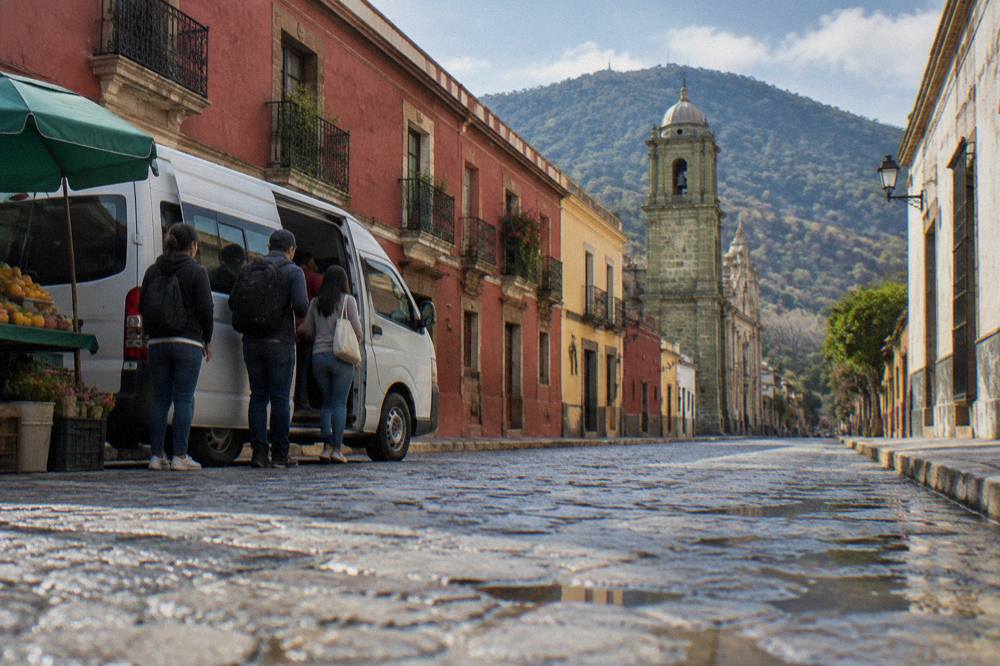
The drive times below are derived from OpenStreetMap road data in free-flow conditions, measured from the Zócalo; real traffic and mountain roads make them slower, so treat them as floors, not promises.
| Destination | Road distance | Free-flow drive time from the Zócalo |
|---|---|---|
| Santa María del Tule | 10.2 km | about 11 minutes |
| Teotitlán del Valle | 29.2 km | about 26 minutes |
| Tlacolula | 31.2 km | about 25 minutes |
| Ocotlán | 32.5 km | about 37 minutes |
| Yagul | 41.9 km | about 38 minutes |
| Mitla | 44.6 km | about 37 minutes |
| Hierve el Agua | 67.1 km | about 57 minutes |
Each town anchors a different day out. Tlacolula and its Sunday market pair naturally with Mitla and, onward, Hierve el Agua, a chain of rides detailed in the Mitla and Tlacolula day trip guide. Teotitlán del Valle is the weaving village, covered in its own page. Ocotlán, to the south, is the Friday market town, and Zaachila, about 12 km in a straight line from the city, combines a Thursday market with a small INAH archaeological zone.
Zone by zone, the archaeological sites at the colectivo destinations are INAH properties with posted hours and fees, and the differences between them matter for timing a day.
| INAH site | Hours | Last access | Fee MXN nationals | Fee MXN foreigners |
|---|---|---|---|---|
| Monte Albán | Mon to Sun 08:00 to 17:00 | 16:00 | 105 | 210 |
| Mitla | Mon to Sun 08:00 to 17:00 | 16:30 | 105 | 210 |
| Yagul | Mon to Sun 08:00 to 17:00 | 16:00 | 105 | 210 |
| Dainzú | Mon to Sun 08:00 to 17:00 | 16:30 | 80 | 145 |
| Lambityeco | Mon to Sun 08:00 to 17:00 | 16:30 | 80 | 145 |
| Zaachila | Thu to Sun 10:00 to 16:00 | 16:00 | 80 | 145 |
| Atzompa | Mon to Sun 08:00 to 16:00 | 15:00 | fee not on the INAH page | fee not on the INAH page |
Zaachila's Thursday to Sunday window is the one that breaks plans: a colectivo rider aiming for the Thursday market arrives on the one weekday the zone is open, but a Monday visitor finds it shut. Atzompa's earlier closing, with last access at 15:00, is the second trap, since it is the closest archaeological zone to the city and easy to leave for late afternoon by mistake.
How Do You Use A Mototaxi In The Valley Towns?
A mototaxi is hailed at a stand or flagged on the street in the valley towns, takes one or two passengers on a short point-to-point hop, and is paid in cash at a fare set by the operator and agreed before the ride begins. In practice it is the connector between a colectivo terminus and the specific place a traveller wants: a site entrance, a workshop, a market gate or a village square.
Mototaxis matter most on the eastern routes. Mitla's archaeological zone, its church group and the stands for onward transport toward Hierve el Agua are walkable from each other, but the jump from Mitla up the hill to the springs is where riders either negotiate a full local transport chain or switch to a booked excursion. The Hierve el Agua and mezcal-making tour exists precisely for that chain, folding the springs, a palenque stop and the valley drive into a single booking; Check availability if that shape of day appeals.
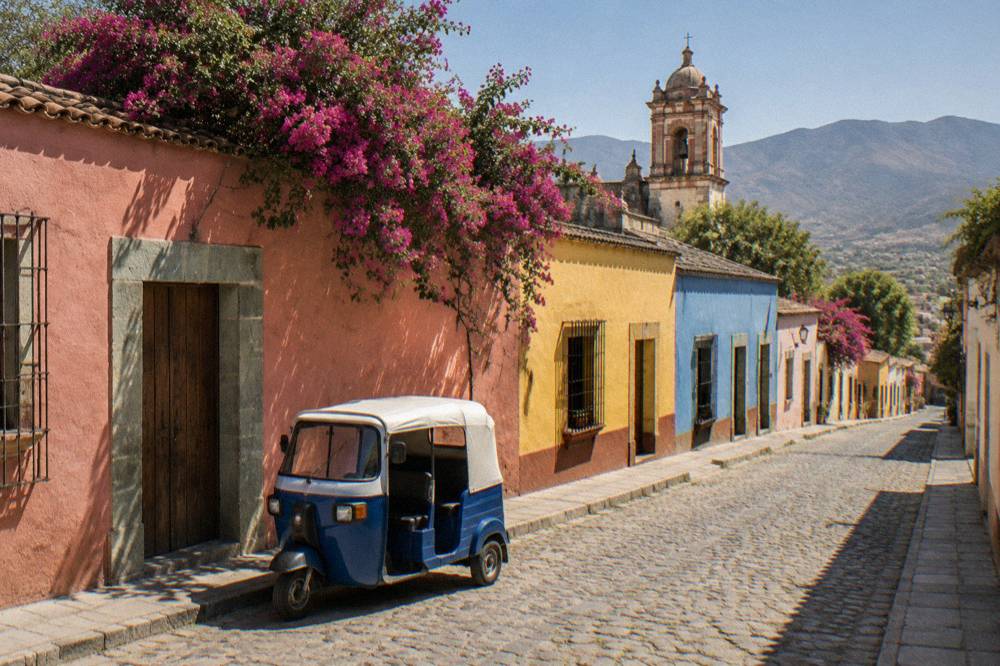
A few working rules keep the layer simple. Carry small peso notes, because neither colectivos nor mototaxis are places for large bills. Agree the mototaxi fare before mounting, since there is no meter. Keep daypacks on your lap rather than in an open tray. And when a town's market day coincides with your visit, expect the stands nearest the market to be the busiest, which in Tlacolula on a Sunday is part of the spectacle; the Tlacolula Sunday market guide covers that day in detail.
Can You Reach Monte Albán By Colectivo?
Monte Albán is the one major site near Oaxaca City that the standard colectivo network does not serve the way it serves the valley towns: the site sits on a hilltop about 8.7 km and about 15 minutes of free-flow driving above the city, reached by tour transport, taxi or a dedicated shuttle arrangement rather than a filling shared van, and the INAH zone is open Monday to Sunday 08:00 to 17:00 with last access at 16:00.
The asymmetry surprises visitors who have just ridden a colectivo to Mitla. The eastern and southern valleys are flat corridors of towns, so shared vans fill and run all day. Monte Albán is a single destination on a mountain shoulder with no town beyond it, so the economics of a colectivo route do not apply. Booked transport fills the gap: a half-day tour with entry logistics handled is the usual solution, and the dedicated Monte Albán and Monte Albán tour pages compare the options.
Monte Albán was the most visited INAH site in the state in 2025 with 416,675 visitors, against Mitla's 104,428, Yagul's 10,185, Lambityeco's 5,545 and Zaachila's 4,229, per the Sectur Oaxaca indicators. The Category I fee, 105 MXN for nationals and 210 MXN for foreigners, is shared with Mitla and Yagul, while the smaller Category III zones charge 80 and 145 MXN respectively. The rest of the planning pages sit on Oaxaca Travel Guide.
What Does A Colectivo Day Trip To The Eastern Valley Look Like?
A colectivo day to the eastern valley chains three rides: a shared van from the city to Santa María del Tule or straight to Tlacolula and Mitla, a mototaxi or onward van for the scattered stops between them, and a final leg to Hierve el Agua, about 57 minutes of free-flow driving from the Zócalo, typically reached by booked tour or by a negotiated local vehicle from Mitla rather than by colectivo alone.
The classic sequence runs Tule first, for the tree, then Teotitlán del Valle for weaving, then Tlacolula for the market and food, then Mitla for the INAH zone, finishing at Hierve el Agua. Done independently, that is four or five separate transport negotiations in one day, which is feasible for confident travellers with Spanish and a full day. The schedule risk sits at the ends: INAH zones stop admitting at 16:00 or 16:30, and the return colectivos thin out in the late afternoon.
Booked valley tours exist because of exactly that friction, and the tour list offers several shapes: an eleven-hour loop with rugs and a mezcal distillery, a full-day Tule, Mitla, Hierve el Agua and mezcal circuit, a petrified falls and pools half-loop, and the mezcal-making itinerary already mentioned. The Hierve el Agua day trip guide compares the independent and booked versions at length.
Craft stops give the eastern and southern routes their other pull.
How Does The Rainy Season Affect Colectivo Travel Around Oaxaca?
The rainy season in Oaxaca runs May to October with its peak from June to September, and it changes colectivo travel mainly through afternoon rain: June averages 188.3 mm, July 118.6 mm, August 131.8 mm and September 163.6 mm at the Oaxaca station, so the working pattern is to ride out early, see the open-air sites before mid-afternoon, and be back in the city or under a market roof when the rain arrives.
The dry season, November to April, is the simpler window: November averages 9.1 mm and December 9.0 mm, with January at 2.4 mm. The cost of that ease is crowds at the signature sites and the festival calendar, from Guelaguetza in July, which falls inside the rainy season, to Día de Muertos at the end of October into November, which sits on the seam. The full monthly picture, including temperatures, is in the Oaxaca weather by month guide and the best time to visit Oaxaca overview.
| Month | Average rain mm | Month | Average rain mm |
|---|---|---|---|
| January | 2.4 | July | 118.6 |
| February | 4.6 | August | 131.8 |
| March | 17.6 | September | 163.6 |
| April | 47.3 | October | 63.1 |
| May | 97.9 | November | 9.1 |
| June | 188.3 | December | 9.0 |
Rain does not stop the colectivo network; the vans run in all weather, and the mountain roads they use are engineered for the season. What rain changes is the walking layer at either end, from uncovered site terraces to the mototaxi queues, and the state of Hierve el Agua's access road, which is community-managed rather than an INAH property. Build a wet-afternoon fallback into any June to September plan, from the museums listed below to the covered markets.
Is Riding Colectivos In Oaxaca Safe?
The advisory picture for Oaxaca is calm relative to much of Mexico: the UK FCDO advises against all but essential travel only to parts of Mexico and does not name Oaxaca on its main page, Canada advises a high degree of caution in Mexico with regional advisories, and the US State Department lists Oaxaca state at Level 2, exercise increased caution, with no restrictions on its staff for Oaxaca City, Monte Albán, Puerto Escondido or Huatulco.
Colectivos themselves are ordinary working transport used daily by valley residents, and the normal shared-van precautions apply: keep bags on your lap, carry only the cash you need, and take the morning departures when the stands are busiest. The specific local risk worth planning around is the standing pattern of road blockades by teachers' unions, which have sporadically closed highway stretches and airport access roads and are usually cleared within a day; a valley day plan should always be one that can absorb a delayed return. Restrictions do apply in the Isthmus region of the state under the US advisory wording.
For the wider safety picture, night walking in the centre and the question of overall safety each have a dedicated page: is Oaxaca safe and is it safe to walk around at night. Solo travellers will find the network entirely usable, as the solo in Oaxaca guide explains, and the practical layers of cash and ATMs are covered in money, ATMs and cash in Oaxaca.
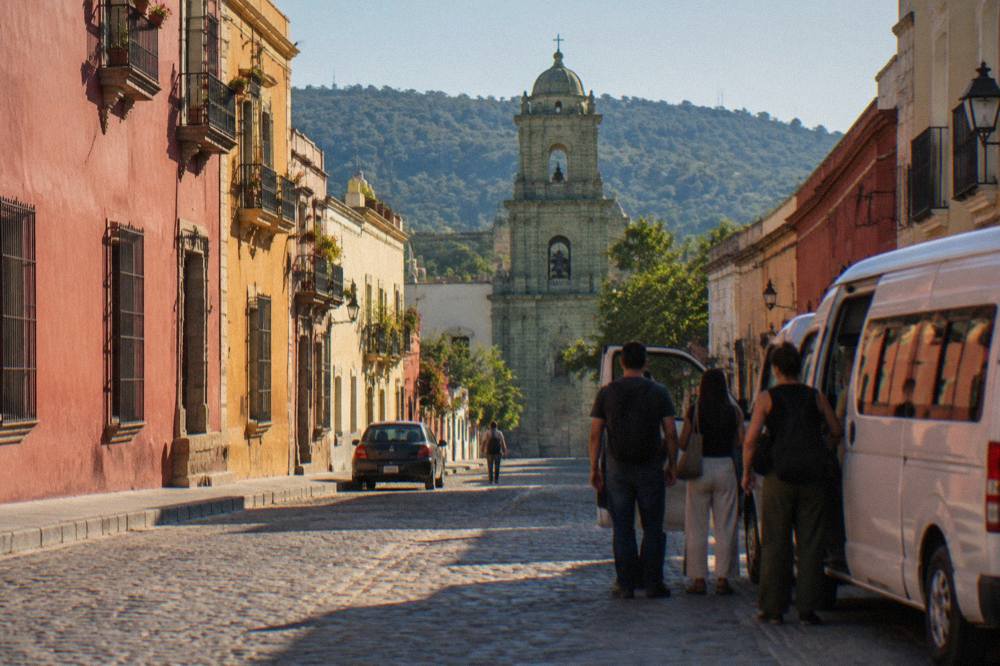
Colectivo Or Booked Tour: Which Suits Your Oaxaca Trip?
Colectivos suit flexible travellers with time, Spanish and a tolerance for negotiation, costing a few tens of pesos per leg at operator-set fares, while booked tours suit anyone who wants several scattered stops in one day, because the eastern valley's signature pairing of Hierve el Agua with Mitla and a mezcal stop is a long, multi-leg chain that a single booking collapses into one departure and one return.
The honest arithmetic is about legs, not money. A two-stop day, say Tlacolula and Mitla, is comfortable by colectivo: one van out, one between, one back, with mototaxis for the frills. A four-stop day that ends at Hierve el Agua is a different animal, and that is where the booked loops earn their price: the mezcal-making itinerary, the eleven-hour rugs and distillery loop, and the full-day Tule, Mitla and Hierve el Agua circuit all solve the same chain. Group size matters too: for two or more, a private valley day such as the private Mitla, weavers' town, mezcal and Hierve el Agua tour often prices close to several tour seats.
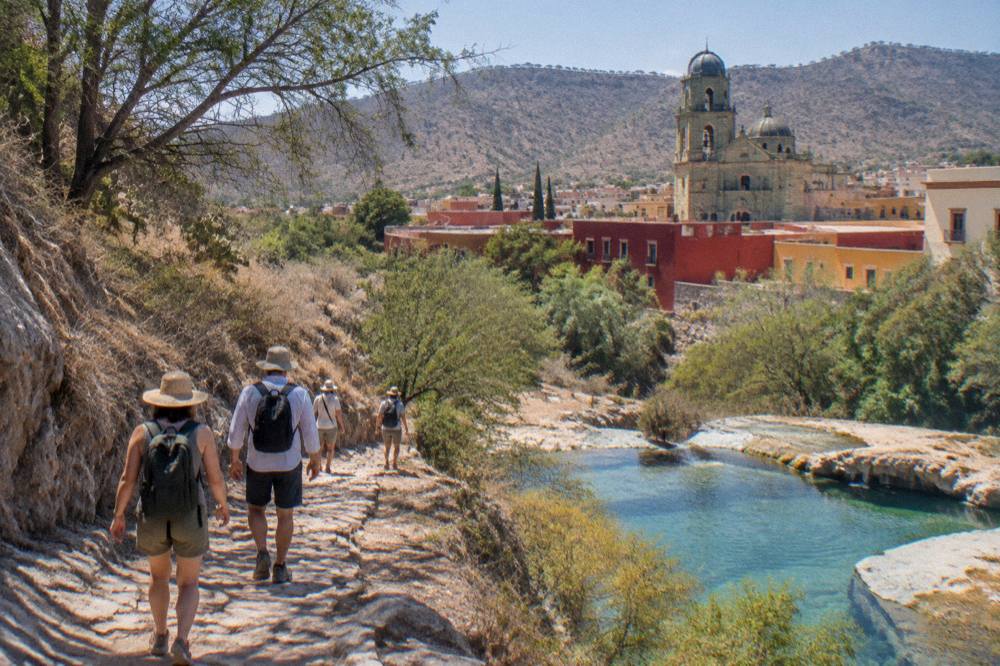
Budget the rest of the trip against whichever mode you choose with the Oaxaca travel costs and budget guide, and if the valley days are the reason for the trip, plan the length of stay with how many days in Oaxaca. The northern alternative, the Sierra Norte and the Pueblos Mancomunados, is a colectivo-and-booking hybrid of its own, with Latuvi about 142 minutes of driving from the city.
Common Questions About Colectivos And Mototaxis In Oaxaca
Do Colectivos In Oaxaca Run On A Schedule?
No. Colectivos depart when the van fills. Mornings are the busiest loading period because valley residents travel into the city then, so early riders wait the least. Afternoon return capacity thins out in the late day.
How Much Does A Colectivo From Oaxaca City To Mitla Or Tlacolula Cost?
Fares are set by the operators and are confirmed at the vehicle. The fare is paid in cash in pesos, usually on boarding or on arrival. Budget a handful of small notes for each leg.
Can You Get To Hierve El Agua By Colectivo?
Not directly in one ride. Colectivos reach Mitla, about 37 minutes of free-flow driving from the Zócalo, and the onward leg to Hierve el Agua, about 57 minutes out from the city, is covered by local transport or by a booked tour. The onward leg is commonly covered by a booked tour.
Can You Reach Monte Albán By Colectivo?
Not on the standard town network. Monte Albán is a single hilltop destination about 15 minutes of driving above the city, reached by tour transport, taxi or shuttle. The INAH zone is open Monday to Sunday 08:00 to 17:00, last access 16:00.
Are Mototaxis Safe In The Valley Towns?
Mototaxis are everyday local transport in the valley towns. Agree the fare before the ride, keep bags on your lap, and use the stands near markets and main squares, where drivers are working in public view.
When Do Colectivos Stop Running Back To Oaxaca City?
There is no fixed last departure; return service thins as the towns quiet down in the late afternoon and evening. On INAH-site days, remember that last access at the zones is 16:00 or 16:30, so plan site visits earlier and keep the return leg flexible.
The valley network rewards early starts and light bags, and the towns it serves, from the tree at Tule to the terraces of Mitla, are the reason many travelers give Oaxaca more days than they first planned.