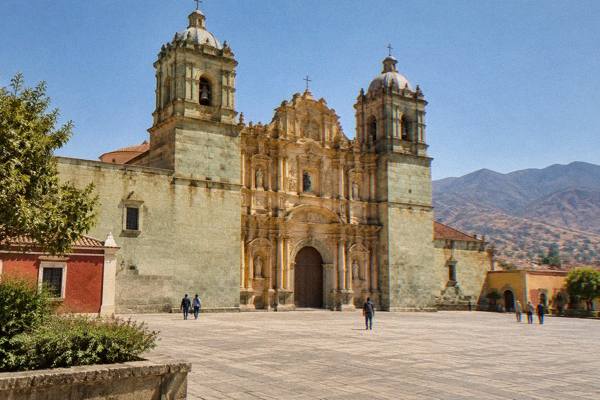
How To Pronounce Oaxaca (And Mitla, Tlayuda, Mezcal)
Oaxaca is pronounced wah-HAH-kah, with the stress on the middle syllable. Everything else on this page follows the same rule: Spanish spelling is phonetic, every vowel is short and pure, and once the system clicks, Mitla, tlayuda, mezcal and Teotitlán del Valle read themselves aloud.
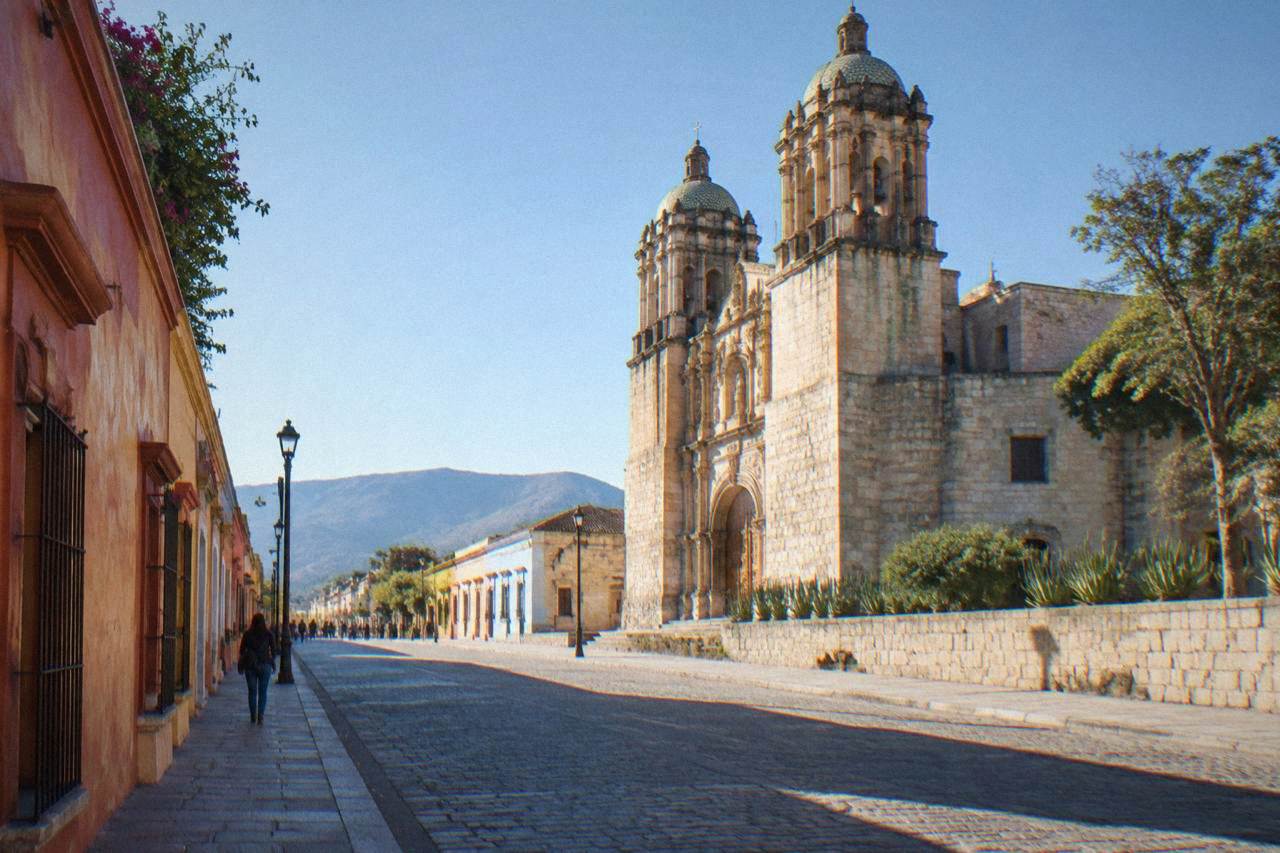
Oaxaca sounds like wah-HAH-kah. The X reads as an English H, the stress falls on the second syllable, and the final A is a full vowel, never silent.
Oaxaca City, the inland highland capital of the state of Oaxaca in Mexico, is pronounced wah-HAH-kah: three syllables, stress in the middle, and an X that works like an English H. That single rule unlocks most of the names on this page, because the X in Oaxaca and the TL in tlayuda are the two sounds visitors stumble on, and both follow a pattern you can learn in a minute. This Oaxaca Travel Guide page walks through the city name first, then the words that appear on menus, market stalls, bus destinations and tour brochures across the Valles Centrales, with stress marks and plain English approximations for each.
How Do You Pronounce Oaxaca?
Oaxaca is pronounced wah-HAH-kah: three syllables, with the stress on the middle one and a soft H sound where the X sits. The full official name of the city is Oaxaca de Juárez, and the state shares the pronunciation. Say wah-HAH-kah, pause, then deh HWAH-res, and you have the name that appears on every map, bus ticket and festival banner in the region.
Break it into three parts: Oa-xa-ca. The opening O and A run together into a single "wah" sound, because in Spanish two adjacent vowels often form one glide. The X is the famous letter: in words inherited from indigenous languages of Mexico, X is regularly pronounced like the English H, so Xa reads "hah" and carries the stress. The final ca is an unstressed "kah", with a short A like the A in "father" but quicker.
The name itself comes from the Nahuatl name of the valley settlement, and the X spelling is a legacy of how colonial-era Spanish wrote that indigenous sound. You do not need any of that history to say it correctly; you only need the pattern, which repeats across Mexico in words like México itself, pronounced MEH-hee-koh in Spanish.
One practical note for travellers: the city is in the Valles Centrales at about 1,550 m, an inland valley setting with a dry season from November to April and a rainy season from May to October. There is no sea and no beach here, so if a bus or tour listing says Oaxaca, it means the highland city, not the Pacific coast towns of Puerto Escondido or Huatulco, which are far extensions from the capital. The things to do in Oaxaca round-up keeps the city and the coast options separate for exactly this reason.
| Syllable | Sounds like | Notes |
|---|---|---|
| Oa | "wah" | Two vowels glide together into one sound |
| xa | "HAH" | X reads as English H, carries the stress |
| ca | "kah" | Short pure A, never silent |
How Do You Pronounce The Other Big Names: Monte Albán, Mitla, Hierve El Agua?
Monte Albán is pronounced MOHN-teh ahl-BAHN, with the stress on Albán's final syllable. Mitla is MEET-lah, with a long E and a clear TL blend. Hierve el Agua is ee-EHR-beh ehl AH-gwah, where the H is silent and the stress lands on the first syllable of each word. All three are archaeology or nature names you will say out loud at ticket windows and taxi stands.
Monte Albán is the easiest of the three for English speakers: it is essentially "Monte" as in monte, "Albán" with the stress on BÁN. The INAH site page lists the zone as open daily 08:00 to 17:00 with last access at 16:00, and entry at 105 MXN for Mexican nationals, 210 MXN for foreign visitors. Mitla, MEET-lah, runs the TL consonant cluster that also appears in tlayuda; in Mitla the TL starts the stressed syllable but the word flows as one smooth "meet-lah" rather than two separate sounds. Mitla's INAH page lists daily 08:00 to 17:00 hours, last access 16:30, and the same 105 / 210 entry fees.
Hierve el Agua is the one that looks harder than it is. The initial H is silent in Spanish: "ee-EHR-beh". "El agua" is "ehl AH-gwah", and the GW cluster matches the English G in "Gwen". The full phrase means a name you will hear on every valley day-trip listing, and drive time from the Zócalo is about 57 minutes over roughly 67 km in free-flow conditions, longer in real traffic on the mountain road. The Mitla attraction guide and the Mitla and Tlacolula day trip planner cover what you actually do at these sites once you can say them.
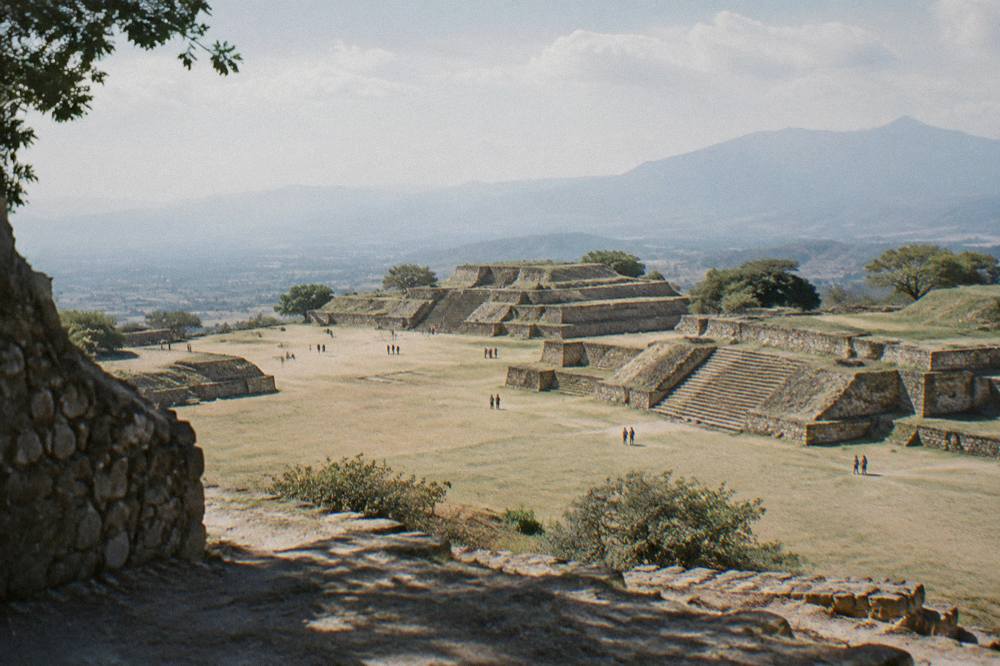
Two more names complete the set. Teotitlán del Valle, the weaving village, is teh-oh-tee-TLAHN dehl VAH-yeh, stress on TLÁN. Santa María del Tule, home of the great tree, is SAHN-tah mah-REE-ah dehl TOO-leh. Both are short drives from the city: Teotitlán about 26 minutes away in free-flow conditions, with Tule closer still.
How Do You Pronounce The Food Words: Tlayuda, Mole, Mezcal?
Tlayuda is pronounced tlah-YOO-dah, with a single TL blend at the start and the stress on YOO. Mole is MOH-leh, two syllables, never one. Mezcal is mess-KAHL, with the stress on the second syllable and the Z reading as a plain S. These three words appear on nearly every menu in the city, and each one has a specific dish or drink behind it.
The TL cluster is the sound that defines Oaxacan pronunciation for visitors. It is not "tuh-lay": the T and L fire together as one consonant, the way the end of "catch" flows in "matchlock" if you speed it up. Put your tongue where you would for a T and release it as an L. Tlayuda, tlah-YOO-dah, is the large crisp tortilla topped with beans, quesillo and meat that anchors the city's street food; the street food overview places it among the dishes worth ordering by name.
Mole trips up English speakers because the final E is a full syllable: MOH-leh. The word names a family of complex sauces, and the Oaxacan mole guide covers the main varieties. Mezcal, mess-KAHL, gives the Z its Spanish value, identical to an S, and the stress falls on the final syllable. The spirit is the reason the city's tasting rooms exist, and the mezcal in Oaxaca guide explains what distinguishes it from tequila in plain terms.
| Word | Pronunciation | What it is |
|---|---|---|
| tlayuda | tlah-YOO-dah | Large crisp tortilla with beans, quesillo and toppings |
| mole | MOH-leh | Family of sauces served over meat or rice |
| mezcal | mess-KAHL | Agave spirit, the region's signature drink |
| tejate | teh-HAH-teh | Traditional cold maize and cacao drink |
| chapulines | chah-poo-LEE-ness | Toasted grasshoppers eaten as a snack |
| quesillo | keh-SEE-yoh | String cheese, the LL reads as a Y |
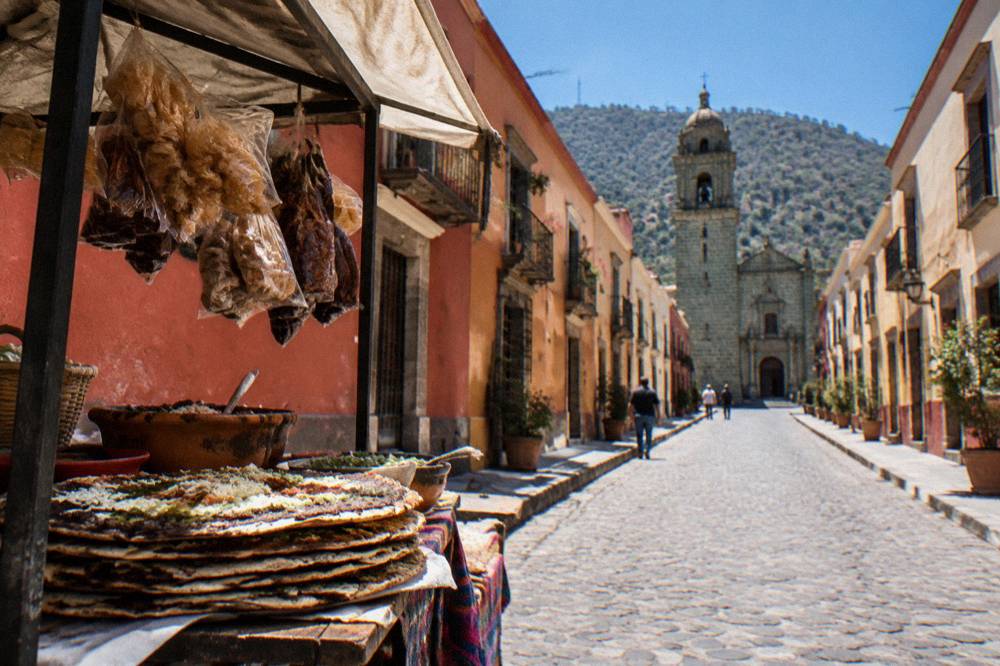
Tejate, teh-HAH-teh, is worth a line of its own because the J reads as a strong English H, the same silent-adjacent sound as in Hierve. Chapulines, chah-poo-LEE-ness, ends in a full "ness" rather than a swallowed "nss". Quesillo, keh-SEE-yoh, shows the double-L-as-Y rule that also appears in Teotitlán's "yeh" ending in some accents and in pollo.
Why Does Oaxaca Have An X In It?
The X in Oaxaca spells an indigenous H sound that colonial-era Spanish writing recorded with that letter, and the spelling survives even though modern Spanish barely uses X this way. México, Oaxaca, Xoxocotlán and Ixmiquilpan all keep the same legacy: X standing for the sound English writes as H. In Oaxaca's case the name comes from the Nahuatl name for the valley settlement.
Spanish spelling has changed over time, and words that once used X for the H-like sound either kept the old spelling, as in México and Oaxaca, or switched to J, as in Don Quixote's modern Spanish form Don Quijote. Oaxaca kept its X, so the spelling and the sound disagree for anyone reading the name with English or modern Spanish instincts. The rule is consistent: in these inherited Mexican place names, treat X as H and you will be right essentially every time.
Xoxocotlán, the municipality that gives the airport its name, doubles the pattern: hoh-hoh-koh-TLAHN. You say this word at the airport and at the cemetery during Día de Muertos season, and the stress sits on the final TLÁN. The Oaxaca airport guide uses the name throughout, as do the flights to Oaxaca and getting around Oaxaca pages.
| Spelling | Sound | Example |
|---|---|---|
| X in inherited names | English H | Oaxaca, México, Xoxocotlán |
| J | Strong English H | tejate, Juárez, Jalatlaco |
| LL | English Y | quesillo, calle |
| Z | English S | mezcal, Zaachila |
| H | Silent | Hierve el Agua, Huitzo pattern |
Which Syllable Gets The Stress In Oaxacan Words?
Spanish stress is regular and written down: if a word ends in a vowel, N or S, the stress falls on the penultimate syllable unless an accent mark says otherwise, and if it ends in a different consonant, the last syllable is stressed unless marked. That is why Mitla stresses MIT and mezcal stresses KAHL, while Oaxaca, ending in a vowel with no accent, stresses the middle syllable. Accent marks always override the pattern: Albán, Teotitlán, Juárez.
Learn the two defaults and the written accents carry you through every name on this page. Words ending in a vowel stress the second-to-last syllable: Oaxaca (wah-HAH-kah), tlayuda (tlah-YOO-dah), mole (MOH-leh). Words ending in other consonants stress the last syllable: mezcal (mess-KAHL), Monte Albán (ahl-BAHN). The written accent is the third signal: Teotitlán del Valle puts a visible mark on TLÁN, so the stress sits there regardless of the ending, and Juárez, the name in the city's full title Oaxaca de Juárez, carries HWAH-res with the marked stress.
This system also explains why the state's name never shifts: whether you say the city or the state, wah-HAH-kah keeps its middle stress. The only trap is English habit, which wants to stress the first syllable of any unfamiliar word. Resist that once and the rest follows.
How Do You Pronounce The Neighbourhood Names: Jalatlaco, Xochimilco, Zócalo?
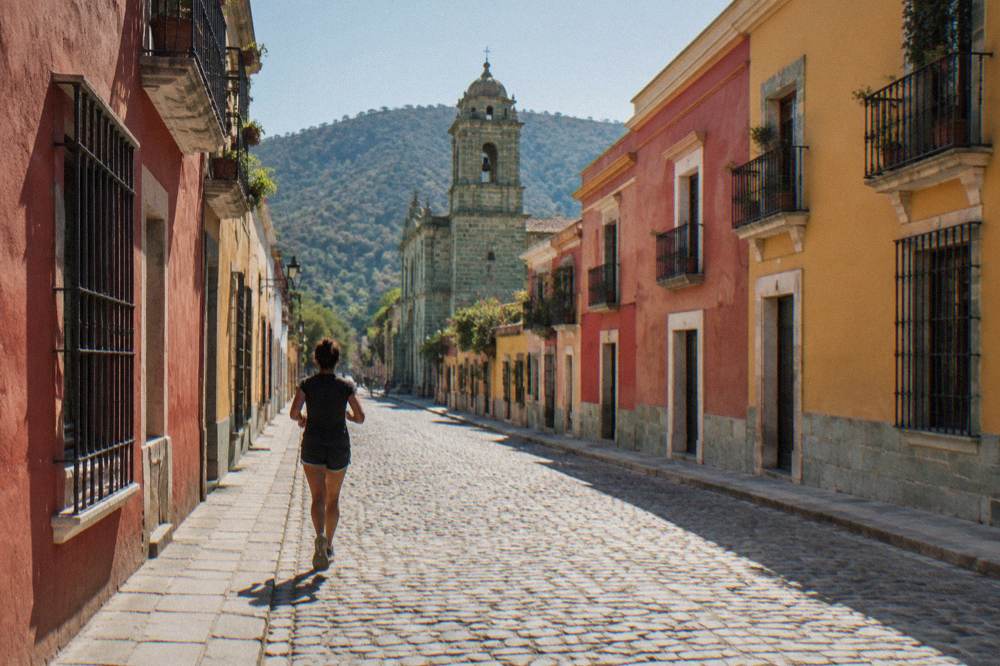
Jalatlaco is hah-lah-TLAH-koh, with the stress on TLAH and the J as a strong H. Xochimilco is soh-chee-MEEL-koh, where this particular X reads as an S sound rather than H, one of the few inconsistencies left in the old spelling. Zócalo is SOH-kah-loh, three clean syllables with the stress written on the first. All three name places you will walk through in the historic centre.
Jalatlaco is one of the city's historic barrios and a magnet for street-art walks; its name runs the TL cluster in the middle, hah-lah-TLAH-koh, and the J gives the strong H heard in tejate. Xochimilco, the neighbourhood that preserves the colonial aqueduct, is the exception worth flagging: the X here sounds as S, soh-chee-MEEL-koh, not hoh-chee. The old letter could record both sounds, and usage settled differently in different words; there is no rule to derive, you simply learn that Xochimilco starts with an S sound while Xoxocotlán starts with H.
Zócalo, SOH-kah-loh, names the main square, formally the Plaza de la Constitución, and the written accent fixes the first-syllable stress. Nearby you will say Andador Macedonio Alcalá, ahn-dah-DOHR mah-ceh-DOH-nyoh ahl-kah-LAH, the pedestrian street that runs from the Zócalo toward Santo Domingo. Santo Domingo de Guzmán itself is SAHN-toh dee-MEEN-goh deh goos-MAHN, with the stress on MIN and MAHN by the standard rule.
How Do You Say The Valley Town Names: Tlacolula, Ocotlán, Zaachila?
Tlacolula is tlah-koh-LOO-lah, with the opening TL and the stress on LOO. Ocotlán is oh-koh-TLAHN, stress on the final TLÁN as the accent mark shows. Zaachila is sah-CHEE-lah, where the double A reads as one long ah and the stress sits on CHEE. These three towns anchor the region's market circuit and day trips east and south of the city.
Tlacolula, about 25 minutes from the Zócalo in free-flow conditions, gives its name to the valley's eastern arm and to the town whose weekly market draws visitors from the city. Ocotlán, about 37 minutes south, sits toward the route to Ocotlán de Morelos. Zaachila, to the south-west of the city, holds its own INAH archaeological zone, and its opening schedule is unusual: the INAH page lists Thursday to Sunday, 10:00 to 16:00 only, with entry at 80 MXN for nationals and 145 MXN for foreign visitors, the Category III rate.
The craft villages complete the set. San Martín Tilcajete, sahn mahr-TEEN teel-kah-HEH-teh, is the alebrije painting town. San Bartolo Coyotepec, sahn bahr-TOH-loh koh-yoh-teh-PEHK, is the black pottery town. Teotitlán del Valle, teh-oh-tee-TLAHN dehl VAH-yeh, is the weaving town, about 26 minutes out. Santiago Matatlán, sah-gee-AH-koh mah-taht-LAHN, is the town that the state's own pages call the world capital of mezcal, and the mezcal route planner covers the road there.
| Town | Pronunciation | Known for |
|---|---|---|
| Tlacolula | tlah-koh-LOO-lah | Valley market town, about 25 min |
| Ocotlán | oh-koh-TLAHN | Valley town south of the city, about 37 min |
| Zaachila | sah-CHEE-lah | INAH zone, Thu to Sun only |
| San Martín Tilcajete | sahn mahr-TEEN teel-kah-HEH-teh | Alebrije painting |
| San Bartolo Coyotepec | sahn bahr-TOH-loh koh-yoh-teh-PEHK | Black pottery |
| Santiago Matatlán | sah-gee-AH-koh mah-taht-LAHN | Mezcal, state pages call it the world capital |
How Do You Pronounce Guelaguetza And Día De Muertos?
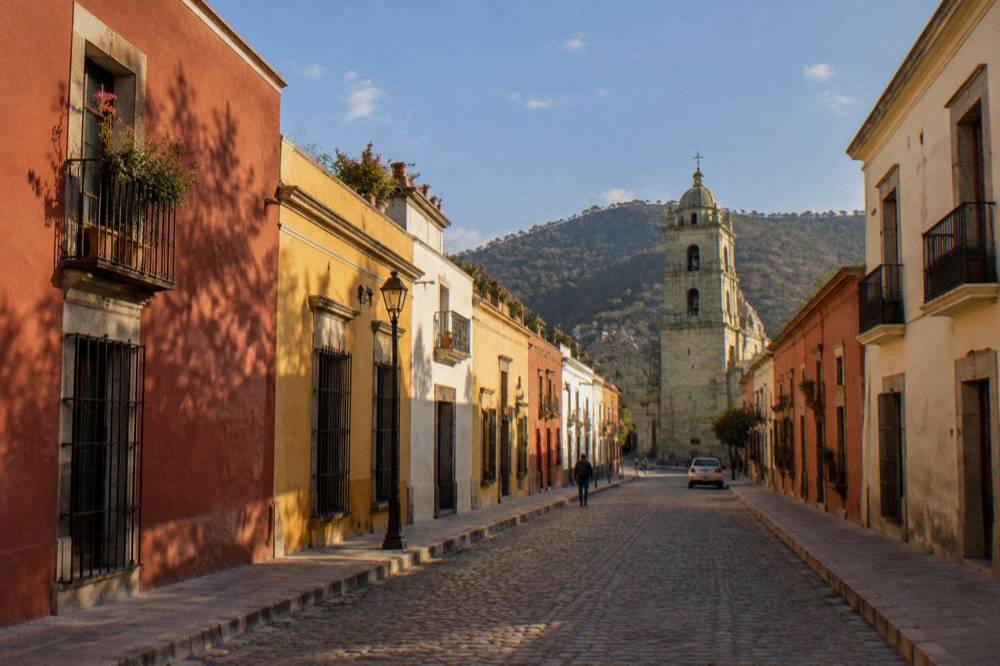
Guelaguetza is pronounced geh-lah-GEHT-sah, with the stress on GEHT and the Z as an S. Día de Muertos is DEE-ah deh MWER-tohs, in which the U in Muertos takes its own quick sound before the EH. Both names attach to the city's two defining festival seasons, July and the turn of November.
Guelaguetza names the annual July festival whose main performances, the Lunes del Cerro, take place on two Mondays at the Auditorio Guelaguetza on the Cerro del Fortín. The 2026 edition ran 20 and 27 July with two shows each day, at 10:00 and 17:00, and paid seating at 1,632 MXN in Palco A and 1,321 MXN in Palco B, with two free sections; the 2027 dates are not announced. The word's spelling is Nahuatl-derived, and the G opens with a hard sound, geh, not a soft jay.
Día de Muertos is said as DEE-ah deh MWER-tohs. The diphthong UE in Muertos is a quick "mwer", with the W audible, and the stress lands on MWER. The festival's traditional centre is 31 October to 2 November; the 2026 city programme has not been announced, so treat any specific date list with caution. The celebrations spread across neighbourhoods like Jalatlaco and cemeteries in Xoxocotlán, hoh-hoh-koh-TLAHN, a name you will now read without hesitating.
Does Anyone Mind If You Say It Wrong?
Nobody in the city's visitor economy expects perfect Spanish, and attempting wah-HAH-kah rather than oh-AX-ah-cuh is received as courtesy, not error. The names on this page are said many times a day in markets, taxi stands and ticket lines, and vendors, drivers and guides hear every accent the world produces. Slow, syllable-by-syllable speech beats fast approximation, and pointing at a sign works when the word escapes you.
There is a practical payoff beyond politeness. Saying Mitla, MEET-lah, or Hierve el Agua, ee-EHR-beh ehl AH-gwah, correctly at a taxi stand or colectivo stop removes ambiguity about where you are going, which matters on valley routes where several towns share road corridors. The same applies at INAH ticket windows: Tule is TOO-leh, Yagul is yah-GOOL, and Atzompa is aht-SOHM-pah. Each of those sites appears on the valley circuit pages, and their INAH hours and fees differ, so the name and the plan travel together.
The where to stay in Oaxaca planner and the how many days in Oaxaca guide both lean on neighbourhood and town names, so a grip on pronunciation pays off before you even arrive, when reading listings and comparing locations.
| Site | Pronunciation | INAH entry (MXN) |
|---|---|---|
| Monte Albán | MOHN-teh ahl-BAHN | 105 national / 210 foreign |
| Mitla | MEET-lah | 105 / 210 |
| Yagul | yah-GOOL | 105 / 210 |
| Dainzú | dah-EEN-soo | 80 / 145 |
| Lambityeco | lahm-bee-TEH-koh | 80 / 145 |
| Zaachila | sah-CHEE-lah | 80 / 145, Thu to Sun only |
| Atzompa | aht-SOHM-pah | fee not listed on the INAH page |
What Other Names Appear On Signs And Menus?
Beyond the headline names, a handful of recurring words cover most signage in the city: mercado (mehr-KAH-doh, market), andador (ahn-dah-DOHR, pedestrian street), templo (TEHM-ploh, church), nieve (nee-EH-beh, sherbet), and palenque (pah-LEHN-keh, a mezcal distillery). Reading these five plus the food table above decodes the majority of signs a visitor meets in the historic centre and the valleys.
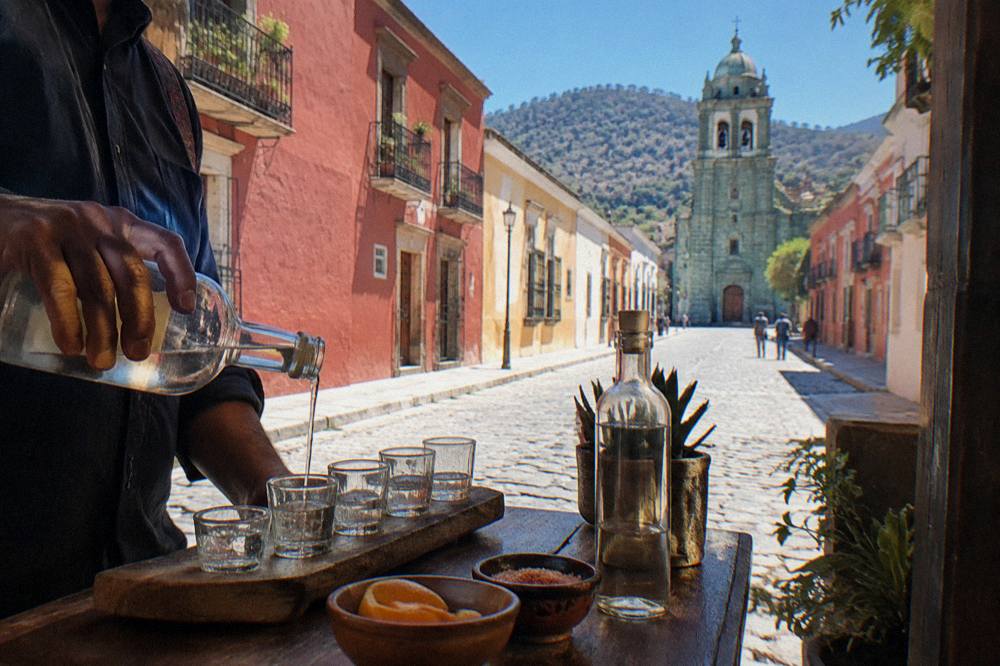
Mercado names the markets, including Mercado 20 de Noviembre, mehr-KAH-doh BAYN-teh deh noh-BEE-EHM-breh, and Mercado Benito Juárez, beh-NEE-toh HWAH-res, both steps from the Zócalo. Andador labels the pedestrian stretches, above all the Andador Macedonio Alcalá. Templo fronts the churches; the Basílica de la Soledad is bah-SEE-lee-kah deh lah soh-leh-DAHD. Nieve is the sherbet sold in the city, and palenque, pah-LEHN-keh, is the word for the small distilleries around Santiago Matatlán that mezcal tours visit; the mezcal tour page and the Hierve el Agua tour listings both use it.
Two longer names reward advance practice. Jardín Etnobotánico, hahr-DEEN eht-noh-boh-TEE-nah-koh, is the botanical garden beside Santo Domingo, whose free guided tours run Monday to Friday at 10:30, 11:00, 11:30, 12:00 and 17:00, and Saturday from 10:30 to 12:00, with large groups booking two weeks ahead. Pueblos Mancomunados, PWEH-blohs mahn-koh-moo-NAH-dohs, is the network of Sierra Norte villages reached on long hikes, among them Latuvi, lah-TOO-vee, about 142 minutes' drive from the city in free-flow conditions, and the trail town of Cuajimoloyas, kwah-hee-moh-LOH-yahs.
How Do You Put The Names Together When Booking?
When booking tours and reading itineraries, sound each name out with the stress rules above. The full-day valley loops pair Hierve el Agua with Mitla, Tule and a mezcal stop in one drive, and those four names, ee-EHR-beh ehl AH-gwah, MEET-lah, TOO-leh and mess-KAHL, are the ones to say fluently at pickup.
The related tour on this page is a full-day loop that strings Mitla, the Tule tree, a weaving stop and mezcal together with a long stay at Hierve el Agua; you can Check availability on the operator's booking page. The itinerary pages help with sequencing: the Oaxaca in 5 days plan slots the valley loop into a full week's framework, and the Oaxaca for couples itinerary pairs the ruins days with market and mezcal evenings. For the journey in, the Mexico City to Oaxaca guide and the ADO bus guide cover the main overland options, and the getting around guide explains the city transport you will navigate by name.
Timing sits alongside pronunciation in planning. The SMN station normals for the city give dry-season months like January a mean maximum of 28.9 C with 2.4 mm of rain, and June 188.3 mm at a mean maximum of 30.9 C, so the best time to visit guide, the weather by month table and the travel costs and budget page are the pages to read once the names on the itinerary make sense aloud.
| Month | Mean max C | Mean min C | Rain mm |
|---|---|---|---|
| January | 28.9 | 10.3 | 2.4 |
| April | 34.9 | 15.8 | 47.3 |
| June | 30.9 | 16.7 | 188.3 |
| September | 29.1 | 16.1 | 163.6 |
| November | 29.0 | 12.3 | 9.1 |
Common Questions About Pronouncing Oaxaca Names
How Do You Pronounce Oaxaca?
Wah-HAH-kah. The X reads as an English H, the stress falls on the middle syllable, and the final A is a full vowel. The full city name, Oaxaca de Juárez, adds deh HWAH-res.
Is The X In Oaxaca Silent?
No. The X is pronounced as an English H. The H letter, by contrast, is silent in Spanish, which is why Hierve el Agua begins with a pure ee sound.
How Do You Pronounce Tlayuda?
Tlah-YOO-dah. The T and L form one blended consonant at the start, and the stress sits on the YOO syllable.
How Do You Pronounce Mezcal?
Mess-KAHL. The Z reads as an S in Spanish, and the stress lands on the final syllable.
How Do You Pronounce Hierve El Agua?
Ee-EHR-beh ehl AH-gwah. The initial H is silent, and agua carries a soft GW sound, as in "Gwen".
How Do You Pronounce Teotitlán Del Valle?
Teh-oh-tee-TLAHN dehl VAH-yeh. The stress sits on TLÁN, marked by the written accent, and the double L in Valle reads as a Y.
Every name on this page follows the same small set of rules: the stress defaults, the written accents, the X-as-H legacy and the TL blend, and once those four patterns are in place, the whole map of the city and its valleys reads aloud without hesitation.