Oaxaca City Or The Coast: How To Split A Trip
Oaxaca City sits inland in the Valles Centrales at about 1,550 m, and the Pacific coast of the same state sits a long mountain road or a short flight away. Splitting a trip between the two works well, but the split needs planning, because the coast is an extension, never a day trip from the city.
Give Oaxaca City and its valley at least four nights, then move to the coast for three or four more. The drive from the Zócalo to Puerto Escondido is about 190 km and roughly 165 minutes of free-flow driving on the new highway, and mountain traffic is slower, so treat the coast as a second base with its own hotel nights.
Oaxaca City, the capital of the state of Oaxaca in Mexico, is an inland highland city in the Valles Centrales at about 1,550 m, and it has no beach, no port and no sea. The Pacific coast of the same state, around Puerto Escondido, Mazunte and Huatulco, belongs to a different landscape entirely, and reaching it means either a long mountain drive or a short flight. Travellers who want both usually split the trip, and the split is worth getting right, because the two halves reward different rhythms. The distances, climate figures, site fees and timing logic for dividing a trip between the city and the coast all come from primary sources.
Should You Split Your Trip Between Oaxaca City And The Coast?
Yes, if you have at least a week, and the standard pattern is four to five nights in Oaxaca City followed by three to four nights on the coast. The two halves are complementary: the city carries the markets, the museums, the archaeological zones of the Valles Centrales and the cooking and mezcal traditions, while the coast carries the ocean.
Trying to day-trip from one to the other does not work, because the coast is roughly 190 km and about 165 minutes of free-flow driving from the Zócalo, and real traffic on mountain roads is slower.
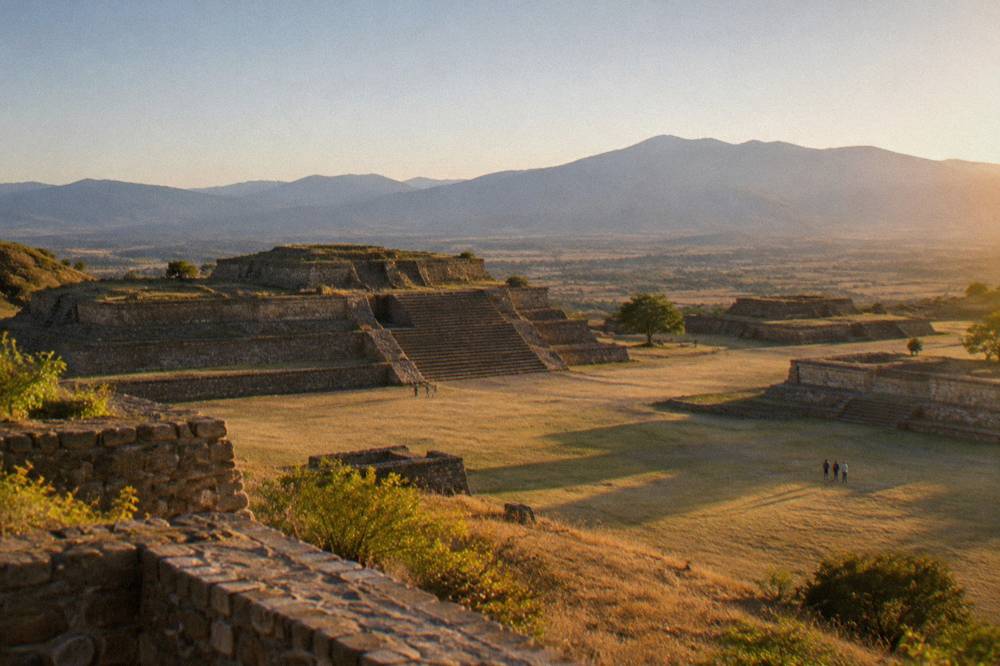
The city half of the trip is dense. Monte Albán, Mitla and Yagul are all INAH Category I sites, each open Monday to Sunday, and the valley craft towns of Teotitlán del Valle, Santa María del Tule and Tlacolula sit between 11 and 37 minutes away by road under free-flow conditions. That density is the argument for basing in the city first: every valley day trip radiates from it, and the one-week itinerary already assumes a full week just for the city and its surroundings.
The coast half is a different trip. Puerto Escondido, Mazunte and Huatulco are extensions of an Oaxaca holiday, not parts of the city's orbit, and the site's Oaxaca beaches guide covers them in their own right. Splitting means two hotel bases, two packing profiles and a transfer day in the middle, so the split only pays off when each side gets enough nights to settle.
How Far Is The Pacific Coast From Oaxaca City?
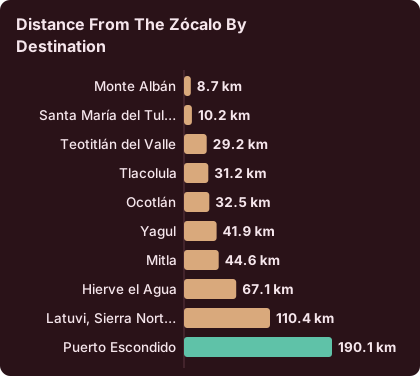
Puerto Escondido is 190.1 km from the Zócalo by road, about 165 minutes of free-flow driving via the new highway, and these are derived route figures, not official ones. Straight-line distances in the region tell a different story: Mitla is about 42 km as the crow flies and Hierve el Agua about 52 km, yet both take well over half an hour by road. The mountains between the Valles Centrales and the coast are the reason the state feels bigger than the map suggests.
The route figures below come from route computation on OpenStreetMap roads, free-flow, from the Zócalo, and they should be read as floors rather than promises. Real traffic, mountain grades and weather all add time.
| Destination | Distance from the Zócalo | Free-flow drive time |
|---|---|---|
| Monte Albán | 8.7 km | about 15 minutes |
| Santa María del Tule | 10.2 km | about 11 minutes |
| Teotitlán del Valle | 29.2 km | about 26 minutes |
| Tlacolula | 31.2 km | about 25 minutes |
| Ocotlán | 32.5 km | about 37 minutes |
| Yagul | 41.9 km | about 38 minutes |
| Mitla | 44.6 km | about 37 minutes |
| Hierve el Agua | 67.1 km | about 57 minutes |
| Latuvi, Sierra Norte | 110.4 km | about 142 minutes |
| Puerto Escondido | 190.1 km | about 165 minutes |
Read that table twice before booking anything. Everything down to Hierve el Agua is a plausible day trip from a city base. Latuvi and the Pueblos Mancomunados are a full day in the Sierra Norte, and Puerto Escondido is a transfer, not an excursion. Prior guides put the coastal drive at 2.5 to 3.5 hours, which matches the derived figure once real conditions are layered on.
How Many Days Should Each Side Get?
Four nights in Oaxaca City and three on the coast is the working minimum for a split, and five plus four is more comfortable. The city side needs the extra night because its anchor sites sit on fixed schedules: Monte Albán opens daily 08:00 to 17:00 with last access at 16:00, the Museo de las Culturas de Oaxaca opens Tuesday to Saturday only, and Zaachila opens Thursday to Sunday only, so a short city stay can collide with closed days.
The closed-day pattern matters more than people expect. The Museo de las Culturas, inside the Santo Domingo complex, is shut Sundays and Mondays, so a city stay of three nights that lands on a weekend may miss it. Zaachila's Thursday-to-Sunday window means a midweek-only city stay misses it too. Four nights gives enough rotation to absorb these constraints and still leave a full day for the Tlacolula valley.
The coast side has no such scheduling problem, but it has a travel cost: the transfer itself eats half a day in each direction once packing, checkout, the drive and check-in are counted. Three coast nights therefore yield about two full beach days. Fewer than three and the transfer starts to outweigh the ocean.
| Trip length | Suggested split | What it covers |
|---|---|---|
| 6 nights | 4 city, 2 coast | City, one valley day trip, one full coast day |
| 7 nights | 4 city, 3 coast | City, two valley day trips, two coast days |
| 8 nights | 5 city, 3 coast | Adds the Sierra Norte or a second museum day |
| 9 nights | 5 city, 4 coast | Comfortable pace on both sides |
| 10+ nights | 5+ city, 4+ coast | Add San José del Pacífico between the two |
San José del Pacífico, on the road between the city and the coast, is the natural midpoint stop for a 10-night trip, and the San José del Pacífico day-trip guide covers it. For shorter trips, deciding how many days in Oaxaca you need before adding the coast is the better question.
What Does Oaxaca City Do Best?
Oaxaca City does the inland half of the state best: the archaeological zones, the colonial centre's museums and churches, the markets, and the food and mezcal traditions that live in the valley around it. Monte Albán alone drew 416,675 visitors in 2025 against the city's 1,324,332 total arrivals that year, which makes it the single biggest draw of the region, and it sits close to the Zócalo.
The INAH sites anchor the city half of any split, and their fees are fixed by category. Category I sites charge 105 MXN for Mexican nationals and 210 MXN for foreign visitors; Category III sites charge 80 and 145 MXN. These are peso figures stated by INAH, not converted.
| Site | Category | Hours | Last access | Fee nationals | Fee foreigners |
|---|---|---|---|---|---|
| Monte Albán | I | Mon to Sun 08:00 to 17:00 | 16:00 | 105 MXN | 210 MXN |
| Mitla | I | Mon to Sun 08:00 to 17:00 | 16:30 | 105 MXN | 210 MXN |
| Yagul | I | Mon to Sun 08:00 to 17:00 | 16:00 | 105 MXN | 210 MXN |
| Dainzú | III | Mon to Sun 08:00 to 17:00 | 16:30 | 80 MXN | 145 MXN |
| Lambityeco | III | Mon to Sun 08:00 to 17:00 | 16:30 | 80 MXN | 145 MXN |
| Zaachila | III | Thu to Sun 10:00 to 16:00 | 16:00 | 80 MXN | 145 MXN |
| Atzompa | not published | Mon to Sun 08:00 to 16:00 | 15:00 | not stated on page | not stated on page |
Beyond the stones, the city half carries the state's food reputation. The what to eat in Oaxaca guide and the best restaurants roundup map that side, and the market and mezcal traditions run through the whole week. A morning at Hierve el Agua paired with Mitla is the classic valley day, and the related half-day Hierve el Agua trip on this page's picks covers the mineral terraces on a schedule that leaves the afternoon free, with Check availability on the operator's booking page. The site's own Hierve el Agua guide has more detail.
What Does The Coast Add To An Oaxaca Trip?
The coast adds the Pacific: ocean beaches, warm-water swimming and a completely different pace from the highland valley, at sea level instead of about 1,550 m. It adds nothing archaeological and nothing colonial, because Puerto Escondido, Mazunte and Huatulco are resort and beach towns, not heritage sites, and the UNESCO inscription, the Historic Centre of Oaxaca and Archaeological Site of Monte Albán, property 415, belongs entirely to the city half of the trip.
Practically, the coast half changes the packing list and the daily rhythm. Valley days involve ruins, workshops and meals; coast days involve water. The temperature difference is real too. The city's SMN station normals put April's mean daily high at 34.9 C, but April nights in the valley drop to a mean minimum of 15.8 C, while coastal towns hold warm nights year round. Layers that work in the valley at 1,550 m are wrong for the shore. The rest of the planning pages sit on Oaxaca Travel Guide.
The coast also changes the budget profile. Beach accommodation, transfers and boat-based activities are not covered on this page, so treat the coast half of the budget as its own exercise. The Oaxaca travel costs and budget guide covers the city side in detail.
| Dimension | Oaxaca City | Pacific coast |
|---|---|---|
| Elevation | about 1,550 m | sea level |
| Core draws | Archaeological sites, museums, markets, food | Ocean, beaches, warm water |
| Nearest INAH Category I site | Monte Albán, 8.7 km | none on this page's figures |
| 2025 visitor context | 1,324,332 city arrivals | covered by the beaches guide |
| Best suited to | Culture, food, craft towns | Water, rest, sun |
How Do You Travel Between Oaxaca City And The Coast?
The realistic options are driving the new highway, about 190 km and roughly 165 minutes free-flow from the Zócalo to Puerto Escondido, or flying from Xoxocotlán airport, which ASUR operates with normal hours of 06:00 to 20:00. Route bus operator ADO also connects the city with Puerto Escondido, with tickets through its official site. Fares for taxis, buses and flights lack any primary-source figure.
Each option trades time against certainty. Driving gives the most flexibility, and the road passes San José del Pacífico, which is why a stop there suits a 10-night split. Flying skips the mountains entirely, and the Oaxaca airport guide plus the flights to Oaxaca page cover the air side. The bus is the middle path, and the ADO bus guide explains the terminal setup; anyone starting from the capital should also read how to get from Mexico City to Oaxaca first, since the return leg from the coast can route differently from the arrival.
One practical note colours every leg of this route. Road blockades by teachers' unions are a standing risk in Oaxaca and can disrupt road and airport access for hours at a time, so a transfer day between city and coast deserves a time buffer. On safety overall, the US State Department lists Oaxaca state at Level 2, exercise increased caution, and the is Oaxaca safe guide gives the full advisory picture.
When Should You Schedule The City And The Coast Halves?
The city's dry season runs November to April and the rainy season May to October, with rain peaking June to September, so the calendar matters most for the valley half of the split. June averages 188.3 mm of rain against January's 2.4 mm, and April's mean daily high of 34.9 C is the year's highest at the SMN station. The coast is a warm-water destination year round, which is why many travellers schedule the valley first and the beach second within the same week.
The full station normals, 1991 to 2020, let you place any month precisely rather than guessing at seasons.
| Month | Mean daily high C | Mean nightly low C | Rain mm |
|---|---|---|---|
| January | 28.9 | 10.3 | 2.4 |
| February | 31.1 | 11.6 | 4.6 |
| March | 33.3 | 13.6 | 17.6 |
| April | 34.9 | 15.8 | 47.3 |
| May | 33.8 | 16.7 | 97.9 |
| June | 30.9 | 16.7 | 188.3 |
| July | 30.1 | 15.9 | 118.6 |
| August | 30.0 | 15.9 | 131.8 |
| September | 29.1 | 16.1 | 163.6 |
| October | 29.3 | 14.5 | 63.1 |
| November | 29.0 | 12.3 | 9.1 |
| December | 28.9 | 11.0 | 9.0 |
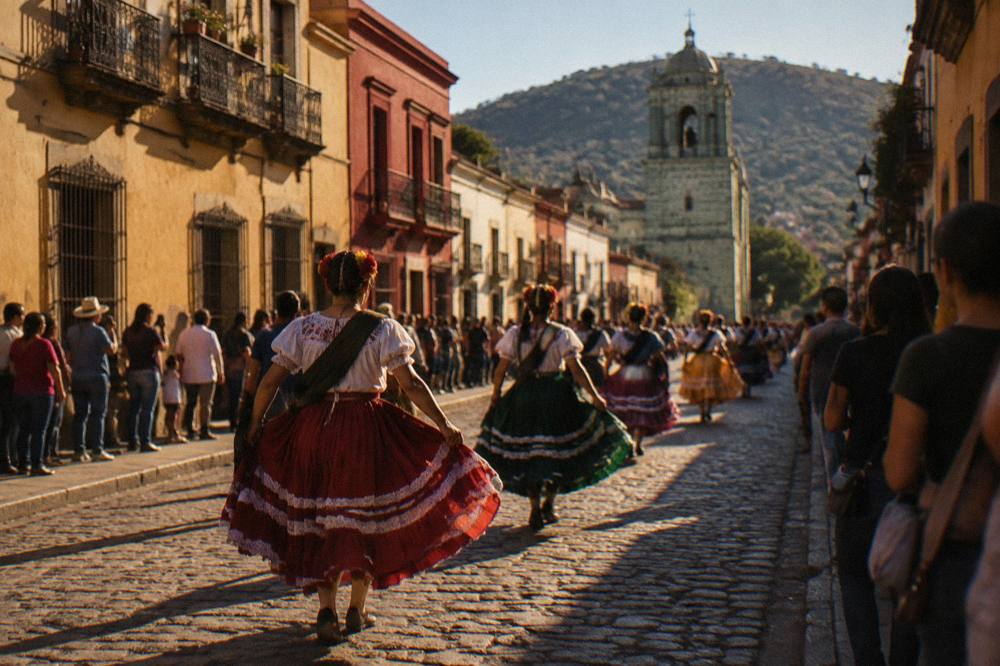
Two festival windows can move the whole split. Guelaguetza takes over the city on two Mondays in July, and the 2026 edition, 20 and 27 July, priced Palco A seats at 1,632 MXN and Palco B at 1,321 MXN, with sections C and D free. Día de Muertos centres on 31 October to 2 November by tradition; the 2026 programme is not announced, so build plans around the traditional dates only. The best time to visit Oaxaca guide and the weather-by-month breakdown expand all of this.
What Does A Sample One-Week Split Look Like?
A tested shape for seven nights is four in the city and three on the coast: arrival plus Monte Albán on days one and two, a Tlacolula valley day trip on day three, museums and markets on day four, a transfer to the coast on the morning of day five, then two full coastal days before flying or busing out. The city block front-loads the fixed schedules, and the coast block lands where the itinerary has nothing left to book.
The logic of putting the city first is scheduling density. Monte Albán needs a morning, the Museo de las Culturas needs a Tuesday-to-Saturday slot, the Jardín Etnobotánico's free guided tours run Monday to Friday at 10:30, 11:00, 11:30, 12:00 and 17:00 and Saturday 10:30 to 12:00, and the Tlacolula valley needs a whole day. The coast, by contrast, needs nothing but weather and a towel.
Day-by-day, the city block writes itself. Day one: the Centro Histórico, the Zócalo and the Andador Macedonio Alcalá. Day two: Monte Albán in the morning, about 15 minutes out, then San José del Pacífico is nowhere near yet, so spend the afternoon at Santo Domingo and the Museo de las Culturas if it is a weekday. Day three: a valley loop, Tule at about 11 minutes, Teotitlán del Valle at about 26, Mitla at about 37, Hierve el Agua at about 57. Day four: markets, a cooking class or a mezcal tasting, and the where to stay in Oaxaca and best hotels pages cover the base for it all.
The transfer day is day five. Leave after breakfast, stop in San José del Pacífico if the schedule allows, and reach the coast by early afternoon. Days six and seven are the ocean's. For the practical layer around all of this, the getting around Oaxaca guide and the taxis, Uber and DiDi page cover city movement, and the money, ATMs and cash guide plus the drinking water page answer the two questions every highland-to-coast trip raises.
Is A Split Trip Better Than One Base?
A split is better when the trip is eight nights or longer and the ocean is a genuine priority, and one base is better at seven nights or fewer, because the transfer costs a half day each way in practice. A city-only week still reaches Monte Albán, Mitla, Hierve el Agua and every craft town in the Valles Centrales, while a coast-only week reaches none of them, so the city base carries more unique content per night.
The deciding factor is honest self-assessment about the beach. If warm water and slow days are half the point of the holiday, split. If they are a nice-to-have, the city plus its valley delivers far more packed variety, and the full menu of options lives on the things to do in Oaxaca page, with the Oaxaca map showing how tight the valley's geography is.
For travellers combining the capital region with the state, there is a third shape: Oaxaca City plus Puebla or Mexico City rather than the coast. The Oaxaca to Mexico City guide covers that inland pairing, which keeps the whole trip at altitude and swaps the ocean for two more of Mexico's great cities.
Common Questions About Splitting Oaxaca City And The Coast
Can You Visit The Oaxaca Coast As A Day Trip From Oaxaca City?
No. Puerto Escondido is 190.1 km from the Zócalo, about 165 minutes of free-flow driving on the new highway, and mountain traffic is slower. The coast needs its own hotel nights; it is an extension of the trip, not a day trip.
How Many Days Do You Need For Oaxaca City Before The Coast?
Four nights is the working minimum. Monte Albán alone takes a morning, the Museo de las Culturas de Oaxaca opens Tuesday to Saturday only, Zaachila opens Thursday to Sunday only, and the Tlacolula valley loop deserves a full day.
Which Is Warmer, Oaxaca City Or The Coast?
The coast, especially at night. Oaxaca City sits at about 1,550 m, where January's mean nightly low is 10.3 C, while the coastal towns hold warm nights year round at sea level.
Does It Rain More In Oaxaca City Or On The Coast?
This page carries rain figures only for the city: the dry season runs November to April and the rainy season May to October, with June averaging 188.3 mm at the SMN station. A coastal comparison figure could not be included here.
Where Should You Stop Between Oaxaca City And The Coast?
San José del Pacífico is the natural midpoint on the highway between the city and Puerto Escondido, and it suits trips of ten nights or more, where one night breaks the transfer into two shorter drives.
Is The Drive Between Oaxaca City And The Coast Safe?
The US State Department lists Oaxaca state at Level 2, exercise increased caution, with no restrictions for US government staff on Oaxaca City or Puerto Escondido. Road blockades by teachers' unions are a standing risk that can disrupt road and airport access, so keep a time buffer on transfer day.