Xoxocotlán And Santa Lucía Del Camino: The Airport Side
Xoxocotlán and Santa Lucía del Camino sit immediately south of central Oaxaca City, and between them they hold the airport, the state's main convention centre and one of the most visited cemeteries in Mexico during Día de Muertos.
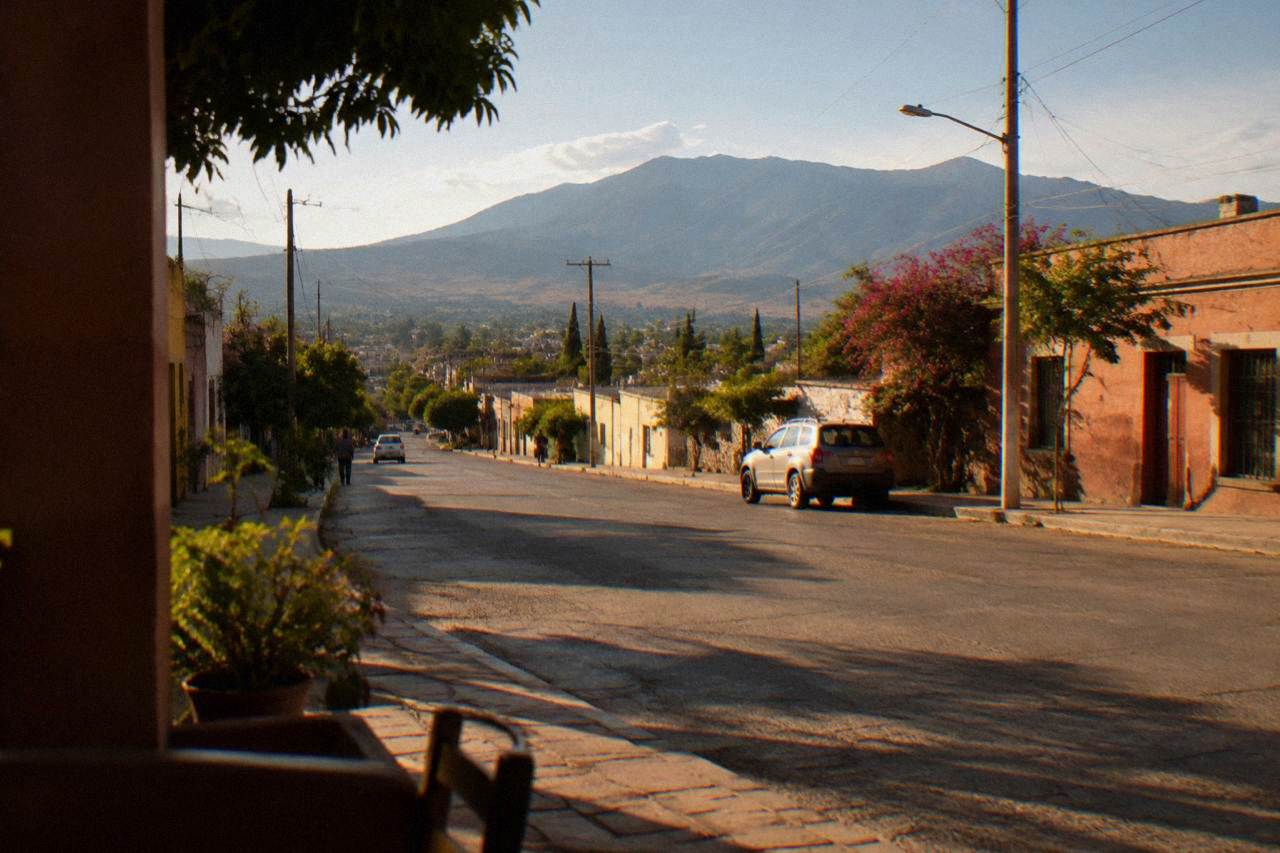
Xoxocotlán and Santa Lucía del Camino are two towns absorbed into the southern edge of Oaxaca City. Xoxocotlán gives the airport its name and its cemetery anchors Día de Muertos; Santa Lucía del Camino hosts the Centro Cultural y de Convenciones where the Feria del Mezcal runs each July.
Xoxocotlán and Santa Lucía del Camino are the two towns on the southern edge of Oaxaca City, the inland highland capital of the state of Oaxaca in Mexico, set in the Valles Centrales at about 1,550 m. Xoxocotlán lends its name to the city's airport, and its panteón is one of the places people come to Oaxaca for at the end of October. Santa Lucía del Camino, next door, holds the Centro Cultural y de Convenciones de Oaxaca, the venue the state government uses for its largest fairs, including the Feria del Mezcal that runs alongside Guelaguetza each July.
For the full spread of options across the city, start with the site's overview of things to do in Oaxaca, and for context on how this quarter compares with others, see the guide to Oaxaca's neighbourhoods.
Where Are Xoxocotlán And Santa Lucía Del Camino In Oaxaca?
Xoxocotlán and Santa Lucía del Camino sit directly south of the Historic Centre of Oaxaca City, along the corridor that carries traffic toward the airport and the highway to the coast. Xoxocotlán is the western neighbor of the airport zone and gives the airport its name, while Santa Lucía del Camino is the address of the Centro Cultural y de Convenciones de Oaxaca. Both lie within the continuous built-up area of Oaxaca de Juárez, continuing the southward line past the markets to the runway. Xoxocotlán is the western neighbour of the airport zone and gives Oaxaca's Aeropuerto Internacional its full name, Xoxocotlán International Airport, operated by ASUR. Santa Lucía del Camino lies on the same southern side of the city and is the address the state government lists for the Centro Cultural y de Convenciones de Oaxaca, the CCCO. Both are within the continuous built-up area of Oaxaca de Juárez, a city of 270,955 inhabitants in the municipality at the 2020 census.
The corridor matters because it is the first and last piece of Oaxaca almost every visitor sees. The airport's normal operating hours are 06:00 to 20:00, per the operator's published details, and everything on this page sits within a short drive of the terminal. Oaxaca keeps a single time zone, UTC-6, all year: Mexico abolished seasonal clock changes in a law published on 28 October 2022, so the question "is the airport on city time" always answers yes.
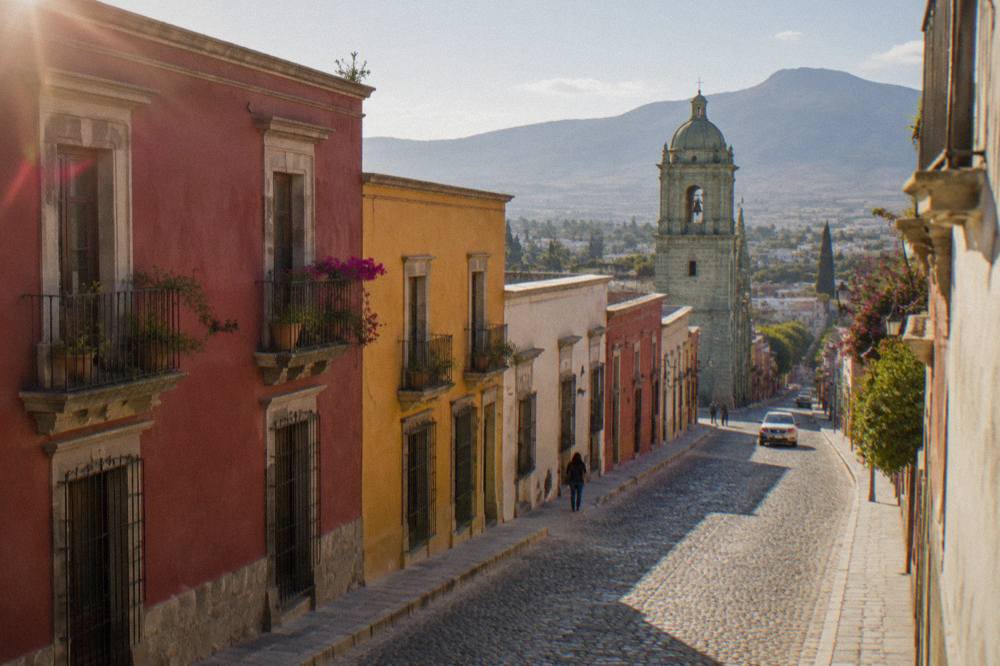
The Historic Centre, a UNESCO World Heritage property together with Monte Albán under the name "Historic Centre of Oaxaca and Archaeological Site of Monte Albán", sits north of this corridor. If you are orienting the city by quarters, the centro and its church core are covered in the Historic Centre area guide, the mural-lined barrios in the Jalatlaco guide and the Xochimilco guide, and the market belt south of the centre in the south-of-centro and mercados guide. Xoxocotlán and Santa Lucía del Camino continue that same southward line past the markets to the runway.
How Far Is The Airport Side From The Oaxaca Zócalo?
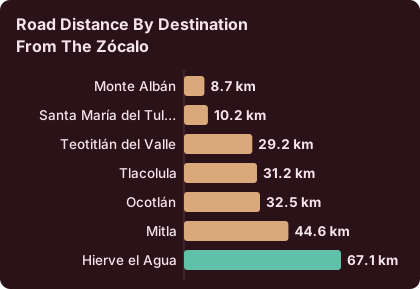
By road, the airport side sits close enough that the whole corridor functions as part of the city rather than a distant suburb: free-flow drive times computed from the Zócalo put Xoxocotlán's airport within minutes of the centre, and every major site in this guide is reachable on a half-day plan. The distances below were computed on the road network, so treat them as best-case figures and add margin for real traffic, which thickens around festival dates and school runs.
| Destination from the Zócalo | Road distance | Free-flow drive time |
|---|---|---|
| Monte Albán | 8.7 km | about 15 minutes |
| Santa María del Tule | 10.2 km | about 11 minutes |
| Teotitlán del Valle | 29.2 km | about 26 minutes |
| Tlacolula | 31.2 km | about 25 minutes |
| Ocotlán | 32.5 km | about 37 minutes |
| Mitla | 44.6 km | about 37 minutes |
| Hierve el Agua | 67.1 km | about 57 minutes |
Two patterns stand out. First, the eastern valley sites, Tule, Teotitlán del Valle, Tlacolula and Mitla, all funnel out along the same eastern road, which is why valley day trips chain them together. Second, Monte Albán is the closest major site of all, roughly 15 minutes from the centre, which makes it the natural pairing for a day that also touches the airport side. The practical write-ups for each site sit at the Monte Albán guide, the Mitla guide, the Hierve el Agua guide and the Tule tree guide.
INAH admission follows a two-tier category system across the valley's archaeological zones, and it is worth knowing before you combine sites on an airport-side day:
| INAH zone | Category | Nationals (MXN) | Foreign visitors (MXN) | Hours |
|---|---|---|---|---|
| Monte Albán | I | 105 | 210 | Daily 08:00 to 17:00, last access 16:00 |
| Mitla | I | 105 | 210 | Daily 08:00 to 17:00, last access 16:30 |
| Yagul | I | 105 | 210 | Daily 08:00 to 17:00, last access 16:00 |
| Dainzú | III | 80 | 145 | Daily 08:00 to 17:00, last access 16:30 |
| Lambityeco | III | 80 | 145 | Daily 08:00 to 17:00, last access 16:30 |
| Zaachila | III | 80 | 145 | Thursday to Sunday 10:00 to 16:00 only |
| Atzompa | listed hours only | fee not on the page | fee not on the page | Daily 08:00 to 16:00, last access 15:00 |
Because Monte Albán is the nearest of these to the airport corridor, a common shape for a short stay is ruins in the morning, the airport-side towns in the afternoon, and the centro at night. The site's Monte Albán tour round-up compares the bookable options, including Check availability on the half-day version.
What Is There To Do In Xoxocotlán And Santa Lucía Del Camino?
The area's two anchors are the Xoxocotlán cemetery, whose Día de Muertos nights draw visitors from across Mexico and abroad, and the Centro Cultural y de Convenciones de Oaxaca in Santa Lucía del Camino, the venue the state lists for the Feria del Mezcal each July. Around them sits workingaday Oaxaca: the market life of the southern barrios, the road out to the valley craft towns, and, on the western flank, Monte Albán, the site that drew 416,675 visitors in 2025, of whom 73,713 were foreign visitors, according to the state tourism indicators.
Santa Lucía del Camino's role as a fair venue comes straight from the state calendar. The Feria del Mezcal was reported for 17 to 28 July 2026 at the CCCO, with entry around 80 MXN and hundreds of stands, and the wider "Julio, mes de la Guelaguetza" programme ran more than 140 activities across the city. Guelaguetza itself, the two Lunes del Cerro performances each July on the Cerro del Fortín, is covered in detail in the Cerro del Fortín guide; in 2026 the two dates fell on 20 and 27 July, with Palco A at 1,632 MXN and Palco B at 1,321 MXN, and the two free sections filling by arrival order. Those dates are the 2026 edition and past; nothing has been announced for 2027.
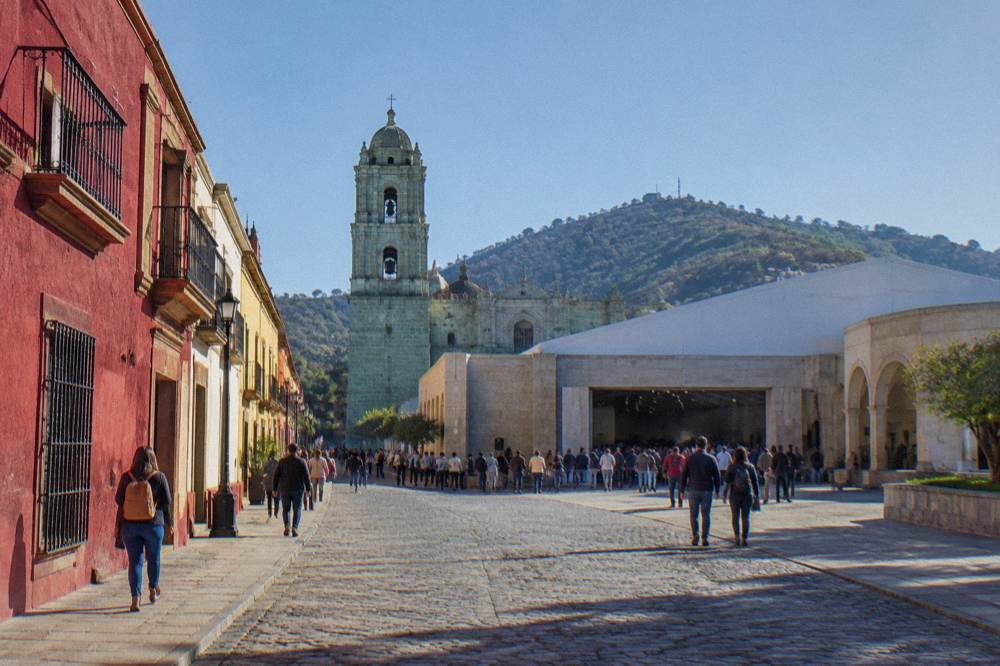
Xoxocotlán's other draw is quieter. The town is the final stop on many Día de Muertos routes, and its cemetery is the one named in the state's own festival material alongside the celebrations in Jalatlaco and Atzompa. Away from festival weeks, the area earns its place as a transit-and-taste zone: the southern markets of the city, covered in the south-of-centro guide, sit between the centro and the airport corridor, and the eastern valley road passes through here on its way to Teotitlán del Valle and Mitla.
For travellers building the day around a guide rather than self-driving, three formats suit this side of the city particularly well:
When Is The Xoxocotlán Cemetery At Its Most Alive?
The traditional core of Día de Muertos in Xoxocotlán runs over the nights of 31 October to 2 November, when families hold vigil at the graves and the cemeteries stay open into the night, with comparsas and street celebrations clustered around 30 and 31 October. Those are the standing dates of the tradition. What cannot be printed is a 2026 festival programme: the state's published 25 October to 4 November calendar with more than 140 activities belongs to the 2025 edition, and no 2026 programme had been announced. Plan around the traditional dates, and check the state's channels close to the festival for the current year's schedule.
The 2026 state artisan contest for Día de Muertos, the fifth edition, ran its entry window from 24 September to 9 October, which gives a sense of how far in advance the machinery of the festival starts. In the city itself, the Zócalo was reported to receive its festival decorations mounted between 25 and 28 October and dismantled after 6 November. None of that closes streets; the state's tender documents describe ornamental arches at the Zócalo accesses rather than closures. The full index of guides sits on Oaxaca Travel Guide.
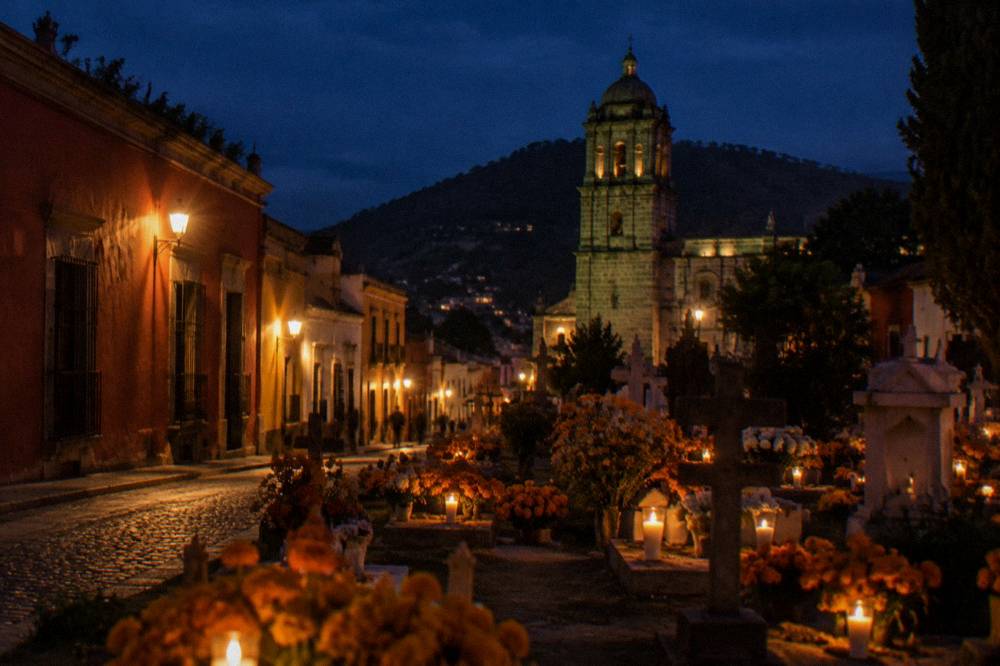
If the visit is not tied to the festival, the weather table matters more than the calendar. Oaxaca's climate normals from the SMN station in the city show a dry season from November to April and a rainy season from May to October, with the heaviest rainfall concentrated from June to September. June averages 188.3 mm of rain and September 163.6 mm; January averages just 2.4 mm.
| Month | Mean daily high | Mean nightly low | Average rain |
|---|---|---|---|
| January | 28.9 C | 10.3 C | 2.4 mm |
| April | 34.9 C | 15.8 C | 47.3 mm |
| June | 30.9 C | 16.7 C | 188.3 mm |
| September | 29.1 C | 16.1 C | 163.6 mm |
| November | 29.0 C | 12.3 C | 9.1 mm |
| December | 28.9 C | 11.0 C | 9.0 mm |
Daytime highs hold near 30 C for much of the year and April's normal high reaches 34.9 C, while December and January nights average 10.3 to 11.0 C, so layers carry more weight than a heavy coat. The nights around Día de Muertos, at the start of November, fall between those poles: the month averages a 29.0 C high and a 12.3 C low.
How Do You Get From Xoxocotlán Airport To Central Oaxaca?
Oaxaca's airport, Xoxocotlán International (OAX), is operated by ASUR, keeps normal operating hours of 06:00 to 20:00, and sits at the southern end of the corridor this page covers, close enough that the transfer to the centre is a short hop rather than a journey. The airport's own details are on the operator's pages, and the practical arrival mechanics, including what to expect on the ground, are covered in full in the Oaxaca airport guide and the answer page on which airport you fly into for Oaxaca.
No fare figure for the transfer belongs on this page: the authorised taxi fare to the Zócalo is not published on a primary source, and the same goes for colectivo fares and the question of whether ride-hailing apps serve the terminal. The booth inside arrivals is where those numbers exist, and that is where to get them. What can be said with source backing is the airport's operator, its hours and its route network, which the guide pages above carry in detail.
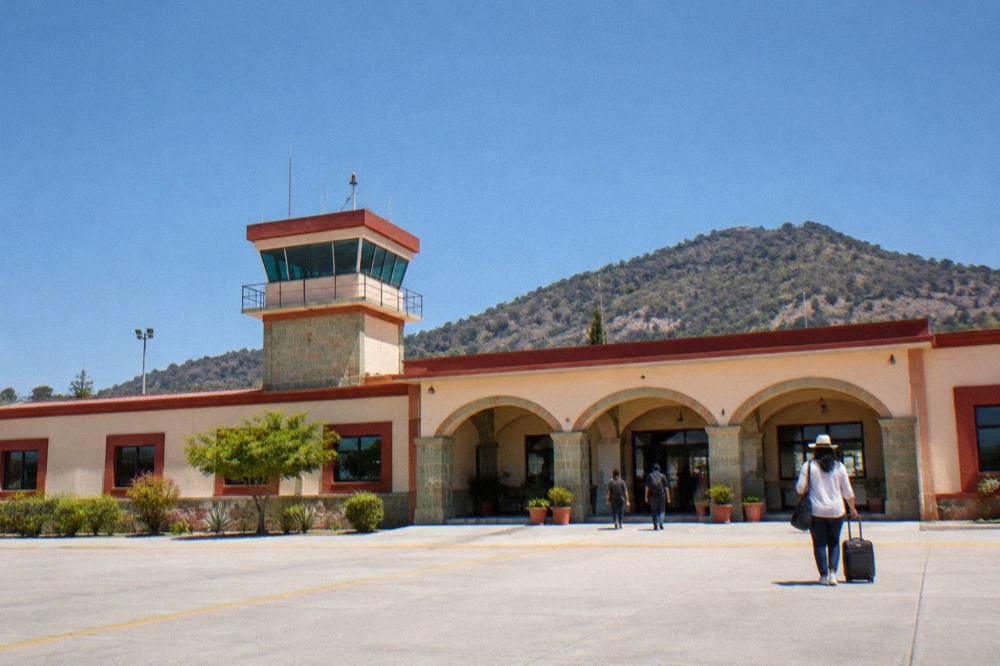
One standing risk deserves a line of its own, because it touches airport access specifically. Road blockades mounted by teachers' unions are a recurring, sporadic form of protest in Oaxaca that has repeatedly disrupted road and airport access for hours at a stretch before being cleared. There is no calendar for these; the practical defence is simply time margin on flight days and a check of local news the morning of departure.
For onward travel beyond the city, the airport corridor is also where the long-distance roads begin. The new highway puts Puerto Escondido about 165 minutes of free-flow driving from the Zócalo, a figure computed on the road network and best treated as a floor, and the mountain crossings to the Sierra Norte and to San José del Pacífico, covered in the San José del Pacífico guide, take correspondingly longer in real conditions.
What Should You Eat On The Airport Side Of Oaxaca?
The southern corridor eats from the same table as the rest of Oaxaca City: tlayudas, mole, quesillo, tejate and mezcal, sold in the neighbourhood markets and fondas between the centro and the runway, with the state's own food fairs staged in Santa Lucía del Camino at the CCCO. The food culture here is not a separate cuisine from the centre's; it is the same kitchen at neighbourhood prices, one neighbourhood further from the Zócalo. The city's markets, including the ones on this southern line, are covered in the south-of-centro and mercados guide.
The festival calendar gives the area two concentrated food moments. The Feria del Mezcal, reported at the CCCO for 17 to 28 July 2026 with around 400 stands and entry near 80 MXN, brings mezcal producers and food vendors together in Santa Lucía del Camino as part of Guelaguetza month. In December, the Noche de Rábanos tradition holds its central event in the Zócalo on 23 December; the 128th edition ran in December 2025, and no 2026 edition had been announced.
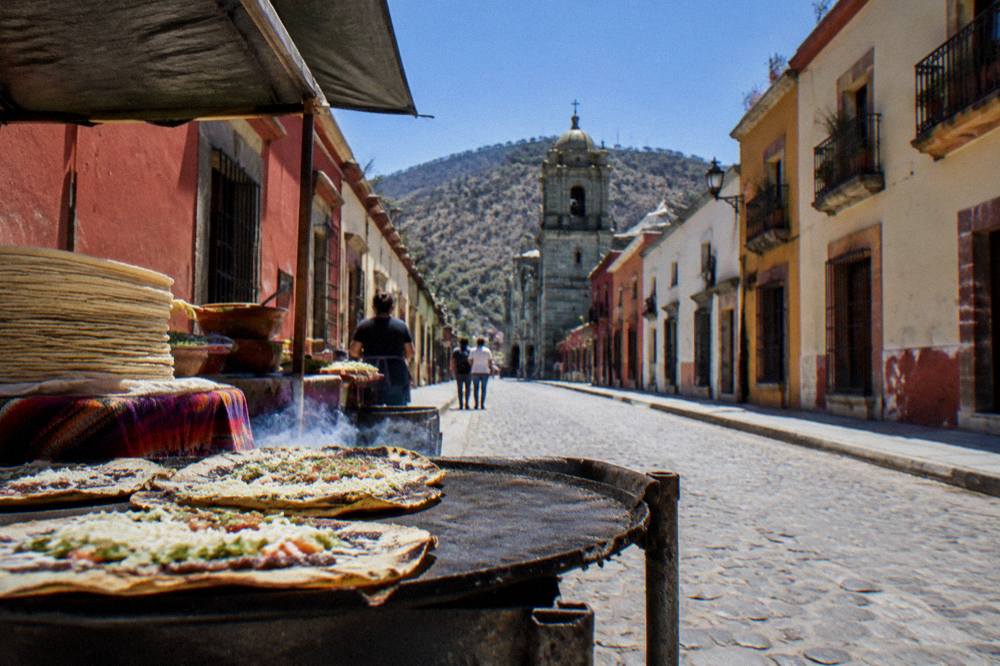
For visitors who want the food explained rather than merely found, guided formats cover both the market daytime and the street night-time versions of the same cuisine. The evening tasting walks in the trio below start from the centre and work outward, and the pairing and tasting sessions around mezcal are catalogued in the mezcal tour round-up.
Is A Stop In Xoxocotlán Or Santa Lucía Del Camino Worth Adding To An Oaxaca Trip?
Yes, in two situations: when your dates overlap Día de Muertos, when the Xoxocotlán cemetery nights are one of the reasons the city fills up, and when your dates overlap July's Guelaguetza month, when Santa Lucía del Camino's CCCO hosts the Feria del Mezcal. Outside those windows the area is a practical zone, the one you pass through between the runway and the centro, pleasant and ordinary, and your hours are better spent in the Historic Centre or the valleys. The city received 1,324,332 tourist arrivals in 2025, with an average stay of 2.00 nights, per the state tourism indicators, and a two-night stay does not stretch to suburbs without a festival pulling them into the itinerary.
A realistic split for a short first visit: give the centre two full blocks of time, one for the Santo Domingo complex, whose church, museum and Jardín Etnobotánico anchor the north end of the centro, and one for the market-and-food belt to the south. The Jardín Etnobotánico runs free guided tours Monday to Friday at 10:30, 11:00, 11:30, 12:00 and 17:00 and Saturdays from 10:30 to 12:00, with large and school groups booking two weeks ahead. The Museo de las Culturas de Oaxaca, inside the same complex, opens Tuesday to Saturday only, 10:00 to 16:00, at 105 MXN for nationals and 210 MXN for foreign visitors.
| If your dates include | Where on the airport side | What the sources say |
|---|---|---|
| Late October to early November | Xoxocotlán cemetery and the centro's festival decorations | Traditional vigil nights 31 October to 2 November; 2026 programme not announced |
| Late July | CCCO, Santa Lucía del Camino | Feria del Mezcal reported 17 to 28 July 2026, entry about 80 MXN |
| Any dates | The corridor between airport and centro | Monte Albán about 15 minutes from the Zócalo; 416,675 visitors in 2025 |
Two cautions keep the plan honest. First, festival dates in Oaxaca are announced late and by edition: the 2026 Guelaguetza tickets and Feria del Mezcal details above are the 2026 edition, and later years are published when they are published. Second, the coastal towns, Puerto Escondido, Mazunte and Huatulco, are far extensions of an Oaxaca trip at about 165 minutes of free-flow driving from the city at the nearest, not day trips you can bolt onto an airport-side afternoon. Keep the coast for its own block of nights.
Common Questions About Xoxocotlán And Santa Lucía Del Camino
Is Xoxocotlán Part Of Oaxaca City?
Xoxocotlán sits in the continuously built-up southern edge of Oaxaca City and gives the city's international airport its name. The airport, Aeropuerto Internacional de Oaxaca (Xoxocotlán), is operated by ASUR and runs to normal operating hours of 06:00 to 20:00. See the Oaxaca airport guide for arrival mechanics.
When Is Día De Muertos In The Xoxocotlán Cemetery?
The traditional vigil nights run 31 October to 2 November, with comparsas and street events clustered around 30 and 31 October. A detailed 2026 festival programme had not been announced; the published 25 October to 4 November calendar with more than 140 activities belongs to the 2025 edition.
Where Is The Feria Del Mezcal Held?
Reported at the Centro Cultural y de Convenciones de Oaxaca (CCCO) in Santa Lucía del Camino, for 17 to 28 July 2026, with entry around 80 MXN. It forms part of the Guelaguetza month programme each July; later editions are announced by the state.
How Far Is The Airport From The Zócalo?
The airport sits at the southern end of a short corridor from the centre. No authorised taxi fare figure is published on a primary source, so confirm the transfer price at the booth inside arrivals.
Can You Visit Monte Albán On An Airport-Side Day?
Yes. Monte Albán is about 15 minutes of free-flow driving from the Zócalo, the closest major INAH site to the airport corridor. Entry is 105 MXN for nationals and 210 MXN for foreign visitors, daily 08:00 to 17:00 with last access at 16:00.
Does It Rain On The Airport Side Of Oaxaca?
The climate is one citywide system: the SMN station normals show a dry season from November to April and a rainy season from May to October, with June averaging 188.3 mm of rain and January 2.4 mm. The airport side has no separate weather pattern from the centro.
The airport side of Oaxaca rewards the traveller whose dates line up with its two festivals and serves everyone else as the quick, practical corridor it is, with Monte Albán fifteen minutes one way and the valley craft towns twenty-five minutes the other.