Hierve El Agua Tours: Mitla, Teotitlán And The Petrified Waterfalls
Hierve el Agua sits about 67 km from the Zócalo of Oaxaca City, and nearly every tour that reaches it loops through Mitla, Teotitlán del Valle or a mezcal stop on the way. This guide compares the valley tours, lists what the sources say about each stop, and helps match a tour to a travel style.
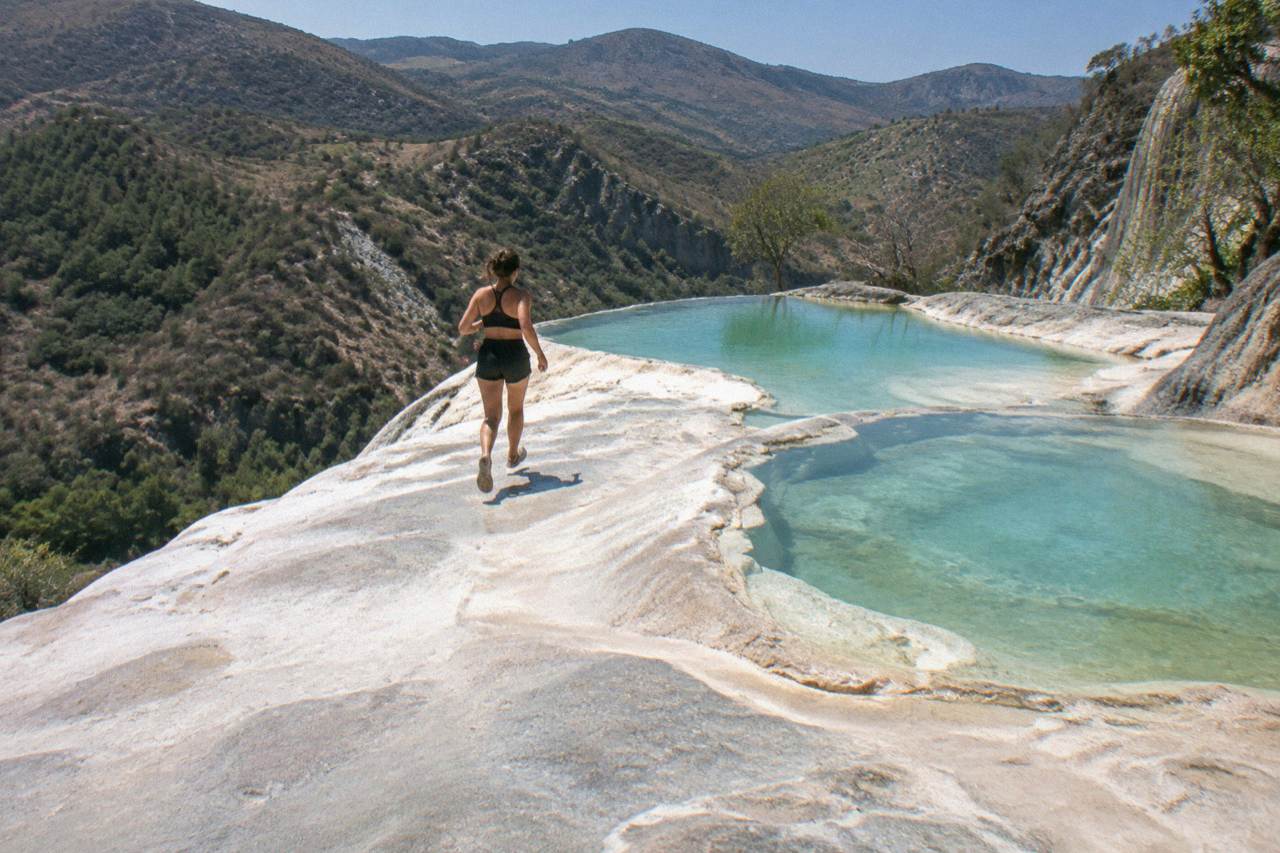
Most Hierve el Agua tours from Oaxaca City run as valley loops that add Mitla, the Tule tree, Teotitlán del Valle rug workshops or a mezcal distillery. The drive is about 57 minutes free-flow each way, so a tour saves the trouble of arranging transport, and Mitla entry is 105 MXN for nationals and 210 MXN for foreign visitors at the INAH gate.
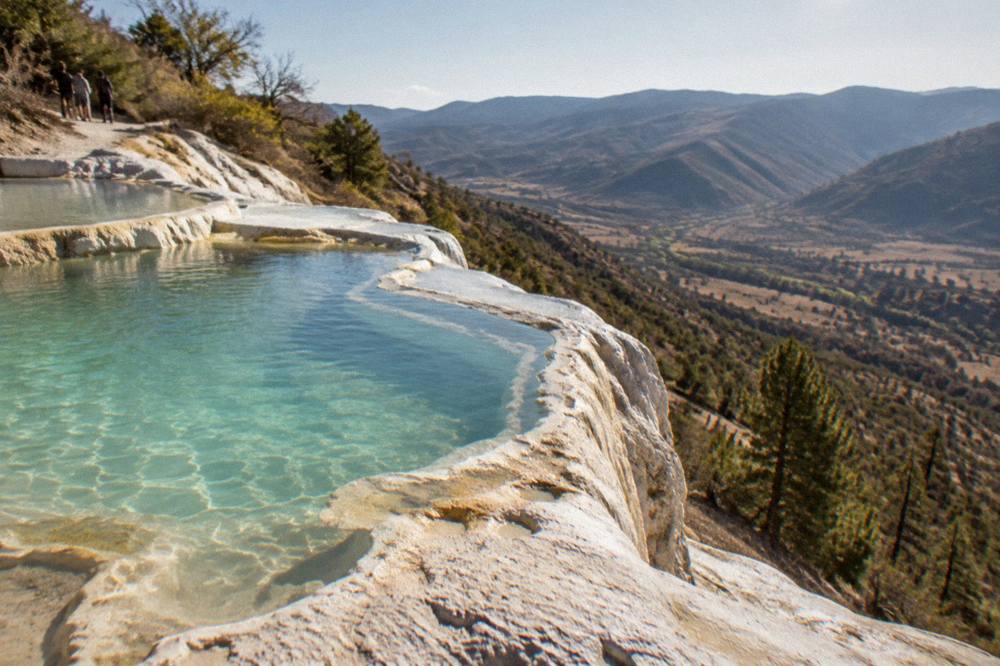
Hierve el Agua, the petrified waterfalls and mineral pools in the mountains east of Oaxaca City, anchors a whole family of valley day tours that combine the site with Mitla, the Tule tree, the weaving village of Teotitlán del Valle and mezcal distilleries. Oaxaca City is an inland highland city in the Valles Centrales at about 1,550 m, and Hierve el Agua is roughly 67 km away by road, which places it firmly in day-trip territory rather than walking distance from the Zócalo. This page compares what the different Hierve el Agua tours cover, what each stop offers, and how to pick the loop that fits a trip.
What Are Hierve El Agua Tours From Oaxaca City?
Hierve el Agua tours are organized day trips from Oaxaca City that reach the petrified waterfalls and mineral pools about 67 km east of the capital, and nearly all of them fold in additional Tlacolula Valley stops such as Mitla, the Santa María del Tule tree, Teotitlán del Valle and a mezcal distillery. Transport from the city center, and in most cases a guide, is included, which matters because the site sits at the end of a mountain road.
The pattern across the operator listings is consistent: a pickup in central Oaxaca City, a drive out through the Tlacolula Valley, one or more craft or archaeology stops, then Hierve el Agua itself, then the return. Some tours run the full loop with several stops; others go straight to the waterfalls and back. The difference between products is mostly the number and type of stops, not the destination at the end of the road.
Hierve el Agua is administered locally rather than as an INAH archaeological zone, so entry conditions are set on site and confirmed at the gate. A tour handles the practical side of that, since the operator arranges arrival times and knows the access situation on the day. For background on the site itself, the site guide at Hierve el Agua explained covers the terraces and pools in detail, and the planning page is Hierve el Agua worth it weighs the stop against a tight itinerary.
The competitive field is genuinely varied. The same valley can be visited on a pools-focused half-day product, on an 11-stop loop with rugs and mezcal, or with a private driver and a custom route. The sections below sort those options by what they actually cover.
Which Stops Belong On A Hierve El Agua And Mitla Day Tour?
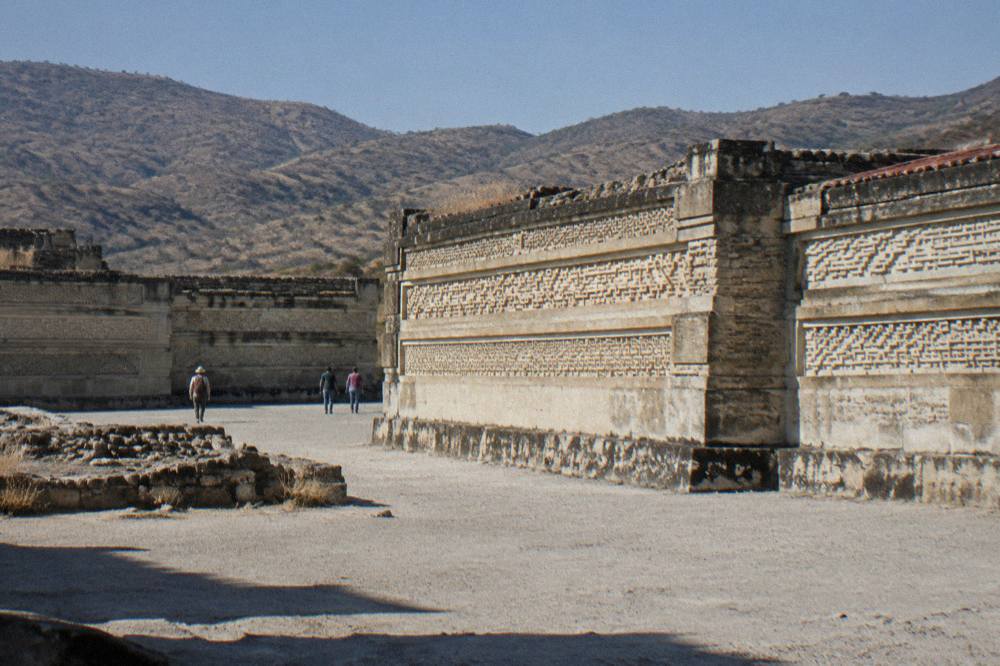
The standard Hierve el Agua and Mitla day tour from Oaxaca City covers four kinds of stops: the petrified waterfalls themselves, the INAH archaeological zone at Mitla, a craft village stop such as Teotitlán del Valle or an alebrije workshop, and a mezcal distillery tasting near Santiago Matatlán. Mitla is open daily 08:00 to 17:00 with last access at 16:30, and entry is 105 MXN for nationals and 210 MXN for foreign visitors.
Mitla is the anchor that pairs most naturally with Hierve el Agua, because both sit at the far end of the same valley road. The INAH page for Mitla lists daily opening from 08:00 to 17:00, with the last access at 16:30, and the Category I fee of 105 pesos for Mexican nationals and 210 pesos for foreign visitors. Mitla recorded 104,428 visitors across 2025 in the state tourism indicators, which makes it by far the most visited of the valley's INAH zones after Monte Albán. The full site background is in the Mitla guide.
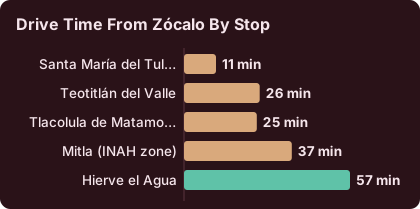
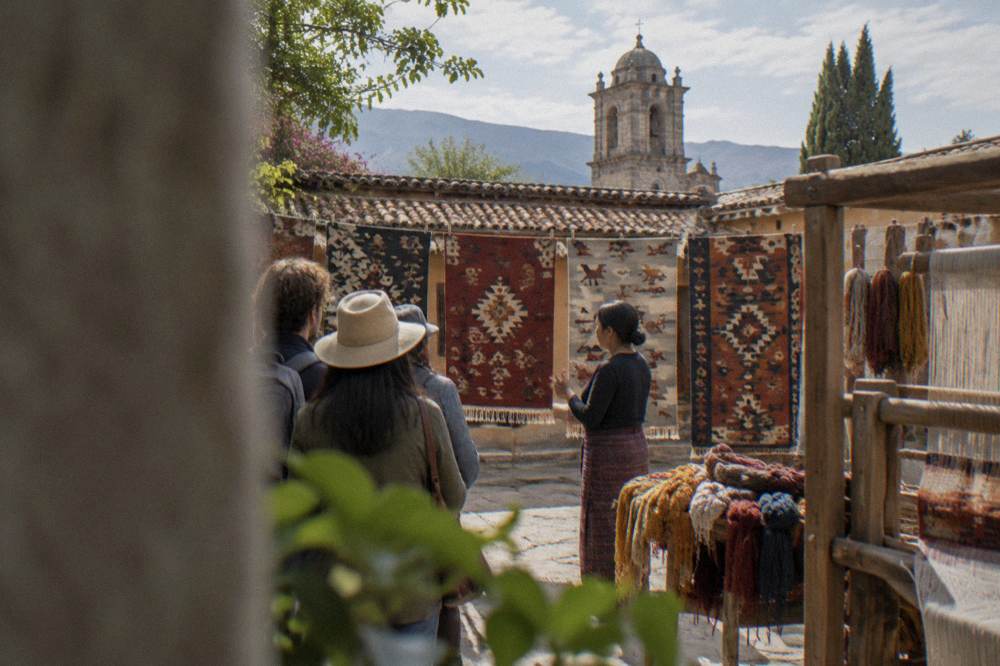
Teotitlán del Valle, about 26 minutes from the Zócalo by road, is the weaving stop on many loops. The village sits west of Mitla on the same valley corridor, so tours commonly string Tule, Teotitlán, Mitla and Hierve el Agua into a single clockwise day. The Teotitlán del Valle day trip page covers what a workshop visit involves, and the combined Mitla and Tlacolula routing shows how the pieces fit when Hierve el Agua is not on the list.
The Tule tree stop, in Santa María del Tule about 11 minutes from the Zócalo, appears on most full-day loops because it sits directly on the route out of the city. The tree's own page, Santa María del Tule tree, and the language note at what does El Tule mean in English cover the stop from both angles. The comparison table below shows how the main stop combinations differ.
| Stop | Drive time from Zócalo (free-flow) | Typical role on a tour loop |
|---|---|---|
| Santa María del Tule | about 11 minutes | First stop out of the city, brief photo and walk stop |
| Teotitlán del Valle | about 26 minutes | Weaving workshop and demonstration visit |
| Tlacolula de Matamoros | about 25 minutes | Market town, longer stop on Sunday itineraries |
| Mitla (INAH zone) | about 37 minutes | Guided archaeology visit, Category I entry |
| Hierve el Agua | about 57 minutes | Final destination, pools and terraces |
These drive times are derived from routing on OpenStreetMap roads at free flow, and real traffic on the mountain sections runs slower, so a loop that strings all five stops together is a full day by definition.
The three products above are the core of this comparison: a pools-focused tour, a mezcal-making version, and a full-day Tule, Mitla, Hierve el Agua and mezcal loop.
What Does A Hierve El Agua Tour From Oaxaca Cost And Include?
A Hierve el Agua tour from Oaxaca City is booked per person through the operator's booking page. What the price generally covers is transport from a central pickup point, a guide, and the drive through the Tlacolula Valley, while Mitla entry at 105 or 210 MXN and any on-site charges at Hierve el Agua itself are paid at the gate.
Reading the listings, the included items are consistent: hotel-zone pickup or a central meeting point, the full loop transport, and a guide for the archaeology stops. Mezcal tastings at distillery stops are included on the tours that list them. Mitla's INAH entry is a separate gate payment, because INAH fees are charged on site and not bundled by operators. Hierve el Agua's own access conditions are set by the local communities that administer the site, so anything charged there is settled on arrival.
The value question depends on the alternative. Arranging the same day independently means transport out and back on the valley road, timing connections between four stops, and absorbing the risk of a changed access situation at the end of a mountain road. A tour converts that into a fixed departure time and a single booking. For travelers weighing that trade directly, the Hierve el Agua day trip planning guide works through the independent option in detail.
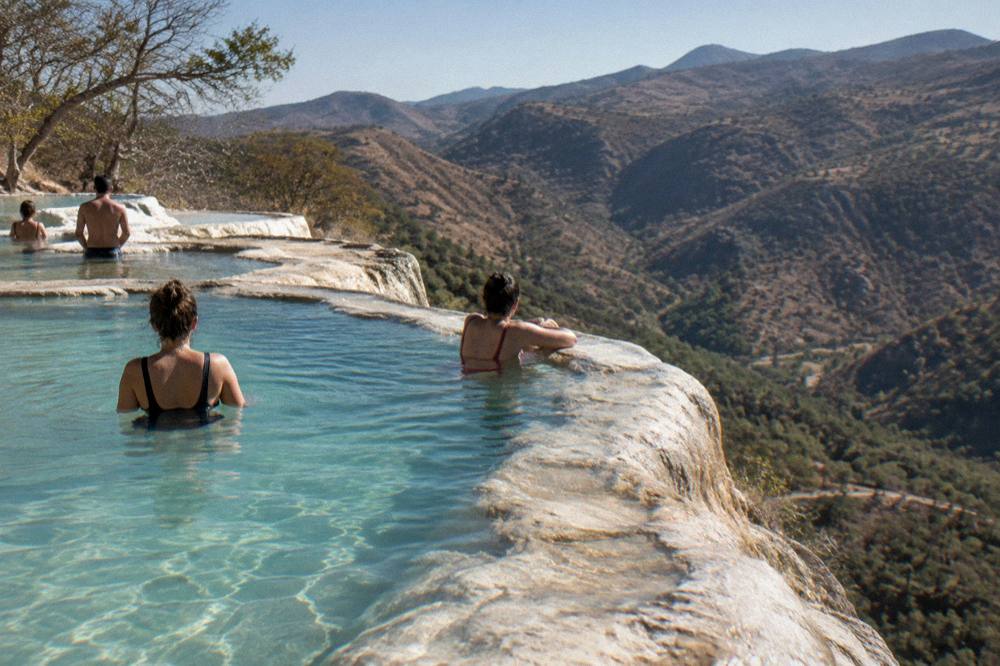
The petrified waterfalls and pools product is the straightforward choice when Hierve el Agua itself is the point of the day: it goes to the site, allows time at the pools, and leaves the craft villages for another visit. Check live availability to see the current departure options.
How Long Is The Drive From Oaxaca To Hierve El Agua?
The drive from the Zócalo of Oaxaca City to Hierve el Agua is about 67 km and about 57 minutes in free-flow conditions, derived from routing on mapped roads. In practice, mountain traffic and the final climb to the site make the real journey longer, and tours that add Mitla, Tule or Teotitlán stops spend much of the day on the road by design.
The routing figures are computed distances, not official drive times, and the standard practice is to round up and say "about". The same computation puts Mitla at about 37 minutes and Tule at about 11 minutes from the Zócalo, which is why the full loops work geographically: every major stop sits along one eastward corridor. The dedicated answer page how long is the drive from Oaxaca to Hierve el Agua covers the route in detail.
Two structural notes affect planning. First, the road corridor through the valley has been improved in recent years: the Mitla to Tehuantepec supercarretera was inaugurated in January 2025, per the state government announcement, which upgraded the highway east of Mitla even though Hierve el Agua turns off northward before that section. Second, road blockades related to protests are a standing, sporadic risk in the state that can affect highway and airport access for hours at a time, so a tour with a local operator has some resilience that a self-planned drive does not.
| Route | Distance | Free-flow time |
|---|---|---|
| Zócalo to Santa María del Tule | about 10 km | about 11 minutes |
| Zócalo to Teotitlán del Valle | about 29 km | about 26 minutes |
| Zócalo to Tlacolula | about 31 km | about 25 minutes |
| Zócalo to Mitla | about 45 km | about 37 minutes |
| Zócalo to Hierve el Agua | about 67 km | about 57 minutes |
Can You Visit Hierve El Agua Without A Tour?
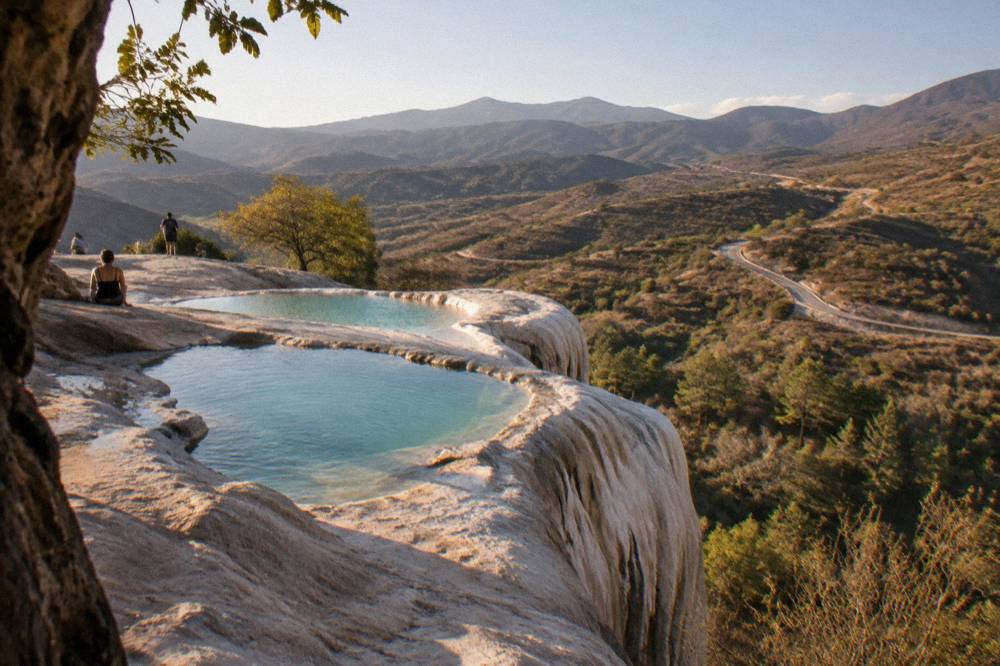
Yes, Hierve el Agua can be visited independently from Oaxaca City, but the site is the farthest common stop in the Tlacolula Valley at about 57 minutes of free-flow driving from the Zócalo, and there is no direct rail or air link, so independent travel means a rental car, a colectivo chain through Tlacolula or Mitla, or a hired driver. A tour removes those connections in exchange for a fixed itinerary.
The independent route is well documented on this site's day trip guide. The trade is time and flexibility: a self-directed day can linger at the pools as long as it likes, but has to solve the last stretch of mountain road, which is where shared transport gets thin. Colectivo services run through the valley towns, and the getting around overview places Hierve el Agua among the stops that reward planning.
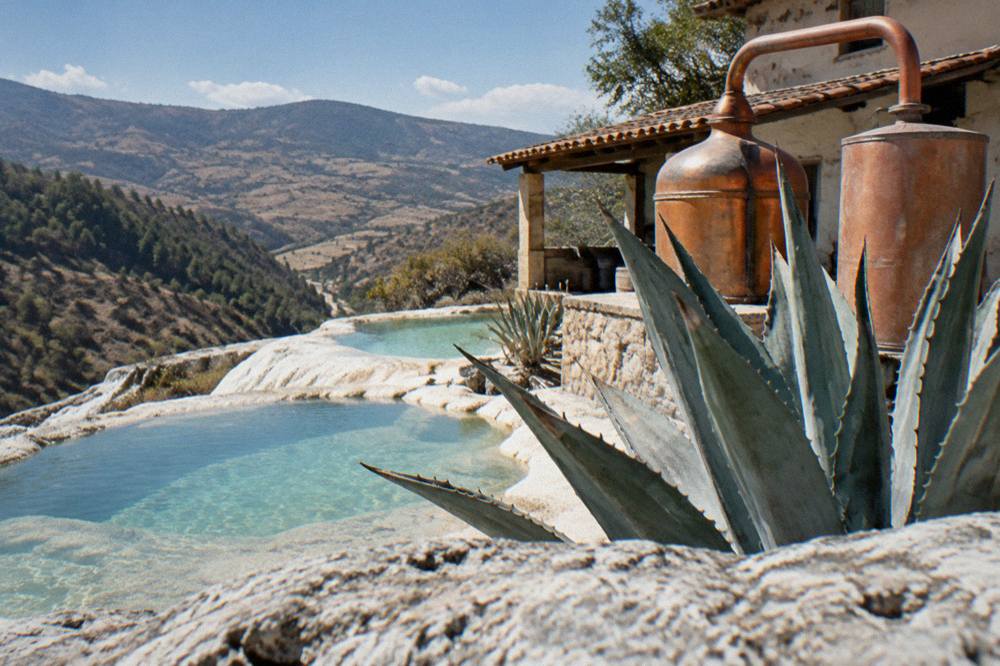
For travelers who want the middle path, the mezcal-making version of the valley loop is a reasonable compromise, since it concentrates on two stops, Hierve el Agua and a distillery with a production walkthrough, rather than five. The listing says the day covers the petrified waterfalls plus the making of mezcal at a palenque, with pickup in the city. More of these guides are collected on Oaxaca Travel Guide.
Hierve El Agua, Mezcal And Teotitlán: Which Tour Fits You?
Choose a Hierve el Agua tour by the stop you care about most: the pools-focused product goes to the waterfalls and back with time at the site, the mezcal-making loop adds a distillery production visit, and the full-day Tule, Mitla, Hierve el Agua and mezcal tour covers the whole valley in one pass. Teotitlán del Valle appears on the craft-heavy loops and rug stops rather than on the pools-only product.
The decision is honestly simple once the stops are ranked. Travelers whose priority is swimming or photographing the mineral pools should take the direct product, since every additional stop cuts time at the water. Travelers who want the archaeology and the crafts in a single day need the full loop, accepting that the day is long by construction, because the distances in the table above do not shrink. Mezcal drinkers fall in between, and the distillery-focused product serves them.
One more angle: the seasonal calendar. The rainy season runs May to October, with June averaging 188.3 mm of rain against January's 2.4 mm at the Oaxaca station, and afternoon storms in the wet months can change what a mountain-road day feels like. Tours run year-round regardless; the weather question is comfort, not access. The full month-by-month picture is in the climate data below.
| Month | Average high C | Average low C | Average rain mm |
|---|---|---|---|
| January | 28.9 | 10.3 | 2.4 |
| April | 34.9 | 15.8 | 47.3 |
| June | 30.9 | 16.7 | 188.3 |
| September | 29.1 | 16.1 | 163.6 |
| November | 29.0 | 12.3 | 9.1 |
These are SMN station normals for the city, 1991 to 2020. The valley and the mountain road to Hierve el Agua sit in the same seasonal rhythm: dry from November to April, wet from May to October.
Should You Combine Hierve El Agua With Monte Albán On One Trip?
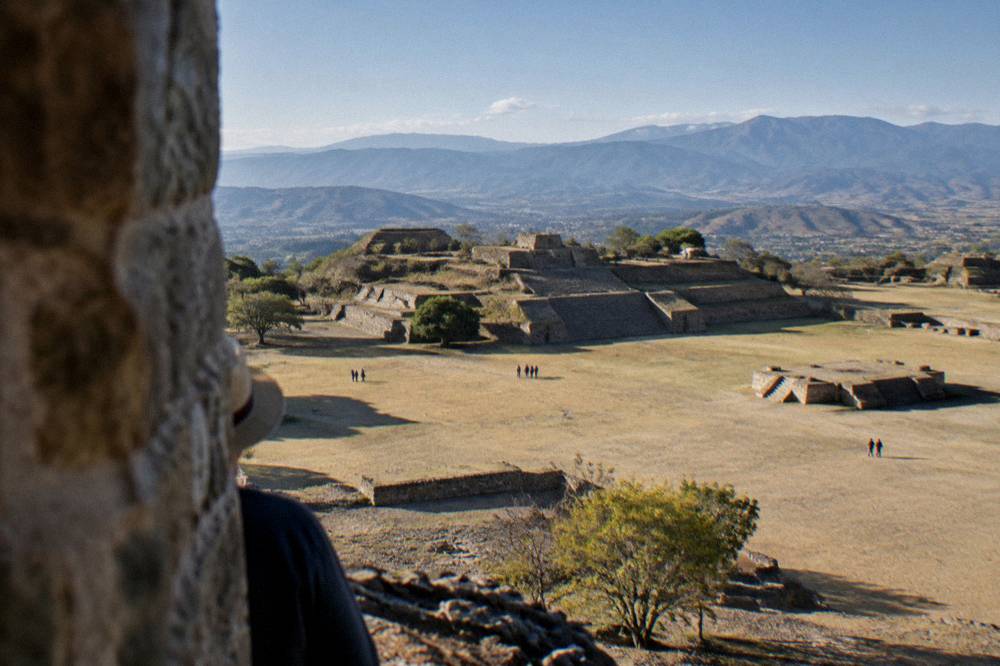
Combining Hierve el Agua and Monte Albán on a single Oaxaca City visit is practical across two days and impractical in one, because the valley loop east is already a full day and Monte Albán sits west of the city about 15 minutes from the Zócalo. Monte Albán is open daily 08:00 to 17:00 with last access at 16:00, entry 105 MXN nationals and 210 MXN foreigners, so it pairs best with a city morning rather than with the valley run.
Monte Albán is the state's headline site, with 416,675 visitors in 2025, and every first-time itinerary debate lands on how it fits against the eastern valley. The geography decides it: the ruins sit on a hill immediately west of the city, while Hierve el Agua, Mitla and Teotitlán run east. A two-day split gives each direction its own day, and the Monte Albán guide plus the Monte Albán tours page cover the western day in full.
For a five-day trip, the five-day Oaxaca itinerary sequences both directions with the city days between them. That spacing also spreads the INAH entry fees: each Category I site, Monte Albán and Mitla alike, charges 210 MXN at the gate for foreign visitors, so a trip that includes both pays the fee twice, on top of any valley tour price.
The petrified waterfalls product is also the natural pick for a two-day plan, because it keeps the eastern day lean and leaves energy for Monte Albán the following morning.
What Should You Bring And Know Before A Hierve El Agua Tour?
Bring swimwear and a towel if the pools are the goal, cash in pesos for the INAH gate at Mitla and any on-site charges at Hierve el Agua, sun protection for a high-altitude day, and a layer for the return drive, since valley nights average around 10 to 16 C depending on month. Confirm the pickup point in central Oaxaca City with the operator before the day.
The cash point is practical: INAH entry fees are paid at the gate in pesos, and the craft and mezcal stops on the loops are cash-preferred businesses. Swimwear matters because the mineral pools at Hierve el Agua are the one swim stop in a valley of dry hills, and tours that list pool time build it into the schedule. Sun protection matters because Oaxaca City sits at about 1,550 m and average daytime highs run from 28.9 C in January to 34.9 C in April on the station normals.
Timing is the other preparation. The full-day loops leave the city in the morning and return in the evening, so anything booked for the same evening in the city center should account for traffic on the return. The Oaxaca itinerary planning guide shows how the tour day slots into a wider trip.
How Do The Valley Tour Options Compare?
The valley tour options differ mainly in stop count and focus: the pools product goes to Hierve el Agua with the shortest day, the mezcal-making product trades craft stops for a distillery walkthrough, and the full-day Tule, Mitla, Hierve el Agua and mezcal loop covers every major stop on the corridor. The choice comes down to whether the day belongs to the pools, the mezcal or the whole valley.
What a reader can lock down is what each day contains, and how that maps onto the corridor geography in the drive-time table earlier on this page.
| Product | Focus | Stops | Best fit |
|---|---|---|---|
| Petrified waterfalls and pools tour | Hierve el Agua itself | Hierve el Agua | Pool time, shortest day, photography |
| Hierve el Agua and mezcal-making tour | Site plus distillery | Hierve el Agua, palenque production visit | Mezcal interest, two-stop pace |
| Full-day Tule, Mitla, Hierve el Agua and mezcal tour | Whole valley | Tule, Mitla, Hierve el Agua, mezcal tasting | First visit, one day only in the valley |
| Private Mitla, weavers town, mezcal and Hierve el Agua tour | Custom pace | Mitla, weaving town, mezcal, Hierve el Agua | Groups, photographers, slow travelers |
The private option listed in the table is worth a sentence: a private car and driver converts the same corridor into a flexible day, at a per-group rather than per-person price. For two or more travelers comparing costs, the per-group arithmetic sometimes favors it.
The full-day loop below is the headline comparison for most readers: it is the product that packages everything this page has described into a single booking.
When Should You Book A Hierve El Agua Tour?
Book a Hierve el Agua tour once the Oaxaca City dates are fixed, because the valley loops run daily but fill around the major festivals, and the two big crowd windows in the city calendar are Guelaguetza in July and Día de Muertos at the end of October and start of November. Dry season, November to April, is the window with the least rain on the station normals.
The festival logic comes straight from the calendar. Guelaguetza 2026 ran on 20 and 27 July with Palco A tickets at 1,632 MXN and Palco B at 1,321 MXN, and the state reported the paid sections selling out fast, which signals what hotel and tour demand looks like that month. Día de Muertos centres on the traditional dates of 31 October to 2 November, with city-center decorations mounted in late October in 2026 per the state's published schedule. Either window means booking the valley tour well ahead.
Outside those windows, availability is steadier. The rainy season from May to October does not stop tours from running, and the rain figures are concentrated in June through September, but the dry months of November through April carry 9.1 mm or less of monthly average rain at the extremes. Whatever the month, the booking step is the same: Check availability with the operator's booking page for the petrified waterfalls and pools tour.
Common Questions About Hierve El Agua Tours
How Far Is Hierve El Agua From Oaxaca City?
About 67 km and about 57 minutes of free-flow driving from the Zócalo, derived from mapped-road routing. Real traffic on the mountain sections is slower, and loops that add Mitla or Teotitlán spend longer on the road by design.
Do Hierve El Agua Tours Include Mitla Entry?
No. INAH entry at Mitla is paid at the gate, 105 MXN for Mexican nationals and 210 MXN for foreign visitors. Tour prices cover transport and guiding, not INAH gate fees.
What Are Mitla's Opening Hours?
The INAH page lists Mitla as open daily from 08:00 to 17:00, with last access at 16:30.
Can You Swim At Hierve El Agua On A Tour?
The mineral pools at the site are a swim stop, and tours that list pool time build it into the schedule. Bring swimwear, a towel and a layer for the return drive.
Is A Hierve El Agua Tour Worth It Compared To Going Alone?
It depends on the appetite for logistics. Independent travel means solving transport along the valley corridor and the final mountain stretch; a tour fixes the day at a single booking. The trade-offs are worked through in the day trip guide on this site.
When Is The Best Season For A Hierve El Agua Tour?
Tours run all year. The dry season from November to April averages the least rain on the station normals, while June through September carries the monthly rain peaks, with June averaging 188.3 mm.
The valley east of Oaxaca City packs the petrified waterfalls, an INAH archaeological zone, a weaving village and the mezcal capital into one corridor, and a well-chosen tour covers it in a single day. Match the loop to the stop that matters most, book ahead around July and the Days of the Dead, and pay the Mitla gate fee in pesos on arrival.