Is Hierve El Agua Worth It?
A straight answer on whether Hierve el Agua earns its long drive from Oaxaca City, with distances, seasons, tour options and what to combine it with.
Hierve el Agua is one of the farthest stops on the standard day-trip circuit out of Oaxaca City, the inland highland capital of the state of Oaxaca, and the question of whether it earns its drive comes up in almost every planning thread. The site lies in the Tlacolula Valley, about 67 km from the Zócalo by road, and it is run by local communities rather than by INAH, the federal institute that runs Monte Albán and Mitla. That distinction matters for planning, because the entry fee and opening hours that INAH publishes for its own sites simply do not exist here in any official source.
This page works through the question the way a planner would: what the site is, what the drive costs in time, how the seasons change it, which tour options cover it, and what it combines with on a single day out. Where a figure exists in a reliable source, it is printed. Where none does, the sentence stays out.
Yes, for almost every visitor who can give it a full day, because Hierve el Agua is the only stop on the Oaxaca City day-trip circuit built around petrified waterfalls and mineral pools rather than ruins or markets, and the valley loop it sits on bundles Mitla, the Tule tree, weaving towns and mezcal into the same drive. The compromise is distance: about 67 km each way from the Zócalo, the farthest of the standard valley stops.
The honest framing is a trade of time against uniqueness. Monte Albán is closer and grander as archaeology, but it is one category of sight. Hierve el Agua gives you a landscape, a swim stop and a route through the Tlacolula Valley, and its 2025 visitation, tracked by the state tourism authority alongside the INAH sites, is part of why nearly every commercial valley tour now includes it.
What it is not is a half-hour add-on. Anyone telling you it fits between breakfast and lunch in the city is describing a drive of about 57 minutes free-flow each way, before the walking, the swimming and the stops on the way back. If your itinerary only has one day outside Oaxaca City, this page's answer is yes. If it has none, read is Oaxaca worth visiting before spending the day on logistics.
What Is Hierve El Agua, Exactly?
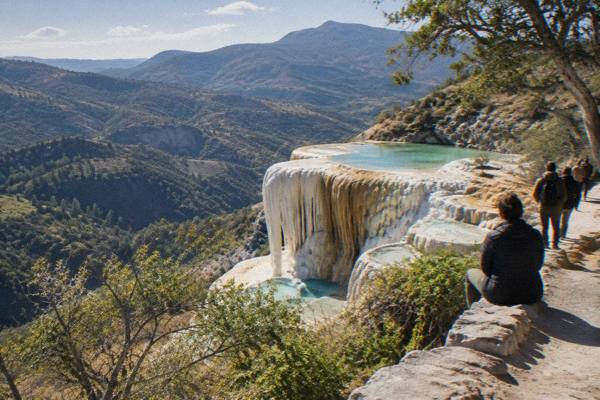
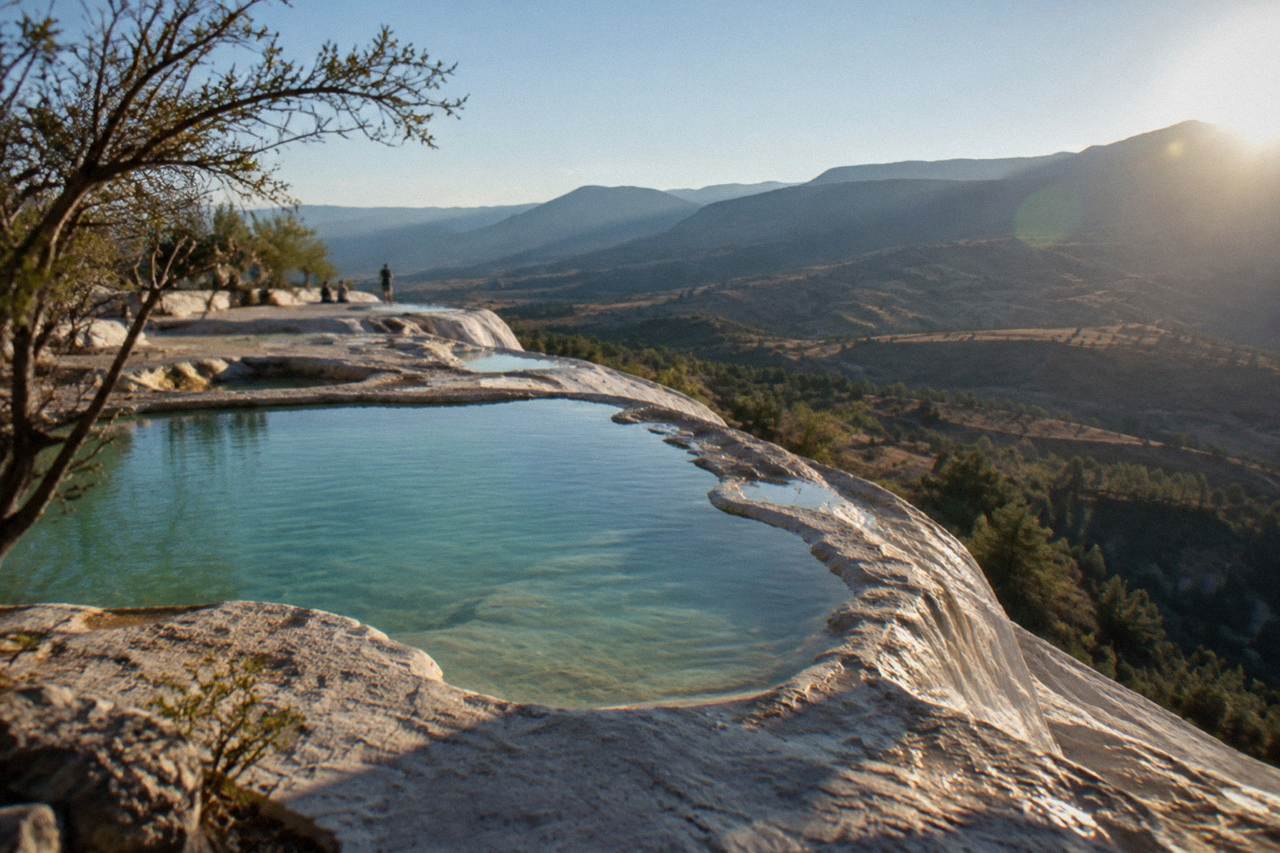
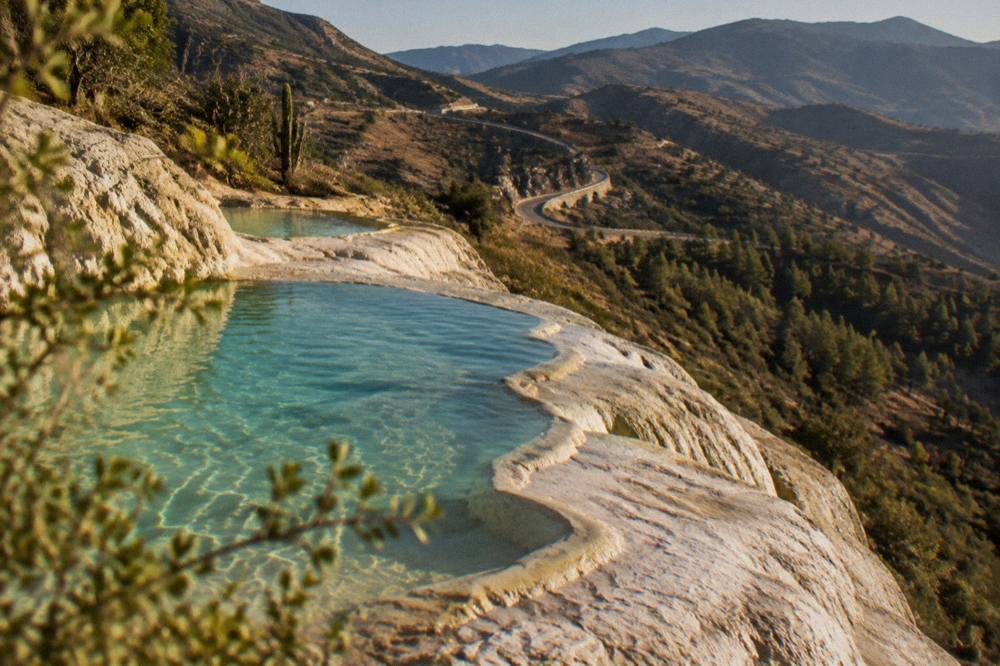
Hierve el Agua is a site in the Tlacolula Valley, east of Oaxaca City, known for petrified waterfalls and mineral pools, and it is administered by the local communities of the area rather than by INAH, which means no federal page publishes its entry fee or its opening hours. The name is Spanish, and the site sits high above the valley road toward Mitla.
Because the communities run it, the practical details that are routine facts elsewhere are not verifiable facts here. No official source publishes what it costs to enter or when the gates open and close, and no entry price or gate schedule will be printed without verification. What can be stated is the geography: the pools and the petrified falls sit at the end of a mountain road past San Lorenzo Albarradas, and tour listings consistently market a swim and a viewpoint walk as the core of the visit.
The state government did complete the Mitla to Tehuantepec superhighway, inaugurated in January 2025, which reshaped access to this whole end of the valley, and no 2026 closures or blockades on the Hierve el Agua access road have been announced. Community checkpoints and informal tolls have existed on this road in past years according to older state diagnostics, so an organised tour, a licensed driver or a current local report is the sane way to handle the last stretch.
How Far Is Hierve El Agua From Oaxaca City?
Hierve el Agua is about 67 km from the Zócalo of Oaxaca City, a free-flow drive of about 57 minutes each way, and the route passes the Tule tree at about 10 km and 11 minutes out, then Mitla at about 45 km and 37 minutes, making Hierve the last and longest leg of the classic valley loop. Real traffic and mountain roads are slower than the free-flow figure.
Those numbers are derived from routing on the road network, not from a government timetable, so the word "about" is doing honest work. The final stretch beyond the valley highway climbs on a mountain road, and that is the segment where weather, traffic and community checkpoints change the clock most.
The full picture of the loop, in one table:
| Stop | Distance From The Zócalo | Free-Flow Drive Time |
|---|---|---|
| Santa María del Tule | about 10 km | about 11 minutes |
| Teotitlán del Valle | about 29 km | about 26 minutes |
| Tlacolula | about 31 km | about 25 minutes |
| Mitla | about 45 km | about 37 minutes |
| Hierve el Agua | about 67 km | about 57 minutes |
Read the table as a chain, not a menu. A loop that hits Tule, Teotitlán del Valle and Mitla on the way out and Hierve el Agua as the turnaround is the pattern almost every commercial day trip follows, because the geography forces it: everything worth stopping for sits on or near the same corridor east. The dedicated drive-time breakdown lives at how long is the drive from Oaxaca to Hierve el Agua, and the sight itself is covered in depth at Hierve el Agua.
How Do You Get To Hierve El Agua Without A Car?
The realistic options from Oaxaca City are an organised valley day trip, a private driver, or public transport toward Mitla with an arrangement for the final mountain stretch, because no train exists, the site is not on a city bus line, and the last kilometres are the part that punish improvisation. Tour transport is the only option that bundles the whole loop without negotiation.
Public transport in this valley means colectivos and shared taxis toward Tlacolula and Mitla from city departure points, and the final leg from Mitla up to Hierve el Agua is where independent travellers have historically needed a local taxi, a tour shuttle or a long walk. Colectivo fares and the current state of the Mitla to Hierve connection go unpublished by any official source; the practical answer is that the connection exists but is the fragile part of a self-drive-free plan.
An organised tour solves the last leg by contract. The most-booked pattern on this route is a full-day valley loop that gives the group a long block at Hierve el Agua itself and folds in Mitla, the Tule tree, a weaving stop and a mezcal distillery on the way out or back; one such product is the Hierve el Agua valley day trip, and the specific loop with the extended Hierve stay can be checked via the operator's booking page: Check availability.
For anyone weighing the whole question of self-drive versus tour versus colectivo across the entire region, the general transport picture is laid out at what is the best way to get around Oaxaca, and a driver-based alternative is described in the Hierve el Agua day trip guide.
When Should You Go To Hierve El Agua?
The dry season, November to April, is when the site is most dependable, because the Oaxaca station normals show June averaging 188.3 mm of rain and September 163.6 mm against 2.4 mm in January and 9.1 mm in November, and a wet mountain road plus a swim in mineral pools is a worse combination than a dry one. April averages a 34.9 C high, so morning arrival beats midday.
The station normals for Oaxaca City, at the climate station in the valley, give the full shape of the year:
| Month | Mean High C | Mean Low C | Rain mm |
|---|---|---|---|
| January | 28.9 | 10.3 | 2.4 |
| April | 34.9 | 15.8 | 47.3 |
| June | 30.9 | 16.7 | 188.3 |
| September | 29.1 | 16.1 | 163.6 |
| November | 29.0 | 12.3 | 9.1 |
Two readings of that table matter for this trip. First, the rainy season, May to October with its peak from June to September, does not make Hierve el Agua impossible, it makes it conditional: afternoon storms on a mountain road are the risk, and tours still run. Second, the temperature band barely moves, so this is a decision about rain, not about heat or cold, and the month-by-month detail lives at what is the best month to go to Oaxaca.
What Should You Combine Hierve El Agua With?
The combinations that work are the ones the geography already forces: Mitla, 45 minutes out and an INAH Category I site open daily 08:00 to 17:00 with entry at 105 MXN for nationals and 210 MXN for foreign visitors; the Tule tree at 11 minutes from the Zócalo; Teotitlán del Valle for weaving; and a mezcal distillery stop, since Santiago Matatlán, the mezcal town, sits on this same corridor. Fighting the geography wastes the day.
Mitla deserves its own sentence here because it is the one stop with fully published visitor facts: INAH lists it Monday to Sunday, 08:00 to 17:00, last access 16:30, at the Category I rate shared with Monte Albán and Yagul. Pairing a ruin with pools and a swim in one day is exactly the mix that makes the long drive defensible, and no other direction out of Oaxaca City offers it. The Tule tree, the widest-tree claim travellers keep asking about, is explained at what does El Tule mean in English.
Mezcal completes the loop. The valley corridor is the mezcal heartland of the state, and distillery stops are standard on commercial loops; the town of Santiago Matatlán carries the title Capital Mundial del Mezcal in state publications. Anyone building a multi-day plan around this single day trip can lift the whole sequence from the Oaxaca in 5 days itinerary, and the wider question of how much time the region needs is answered at how many days in Oaxaca is enough.
Who Should Skip Hierve El Agua?
Skip it if your trip is under three nights, if you have only one day outside the city and ruins matter more to you than landscape and swimming, or if you are unwilling to spend roughly two hours of a day on the road, because the site's whole cost is distance and its whole reward is a landscape the rest of the circuit does not offer. Monte Albán, 15 minutes out, is the higher-yield stop on a tight clock.
The two-night case is the clearest. With two nights in the city you have at most one full day outside it, and that day buys either Monte Albán plus craft villages at short range, or this valley loop at long range. Both are strong; they are not both possible. On three nights or more, the question dissolves, because the valley loop fits as one day and the closer sights fill the other, a structure the editors of this Oaxaca Travel Guide recommend for first visits in the planning pages.
The final filter is season and stomach for mountain roads. In the depth of the rainy season, with the June and September rainfall figures on the table, a traveller who dislikes wet switchbacks should trade this day for city and near-valley days and keep Hierve el Agua for a return trip in the dry months. That is not a safety warning, it is arithmetic about 188.3 mm of monthly rain on a mountain road.
Common Questions About Hierve El Agua
Is Hierve El Agua Worth It?
Yes, for anyone with a full day to spend: it is the only stop on the Oaxaca City day-trip circuit built around petrified waterfalls and mineral pools, and the valley loop it anchors adds Mitla, the Tule tree, weaving towns and mezcal to the same drive. The cost is distance, about 67 km each way.
Can You Swim At Hierve El Agua?
The pools are the core of the visit and tour listings consistently market swimming as the main activity at the site. Entry conditions and rules are set by the local communities that administer it, so confirm current arrangements with your operator before you go.
How Long Does It Take To Get There From Oaxaca City?
About 67 km from the Zócalo, roughly 57 minutes of free-flow driving each way, with real traffic and the final mountain stretch making it longer. The route passes the Tule tree at about 11 minutes and Mitla at about 37 minutes from the city.
What Does Entry To Hierve El Agua Cost?
No official source publishes a fee. The site is run by local communities rather than by INAH, so unlike Mitla or Monte Albán there is no federal page with a printed rate.
Can You Visit Hierve El Agua Without A Tour?
Yes, via colectivo transport toward Mitla and a local arrangement for the final mountain stretch, though the last leg is the fragile part of an independent plan. An organised valley day trip or a private driver covers the whole loop without negotiation.
Is Hierve El Agua Open In The Rainy Season?
No official hours exist for the site, and tours run year-round, but the Oaxaca station normals show June averaging 188.3 mm of rain and September 163.6 mm, so wet-road conditions on the mountain approach are the real constraint from May to October.