Oaxaca Itinerary: How To Build One From Scratch
Oaxaca City sits inland in the Valles Centrales of Mexico at about 1,550 m, and the shape of a good itinerary comes from three fixed things: INAH site hours, market days in the surrounding towns, and the dry and rainy seasons. The planning framework follows, day by day.
Plan at least four days: one for the Centro Histórico, one for Monte Albán, one for the Tlacolula Valley (Mitla and Hierve el Agua), and one flexible day for craft villages or a cooking class. Match each day to opening hours, since Zaachila opens Thursday to Sunday only and the Museo de las Culturas closes Mondays.
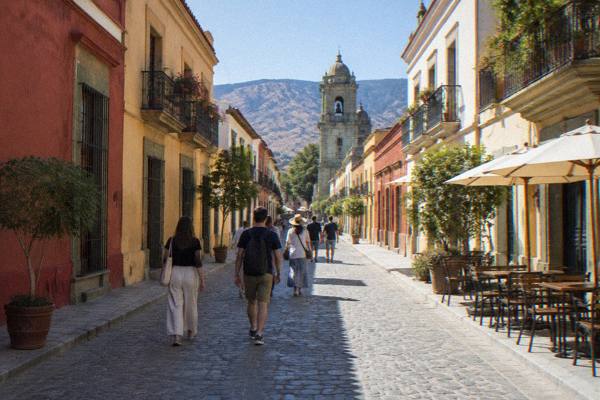
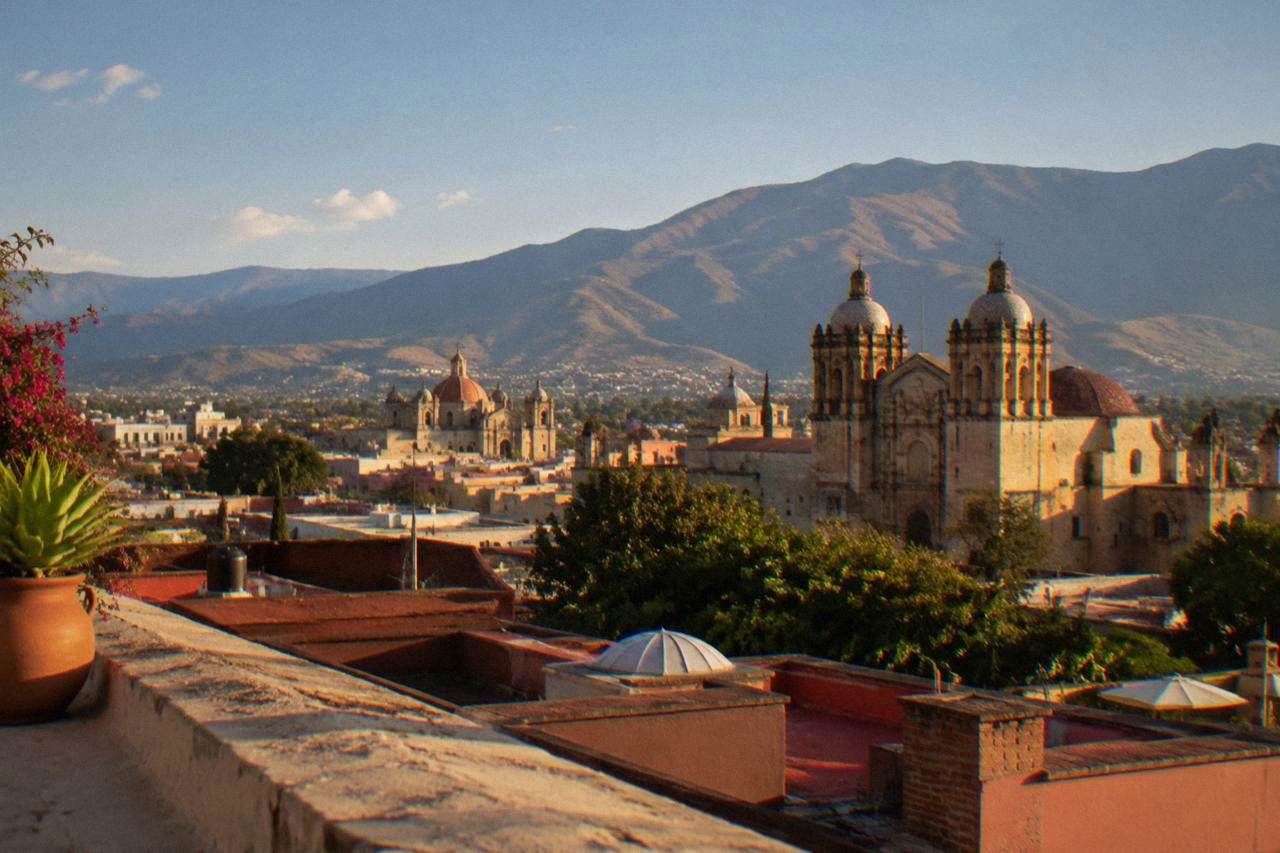
Oaxaca City (Oaxaca de Juárez) is the capital of the state of Oaxaca in Mexico, an inland highland city in the Valles Centrales at about 1,550 m, and the raw material for an itinerary is unusually concentrated: the Centro Histórico, the Monte Albán archaeological site about 15 minutes away, the Tlacolula Valley towns to the east, and craft villages scattered around the valley rim. The UNESCO World Heritage property is listed as "Historic Centre of Oaxaca and Archaeological Site of Monte Albán", property 415, which captures the two anchors of almost every plan. What actually shapes the day-by-day sequence is less distance and more fixed schedules: INAH opening hours, the Thursday-to-Sunday window at Zaachila, the Tuesday-to-Saturday run of the Museo de las Culturas de Oaxaca, and the rainy season from May to October.
How Many Days Do You Need For An Oaxaca Itinerary?
Four full days is the working minimum for a first visit: one day for the Centro Histórico and its museums, one for Monte Albán, one for the Tlacolula Valley (Mitla and Hierve el Agua), and one flexible day for craft villages, a cooking class or a market town. Five days adds the Ocotlán or Zaachila circuit; a week adds the Sierra Norte or a long extension to the Pacific coast. Fewer than four days forces a choice between the city and the valleys, and the two halves reward different paces. The city is walkable and dense; the valley sites run on transport time and fixed last-entry cutoffs. Sectur's 2025 indicator report puts the average stay in the city at 2.00 nights, so anything at four days is already a slower visit than the typical one.
The practical floor for each block is firm. Monte Albán needs a half day: the INAH page lists daily hours of 08:00 to 17:00 with last access at 16:00, and the drive from the Zócalo is about 15 minutes. The Tlacolula Valley loop (Tule, Mitla, Hierve el Agua) is a full day by any route, with Mitla about 37 minutes away and Hierve el Agua about 57 minutes beyond the city on derived free-flow drive times. The Centro Histórico can be compressed into one long day, but the Museo de las Culturas closes on Sunday and Monday, which pushes museum-heavy plans onto a Tuesday-to-Saturday frame.
If your dates are locked to late July, add a day: the Guelaguetza programme fills the Auditorio Guelaguetza on two Mondays and spreads related events across the whole month. The 2026 edition ran 20 and 27 July with performances at 10:00 and 17:00, Palco A at 1,632 MXN, Palco B at 1,321 MXN plus fees, and Palcos C and D free. Treat those figures as a reference for scale: the 2027 dates are not announced.
What Order Should You Visit Oaxaca City And The Valleys In?
Sequence the trip as city first, Monte Albán second, the Tlacolula Valley third, and the Ocotlán-and-Zaachila or Teotitlán-and-craft-villages day last, because each block gets progressively more transport-dependent and more sensitive to day-of-week constraints: the city needs Tuesday-to-Saturday days for the Museo de las Culturas, Monte Albán runs every day, and Zaachila opens only Thursday to Sunday. The city block needs Tuesday-to-Saturday days for the Museo de las Culturas; Monte Albán runs every day; Zaachila opens only Thursday to Sunday; and the Sierra Norte is a full-day commitment to mountain roads. Building in this order means a weather hiccup or a blockade can reshuffle the flexible tail without breaking the anchors.
Start with the Centro Histórico because it calibrates everything else. A walking structure links the Zócalo (Plaza de la Constitución), the Andador Macedonio Alcalá, Santo Domingo de Guzmán and the Jardín Etnobotánico, whose free guided tours run Monday to Friday at 10:30, 11:00, 11:30, 12:00 and 17:00, and Saturday from 10:30 to 12:00, with large and school groups booking two weeks ahead. Our Oaxaca one day itinerary compresses this into a single day if your time is short.
Second day: Monte Albán, either independently or with a guide. Third: the Tlacolula Valley. If that day falls on a Sunday, fold in the Tlacolula Sunday market, which is a standing regional market day, though official current hours are not published; plan around the day itself rather than a timetable. Fourth: the Ocotlán-and-Zaachila or Teotitlán-and-craft-villages day, matched to Zaachila's Thursday-to-Sunday window. Our one week in Oaxaca itinerary runs the full sequence with timing detail.
The trio above covers the three easiest blocks to outsource: a guided historic-centre walk for day one, a Monte Albán-and-crafts day trip for day two, and a printmaking workshop as a city-based activity for a lighter day. Between them they leave the Tlacolula Valley, which has its own list of day trips, as the piece you plan around transport rather than tours.
Which Archaeological Sites Belong In An Oaxaca Itinerary?
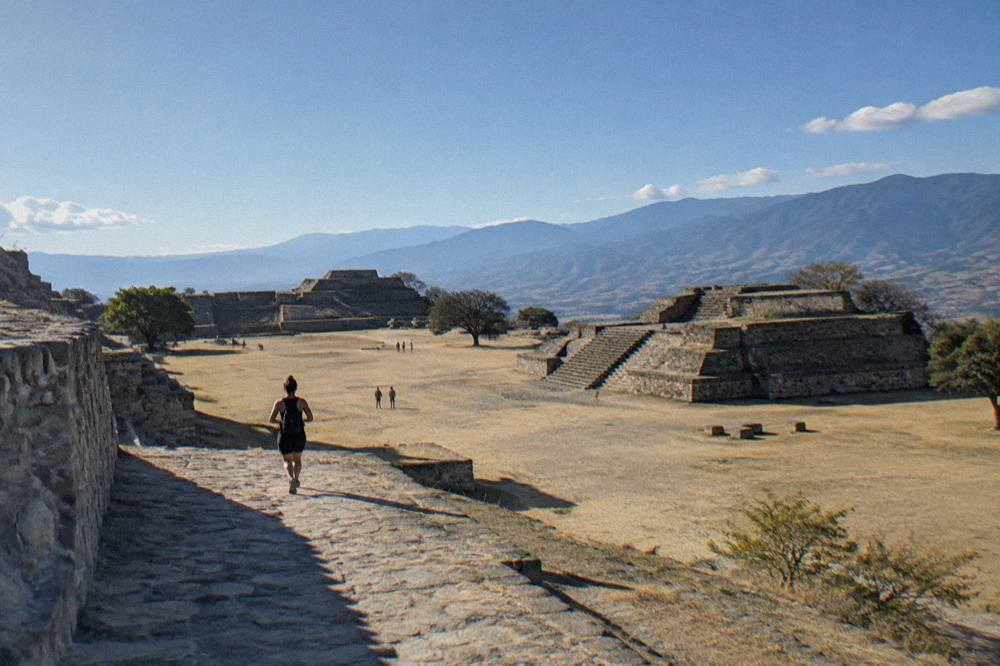
Monte Albán and Mitla are the two sites almost every itinerary carries, with Yagul as the third choice for a second valley day; Atzompa works as a short morning stop near Monte Albán, and Zaachila only fits a Thursday-to-Sunday plan. All are INAH zones with published hours and peso fees, and the fee split matters for budgeting: Category I sites (Monte Albán, Mitla, Yagul) charge 105 MXN for Mexican nationals and 210 MXN for foreign visitors, while Category III sites (Dainzú, Lambityeco, Zaachila) charge 80 and 145 MXN.
The INAH site pages give the hours, and they are not identical. Monte Albán runs 08:00 to 17:00 with last access at 16:00. Mitla runs 08:00 to 17:00 with last access at 16:30, as do Dainzú and Lambityeco. Yagul matches Monte Albán with a 16:00 last access. Atzompa closes earlier, 08:00 to 16:00 with last access at 15:00, which makes it a morning stop rather than an afternoon one. Zaachila is the outlier: Thursday to Sunday, 10:00 to 16:00, full stop.
| INAH Site | Category | Hours | Last Access | Fee (MXN, national / foreign) |
|---|---|---|---|---|
| Monte Albán | I | Mon-Sun 08:00-17:00 | 16:00 | 105 / 210 |
| Mitla | I | Mon-Sun 08:00-17:00 | 16:30 | 105 / 210 |
| Yagul | I | Mon-Sun 08:00-17:00 | 16:00 | 105 / 210 |
| Dainzú | III | Mon-Sun 08:00-17:00 | 16:30 | 80 / 145 |
| Lambityeco | III | Mon-Sun 08:00-17:00 | 16:30 | 80 / 145 |
| Zaachila | III | Thu-Sun 10:00-16:00 | (closing time) | 80 / 145 |
| Atzompa | (hours only published) | Mon-Sun 08:00-16:00 | 15:00 | not on the INAH page |
A common sequencing move is to pair Atzompa with Monte Albán in one morning-to-afternoon block, since both sit on the western side of the valley. An eastern day naturally chains Tule, Mitla and Hierve el Agua along the Tlacolula corridor, with Yagul and Lambityeco as add-ons for a slower pace. Our Monte Albán guide and Mitla guide carry the site detail, and the Monte Albán tour guide compares the guided options.
The 2025 visitor counts argue for putting Monte Albán early in the trip rather than late: at 416,675 visitors it carried roughly four times the traffic of every other valley site combined, so a morning arrival window matters more there than anywhere else. Mitla's 104,428 and Yagul's 10,185 tell you the eastern sites spread people out.
A guided day trip that bundles Monte Albán with the alebrije workshops of San Martín Tilcajete and the black pottery of San Bartolo Coyotepec solves two planning problems at once: the early start at the ruins and the logistics of reaching villages that have no single transit hub. The listing carries the current price and availability.
How Do You Fit Museums And Opening Days Into An Oaxaca Itinerary?
Treat the city's museum and garden schedule as the skeleton of the plan: the Museo de las Culturas de Oaxaca is open Tuesday to Saturday 10:00 to 16:00, the Jardín Etnobotánico runs free guided tours Monday to Friday at 10:30, 11:00, 11:30, 12:00 and 17:00 and Saturday 10:30 to 12:00, so a weekend arrival should put the Centro Histórico museums on the following Tuesday-to-Saturday stretch. The Museo de las Culturas charges the Category I rates, 105 MXN national and 210 MXN foreign, per its INAH page.
The trap is the Monday arrival. A traveller landing Monday finds the Museo de las Culturas closed both Sunday and Monday, which makes Monday the natural day for Monte Albán or a valley trip, both of which run daily. Saturday carries the Jardín Etnobotánico's morning tour block only, with no 17:00 slot. Those two constraints alone will fix two of your days.
| Fixed Schedule In The City | Days | Hours / Slots | Cost |
|---|---|---|---|
| Museo de las Culturas de Oaxaca (Santo Domingo) | Tue-Sat | 10:00-16:00 | 105 / 210 MXN |
| Jardín Etnobotánico guided tours | Mon-Fri | 10:30, 11:00, 11:30, 12:00, 17:00 | free |
| Jardín Etnobotánico guided tours | Sat | 10:30-12:00 | free |
| Zaachila archaeological zone | Thu-Sun | 10:00-16:00 | 80 / 145 MXN |
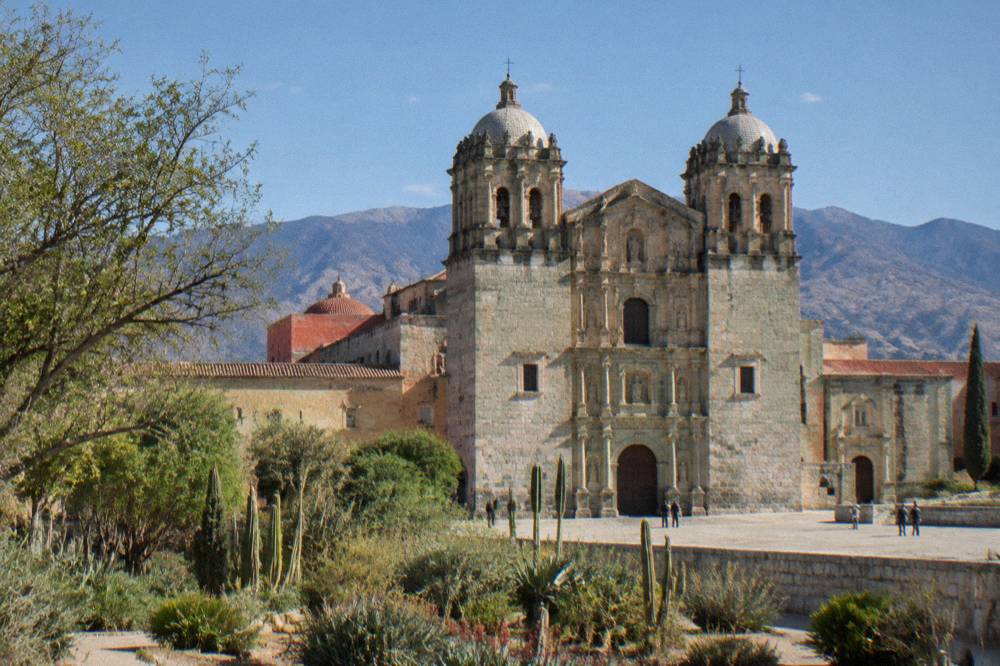
Santo Domingo de Guzmán anchors the whole block: the church, the museum inside the former convent complex and the Jardín Etnobotánico sit together, so one morning can cover all three if you take an early garden slot and the museum from 10:00. Our Santo Domingo church guide and Jardín Etnobotánico guide give the site-level detail, and the museum guide covers the collection.
What Should A Four-To-Five Day Oaxaca Itinerary Look Like?
A four-day template runs: Day 1, Centro Histórico with Santo Domingo, the museum and a garden tour slot; Day 2, Monte Albán in the morning plus Atzompa or a craft village; Day 3, the Tlacolula Valley (Tule, Mitla, Hierve el Agua) as a full-day loop; Day 4, food: a market morning in Mercado 20 de Noviembre and a cooking class. A fifth day slots in either the Ocotlán-and-Zaachila circuit (Thursday to Sunday) or the Teotitlán del Valle weaving villages.
The template flexes on day-of-week. If Day 1 falls on a Sunday or Monday, swap it with Day 2, since Monte Albán opens daily and the museum does not. If your trip spans a Thursday, the Zaachila-and-market circuit becomes the strongest fifth-day candidate; if it spans a Sunday, the Tlacolula market belongs on that day and the valley loop should follow the market rather than precede it. More of these guides are collected on Oaxaca Travel Guide.
| Day | Block | Anchor Stops | Fixed Constraint |
|---|---|---|---|
| 1 | Centro Histórico | Zócalo, Andador Macedonio Alcalá, Santo Domingo, Museo de las Culturas, Jardín Etnobotánico | Museum Tue-Sat; garden slots listed above |
| 2 | Monte Albán side | Monte Albán, Atzompa | Monte Albán last access 16:00; Atzompa 15:00 |
| 3 | Tlacolula Valley | Santa María del Tule, Mitla, Hierve el Agua | Mitla last access 16:30; Hierve el Agua is community-run, hours not published |
| 4 | Food day | Mercado 20 de Noviembre, cooking class, evening Centro | Cooking classes run on their own schedules |
| 5 (optional) | South valley | Ocotlán, Zaachila, San Martín Tilcajete | Zaachila Thu-Sun only |
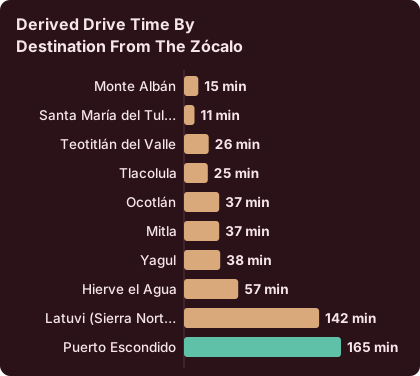
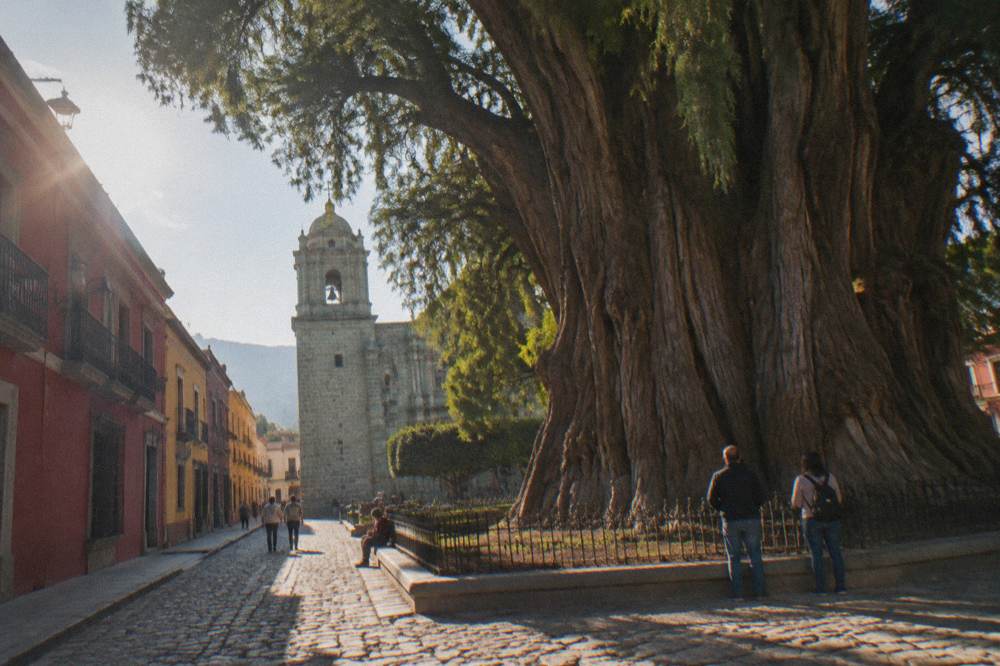
Drive times frame the valley days. From the Zócalo, derived free-flow times are about 15 minutes to Monte Albán, 11 to Tule, 26 to Teotitlán del Valle, 25 to Tlacolula, 37 to Ocotlán, 38 to Yagul, 37 to Mitla and 57 to Hierve el Agua. Real traffic and mountain roads are slower, so round up when you plan. The Teotitlán del Valle guide and the Hierve el Agua day trip guide carry the stop-level planning.
How Does The Rainy Season Change An Oaxaca Itinerary?
The rainy season runs May to October with June to September the peak, and the SMN station normals show June at 188.3 mm and September at 163.6 mm against January's 2.4 mm, so a wet-season itinerary keeps indoor and covered options, markets and museums, elastic for the afternoon and books valley day trips for the mornings. Dry season, November to April, carries under 20 mm per month from November to March and removes most of that juggling. The same table puts April's average daily high at 34.9 C and January's average overnight low at 10.3 C, which shapes packing more than planning.
The daily rhythm in the rainy season matters more than the monthly totals: rain days average 19.9 in June and 21.4 in September against 1.4 in January, and the pattern rewards morning-heavy schedules with city afternoons. A Hierve el Agua trip is better placed in a dry-season plan or a dry forecast window, since the access road climbs into the hills east of Mitla.
| Month | Avg High C | Avg Low C | Rain mm | Rain Days |
|---|---|---|---|---|
| Jan | 28.9 | 10.3 | 2.4 | 1.4 |
| Feb | 31.1 | 11.6 | 4.6 | 1.1 |
| Mar | 33.3 | 13.6 | 17.6 | 4.1 |
| Apr | 34.9 | 15.8 | 47.3 | 7.6 |
| May | 33.8 | 16.7 | 97.9 | 13.7 |
| Jun | 30.9 | 16.7 | 188.3 | 19.9 |
| Jul | 30.1 | 15.9 | 118.6 | 20.4 |
| Aug | 30.0 | 15.9 | 131.8 | 20.5 |
| Sep | 29.1 | 16.1 | 163.6 | 21.4 |
| Oct | 29.3 | 14.5 | 63.1 | 12.0 |
| Nov | 29.0 | 12.3 | 9.1 | 3.5 |
| Dec | 28.9 | 11.0 | 9.0 | 2.4 |
These are SMN station 20079 normals for 1991-2020, published by CONAGUA. Our month-by-month breakdown in the Oaxaca weather by month guide and the best time to visit guide build on the same table, and the rainy season guide has wet-season-specific plans.
One planning caution that belongs in any season: road blockades by teachers' unions are a standing, sporadic risk in Oaxaca and can disrupt road and airport access for hours at a time. Keep at least one city-only fallback day in a tight itinerary, and read the Oaxaca safety guide for the advisory wording.
Should You Book Tours Or Plan Independently In Oaxaca?
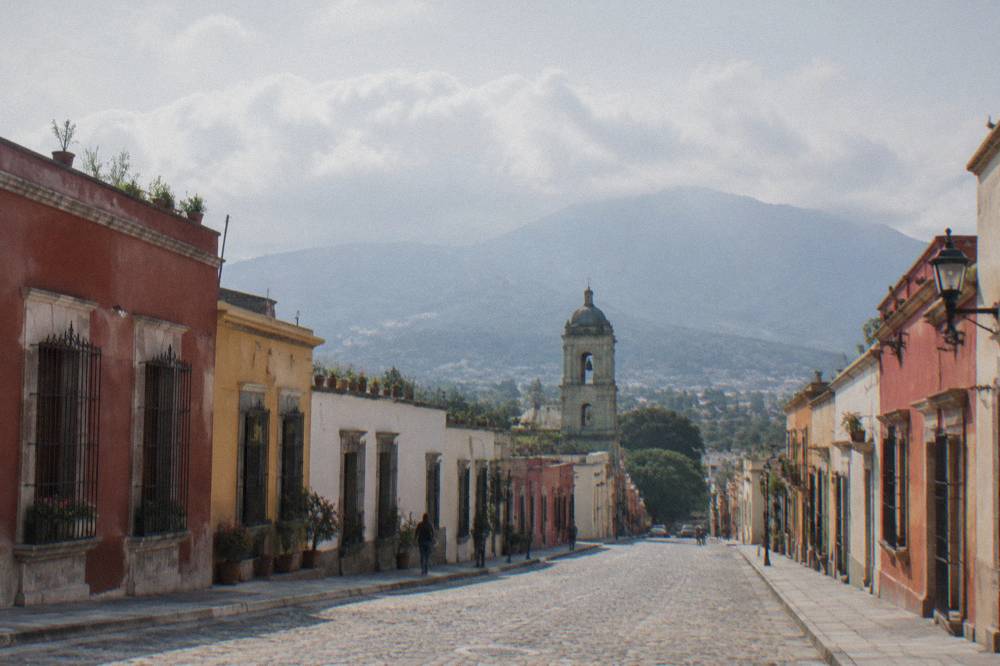
Plan the Centro Histórico, museums and gardens independently (they are walkable and scheduled), and lean on guided day trips for Monte Albán, the Tlacolula Valley and the craft villages, where transport, timing and last-access cutoffs are the real work. The city block needs nothing but a garden tour slot; the valley blocks involve colectivo routes or private transport, early starts and site hours that punish a late departure. Food experiences, cooking classes and mezcal tastings sit in between: bookable, but perfectly plannable alone once you know what you want to eat. Our what to eat in Oaxaca guide and the cooking classes guide cover the food side.
What a guided trip buys is the schedule: a Monte Albán departure that lands before the crowds and a valley loop that chains Tule, Mitla and Hierve el Agua without backtracking. The trade is flexibility, especially around market days.
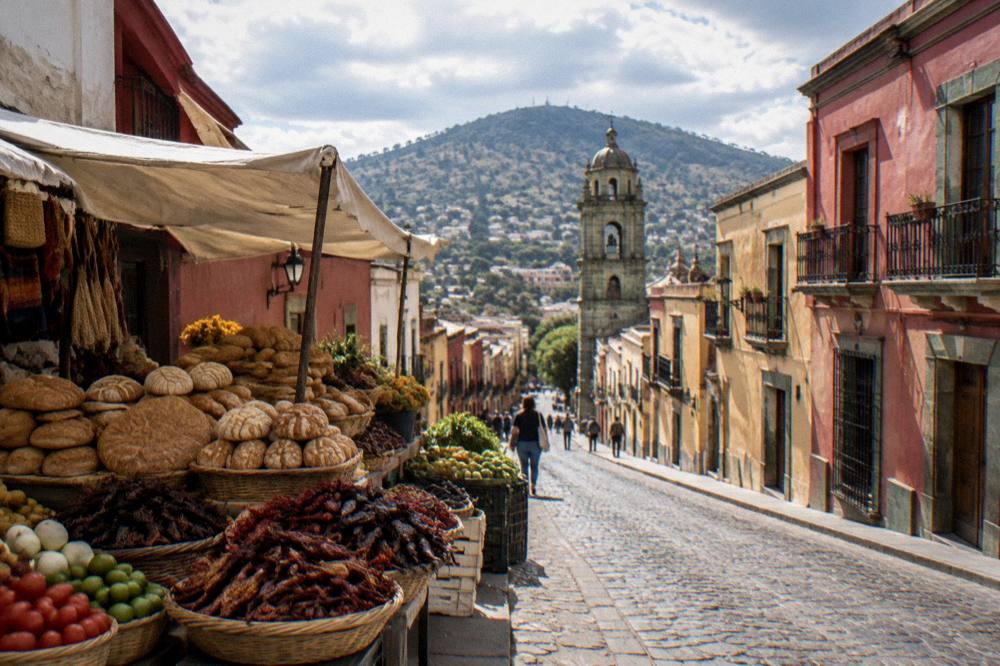
For the city days, a historic-centre walking tour is the cheapest way to orient on day one, and it pairs with a workshop day for bad-weather cover. You can check availability for the Monte Albán and craft villages day trip through the operator's booking page at any point: Check availability.
Where Should You Stay While Planning An Oaxaca Itinerary?
Base yourself in or beside the Centro Histórico for a first visit of four to six days, because every transport node, tour departure point and walkable block sits within or on the edge of it; a longer stay or a quieter preference moves you to Jalatlaco or Xochimilco, both adjacent neighbourhoods, and only a coast extension justifies changing cities. The state lodging tax is 3 percent on hotel-type stays, 5 percent where an intermediary platform collects it, under decree 884 published 10 December 2025, so a quoted room rate and the final bill can differ by that margin.
The neighbourhood logic follows the itinerary rather than the hotel: the Centro Histórico puts the Zócalo, the Andador Macedonio Alcalá and Santo Domingo on foot; Jalatlaco and Xochimilco add a 10-to-20-minute walk to the same set. Our where to stay in Oaxaca guide maps the neighbourhoods, the best hotels guide covers the upper range, and the neighbourhoods overview compares all of them including Reforma and the area south of the centre.
For festivals, location matters more than usual. Guelaguetza pushes demand into late July, and Día de Muertos, whose traditional centre is 31 October to 2 November, does the same for early November. The 2026 programme for either is not announced, so plan dates around the standing pattern and book lodging early rather than around a published schedule.
How Do You Get Around Oaxaca Without A Car?
The Centro Histórico is entirely walkable, colectivos and taxis cover the near valley towns, and a car or a guided trip earns its cost only on the far loop: Hierve el Agua at about 57 minutes, the Sierra Norte at about 142 to Latuvi, or the Pueblos Mancomunados. There is no bike-share in Oaxaca, ride-hailing serves the city but not the airport, and the airport itself, Xoxocotlán (OAX), is operated by ASUR. Those are the fixed facts; fares are not published in primary sources, so confirm transport costs on the ground.
The practical split by itinerary block: walk the centre; take a tour or a colectivo to Monte Albán and the near craft towns; use a full-day tour, a private driver or a rental for the Hierve el Agua loop; and treat the Sierra Norte as an organised trip or a committed drive. Puerto Escondido is about 165 minutes on the new highway by derived free-flow time, which makes it an extension, never a day trip. Our getting around Oaxaca guide and the driving in Oaxaca guide carry the detail.
| Destination From The Zócalo | Derived Drive Time | Itinerary Use |
|---|---|---|
| Monte Albán | about 15 min | half-day block |
| Santa María del Tule | about 11 min | stop on the valley loop |
| Teotitlán del Valle | about 26 min | craft village day |
| Tlacolula | about 25 min | valley loop, Sunday market |
| Ocotlán | about 37 min | south valley day |
| Mitla | about 37 min | valley loop anchor |
| Yagul | about 38 min | add-on to the valley loop |
| Hierve el Agua | about 57 min | full-day loop |
| Latuvi (Sierra Norte) | about 142 min | committed full-day trip |
| Puerto Escondido | about 165 min | coast extension, not a day trip |
Times are derived from free-flow routing on OSM roads; real traffic and mountain roads are slower. Round up, and read the colectivos guide for the shared-transport patterns that serve the near valley towns.
The same trio closes the planning loop: a guided centre walk for the arrival day, the Monte Albán and crafts day trip for the anchor day, and a workshop as the flexible-day filler.
What Should You Leave Out Of A First Oaxaca Itinerary?
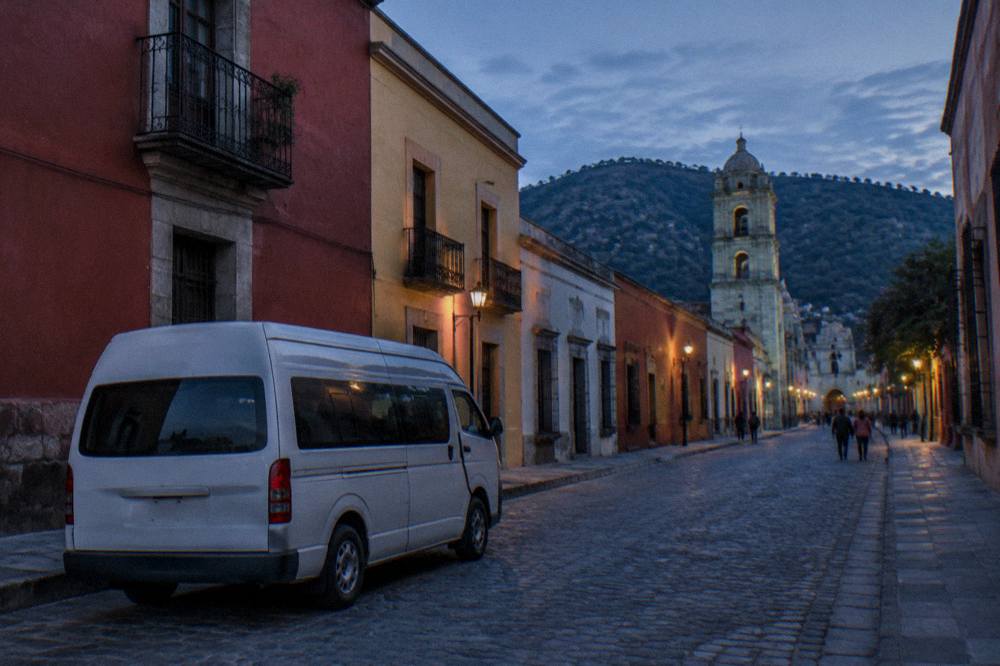
Cut the coast from a first trip of six days or fewer: Puerto Escondido is about 165 minutes away each way, Mazunte, Huatulco and San José del Pacífico are further, and Puebla is a separate route entirely; also drop Zaachila unless your dates include a Thursday to Sunday, and drop the Sierra Norte unless you have a spare full day and a mountain-road tolerance. The Pueblos Mancomunados are a destination in their own right, not a valley add-on. Our Oaxaca city or the coast guide walks the split decision, and the how many days in Oaxaca guide quantifies the trade.
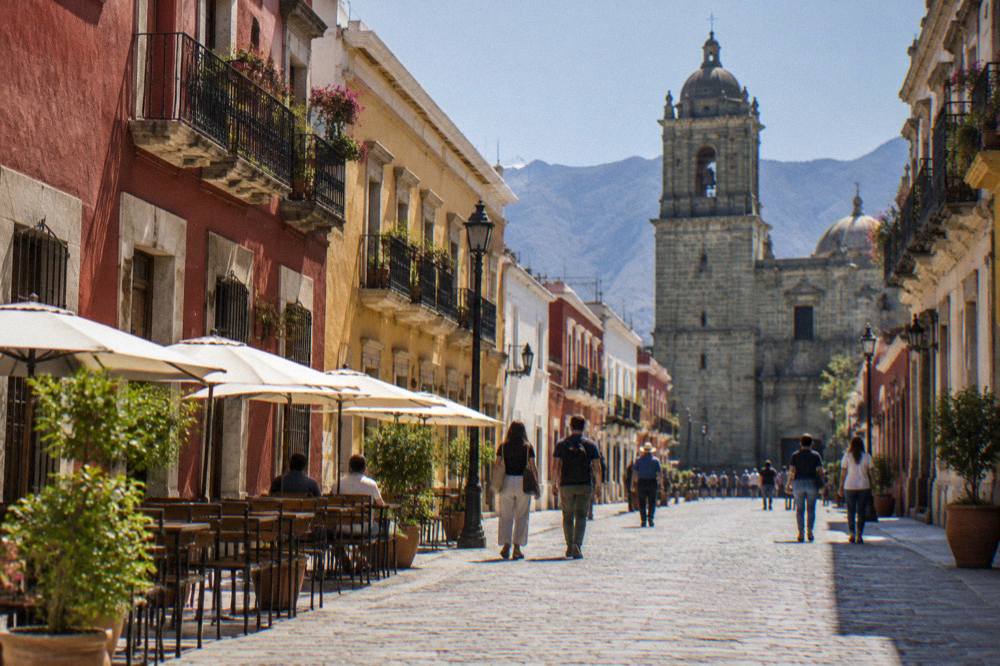
The second cut is over-scheduling the Centro Histórico. The Jardín Etnobotánico's tour slots, the Museo de las Culturas's 10:00-to-16:00 window and the walking distances between the Zócalo, Santo Domingo and the Basílica de la Soledad mean two unhurried days beat three compressed ones. A market morning at Mercado 20 de Noviembre or Benito Juárez belongs in the plan, but market hours are not published in primary sources, so let the stalls set the schedule rather than the reverse; the Mercado 20 de Noviembre guide covers what to look for.
The third cut is trying to time festivals that have no announced dates. Noche de Rábanos keeps its traditional 23 December date, but the 2026 edition is not announced; the 128th edition ran in December 2025. Día de Muertos centres on 31 October to 2 November by tradition. Build the trip on the standing pattern, then adjust when a programme drops.
Common Questions About Planning An Oaxaca Itinerary
How Many Days Do You Need In Oaxaca?
Four full days is the working minimum: Centro Histórico, Monte Albán, the Tlacolula Valley and a food day. Five days adds the south-valley craft circuit; a week adds the Sierra Norte or a coast extension.
Can You Visit Monte Albán And Hierve El Agua On The Same Day?
The drive times are about 15 minutes to Monte Albán and about 57 to Hierve el Agua in opposite directions, so pairing them in one independent day is tight. Most itineraries split them across two days, or use a full-day valley tour that covers the eastern sites only.
What Days Is The Museo De Las Culturas De Oaxaca Open?
Tuesday to Saturday, 10:00 to 16:00, per its INAH page, with entry at 105 MXN for Mexican nationals and 210 MXN for foreign visitors. It is closed Sunday and Monday.
When Is The Rainy Season In Oaxaca?
May to October, with June to September the peak, per the SMN station normals. June averages 188.3 mm of rain and 19.9 rain days; January averages 2.4 mm and 1.4 rain days.
Do You Need A Car For An Oaxaca Itinerary?
No for the Centro Histórico and Monte Albán, which colectivos and tours reach; a car, a private driver or a guided trip pays off for the Hierve el Agua loop and the Sierra Norte. There is no bike-share in Oaxaca.
When Is Guelaguetza Held In Oaxaca?
Two Mondays in July (Lunes del Cerro) at the Auditorio Guelaguetza on the Cerro del Fortín. The 2026 edition ran 20 and 27 July; the 2027 dates are not announced, so plan around the July pattern.
Build the plan on the fixed anchors first: the museum's Tuesday-to-Saturday week, Zaachila's Thursday-to-Sunday window, the INAH last-access cutoffs, and the dry-season months from November to April. Everything else in an Oaxaca City itinerary can move around those pegs.