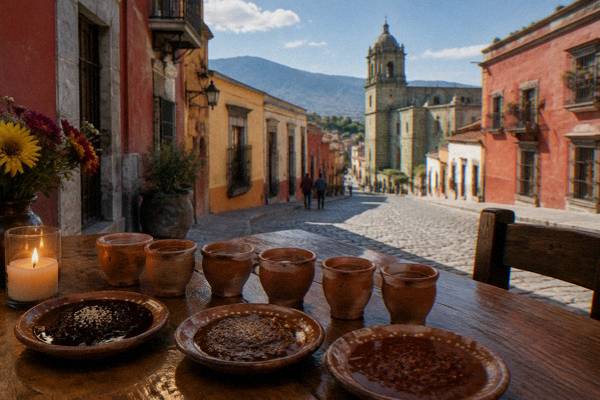
What Drink Is Oaxaca Known For?
The drinks Oaxaca City is known for: mezcal above all, plus tejate and Oaxacan chocolate, with where to taste each and which guided tastings cover them.
Oaxaca City, the inland highland capital of the state of Oaxaca in Mexico, answers this question with one word before any other: mezcal. The state's own communications describe nearby Santiago Matatlán as the Capital Mundial del Mezcal, and distillery visits sit at the centre of the valley day trips that leave the city every morning. But the city's glass holds more than one tradition. Tejate and Oaxacan chocolate belong to the same answer, and both are easier to find in the Centro Histórico than any spirit. This page, from the Oaxaca Travel Guide desk, sets out what the primary sources say about each drink, where each one comes from, and how a visitor tastes all three without leaving the Valles Centrales.
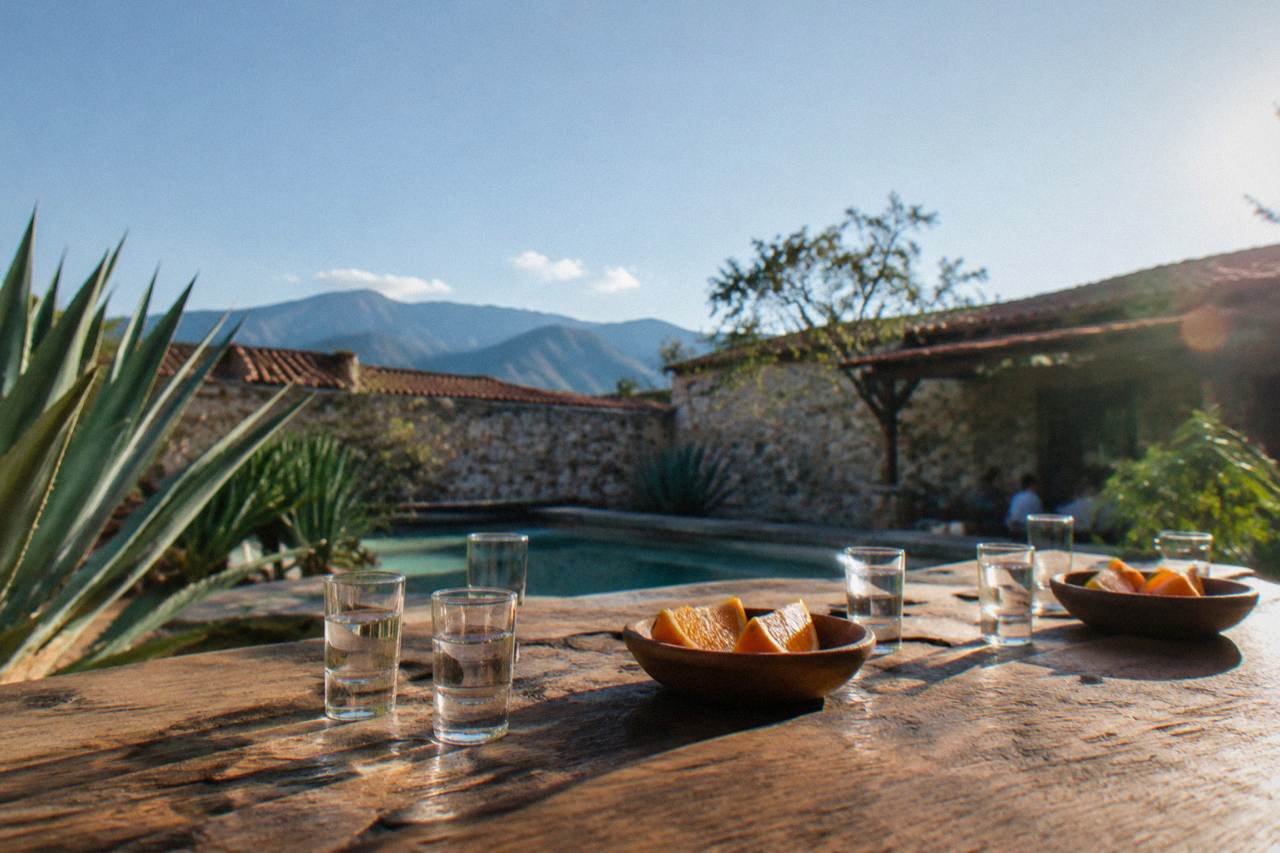
Oaxaca City is known for mezcal, the agave spirit the state government ties to Santiago Matatlán, the community its own pages describe as the Capital Mundial del Mezcal. Two non-alcoholic drinks share the answer: tejate and Oaxacan chocolate, both served in the markets and cafes of the Centro Histórico. Mezcal carries the international reputation, while the other two carry the daily one.
That split matters for planning. A visitor who arrives asking only about mezcal will find an entire industry ready: distillery tours from the city, tasting rooms, pairing sessions and a state fair in July built around the spirit. A visitor who walks into the Mercado 20 de Noviembre or the Mercado Benito Juárez will meet the other half of the answer in the same hour, because the chocolate and tejate stalls sit among the food corridors the markets are known for. The two halves of the city's drinking culture do not compete; they occupy different hours of the same day.
The state's numbers back the reputation. Santiago Matatlán is repeatedly described in state communications as the world capital of mezcal, with references to many palenques in and around the community, and the Feria del Mezcal in July draws hundreds of stands to the city's convention centre. No other drink in Oaxaca has a fair of its own, and none has a string of valley communities organised around its production the way the Tlacolula Valley is organised around agave.
For travellers whose first question is really about food as well as drink, the companion page on what food Oaxaca is famous for covers mole, tlayudas and the rest of the table that mezcal is poured alongside.
Where Mezcal Comes From Around Oaxaca
Mezcal country begins outside the city, in the Tlacolula Valley, where Santiago Matatlán sits on the Mitla road, and the distillery villages string out along the same corridor toward Mitla and Hierve el Agua. State pages describe Matatlán as the world mezcal capital with dozens of palenques. Hierve el Agua lies about 57 minutes from the centre, and Mitla about 37.
Those figures are derived drive times under free-flow conditions, so real traffic and mountain roads make them longer in practice. The geography is the useful part: mezcal tasting, an archaeological zone and a set of craft stops all sit on one eastward corridor, which is why the valley day trips in the tour list bundle them together. A single morning departure can cover a distillery, the Tule tree and Mitla, and still return to the city for dinner.
| Destination From The Zócalo | Distance | Free-Flow Drive Time |
|---|---|---|
| Santa María del Tule | 10.2 km | About 11 minutes |
| Teotitlán del Valle | 29.2 km | About 26 minutes |
| Tlacolula | 31.2 km | About 25 minutes |
| Mitla | 44.6 km | About 37 minutes |
| Hierve el Agua | 67.1 km | About 57 minutes |
The distances come from route data on OpenStreetMap roads, not from any operator's schedule, and they describe the starting point of most tastings rather than the end of one. Santiago Matatlán sits beyond Mitla on the same corridor, which is why so many distillery visits share a vehicle with ruins and rugs. A visitor planning a self-drive day should treat the table as a floor, not a promise.
Where To Taste Mezcal In Oaxaca City
Mezcal tasting in Oaxaca City takes three forms: guided tastings in the Centro Histórico, distillery day trips into the Tlacolula Valley, and pairing sessions that set the spirit against Oaxacan food. The city-based options need no vehicle, while the distillery visits pair naturally with Mitla, Tule and Hierve el Agua on a single valley loop.
The choice is mostly about hours. A short tasting or pairing session fits between other plans in the centre; a distillery trip takes the day and returns with stops at workshops and ruins along the corridor described above. The pairing format deserves a specific mention, because it treats mezcal as a table drink rather than a souvenir: one option on this site's tour list sets seven pours against seven mole dishes under a certified sommelier, and the operator's booking page carries the current price, rating and schedule. That tour also has its own page on this site if you want the full breakdown before deciding, and Check availability before locking a date.
The evening street-food option in that band serves a different purpose: it puts the drinks beside the food stalls rather than in a tasting room, which suits travellers who want the market half of the answer first. The walking tour covers neither spirit nor chocolate in depth, but it maps the centre where both are sold.
Tejate And Oaxacan Chocolate: The Other Two Drinks
Tejate and Oaxacan chocolate are the city's two signature non-alcoholic drinks, both served in and around the central markets, and both tied to the food culture rather than the distilleries. Chocolate in Oaxaca is a drink first and a bar second, and tejate is a traditional cold drink of the Valles Centrales sold by the cup. Neither needs a tour, a booking or a drive out of the Centro Histórico.
What the sources do support is where each sits: the markets page on this site places the chocolate and tejate sellers among the food corridors of the Centro Histórico, and the state's market communications describe those halls as guardians of local identity and tradition. The companion page on whether Oaxaca is known for chocolate takes that half of the story further.
Practically, both drinks cost a fraction of any bookable tasting, and both are bought standing up. A morning that pairs a market circuit with an afternoon mezcal pairing session covers the full answer to this page's question in a single day, with the walking time between them measured in minutes inside the same grid of streets.
The Feria Del Mezcal: Oaxaca's Drink On The Calendar
The Feria del Mezcal is the state's own mezcal festival, reported for 2026 as running 17 to 28 July at the Centro Cultural y de Convenciones de Oaxaca in Santa Lucía del Camino, with entry around 80 MXN and hundreds of stands. It sits inside the July Guelaguetza month, when paid auditorium seats ran 1,632 and 1,321 MXN in the 2026 edition, with two free sections.
Those Feria dates are reported rather than confirmed on the page text, so a July traveller should confirm the schedule before building a trip around it. The Guelaguetza figures are the 2026 edition's, from the state's ticketing announcements, and 2027 dates have not been announced. The useful planning point is simpler: July is the month when the city's drinking culture and its dance culture share one programme, and hotel demand follows.
| July Event In Oaxaca | 2026 Detail |
|---|---|
| Feria del Mezcal | 17 to 28 July, CCCO Santa Lucía del Camino, entry about 80 MXN |
| Guelaguetza Lunes del Cerro | 20 and 27 July, Auditorio Guelaguetza, 10:00 and 17:00 |
| Guelaguetza paid seats | Palco A 1,632 MXN, Palco B 1,321 MXN plus fees, Palcos C and D free |
A visitor outside July loses nothing essential. The distilleries pour year-round, the tasting rooms open on the city's ordinary calendar, and the markets sell chocolate and tejate in every season, since the rain-heavy months of June through September average between 118.6 and 188.3 mm and the dry months of November through April under 50 mm, none of which closes a still or a market stall.
Which Drink Experience Fits Which Trip
A first-time visitor with one free evening should take a tasting or pairing session in the Centro Histórico; a visitor with a full day should take a distillery trip into the Tlacolula Valley; a visitor on a tight budget should drink the answer in the markets, where tejate and chocolate cost a few coins and no booking. Each option answers this page's question at a different depth.
The length of stay shapes the choice more than anything else. The page on how many days in Oaxaca is enough makes the same point for the city as a whole: short stays do better with city-based experiences, longer stays earn the valley loops. Solo travellers can read the safety framing on whether Oaxaca is safe for Americans right now before booking evening plans; the US advisory wording for the state stops at Level 2, exercise increased caution.
Between blocks: a word on water. Mezcal, tejate and chocolate aside, the tap water question has its own page on whether you can drink the water in Oaxaca, and it is worth reading before the first morning, because it shapes every other drink decision on the trip.
Common Questions About Drinks In Oaxaca
What Drink Is Oaxaca Known For?
Mezcal, above all. The state's own pages describe Santiago Matatlán as the Capital Mundial del Mezcal. Tejate and Oaxacan chocolate share the answer as the city's two signature non-alcoholic drinks.
Is Mezcal The Same As Tequila?
Practically, the two are distinct spirits with separate protected-name systems, and mezcal is the one tied to Oaxaca.
Can You Visit A Mezcal Distillery From Oaxaca City?
Yes. Distillery day trips run from the city into the Tlacolula Valley, often combined with Mitla, the Tule tree, Teotitlán del Valle and Hierve el Agua on the same loop. Drive times from the Zócalo run about 25 minutes to Tlacolula and about 37 to Mitla under free-flow conditions.
Where Do You Taste Tejate And Chocolate In Oaxaca?
In the central markets. The Mercado 20 de Noviembre and the Mercado Benito Juárez sit south and west of the Zócalo, and both are covered in depth on this site's market pages.
When Is The Feria Del Mezcal?
Reported dates for the 2026 edition are 17 to 28 July at the Centro Cultural y de Convenciones de Oaxaca in Santa Lucía del Camino, with entry around 80 MXN. Confirm the schedule on the state's channels before planning around it, and expect it to sit inside Guelaguetza month.
Mezcal is the headline, tejate and chocolate are the fine print, and all three sit within a short walk or a single valley drive of the Zócalo.