Does Oaxaca Have Mayan Ruins?
No, Oaxaca has no Mayan ruins. Here is what the area around Oaxaca City actually has: Monte Albán, Mitla, Yagul and the smaller INAH sites, with hours, entry fees and drive times.
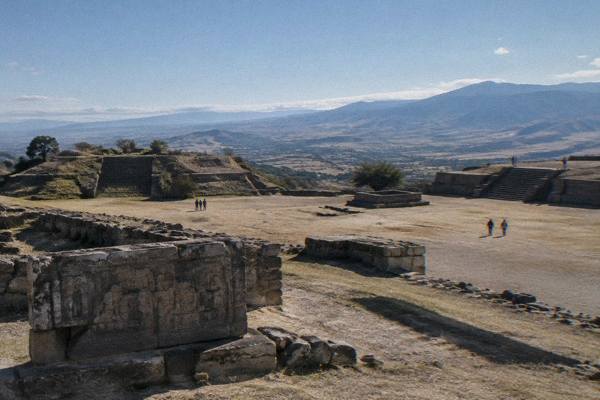
Oaxaca City, the capital of the state of Oaxaca in Mexico, sits inland in the Valles Centrales at about 1,550 m, and the ruins that surround it are not Mayan. The great stone cities of the Maya world lie far from this region, in the southeast of the country and beyond, and none of them are within reach of Oaxaca City. What the valleys here hold instead is a dense cluster of archaeological zones, Monte Albán above all, along with Mitla, Yagul, Dainzú, Lambityeco, Zaachila and Atzompa, all administered by INAH and all reachable in under an hour by road from the Zócalo. Travellers who arrive expecting Maya pyramids leave with something else entirely, and by the Sectur count for 2025, 416,675 people visited Monte Albán alone that year.
No, Oaxaca has no Mayan ruins. The pre-Hispanic sites in and around the state's Valles Centrales, including Monte Albán, Mitla, Yagul, Dainzú, Lambityeco, Zaachila and Atzompa, belong to other Mesoamerican traditions of the region, not to the Maya, whose great cities were built far to the east and south. The confusion is understandable, since Mexico is home to famous Maya sites, but none of them are near Oaxaca City.
That distinction matters for planning. A visitor flying into Xoxocotlán airport and staying in the Centro Histórico is within an hour's drive of seven INAH archaeological zones, and none of them is Maya. The historic centre of Oaxaca de Juárez and the Monte Albán site together form the UNESCO World Heritage property listed as "Historic Centre of Oaxaca and Archaeological Site of Monte Albán", property 415, inscribed for the valley's own civilization rather than for the Maya. The city itself was founded in 1529 as Antequera, long after the hilltop site above it had been abandoned.
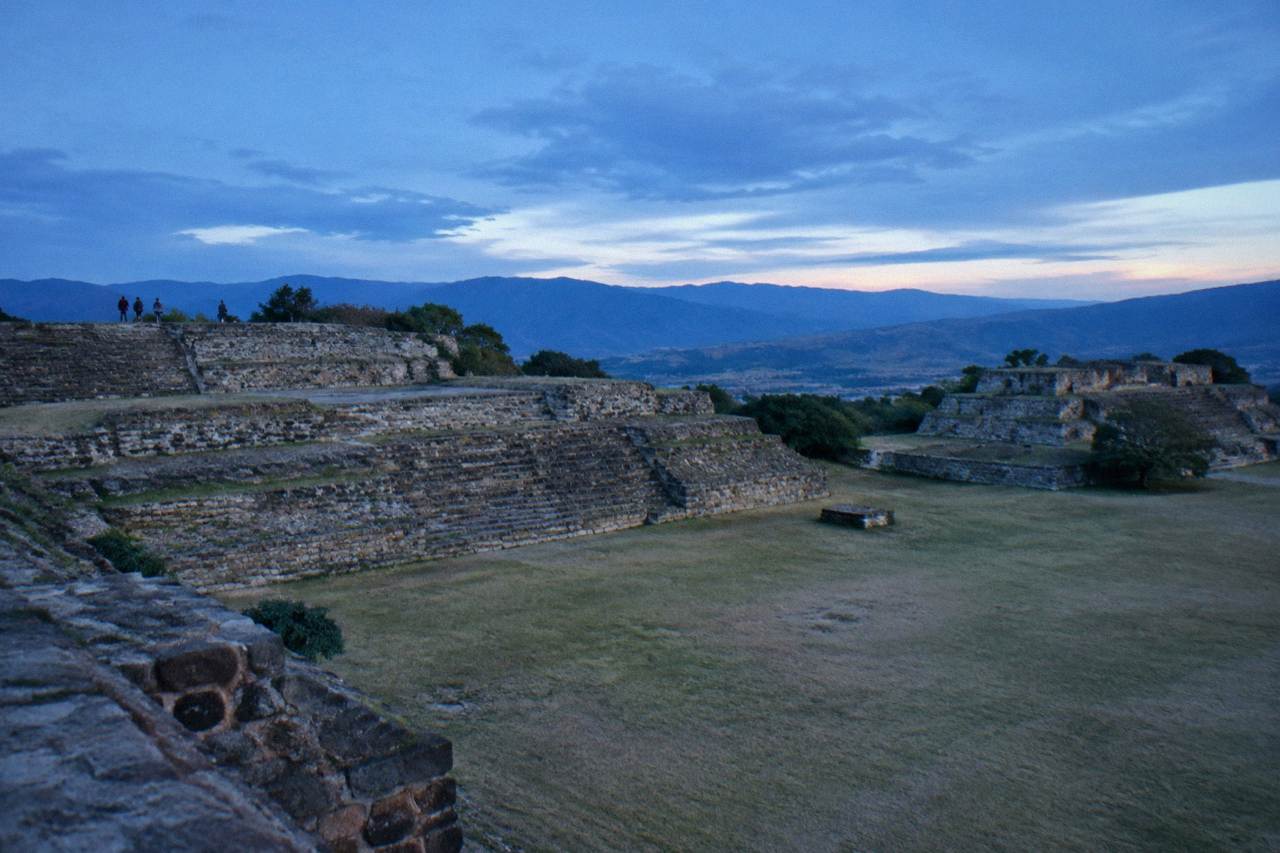
So if the question behind the search is "will I see pyramids like the ones in guidebooks to the Yucatán?", the honest answer is that the architecture, the setting and the history here are different. Monte Albán sits on a flattened hilltop with long views over the valley. Mitla lies in the Tlacolula arm of the valley. Yagul and Dainzú sit along the same eastern corridor, and Zaachila and Atzompa sit south and west of the city. None requires a flight or an overnight journey; all are day trips from the capital.
Which Archaeological Sites Can You Actually Visit Around Oaxaca City?
Seven INAH sites sit within about an hour of the Zócalo: Monte Albán, Mitla, Yagul, Dainzú, Lambityeco, Zaachila and Atzompa. Monte Albán is the largest and by far the most visited, with 416,675 visitors in 2025 against 104,428 at Mitla, 10,185 at Yagul, 5,545 at Lambityeco and 4,229 at Zaachila, per Sectur's arrivals count for that year.
Monte Albán is the headline. It is the site inscribed with the historic centre on the UNESCO list, it is the closest of the major zones to the city, and it is the one most first-time visitors should build a day around. The INAH page for the zone lists daily opening from 08:00 to 17:00 with last access at 16:00.
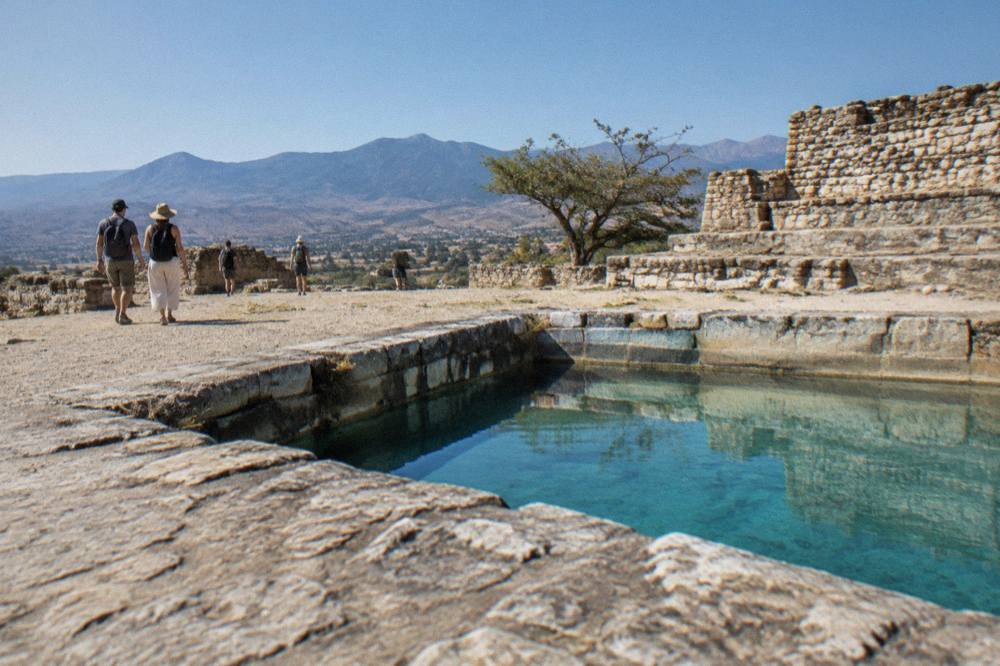
Mitla, out past Tlacolula in the eastern valley, is the second stop on nearly every valley loop, often combined with the Tule tree, a weaving town and a mezcal stop. It keeps the same daily 08:00 to 17:00 hours, with last access at 16:30. Yagul, Dainzú and Lambityeco are smaller zones along the same corridor, and Zaachila and Atzompa are half-day options closer to the city. Two scheduling traps catch visitors every year: Zaachila opens Thursday to Sunday only, 10:00 to 16:00, and Atzompa closes earlier than the rest, at 16:00 with last access at 15:00. A fuller rundown of the Monte Albán question, including whether it deserves the half day, sits in is Monte Albán worth it.
| INAH Site | Hours (INAH page) | Last Access | Fee, Nationals | Fee, Foreigners | 2025 Visitors |
|---|---|---|---|---|---|
| Monte Albán | Daily 08:00 to 17:00 | 16:00 | 105 MXN | 210 MXN | 416,675 |
| Mitla | Daily 08:00 to 17:00 | 16:30 | 105 MXN | 210 MXN | 104,428 |
| Yagul | Daily 08:00 to 17:00 | 16:00 | 105 MXN | 210 MXN | 10,185 |
| Lambityeco | Daily 08:00 to 17:00 | 16:30 | 80 MXN | 145 MXN | 5,545 |
| Zaachila | Thu to Sun 10:00 to 16:00 | 16:00 | 80 MXN | 145 MXN | 4,229 |
| Atzompa | Daily 08:00 to 16:00 | 15:00 | Fee not on the INAH page | Fee not on the INAH page | not published |
Dainzú's own 2025 figure is not in the Sectur counts used here. Treat all these counts as context, not a crowd forecast: a zone with four thousand visitors a year is not an empty site, and Monte Albán's total is spread across every opening day of the year.
What Do The Ruins Around Oaxaca Cost To Enter?
Entry to Monte Albán, Mitla and Yagul, INAH's Category I sites in the valleys, is 105 MXN for Mexican nationals and 210 MXN for foreign visitors. The Category III sites, Dainzú, Lambityeco and Zaachila, charge 80 MXN and 145 MXN respectively, and visits outside normal INAH hours at several zones cost 730 MXN, a figure listed on the Yagul, Lambityeco, Atzompa and Museo de las Culturas pages.
Those are cash figures in pesos, paid at the gate, and they are the only official site fees a visitor needs for a ruins day in the valleys. Nothing else about fees can be stated with a source: the Atzompa INAH page lists hours only, so no entry price is given for it here, and camera, drone or parking fees do not appear on the INAH pages at all. Hierve el Agua, the mineral-spring terraces that often share an itinerary with Mitla, is not an INAH zone and its fee and hours are set by the local communities, so this page prints no figure for it; the question of whether that stop earns its place is covered in is Hierve el Agua worth it.
A reasonable ruins budget for a foreign visitor is therefore two Category I tickets at 210 MXN each if Monte Albán and Mitla are both on the list, or one big site plus a Category III zone for 210 MXN plus 145 MXN. Add food and transport on top. The Museo de las Culturas de Oaxaca at Santo Domingo, which many visitors pair with a Monte Albán morning, charges the same 105 / 210 rates and opens Tuesday to Saturday only, 10:00 to 16:00. Other pages covering the same trip are gathered on Oaxaca Travel Guide.
| Cost Item | Fee (MXN) | Notes |
|---|---|---|
| Monte Albán, national | 105 | Category I, daily site |
| Monte Albán, foreign visitor | 210 | Category I, daily site |
| Mitla, national | 105 | Category I, daily site |
| Mitla, foreign visitor | 210 | Category I, daily site |
| Yagul, national / foreign | 105 / 210 | Category I, daily site |
| Dainzú or Lambityeco, national / foreign | 80 / 145 | Category III, daily sites |
| Zaachila, national / foreign | 80 / 145 | Category III, Thu to Sun only |
| Visit outside normal INAH hours | 730 | Listed for Yagul, Lambityeco, Atzompa, Museo de las Culturas |
How Far Are The Sites From Oaxaca City?
Monte Albán is the closest major site at about 15 minutes by road from the Zócalo, roughly 9 km. Mitla is the farthest of the classic stops at about 37 minutes, with Hierve el Agua beyond it at about 57 minutes, and every other INAH zone in the valleys falls between about 11 and about 38 minutes of free-flow driving, per route computations on OpenStreetMap roads.
Real traffic and mountain roads make these floors, not promises. The road up to Monte Albán climbs from the valley floor, and the corridor east through Tule, Teotitlán del Valle and Tlacolula toward Mitla carries market traffic on certain days. The figures below are computed free-flow times, so round up and leave margin, especially for the last-access cutoffs, which are strict and differ by site.
| Destination | Distance From The Zócalo | Free-Flow Drive Time |
|---|---|---|
| Monte Albán | 8.7 km | about 15 minutes |
| Santa María del Tule | 10.2 km | about 11 minutes |
| Teotitlán del Valle | 29.2 km | about 26 minutes |
| Tlacolula | 31.2 km | about 25 minutes |
| Ocotlán | 32.5 km | about 37 minutes |
| Yagul | 41.9 km | about 38 minutes |
| Mitla | 44.6 km | about 37 minutes |
| Hierve el Agua | 67.1 km | about 57 minutes |
The practical shape this gives a trip is a western half day, Monte Albán and possibly Atzompa, and an eastern full day, Tule, Teotitlán del Valle or Yagul, Mitla and, with the extra hour of driving, Hierve el Agua. Zaachila and its Thursday-to-Sunday window fit a south-of-the-city morning alongside Ocotlán. Anyone working out how to fit the pieces together in order will find a ready sequence in three days in Oaxaca.
Should You Take A Tour Or Go To The Ruins On Your Own?
Going independently to Monte Albán, Mitla or the smaller zones is straightforward: the fees are fixed pesos amounts at the gate, the hours are daily, and a taxi or colectivo covers the shorter legs. A guided tour earns its place at Monte Albán itself, where the site is large and the INAH page gives no in-site interpretation, and on the eastern valley loops, where one vehicle strings together Mitla, a craft town and a mezcal stop without route planning.
The trade-off is control against logistics. Independent travel lets a visitor set the clock, arrive near opening and leave at will, and the Category I ticket prices are modest. Guided products, meanwhile, bundle transport from the city with a guide who can carry the narrative, and the tour list around Oaxaca City is deep: the related pick on this page is a guided half day at Monte Albán, and the wider selection spans craft-village routes, street-art walks in the city and private car-and-driver days that reach the master artisans of the valleys. Whether the ruins alone fill a first visit, or share it with markets and mezcal, is really a question of trip length, and how many days in Oaxaca is enough works through the arithmetic.
One scheduling note worth the attention of anyone building a ruins day: because Atzompa's last access is 15:00 and Zaachila only opens four days a week, these two zones cannot be treated as late-afternoon add-ons the way Mitla sometimes can, with its 16:30 cutoff. Build them early or on the right weekday.
For the flagship site itself, the guided half day from the city is the most direct way to put the question of interpretation in a professional's hands: Check availability. The same product page carries the current price, rating and review count from the operator's booking page.
Common Questions About Mayan Ruins In Oaxaca
Does Oaxaca Have Mayan Ruins?
No. The archaeological zones around Oaxaca City, Monte Albán, Mitla, Yagul, Dainzú, Lambityeco, Zaachila and Atzompa, belong to the pre-Hispanic traditions of the Valles Centrales. The Maya cities lie far from Oaxaca, in other regions of Mexico and Central America.
Which Ruin Near Oaxaca City Should I See If I Only Have Time For One?
Monte Albán. It is about 15 minutes from the Zócalo, it is open daily 08:00 to 17:00 with last access at 16:00, it charges 105 MXN for nationals and 210 MXN for foreign visitors, and it is the site inscribed with the historic centre on the UNESCO World Heritage list.
Are Monte Albán And Mitla Open Every Day?
Yes, both are open Monday to Sunday, 08:00 to 17:00. Last access is 16:00 at Monte Albán and 16:30 at Mitla. Zaachila is different: it opens Thursday to Sunday only, 10:00 to 16:00.
How Much Does It Cost To Visit The Archaeological Sites Near Oaxaca?
Monte Albán, Mitla and Yagul, the Category I zones, charge 105 MXN for Mexican nationals and 210 MXN for foreign visitors. Dainzú, Lambityeco and Zaachila, the Category III zones, charge 80 MXN and 145 MXN. A visit outside normal INAH hours costs 730 MXN at the zones that list the option.
Can You Visit The Ruins From Oaxaca City Without A Car?
Yes. Monte Albán is about 15 minutes from the centre by road and is the subject of frequent guided half-day products with city pickup, while the eastern zones combine into full-day valley loops. Independent visits are also workable, since the sites are close and the hours are daily.
The bottom line for anyone searching this question while planning: leave "Mayan ruins" out of the Oaxaca itinerary and put Monte Albán at the top of it instead, because what the valleys around this highland city actually hold is one of Mexico's most visited archaeological zones, and it is a quarter of an hour from the Zócalo.